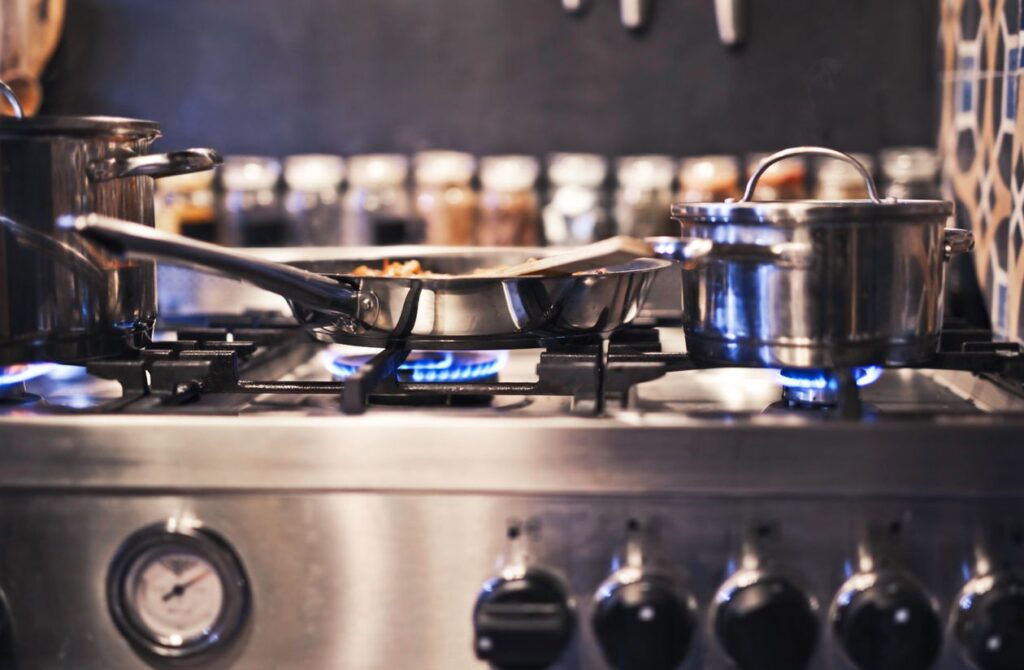
Photo by Nicolas Postiglioni from Pexels
Disclosure: I earn a small commission if you buy through links on this page, at no extra cost to you.
For most households cooking on gas, the T-fal Ultimate Hard Anodized 17-piece set is the one to buy: it was $179.99 on Amazon, has 4.7 stars across 18,881 ratings, and covers a whole kitchen. If you want stainless steel for searing, the Cuisinart MultiClad Pro 12-piece set at $191.36 is the value pick, and TechGearLab scored it 73 out of 100.
A gas burner heats a ring under the pan, so how a set spreads that heat and how it handles a hot oven finish matter more than the piece count. Every price, rating and seller below was read from Amazon.com on 7 October 2026, and each pick is checked against TechGearLab’s cookware set test where it covered the set and says so where it did not.
Quick Comparison
| Product | Best For | Price | Rating | Buy |
|---|---|---|---|---|
| T-fal Ultimate Hard Anodized 17-Piece | Best Overall | $179.99 | 4.7★ (18,881) | Check Price |
| Tramontina Signature Tri-Ply Clad 12-Piece | Best Heavy-Duty Stainless | $299.95 | 4.4★ (1,745) | Check Price |
| Cuisinart MultiClad Pro 12-Piece | Best Value Stainless | $191.36 | 4.5★ (11,229) | Check Price |
| GreenPan Lima 12-Piece | Best PFAS-Free | $149.99 | 4.4★ (1,613) | Check Price |
| T-fal Signature 12-Piece | Best Budget | $89.99 | 4.7★ (18,442) | Check Price |
The T-fal, Cuisinart and GreenPan sets were sold by Amazon.com; the Tramontina set was sold by the Tramontina Store on Amazon. Ratings are star averages from the listing; “owner critical share” below means 1 to 3 star written reviews as a share of all written reviews for that exact listing.
What the Independent Test Found
TechGearLab’s cookware set review (updated 26 November 2025) tested 12 sets and covers three of these picks by name:
- Cuisinart MultiClad Pro: 73 out of 100, heating evenness within about 11°F, and stainless sets like it did well at searing; TechGearLab priced it at $380
- T-fal Signature 12-piece (dishwasher safe): 67 out of 100, at $130
- Tramontina Gourmet Tri-Ply Clad 12-piece: 69 out of 100, at $400, which is a different set from this guide’s Tramontina Signature
It did not test the T-fal Ultimate or the GreenPan Lima, so those two rest on the listings and owner reviews. The summary I could read does not give a gas-specific result, and the model names it lists are close to, but not always the same as, the listings linked here.
What Matters in Cookware for a Gas Stove
How the set spreads heat from a flame ring
A flame heats a ring under the base rather than the whole surface. Aluminum is a more conductive metal than stainless steel, and copper is more conductive still, which is why most stainless sets sandwich an aluminum core. A fully clad set carries that core up the walls, while a disc-bottomed set only has it in the base; my guide to cookware materials for gas stoves explains the mechanics.
Oven rating changes what you can finish in the oven
From the listings: the T-fal Signature is rated to 350°F, the T-fal Ultimate to 400°F with lids to 350°F, the Cuisinart and the Tramontina to 500°F and the GreenPan pans to 600°F with lids to 425°F. A dish started on a burner and finished in a hot oven needs one of the last three.
Base flatness and grate stability
A pan that rocks on a grate is a safety problem as well as a cooking one. Owners of several sets here report warping, and my guide to a warped pan that will not sit flat covers what to do. Match pan size to burner size, because a base wider than the flame develops a hot ring.
Nonstick coating: PTFE or ceramic
The T-fal sets use a conventional nonstick coating and the GreenPan Lima uses a ceramic one whose listing says it is free of PFAS, PFOA, lead and cadmium. Makers of conventional nonstick advise against high heat and against preheating an empty pan, and gas responds instantly, so keep to low or medium heat on any coated set.
1. T-fal Ultimate Hard Anodized 17-Piece Set — Best Overall

4.7 stars | 18,881 ratings | $179.99 | sold by Amazon.com
This is the set most gas-stove households should start with, because it is the most-reviewed and one of the lowest in critical share, and it covers a whole kitchen. The listing gives 17 pieces including a griddle, a 3.5-quart sauté pan, a 5-quart Dutch oven, a 3-quart steamer and an egg frypan, hard-anodized aluminum bodies, oven safety to 400°F (lids to 350°F), a weight of 23.8 pounds and a set that suits all stovetops excluding induction. TechGearLab did not test it, so it rests on the listing and owner reviews.
Amazon asked $179.99, well below the $230 this guide used to show, which puts it about $90 above the T-fal Signature rather than $120. My T-fal Ultimate review covers the coating, the lids and gas-grate stability.
Of 3,933 written reviews of this listing, 750 are critical (19%). The recurring complaint is the coating wearing out: in a sample of 18 critical reviews, titles describe nonstick lost after six months, a set that “wears fast” and chipping after two years, and at least three mention customer service or the warranty.
Pros:
- The largest owner base here: 18,881 ratings at 4.7 stars
- A 19% critical share, the lowest of the five alongside the T-fal Signature
- 17 pieces including a griddle, sauté pan, Dutch oven and steamer
- Oven-safe to 400°F, lids 350°F
Cons:
- Owner reviews often describe the coating wearing out within months to two years
- Does not work on induction, per the listing
- No independent test found for this set
- Lids limit the oven rating to 350°F
2. Tramontina Signature Tri-Ply Clad 12-Piece Set — Best Heavy-Duty Stainless

4.4 stars | 1,745 ratings | $299.95 | sold by the Tramontina Store
This is the heavy, fully clad option. The listing gives tri-ply construction (stainless, an aluminum core, stainless again), stainless lids, oven safety to 500°F, a lifetime warranty and a weight of 26.4 pounds, and all twelve pieces are cookware: 8-inch and 10-inch frying pans, three lidded saucepans, a 6-quart sauté pan and an 8-quart stock pot. My Tramontina Signature Tri-Ply Clad review covers the set in full.
TechGearLab tested a Tramontina Gourmet Tri-Ply Clad 12-piece (69 out of 100, $400), not this Signature set, so treat that score as belonging to a related model. At $299.95 it costs about $109 more than the Cuisinart, which TechGearLab did test.
Of 332 written reviews of this listing, 93 are critical (28%), the second highest here. In a sample of 15 critical reviews, four titles are about food sticking or the set being hard to clean, three about missing or wrong pieces or shipping problems, and two about the made-in-Brazil claim, with one owner reporting chipping inside a pot.
Pros:
- Full tri-ply walls rather than a disc base, and stainless lids that keep the oven rating at 500°F
- All twelve pieces are cookware, with a lifetime warranty
- Eight-inch and ten-inch frying pans, three saucepans, a sauté pan and a stock pot in the box
- Oven-safe to 500°F with the lids on, per the listing
Cons:
- $299.95, about $109 more than the Cuisinart
- A 28% critical share, with sticking, cleaning and delivery complaints
- At 26.4 pounds it is the heaviest set here
- The listing’s made-in-Brazil claim is disputed by some owners
3. Cuisinart MultiClad Pro 12-Piece Set — Best Value Stainless
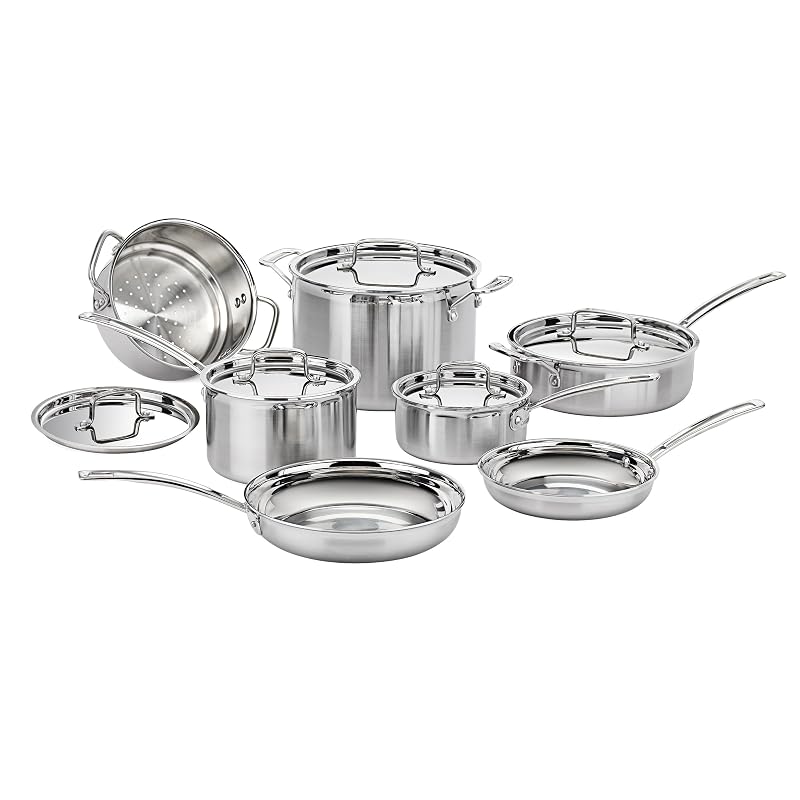
4.5 stars | 11,229 ratings | $191.36 | sold by Amazon.com
This is the independently tested stainless set. TechGearLab scored the Cuisinart MultiClad Pro 73 out of 100, with heating evenness within about 11°F, at $380 when it tested; the listing here is the 12-piece set at $191.36, matched by name. The listing gives a stainless steel set with an induction-compatible title, oven safety to 500°F, tapered drip-free rims, a lifetime limited warranty and a weight of 26 pounds. My Cuisinart MultiClad Pro review covers the cladding and the warping reports.
It also costs less than it did: the $220 this guide showed is now $191.36, and the 4.5-star average holds across about six times as many ratings as the Tramontina.
Of 3,536 written reviews of this listing, 777 are critical (22%). In a sample of 15 critical reviews, three titles describe warping (one within two months), three describe food sticking, and handle and rivet residue comes up repeatedly.
Pros:
- TechGearLab 73 out of 100 for the MultiClad Pro, with even heating (about 11°F)
- Oven-safe to 500°F and induction compatible
- 4.5 stars on 11,229 ratings and a 22% critical share
- $191.36 for 12 pieces
Cons:
- Warping reports from several sampled owners
- Food sticks unless you preheat and use oil, as on any stainless
- TechGearLab’s price was $380, so the test used a different price point
- Handles and rivets draw owner complaints
4. GreenPan Lima 12-Piece Set — Best PFAS-Free
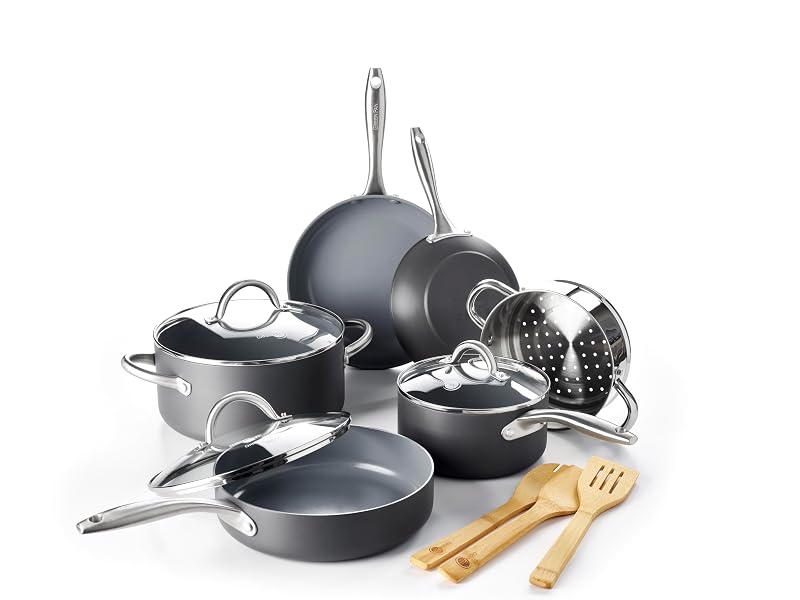
4.4 stars | 1,613 ratings | $149.99 | sold by Amazon.com
This is the set to buy for the coating. The listing says the ceramic nonstick coating is free of PFAS, PFOA, lead and cadmium, with hard-anodized aluminum bodies, pans oven and broiler safe to 600°F, lids to 425°F and a weight of 11.9 pounds. TechGearLab did not test it, so it rests on the listing and owner reviews. My GreenPan Lima review covers the set in full.
The owner record is the weakest of the five. Of 374 written reviews of this listing, 135 are critical (36%), and the average is 4.4 stars. In a sample of 14 critical reviews, at least five titles describe the coating wearing off or coming off, three mention the outside finish, and one mentions handles that get very hot.
Pros:
- The listing says PFAS-, PFOA-, lead- and cadmium-free
- Pans oven and broiler safe to 600°F
- 11.9 pounds, light to handle
- $149.99, below the old $160
Cons:
- A 36% critical share, the highest of the five
- Coating and outer-finish wear are the most common complaints
- No independent test found for this set
- Lids are rated to only 425°F
5. T-fal Signature 12-Piece Set — Best Budget

4.7 stars | 18,442 ratings | $89.99 | sold by Amazon.com
This is the cheap, light set, and it is cheaper than it was: $89.99 against the $110 this guide showed. The listing gives standard aluminum nonstick, an oven rating of 350°F, a set that suits all cooktops excluding induction, a weight of 11.46 pounds and a bundle that includes utensils among the twelve pieces. TechGearLab scored the T-fal Signature 12-piece 67 out of 100 at $130, matched by name. My T-fal Signature review covers what the twelve pieces actually are.
Of 3,133 written reviews of this listing, 589 are critical (19%). In a sample of 16 critical reviews, at least five titles call it low quality or cheap and three describe peeling coating or food that sticks.
Pros:
- $89.99 for 12 pieces, the lowest price here
- 4.7 stars on 18,442 ratings and a 19% critical share
- TechGearLab scored it 67 out of 100
- 11.46 pounds, the lightest of the five
Cons:
- Oven-safe to only 350°F, so it does not suit hot oven finishes
- Owner reviews often call it cheaply made, and the coating peels in some
- Does not work on induction, per the listing
- Some of the twelve pieces are utensils, not pans
How to Choose Cookware for a Gas Stove
If you want one set to cover everything
Buy the T-fal Ultimate. It has the largest owner base, a 19% critical share and a griddle, sauté pan and Dutch oven in the box. Expect to replace it when the coating wears.
If you want stainless for searing and oven finishes
The Cuisinart MultiClad Pro is the independently tested value pick at $191.36. The Tramontina Signature costs about $109 more, is heavier and has a lifetime warranty, but has a higher critical share and no matching test result.
If the coating is your main concern
The GreenPan Lima says PFAS-, PFOA-, lead- and cadmium-free, but it has the highest critical share here, 36%. Care for it by hand and keep to low or medium heat.
If you want the cheapest decent start
The T-fal Signature is $89.99 and 19% critical, with a 350°F oven limit. For a single pan rather than a set, see my best omelette pan guide, and for cooking on induction, see which cookware works on induction.
Frequently Asked Questions
Is stainless steel or nonstick better for gas stoves?
It depends on what you cook. Stainless steel, especially tri-ply, handles high heat and builds fond for sauces; nonstick is easier for eggs and fish. Many households keep one nonstick pan for daily use and a stainless one for searing.
Does copper or cast iron work on gas?
Both work. Cast iron holds heat well, and copper conducts heat best of the common metals but costs more and needs more care. Neither is in this guide because they are specialist materials; see my cookware guides for each.
Why does my nonstick pan get hot spots on a gas burner?
The flame heats a ring smaller than the pan base, so the middle of the pan runs hotter than the edges. Use medium rather than high heat, and match the pan to the burner size.
Are PFAS-free pans worth it for gas cooking?
That depends on your priorities. The GreenPan Lima listing says its coating is free of PFAS, PFOA, lead and cadmium, but it has the highest critical share of the five (36%), mostly about the coating and outer finish wearing.
How do I stop stainless steel from sticking on a gas stove?
Preheat the pan on medium heat for a minute or two, add oil and let it shimmer, then add food and leave it alone until it releases. Sticking was one of the most common complaints among the stainless sets’ critical reviews, which usually points to technique.
How long will cookware last on a gas stove?
I found no independent source that measures lifespan for these sets. Owner reviews describe coatings wearing out between six months and two years on the nonstick sets, and warping on some stainless ones, so budget accordingly and replace coated pans when the coating fails.
How These Picks Were Chosen
Plainly: this is a research-based guide, not a hands-on test. I have not run these sets side by side, and nothing here should be read as a report from my own kitchen.
What the picks rest on: TechGearLab’s cookware set review (updated 26 November 2025), the manufacturers’ listings on Amazon, and the written reviews on each exact listing, counted by star band. The owner themes come from a sample of the most helpful and the most recent critical reviews on each listing (14 to 18 reviews) and count mentions, not confirmed failures.
What I could not establish: how any of these sets performs specifically on gas, because the test summary I could read gives no gas-specific result; how long any of them lasts; whether the TechGearLab models match these listings exactly; and warping resistance over years of high flame, which is the failure that ends a pan on a gas hob. Review counts are not tests.
The Verdict
For most households cooking on gas, the T-fal Ultimate Hard Anodized is the straightforward choice: 18,881 ratings at 4.7 stars, a 19% critical share and 17 pieces for $179.99. If you want stainless, the Cuisinart MultiClad Pro is the tested value pick, and the Tramontina Signature is the heavier, pricier alternative.
The GreenPan Lima is for buyers who prioritise the coating over durability, and the T-fal Signature is the budget start. For wider choices, see my best cookware sets guide and the cookware hub. Gas also puts combustion byproducts into the air, so if your kitchen has no outside duct, my best ductless range hood guide and the ductless range hood guide cover recirculating hoods. For holiday roasting, best roasting pan for prime rib covers dedicated pans.

I'm Glenn, and I started Kitchenware Compare to cut through conflicting product reviews and help readers pick kitchen gear with confidence. I don't own or test the products I write about — these guides are built from verified-purchase reviews, manufacturer specifications, and independent testing where it exists, with the reasoning shown, not just a rating.