I earn a commission if you buy through the Amazon links below, at no extra cost to you.
The Cuisinart DLC-10SYP1 7-Cup Pro Classic is the Best for Food Processing pick in my best blender food processor combo guide. It costs $162.17, runs a 600-watt motor, and comes with a chopping blade plus stainless steel shredding and slicing discs in a 7-cup bowl.
Amazon shows 4.5 stars across 3,976 global ratings on this exact listing — not the 22,206 the guide previously cited, which appears to have come from a different Cuisinart listing at some point and was never corrected.
Owners who like it describe a machine that performs its core job well and, in a striking number of cases, replaced a Cuisinart that lasted 18 to 42 years. The concern that recurs is narrower: some owners say the plastic work bowl on current units feels thinner than the one on their old Pro Classic, and Amazon’s own review summary flags plastic parts fatiguing and breaking as a mixed durability signal.
Quick Verdict
| Score | Price | Rating | Buy |
| 7/10 | $162.17 | 4.5★ (3,976) | Check Price on Amazon |
What Comes in the Box

The motor base, work bowl, chopping/mixing/dough blade, stainless steel shredding disc, stainless steel slicing disc, detachable disc stem, compact flat cover and spatula, per the manual’s parts list. The instruction and recipe booklet includes 20-plus recipes from guacamole to pizza dough.
The manual identifies this as the DLC-10S Series and names the model DLC-10S or DLC-10C depending on color; the current Amazon listing is the DLC-10SYP1 in white, consistent with that series.
The warranty is three years on the entire machine and five years on the motor specifically, U.S. and Canada only, for personal or household use — it does not cover commercial use.
Specifications
| Model | Cuisinart Pro Classic 7-Cup Food Processor, DLC-10SYP1 |
| Capacity | 7 cups; per the manual, 5 cups sliced/shredded, 2 cups chopped, 1½ cups puréed, 1¼ lb chopped meat, 4 cups all-purpose flour for bread dough |
| Motor | 600 watts, with an automatic thermal circuit breaker that stops the motor if it overheats |
| Included blades/discs | Chopping/mixing/dough blade, stainless steel shredding disc, stainless steel slicing disc (4mm), detachable stem |
| Feed tube | Extra-large, fits whole fruits and vegetables; small feed tube insert for narrower items |
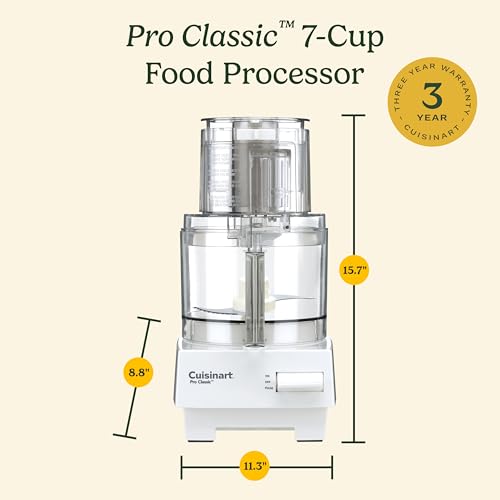
| Dimensions | 11.3″ W × 8.8″ D × 15.7″ H, per Cuisinart’s own product image |
| Bowl material | Lexan plastic — shatter-resistant and heat-resistant, but not microwave-safe, per the manual |
| Cleaning | All parts except the motor base are dishwasher safe, per the manual; insert the bowl upside down |
| Controls | On / Off / Pulse paddle switch |
| Warranty | Three years on the entire machine, five years on the motor (U.S. and Canada only) |
The Review Count the Guide Cited Was Wrong
This exact listing shows 3,976 global ratings at 4.5 stars, confirmed directly on the product page on 16 September 2026. The guide’s comparison table previously listed 22,206 reviews for this pick, which does not match this listing and has been corrected.
The price has also moved. The guide cited two different stale figures in two places ($167.02 and $169.15); the verified price on 16 September 2026 was $162.17, against a $169.95 list price.
Why this matters for the comparison: the guide ranks this pick partly on its review volume relative to the Ninja systems. At 3,976 ratings it still has a substantial review base, just not the outlier volume the old figure implied.
Who It’s For
- Anyone whose main job is chopping, slicing, shredding or kneading, with blending as an occasional extra. The 600-watt motor is undersized for ice and frozen drinks but well matched to the discs and blade it ships with.
- Anyone who wants a genuine 5-year motor warranty and a 3-year warranty on the rest of the machine.
- Anyone drawn in by Cuisinart’s reputation for longevity. Multiple current owners specifically mention replacing an earlier Cuisinart Pro Classic that ran for 18 to 42 years, not because the motor failed but because a bowl eventually cracked.
- Anyone who wants a compact single-bowl footprint rather than a pitcher-plus-bowl combo system.
Who Should Look Elsewhere
- Anyone who wants frozen drinks or crushed ice. This is a food processor with blending as a secondary function, not a blender — see the Ninja systems in the guide for that job.
- Anyone who dishwashes every part without exception. Amazon’s own review summary flags plastic parts fatiguing and breaking as a mixed signal, and one detailed recent review specifically recommends handwashing the bowl and lid over reports of dishwasher heat-warping.
- Anyone comparing it directly to an older Cuisinart Pro Classic. More than one owner who grew up with, or previously owned, an older-generation Pro Classic describes the current bowl’s plastic as feeling thinner and more prone to cracking than the older one.
- Anyone who wants a food processor and a proper blender pitcher in one box. This model has no dedicated blending pitcher; the Ninja combo systems in this guide do.
Performance
What the Discs and Blade Are Actually Rated For

Per the manual’s recommended maximum capacities: 5 cups sliced or shredded fruit, vegetables or cheese; 2 cups chopped; 3 cups cooked vegetables reduced to 1½ cups purée; 1¼ pounds of chopped or puréed meat, fish or seafood; and up to 5 cups of thin liquid.
For dough, the ceiling is 4 cups of all-purpose flour or 2½ cups of whole-grain flour for a typical bread dough, and 3½ cups of flour for a richer, sweeter dough. The manual is explicit that exceeding this means processing in two batches, not pushing the machine past its limit.
The manual also warns never to slice soft cheese like mozzarella or hard cheese like Parmesan — both can damage the slicing disc or the processor itself — and never to process cheese too hard to cut with a knife.
The Durability Question: Old Units vs. New

The most repeated durability story in the visible reviews is not about this unit failing — it is owners replacing an older Cuisinart that finally gave out after a very long service life. One reviewer’s original lasted 42 years; another describes an 18-year-old Pro Classic whose bowl cracked only after nearly two decades of regular, mostly dishwasher, use; a third replaced a unit that ran 35 years.
Set against that, Amazon’s own AI-generated summary of this listing’s reviews describes durability as a mixed signal: some owners report it lasting, others report plastic parts fatiguing and breaking. One recent, detailed review specifically compares the current bowl unfavorably to an older, thicker-walled 14-cup Pro Classic the reviewer grew up using, and now handwashes the bowl and lid rather than risk what they describe as dishwasher heat-warping reported by other owners.
Read together, the honest version is: this line has a real, multi-decade reputation for outlasting its warranty by a wide margin, and a smaller, more recent thread of concern that current-production bowls may not match the older ones for wall thickness. Both can be true at once.
The Motor Stopping Mid-Task Is a Safety Feature, Not a Fault
The manual describes an automatic, temperature-controlled circuit breaker built into the motor: if the processor runs unusually long on a thick or heavy load — a large batch of stiff dough, for example — the motor can overheat and stop on its own. Cuisinart’s guidance is to turn it off and wait, typically 5 to 10 minutes and in extreme cases up to an hour, rather than to treat a stall as a breakdown.
The same manual is specific that dough too stiff to knead comfortably by hand should not be forced through the machine at all — the recommended maximum is 4 cups of flour for bread dough, in two batches if a recipe calls for more.
The Full Feature Set, at a Glance

Cuisinart’s own product imagery frames this as a “countertop workhorse” built around three things: the 7-cup bowl, two feed tubes (extra-large and small) for different food sizes, and interchangeable stainless steel blade and discs for what the company calls “precision prep.”
The same imagery describes the 600-watt motor as “powerful yet quiet” and the paddle control as deliberately simple — On, Off and Pulse, with no digital display or presets to learn.
Design and Build
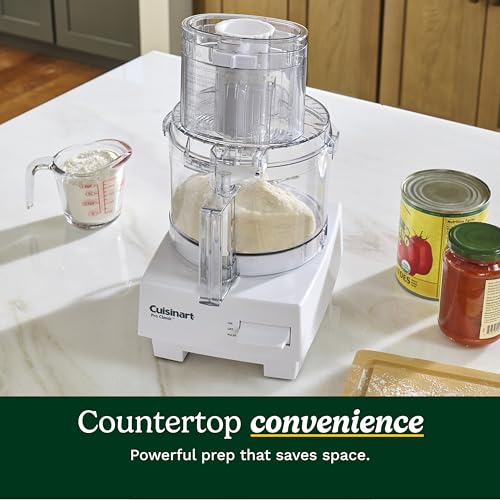
A white base with a clear Lexan work bowl and a control paddle for On, Off and Pulse. Per Cuisinart’s own product image, it measures 11.3 inches wide, 8.8 inches deep and 15.7 inches tall.
The work bowl is Lexan plastic, which Cuisinart describes as shatter-resistant and heat-resistant, but the manual is explicit that it should not go in a microwave.
The manual also flags that chopping ice, whole spices or oils like wintergreen can scratch or cloud the work bowl over time — a maintenance note worth knowing before using the bowl for tasks outside normal food prep.
What Owners Report
Amazon shows 79% five-star and 11% four-star ratings against 3% three-star, 2% two-star and 5% one-star, across 3,976 ratings on this listing. Amazon’s own AI-generated summary and the individually visible reviews below are the basis for the themes that follow, since filtered access to the full written-review set was not available at the time of writing.
What recurs in the positive reviews
- Performs its core job well. The single largest theme in Amazon’s own review summary, cited in 643 reviews.
- Easy to use and clean. Cited in 185 and 155 reviews respectively in Amazon’s summary; several owners specifically mention this being their first food processor and finding it approachable.
- Genuine multi-decade longevity for some units. Multiple owners describe a previous Cuisinart Pro Classic lasting 18, 35 or 42 years before replacement.
- Right-sized for two people. More than one owner specifically calls the 7-cup bowl the correct size for a two-person household, over the larger 11- or 14-cup models.
- Value relative to commercial equipment. One reviewer describes it as offering Robot Coupe-style convenience at a fraction of the price.
What recurs in the critical reviews
- Plastic bowl feels thinner on current units, per some owners. A reviewer who grew up with an older 14-cup Pro Classic describes the new bowl as more brittle and prone to cracking by comparison.
- Dishwasher heat-warping reported by some owners, enough that at least one detailed reviewer now handwashes the bowl and lid as a precaution.
- Plastic parts fatiguing and breaking, per Amazon’s own review summary, alongside the positive durability reports.
- No blending pitcher. This is a food processor first; anyone wanting frozen drinks needs a dedicated blender or one of the guide’s Ninja combo picks.
The clearest pattern is a split by wear point, not by function: almost nobody reports the motor failing, and almost everybody who reports a problem is talking about the bowl or lid after years of use, not the machine failing to chop, slice or knead.
Value
At $162.17, the DLC-10SYP1 sits above the guide’s NutriBullet Combo ($111.99, verified 16 September 2026 — also higher than the guide’s previously listed $99.99) and below the Ninja BL770 Mega Kitchen System ($179.99).
The Ninja systems in the guide — the BN801, BL770 and Compact Kitchen System — all include a dedicated blending pitcher the Cuisinart does not. If blending is a real priority alongside food processing, that is the deciding factor, not price.
Against the NutriBullet Combo specifically: the NutriBullet has no food processor bowl at all, so the comparison only matters if chopping, slicing and shredding are part of what you need. For that job, the Cuisinart is the more capable machine at a moderate premium.
Durability
The warranty is three years on the whole machine and five years on the motor specifically, U.S. and Canada only, and explicitly excludes commercial use.
The clearest positive signal is anecdotal but consistent: several current owners are replacing a previous-generation Cuisinart Pro Classic that ran for 18 to 42 years, with the bowl — not the motor — as the part that eventually gave out.
Against that, Amazon’s own AI-generated review summary names durability as a mixed theme, citing plastic parts fatiguing and breaking alongside the positive longevity reports, and at least one detailed recent review describes the current bowl as feeling thinner than an older model and recommends handwashing over dishwashing it.
None of this is a failure rate, and the star-filtered written-review data this site normally uses to quantify a critical share was not accessible at the time of writing — see the note below.
Alternatives to Consider
- For a true blender-plus-food-processor combo with a dedicated pitcher, see my Ninja BN801 review, the guide’s Best Overall pick.
- For a smaller-footprint Ninja combo, see my Ninja Compact Kitchen System review.
- For pure blending without any food processing, see the NutriBullet Combo section of the best blender food processor combo guide.
- Everything else on blenders and combo systems is in the blenders hub.
Verdict
The Cuisinart DLC-10SYP1 does one job — chopping, slicing, shredding and kneading — better than any of the blender-first Ninja systems in this comparison, backed by a genuine reputation for multi-decade durability among long-time Cuisinart owners.
Against that: it has no blending pitcher, current-production bowls draw some complaints about thinner plastic and dishwasher warping compared with older units, and the guide previously cited a review count and price for this pick that did not match the live listing, both now corrected.
Seven out of ten: marked up for food-processing capability, the 5-year motor warranty and the multi-decade track record several owners report, marked down for the no-blending tradeoff and the current-bowl durability questions.
How This Review Was Put Together
Plainly: this is research-based, not a hands-on test. I have not owned or used this food processor, and nothing here should be read as a report from my own kitchen.
What it rests on: the published specification — Cuisinart’s own DLC-10S Series instruction and recipe booklet — capacity limits, safety warnings, cleaning instructions and warranty terms — and the claims on its Amazon listing — read against the other food processors in my best blender food processor combo guide; the star breakdown and the AI-generated review summary Amazon publishes for this exact listing, since Amazon currently restricts filtered access to individual written reviews by star rating; and the text of the positive and critical reviews, read for themes that recur across independent owners.
Why owner reviews are treated as evidence here: one reviewer cooking on one unit for a fortnight cannot show whether the work bowl and lid hold up to years of dishwasher use and whether the newer plastic is really thinner than older Pro Classic models. Owners who have run one for a decade or more, and the handful comparing this bowl to the one it replaced, are the closest thing available. A theme is only reported above where more than one unconnected owner raised it.
What I could not establish: what share of the newer bowls actually crack or warp sooner than older-generation bowls, since this rests on a handful of owners directly comparing generations rather than a controlled test; and the model-specific critical share of written reviews, since Amazon restricted filtered review access by star rating at the time of writing and only the aggregate star distribution and its own AI-generated summary were available.
Price, stock and ratings were read from Amazon’s US marketplace on 16 September 2026 and will move.
Frequently Asked Questions
Is the Cuisinart DLC-10SYP1 dishwasher safe?
All parts except the motor base are dishwasher safe, per Cuisinart’s manual, which recommends loading the work bowl upside down. Some owners report the plastic bowl and lid warping from dishwasher heat over years of use and now handwash those two parts as a precaution.
What is the warranty on the Cuisinart DLC-10SYP1?
Three years on the entire machine and five years specifically on the motor, for U.S. and Canada consumer use only. It does not cover commercial use, accident, misuse or damage from unauthorized accessories.
Can the Cuisinart work bowl go in the microwave?
No. The bowl is made of Lexan plastic, which Cuisinart describes as shatter-resistant and heat-resistant, but the manual explicitly says it should not be placed in a microwave oven.
How much dough can the Cuisinart DLC-10SYP1 knead?
Up to 4 cups of all-purpose flour or 2½ cups of whole-grain flour for a typical bread dough, and up to 3½ cups for a richer sweet dough, per the manual. Larger amounts should be processed in two batches rather than forced through in one.
Why did the motor stop while I was using it?
The motor has a built-in automatic thermal circuit breaker that stops it if it overheats, typically from an unusually long run on a thick or heavy load. This is a safety feature, not a fault — Cuisinart’s guidance is to turn the machine off and let it cool, usually 5 to 10 minutes.
Can you slice hard cheese like Parmesan in this food processor?
No. The manual specifically warns never to slice hard cheese like Parmesan or soft cheese like mozzarella, since either can damage the slicing disc or the machine. Most cheeses shred well when semi-frozen; Parmesan shreds best at room temperature.
Does the Cuisinart DLC-10SYP1 include a blending pitcher?
No. This model is a food processor with a single 7-cup bowl; it purées and blends within that bowl but has no separate blender pitcher. The Ninja combo systems in the same guide include a dedicated pitcher alongside their food processor bowl.