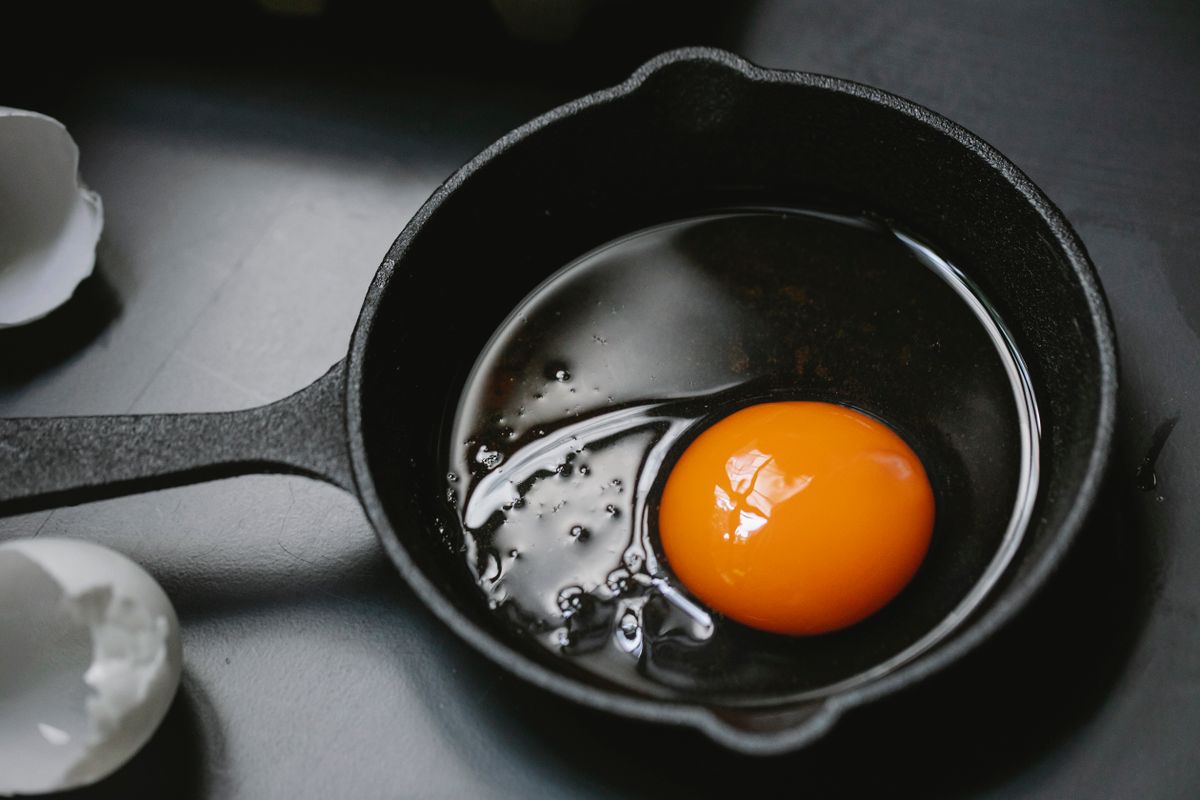
A cast iron pan that comes out of the oven tacky has not been ruined, and it does not need stripping back to bare metal in most cases. It usually means one specific thing went wrong, and it is the easiest seasoning mistake to make. If the seasoning is coming away in black flecks rather than staying tacky, that is a different failure with a different fix — see cast iron seasoning that is flaking off.
First: which kind of sticky?
Two very different complaints get filed under the same word, and only one of them is a seasoning failure.
Tacky or gummy to the touch, before you have cooked anything. You run a finger over the pan and it drags.
It may feel slightly greasy, or leave a faint residue. This is a curing failure — the oil did not fully convert. It is fixable, and the rest of this section is about it.
The surface is dry and hard, but food sticks to it while cooking. The pan feels fine cold. This is not a seasoning failure at all, and re-seasoning will not help much. It is nearly always heat or technique, covered further down.
So: is the problem how the pan feels, or how it cooks? Answer that first.
If it is tacky to the touch
Almost always: too much oil
This is the cause in the large majority of cases, and it is counterintuitive, because more oil sounds like more seasoning.
Seasoning is not a coat of oil. It is a chemical change — oil heated past its smoke point oxidises and cross-links into a hard, plastic-like polymer bonded to the iron. That reaction needs a film thin enough to be measured in molecules.
Leave a visible layer of oil and the part touching the iron may polymerise while the surface above it never fully cross-links. What you are left with is a half-converted layer: soft, tacky, and slightly sticky to the touch.
The rule that prevents it sounds wrong the first time you hear it: rub the oil in, then wipe it all off again. Wipe as though you have changed your mind and want the oil gone. The pan should look dry, not glossy. What remains in the surface texture is more than enough — that residue is the seasoning layer.
Or it did not get hot enough, or was not held there long enough
Polymerisation only happens above the oil’s smoke point. Below that temperature the oil simply sits there and bakes gently, which produces exactly the sticky varnish described above.
The usual approach is an hour at around 230 °C (450 °F), which is above the smoke point of the common seasoning oils, then leaving the pan to cool in the oven as it turns off. Pulling it out early, or running the oven at a moderate baking temperature, gives you a tacky pan.
Or the oil is not suited to it
A high smoke point matters, because the oven temperature has to exceed it. Neutral oils such as grapeseed, sunflower, canola and refined vegetable oil all work, as do purpose-sold seasoning oils. Olive oil and butter have smoke points too low to be reliable.
Flaxseed oil is widely recommended and is genuinely contested. It polymerises hard and fast, which is why it became popular, but a great many owners report the resulting layer flaking off in sheets after some months. I could not find a controlled comparison that settles it, so I am not going to tell you it is either the best choice or a mistake — but if you want the low-risk option, a neutral high-smoke-point oil is it.
What a correctly seasoned pan should look like
Useful as a reference point, because “seasoned” is often described without being described.
- Colour: even dark brown to black. New pans start mid-brown and darken across the first several months on the stove. Patchiness is normal early on and evens out.
- Finish: a low satin sheen, not a wet-looking gloss. A pan that looks freshly oiled after it has cooled has too much oil on it.
- Feel: dry and hard. A dry fingertip should slide, not drag or tack.
- Smell: nothing much. A rancid smell means oil that never polymerised and has since gone off — the same excess-oil problem, further along.
A note if the pan was sold pre-seasoned
Most cast iron now arrives pre-seasoned from the factory, and a lot of tacky-pan problems start with someone seasoning a new pan that did not need it.
Factory seasoning is applied and cured industrially, and it is ready to cook on. You do not need to season it before first use — and if you do, applying a normal home-sized amount of oil on top of it is a very easy way to produce exactly the sticky layer described above. Cook on it first. Add a maintenance coat later, when the surface tells you it wants one.
How to fix a pan that is already tacky
Pick based on how bad it is.
Lightly tacky: bake it again
- Wipe the pan hard with a dry cloth or paper towel to take off anything loose.
- Put it in the oven upside down at around 230 °C (450 °F) for an hour, with something underneath to catch drips.
- Turn the oven off and let the pan cool inside it.
You are simply finishing the reaction that did not complete. Often that is all it takes, and the surface comes out hard and dry.
Heavily gummy or uneven: take it back and redo it
- Scrub the tacky layer off with coarse salt and a little oil, or a stiff brush, or fine steel wool. Cast iron is not delicate — unlike a coated pan, you cannot ruin it this way.
- Wash with hot water and dish soap. Modern washing-up liquid is fine on cast iron; the old warning refers to the harsh lye soaps of a century ago, and polymerised seasoning is not dissolved by detergent.
- Dry it immediately and completely, on a low hob burner for a minute or two if in doubt.
- Apply a very small amount of oil, rub it over every surface, then wipe it all off again.
- Bake upside down at 230 °C (450 °F) for an hour and cool in the oven.
Repeat the oil-and-bake cycle two or three times if you want a solid base. Thin layers built up repeatedly are what produces a durable surface — one thick layer never does.
If the pan is dry but food still sticks
Re-seasoning is the wrong tool here. Work through these instead.
It was not preheated properly
Cast iron heats slowly and unevenly, and this is the single most common cause of sticking in use. Dropping food into a pan that has been on the heat for ninety seconds means putting it onto cold patches. Give it several minutes on a medium burner, and let the heat spread rather than blasting it.
There is not enough fat in the pan
Seasoned cast iron is not a non-stick coating and was never going to behave like one. It needs a working layer of fat to release food. A well-seasoned pan needs less fat than a bare one, not none.
You are cooking the hardest foods too early
Eggs and delicate fish are the most demanding things you can ask of a new pan. A young seasoning is thin and patchy. Cook bacon, sausages, roast vegetables and steak on it for a few weeks first — those add to the seasoning while being forgiving about it — and come back to eggs later.
The seasoning has been thinned
Long simmering of tomatoes, wine or vinegar strips seasoning, as does prolonged soaking. If the pan used to release well and now does not, and the surface looks patchy or grey in places, it needs a maintenance coat rather than a diagnosis.
The same chemistry as a non-stick pan, with the opposite goal
Worth noticing, because it explains both problems at once.
Polymerised oil is exactly what a sticky non-stick pan is suffering from. On a coated pan, oil that has cross-linked into a hard film is contamination sitting on top of the working surface, and the fix is to remove it — which is what the guide to a non-stick pan that has started sticking is about.
On cast iron, that same polymerised layer is the working surface. You are deliberately creating what you would strip off a coated pan.
Which is why the two need opposite treatment. Cast iron wants heat above the smoke point, repeated oiling and no fear of an abrasive scrub. A coated pan wants none of those things, and doing any of them to it causes the damage described in the guide to coatings that flake. Advice that works brilliantly on one will wreck the other, which is worth remembering when you read general cookware tips.
The order worth working through
- Touch the cold pan. Tacky, or dry and hard? That decides which half of this applies.
- Tacky: re-bake at 230 °C (450 °F) for an hour, cooling in the oven.
- Still tacky: scrub it back, wash, dry thoroughly, then oil and wipe it all off before baking again.
- Dry but food sticks: preheat for longer on a medium burner, and use more fat.
- Still sticking: stop cooking eggs and fish on it for a few weeks and build the seasoning with forgiving foods.
How This Guide Was Put Together
Plainly: this is a research-based guide, not a hands-on test. I have not seasoned a row of pans with different oils to compare the results, and nothing here is a report from my own kitchen.
What it rests on: the chemistry of oil polymerisation, which is well documented and explains why film thickness and temperature relative to the oil’s smoke point determine whether you get a hard layer or a tacky one; the seasoning instructions published by cast iron manufacturers, which agree closely on the wipe-it-all-off principle and on oven temperatures around 230 °C; and the pattern of what owners report, where excess oil dominates the reported causes by a wide margin.
What I could not establish: whether flaxseed oil is genuinely worse than neutral oils for long-term durability. The reports of it flaking are numerous and consistent enough to be worth mentioning, but I found no controlled comparison, so the guide declines to rule on it and points to the lower-risk option instead.
Frequently Asked Questions
Is cast iron supposed to be sticky after seasoning?
No. A correctly seasoned pan comes out dry, hard and slightly glossy, and feels smooth rather than draggy. Tackiness means the oil did not fully polymerise, nearly always because too much of it was left on the surface before baking.
How do you fix sticky cast iron seasoning?
If it is lightly tacky, wipe it hard with a dry cloth and bake it upside down at around 230 °C (450 °F) for an hour, then let it cool in the oven — you are finishing a reaction that did not complete. If it is heavily gummy, scrub the layer off with coarse salt or steel wool, wash, dry completely, then re-oil and wipe it all off before baking.
What happens if you use too much oil when seasoning cast iron?
You get exactly this problem. Polymerisation needs an extremely thin film. A visible layer of oil cannot fully cross-link, so the surface stays soft and tacky instead of hardening. Apply the oil, then wipe it all off before the pan goes in the oven.
Why does my cast iron stick even after seasoning?
If the pan is dry and hard rather than tacky, this is not a seasoning fault. The usual causes are not preheating long enough — cast iron heats slowly and unevenly — not using enough fat, or asking a young seasoning to handle eggs and delicate fish before it has built up.
What oil should I use to season cast iron?
A neutral oil with a high smoke point: grapeseed, sunflower, canola or refined vegetable oil, or a purpose-sold seasoning oil. The oven temperature has to exceed the oil’s smoke point for polymerisation to happen, which rules out olive oil and butter.
Can I use soap on cast iron?
Yes. Modern washing-up liquid does not dissolve polymerised seasoning. The warning against soap dates from when soap meant harsh lye-based products. What genuinely damages seasoning is prolonged soaking, long simmering of acidic foods, and putting the pan away wet.
How many layers of seasoning does a pan need?
Several thin ones beat any attempt at a thick one. Two or three oil-and-bake cycles give a workable base, and normal cooking with fat adds to it from there. A single heavy application does not produce a thicker seasoning — it produces the sticky pan this guide is about.
More cast iron reading
For choosing a pan in the first place, there is a cast iron skillet buying guide covering sizes and surface finish, and the best cast iron skillet picks compare specific models. For Dutch ovens, see the cast iron Dutch oven guide.

I'm Glenn, and I started Kitchenware Compare to cut through conflicting product reviews and help readers pick kitchen gear with confidence. I don't own or test the products I write about — these guides are built from verified-purchase reviews, manufacturer specifications, and independent testing where it exists, with the reasoning shown, not just a rating.
Leave a Reply