For most U.S. kitchens, an electric kettle is the better everyday pick: it boils faster, shuts itself off, and costs a few cents per boil. A stovetop kettle earns its place when you have no free outlet, cook on gas and like the whistle, or want a pour-over spout that lives on the range. I wrote this to help you decide in a few minutes, using published figures and owner feedback rather than anything I claim to have done myself.
TL;DR
- Speed: An electric kettle usually wins. According to Tasting Table, roughly 1.7 liters takes 2 to 5 minutes in an electric kettle and 5 to 10 minutes on a stovetop at sea level.
- Cost to run: Both are cheap. In one published home comparison, an electric kettle used 0.11 kWh and a pot on an electric stove used 0.18 kWh for the same quart of water.
- Safety and convenience: Electric kettles switch off automatically at the boil. Stovetop kettles need you nearby.
- Pick a stovetop kettle if: you lack counter space or outlets, want a classic whistle, or want a gooseneck for pour-over on the burner.
What actually differs between the two
A stovetop kettle is a metal vessel with a flat bottom that takes its heat from your burner, and many have a steam whistle. An electric kettle is a small appliance with its own heating element that switches off automatically once the water boils, according to Wikipedia’s kettle entry. That entry also notes that electric kettles typically draw 2 to 3 kW in countries with higher-voltage outlets.
That last detail matters in the U.S. According to Electrical Technology, standard 120V American outlets limit kettle power to around 1,500 watts, which is one reason stovetop kettles stayed popular here while electric kettles became the default in the U.K. and much of Europe. So a U.S. electric kettle is slower than the British ones in many online videos, but it is still usually quicker than a burner.
In short:
| Electric kettle | Stovetop kettle | |
|---|---|---|
| Heat source | Built-in element, plugs into a 120V outlet | Your gas or electric burner |
| Typical boil time, about 1.7 L | 2 to 5 minutes | 5 to 10 minutes, longer at altitude |
| Shuts off by itself | Yes, on standard designs | No, you watch it or rely on the whistle |
| Needs an outlet | Yes | No |
| Temperature control | Available on many models | Manual, by eye or thermometer |
| Storage | Counter space | Sits on the range |
Boil time: how much faster is electric?
Speed is the most common reason people switch. Tasting Table reported in January 2024 that an electric kettle can bring about 1.7 liters to a boil in 2 to 5 minutes, while a standard stovetop takes 5 to 10 minutes at sea level and up to 20 minutes at higher elevations. The same piece says electric ranges boil faster than gas, and wider pots boil faster than narrow ones.
Two things move your own number:
- How much water you heat. A full kettle takes longer than one mug. Filling to the minimum line for a single cup is the quickest way to shorten the wait on either type.
- Your burner. A weak electric coil and a strong gas burner can swap places. A kettle with a wide, flat base catches more heat than a tall narrow one.
If you want to see the gap measured on a small scale, one home comparison published by Jeff Kaufman in 2022 used a 1,000W electric kettle and a pot on a 1,500W glass-top electric burner. The kettle boiled a quart of water in 6 minutes 32 seconds, and the pot took 7 minutes 20 seconds. That is a single household’s result, not a benchmark, but it shows the gap on a low-powered U.S. kettle can be modest. Higher-wattage 1,500W models and a gas-free kitchen widen it. Gas ranges and big burners can close it altogether for small amounts of water.
What each costs to run
Boiling water is cheap either way, so energy should not decide this on its own. In the same Kaufman comparison, the electric kettle used 0.11 kWh and the stove pot used 0.18 kWh, which worked out to about $0.02 against $0.04 at his rate of $0.21 per kWh. Your rate will differ, so treat that as an illustration of the ratio.
On efficiency, Inside Energy cited National Renewable Energy Laboratory researcher Tom Williams in 2016 with rough figures of about 70% for an electric stovetop and about 80% for an electric teakettle. Inside Energy’s analysis also made a point that is easy to miss: how much water you boil matters as much as the appliance. Heating only what you need saves more than switching equipment.
So the practical rule is simple:
- Measure the water for your mug or pot instead of filling to the top.
- Pick the kettle that fits how you cook, not a theoretical saving of a few cents a month.
Safety and daily convenience
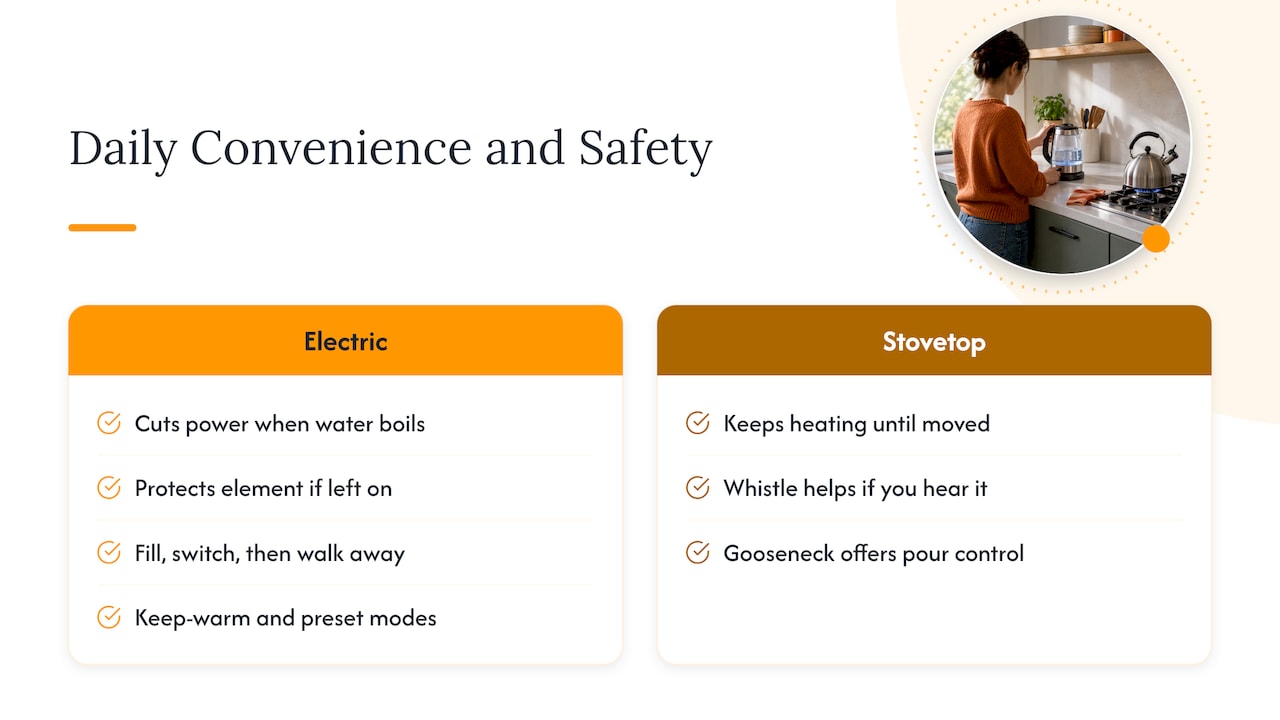
The biggest daily difference is attention. Standard electric designs cut power when the water boils, which also protects the element if the kettle is left on. A stovetop kettle keeps heating until you move it. A whistle helps, but only if you hear it, and an empty kettle left on a burner is the classic way to ruin one.
Electric kettles are also easier to use in a way that is hard to quantify. You fill, press a switch and walk away. Many have a keep-warm mode and preset temperatures, which matter if you drink green tea or brew pour-over coffee at specific temperatures. If those drinks are your reason for buying, a variable-temperature electric model is the simpler route. If you want the spout control for pour-over, I compare options in my guide to the best gooseneck kettles.
One more point for people who care about what touches their water: some electric kettles use plastic in the water path. I compared models that avoid it in best electric kettle without plastic. Stainless steel, glass and ceramic bodies are the usual alternatives.
Durability and lifespan
This is where stovetop kettles have a real argument. A single piece of stainless steel with no electronics has little to fail. An electric kettle adds a switch, a base connector and a heating element, and those are the parts owners most often report failing. Neither category has a published industry lifespan I can cite, so look at the construction instead:
- Stovetop: a thick, flat base, a riveted or welded handle and a spout that pours without dripping.
- Electric: a concealed element, a sturdy base connector and a lid hinge that feels solid in owner photos.
The same logic applies across the kitchen, and my breakdown of the most durable cookware types shows how material choice affects longevity for pans and pots too.
When a stovetop kettle is the better fit
Here is where I would point someone toward the stovetop:
- No outlet or no counter space. A stovetop kettle can live on the range and needs no cord. For a kitchen short of outlets, that is the whole case.
- You cook on gas and brew by hand. A gooseneck on the burner gives you the pour control and a familiar workflow.
- Power outages or off-grid use. A kettle on a camp stove or gas range keeps working when the grid does not.
- You like the whistle. For a lot of people it is part of the ritual.
If you cook on the same burner, the pan underneath matters as well. A 20cm non-stick egg frying pan is the kind of small, quick-heating piece that shares range space easily with a kettle.
People who want a stovetop-style routine without a full range can also look at a dedicated burner. I list options in best hot plate for boiling water. And if your morning drink is stovetop espresso, my moka pot picks pair naturally with a kettle for pre-heating water.
When an electric kettle is the better fit
Choose electric if you:
- boil water several times a day for tea, instant oatmeal, French press or pasta water;
- want an automatic shut-off and no standing at the stove;
- need specific temperatures for tea or pour-over;
- have a counter outlet near the sink;
- want a gift that people use daily. A kettle with temperature presets is an easy one to give.
For first-time buyers, my suggestion is to check three things before choosing: wattage (1,500W is the ceiling on a standard 120V circuit), capacity, and the materials that contact the water. Then compare reviews for owner complaints about lids, spouts and bases, which is where problems show up.
Quick decision guide
| Your situation | Better pick |
|---|---|
| Daily tea or coffee, one outlet near the sink | Electric |
| Specific temperatures for green tea or pour-over | Electric with presets |
| No spare outlet or tight counter | Stovetop |
| Gas range, you like a whistle, occasional use | Stovetop |
| Frequent power cuts or camping | Stovetop |
| Budget-minded, wants the fastest boil for the money | Electric |
Where I come down
I read a lot of owner reviews and spec sheets for kitchen gear, and the kettle question comes down to habits more than hardware. I have not used these products myself, so I base my view on manufacturer specifications, owner reports and the published measurements above.
The pattern is consistent. People who boil water daily end up happy with an electric kettle because the shut-off and the speed remove a small chore. People who keep a stovetop kettle usually do so on purpose: they have the burner, they want the pour, or they lack an outlet.
My advice is to decide on where the kettle will live and how often you will reach for it. Then compare the specific models side by side, including the owner-reported complaints, before you buy.
Glenn
Compare models before you buy
If you have settled on a type, the next step is comparing specific models on specifications, price and owner-reported complaints. Kitchenware Compare puts those side by side, and the cookware reviews and buying guides cover the pots and pans that go with a stovetop setup. For how I research products, see how I review kitchen equipment.
FAQ
Is an electric kettle really faster than a stovetop kettle?
Usually, yes. Tasting Table puts roughly 1.7 liters at 2 to 5 minutes in an electric kettle against 5 to 10 minutes on a stovetop at sea level. A strong gas burner and a small amount of water can narrow the difference.
Does an electric kettle use less energy?
Typically a little less. Inside Energy cited roughly 80% efficiency for an electric teakettle against about 70% for an electric stovetop. In Jeff Kaufman’s home comparison, the cost difference was about two cents per boil, so measuring only the water you need matters more.
Why do many Americans use stovetop kettles?
Mostly voltage. According to Electrical Technology, 120V outlets limit kettle power to around 1,500 watts, so U.S. electric kettles are slower than those in countries with 240V outlets. Gas ranges, existing habits and limited outlets add to it.
Which is safer?
Standard electric kettles shut off automatically when the water boils, per Wikipedia’s kettle entry. A stovetop kettle keeps heating until you remove it, so it needs your attention, especially when it is nearly empty.
Sources
- Kettle, Wikipedia
- Boil Water Faster With The Help Of An Electric Kettle, Tasting Table
- A Watched Pot: What Is The Most Energy Efficient Way To Boil Water, Inside Energy
- Electric Kettle vs Stove, Jeff Kaufman
- Why Do Americans Use Gas Kettles Instead of Electric Kettles, Electrical Technology
Recommended
- Best Electric Kettle Without Plastic: 4 Picks Compared
- Best Hot Plate for Boiling Water 2026: 5 Picks
- Best Gooseneck Kettle 2026: 5 Picks Compared
- How to Descale an Electric Kettle: What 9 Makers Say

I'm Glenn, and I started Kitchenware Compare to cut through conflicting product reviews and help readers pick kitchen gear with confidence. I don't own or test the products I write about — these guides are built from verified-purchase reviews, manufacturer specifications, and independent testing where it exists, with the reasoning shown, not just a rating.
Leave a Reply