The short answer: aluminum heats faster and costs less, while stainless steel is nonreactive, tougher and easier to live with for decades. For most home cooks the best pan is neither one alone but stainless steel wrapped around an aluminum core. Plain aluminum still wins for baking sheets and quick, light-duty frying. I base this on published specs, owner feedback and the sources linked below. I do not own or hands-on use the pans I compare.
TL;DR
- Aluminum conducts heat quickly and is light and inexpensive, but bare aluminum reacts with acidic foods and wears faster.
- Stainless steel is nonreactive, durable and good for searing and sauces, but on its own it spreads heat poorly.
- Clad (tri-ply) stainless puts an aluminum core inside stainless, so you get even heat and a nonreactive cooking surface. Impact-bonded pans put the aluminum only in the base.
- Baking sheets are the exception: bare aluminum or aluminized steel usually browns better than plain stainless.
- A 2024 study found some aluminum cookware leached lead, so buy from sellers who state the alloy and construction.
The quick comparison
Here is the whole decision on one screen, before I explain each row.
| Factor | Aluminum (bare) | Stainless steel (solid) | Clad stainless with aluminum core |
|---|---|---|---|
| Heat-up speed | Fast and responsive | Slow | Moderate, even |
| Hot spots | Few | Common | Few |
| Reactive with acid | Yes | No | No |
| Weight | Light | Heavy | Medium to heavy |
| Scratch and dent resistance | Low | High | High |
| Price | Low | Moderate | Moderate to high |
| Best at | Quick everyday cooking, baking sheets | Searing, sauces, oven finishing | Nearly everything on the stovetop |
The rest of this guide explains what sits behind each row and where each material goes wrong.
How the two metals handle heat
Aluminum is one of the best heat conductors used in kitchens. A bare aluminum pan warms up quickly and cools quickly when you lower the flame, which makes it forgiving for eggs, pancakes, vegetables and fast sautés. A GreenPan comparison makes the same split: aluminum is quick and responsive, while stainless warms more slowly but holds up at higher temperatures.
Solid stainless steel is a weaker conductor. Heat tends to collect right over the burner and stay there, so the center of the pan can scorch while the edges stay cool. That is why a thin, all-stainless skillet often gives uneven browning and why preheating it slowly matters.
This conduction gap is the reason most good stainless pans are not solid stainless at all. Makers layer a conductive metal, usually aluminum, inside or underneath the steel. You get the fast, even heat of aluminum and the surface of stainless steel. I cover the layering options in the construction section below.
What this means at the stove:
- For fast, low-fuss cooking, aluminum’s quick response is an advantage.
- For a hard sear, you want mass and stable heat, which a heavier stainless or clad pan holds better than thin aluminum.
- If you want the sear and the evenness, look for aluminum inside stainless rather than choosing one metal.
If your real question is stainless versus a coated pan, I compare those in nonstick vs stainless steel.
Reactivity and safety
This is where the two materials differ most, and it is also where the most useful health guidance sits.
Acidic foods and uncoated aluminum
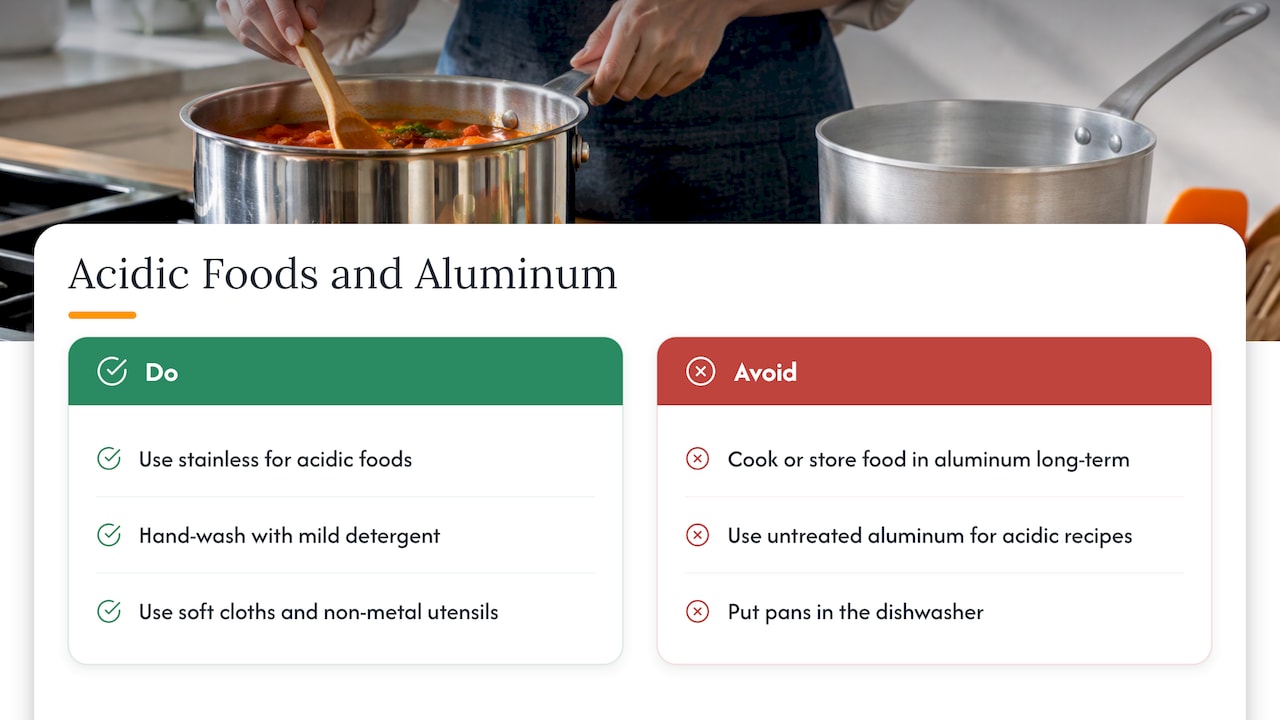
Bare aluminum reacts with acidic or salty foods. According to Health Canada, foods high in acid or salt, such as tomatoes, citrus and sauerkraut, make aluminum or lead transfer from cookware to food more readily, especially from worn or pitted pans. The same page advises against cooking or storing food in aluminum for long periods and recommends hand washing with a mild detergent and a soft cloth, plus non-metal utensils.
In practice, that means bare aluminum is a poor choice for long tomato sauces, wine reductions, lemon-heavy dishes or anything you leave in the pan overnight. Stainless steel does not have this problem. According to experts quoted in a December 2025 Yahoo report on aluminum pans, stainless is nonreactive for everyday cooking, and hard-anodized aluminum is less reactive with acidic foods than untreated aluminum. The same report quotes Pollitt advising caution with untreated aluminum for long-cooked or acidic recipes, and says discoloration or scratching can be a sign it is time to replace a pan.
Care matters here. The report cites Fellows recommending hand washing with mild soap and a soft sponge, drying thoroughly and skipping the dishwasher. For anodized pans in particular, this guide to cleaning anodized aluminum explains how to avoid scratching or staining the surface.
The lead question
A 2024 peer-reviewed paper, Evaluating metal cookware as a source of lead exposure by Fellows, Samy and Whittaker, screened 28 additional aluminum cookware items. Many contained more than 100 ppm lead, and some leached enough lead under simulated cooking or storage conditions to exceed recommended dietary limits. According to the same study, stainless steel cookware leached much lower lead levels than the aluminum items tested.
The authors’ results cover the items they screened. They do not show that every aluminum product carries the same contamination. Health Canada makes a similar point, noting that some aluminum cookware made outside North America has been found to transfer lead into food.
So the practical rules are simple:
- Buy aluminum cookware from sellers that name the alloy, the country of manufacture and the construction.
- Keep acidic dishes out of bare aluminum.
- Retire pans that are pitted, deeply scratched or discolored.
- If you cook for children or someone pregnant and want to remove the question, choose stainless or clad stainless pans for daily use. Your doctor or pediatrician is the right person for any specific exposure concern.
On the older worry that aluminum cookware is linked to Alzheimer’s disease, Health Canada describes the current evidence as conflicting.
Durability, weight and upkeep
Stainless steel is the harder-wearing material. It resists dents, dings and the acidic and abrasive hits that pit bare aluminum. Because it does not react with food, it does not discolor from tomatoes or wine. Many sellers state that a good stainless pan can last decades, though lifespan claims vary by seller and I would treat any single number as marketing range rather than a guarantee.
Aluminum is softer. It scratches, dents and warps more easily, particularly in thin, inexpensive pans. Its main advantage is weight: an aluminum skillet is far easier to lift and toss than a heavy clad one. If you have wrist or grip issues, that matters more than a few seconds of heat-up time.
Care differs too:
- Aluminum: hand wash, avoid the dishwasher, avoid metal utensils.
- Stainless: more tolerant, and can handle firmer scrubbing. My guide to cleaning and polishing stainless steel cookware covers routine care, and metal utensils on stainless pans covers what the surface tolerates.
- Hard-anodized aluminum: a treated aluminum surface that is tougher and less reactive than bare aluminum. I compare it directly in hard anodized vs stainless steel cookware.
Clad vs impact-bonded: how stainless pans are built
Most of the confusion in the stainless aisle comes from construction, not the metal. Here is how the common builds differ.
| Construction | How it is made | What you get |
|---|---|---|
| Fully clad (tri-ply or more) | Layers of metal are bonded together across the whole pan, usually stainless, aluminum, stainless, and the layers extend up the sides | Even heat across the bottom and walls |
| Impact-bonded (disc base) | A disc of aluminum, often with a steel cap, is bonded to the base of a stainless body | Better heat at the bottom, with thin and less even sides |
| Solid stainless | One thickness of stainless steel | Durable and nonreactive, but uneven heat |
The difference shows up in specific jobs. Fully clad walls help when you simmer sauces or braise, because heat reaches up the sides. An impact-bonded pot can still heat well on the bottom, and it is usually lighter and less expensive. For a skillet or saute pan that does the browning on the base, a disc base can do fine. For a stockpot or saucier, clad walls give an even simmer.
When you compare listings, check three things: whether the aluminum extends up the sides, how thick the base is, and whether the cooking surface is stainless steel. My explainer on stainless steel cladding, ply, core and metal release goes deeper on each of these.
Baking sheets: aluminum, aluminized steel or stainless
Baking sheets reverse the cookware logic. You are not searing or simmering acid, so conduction and browning matter most.
- Bare aluminum is light, conducts heat well and is the usual choice for even browning on cookies, roasted vegetables and sheet-pan dinners. It will react with acidic ingredients touching the pan, so line it with parchment for lemon bars, rhubarb or tomato-heavy roasts.
- Aluminized steel is steel coated with an aluminum-silicon alloy. It resists rust, is stiffer than bare aluminum and keeps good conduction. It is a sensible middle choice when acidic foods will touch the pan and you still want even browning.
- Stainless steel is easy to clean and nonreactive but conducts heat less well, so browning can be less even. It suits cooks who put cleanup and nonreactivity ahead of crisp bottoms.
The same trade-off applies to cake pans: pick aluminum or aluminized steel for even color, and choose an uncoated pan for something like angel food cake, which needs to grip the pan wall to climb. If you are working out which baking pans to buy and how to care for them, the questions are the same as for cookware: what the surface is made of, whether it is coated, and how you will wash it. I also keep a bakeware care guide and a wider baking equipment hub for reference.
One practical care point: cutting inside a coated pan can scratch the surface, so lift baked goods out before slicing.
Which should you buy?
Match the pan to the way you cook.
First-time buyers. Start with one clad stainless skillet and one saucepan. They cope with the widest range of foods and forgive more mistakes in care. Round it out with the pieces from kitchen essentials for a new home.
Budget shoppers. A hard-anodized or lined aluminum skillet and an impact-bonded stainless pot give you most of the performance for less money. Spend on the pan you use most. A cookware set can save money if you actually need every piece.
Serious home cooks and professionals. Fully clad stainless for sauces, searing and oven finishing, plus bare aluminum sheet pans for baking. If you are weighing a heavier option, see cast iron vs stainless steel.
Gift shoppers. A clad stainless skillet is a safe gift. It does not need a specific cook’s preference for coatings, it does not react with food, and it is a pan people keep.
Anyone cooking lots of tomato, wine or citrus. Pick stainless or clad stainless and leave bare aluminum for dry-heat jobs.
Where to compare pans side by side
If you want the full set of cookware comparisons, specs and owner-reported complaints in one place, my cookware reviews and buying guides lay them out next to each other with pricing and deals. I show strengths and the complaints owners report, so you can see what a pan is like to live with before you buy.
If you buy through a link on the site, I may earn a commission. The details are on the affiliate disclosure page, and how I review kitchen equipment explains that I work from specs, owner reviews and cited sources rather than hands-on testing.
My perspective
I do not think the real choice is aluminum or stainless. Almost every question I see about this comes down to one thing: people want aluminum’s even heat without giving up stainless steel’s clean, nonreactive cooking surface. Clad construction is the build designed to deliver both, which is why it is where I start for a daily skillet or saucepan.
I also think buyers get misled by lifespan claims and by vague listings. Read the construction line first: does the aluminum run up the sides, how thick is the base, what is the cooking surface? Then read owner reviews for warping, sticking and handle complaints, because those show up long before a spec sheet does.
For baking, I keep aluminum and aluminized steel in the picture. That is the reason I compare on cooking task rather than crowning one metal. I am working from specs, owner reports and cited research, not from my own kitchen, and I would rather you know that than assume it.
Glenn
FAQ
Which is better, aluminum or stainless steel cookware?
For most home cooks, stainless steel with an aluminum core is the better all-around choice, because it combines even heat with a nonreactive, durable surface. Bare aluminum is better for fast, light cooking and for baking sheets. Choose by task rather than by metal alone.
What should not be cooked in aluminum?
Health Canada advises against using aluminum cookware for foods high in acid or salt, such as tomatoes, citrus and sauerkraut, and against long cooking or storage in it. Hard-anodized aluminum is less reactive, and stainless steel is nonreactive.
Is aluminum cookware safe?
It depends on the pan. A 2024 study of screened aluminum cookware found many items with high lead content, and some leached lead above recommended dietary limits, while stainless steel leached much less. Buy from sellers who state the alloy and origin, avoid acidic dishes in bare aluminum and replace pitted or scratched pans.
What is the difference between tri-ply and impact-bonded cookware?
Tri-ply cookware layers stainless steel and aluminum through the whole pan, including the sides. Impact-bonded cookware has an aluminum disc bonded only to the base of a stainless body. Tri-ply tends to heat the walls more evenly, which helps sauces and braises.
What is the best material for a baking sheet?
Bare aluminum and aluminized steel are the usual choices because they conduct heat well and brown evenly. Aluminized steel suits recipes where acidic ingredients touch the pan. Stainless steel is easy to clean but browns less evenly.
Sources
- Evaluating metal cookware as a source of lead exposure (Fellows, Samy and Whittaker, 2024)
- Are aluminum pans safe to cook with? (Yahoo Shopping, December 10, 2025)
- The safe use of cookware and bakeware (Health Canada)
- Cleaning anodized aluminum without scratching or staining
- Baking pans (bakeware selection)
Recommended
- Nonstick vs Stainless Steel: Which Pan Fits Your Cooking?
- Hard Anodized vs Stainless Steel Cookware: Which to Buy
- Cast Iron vs Stainless Steel: Which Pan for Which Job?
- Cookware Types for Induction Cooktops: Complete Guide

I'm Glenn, and I started Kitchenware Compare to cut through conflicting product reviews and help readers pick kitchen gear with confidence. I don't own or test the products I write about — these guides are built from verified-purchase reviews, manufacturer specifications, and independent testing where it exists, with the reasoning shown, not just a rating.
Leave a Reply