This guide has no affiliate links, but some pages it links to do. If you buy through those, I may earn a commission at no extra cost to you.
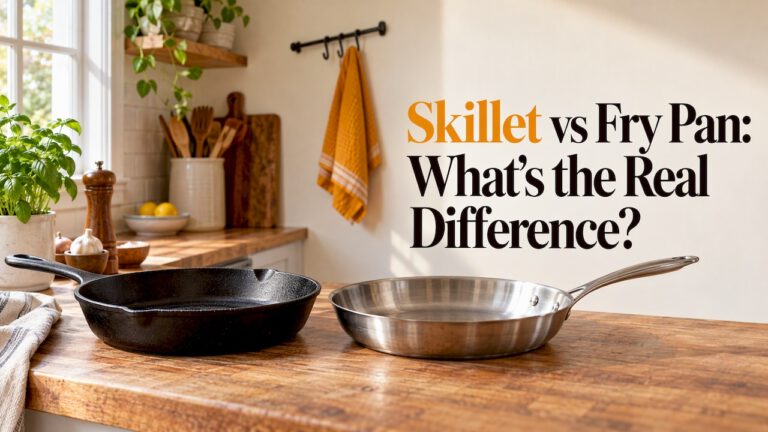
For most American kitchens, a skillet and a fry pan are the same pan: a wide, flat-bottomed pan with sloped sides and one long handle. The names overlap so much that Food & Wine calls a good skillet “aka frying pan”. The differences that actually change how you cook sit one step over, in the sauté pan (straight sides, more depth) and the saucepan (tall sides, built for liquid). I’ll sort out all four below, so you can buy the right one and use it for the right job.
TL;DR
- Skillet and fry pan are mostly interchangeable names. Where a distinction is made, a skillet has slightly higher, flared sides and is often cast iron, while a fry pan has lower sides and is often nonstick.
- Sauté pan has tall, straight sides and usually a lid. Pick it for pan sauces, braises and shallow frying.
- Saucepan is the deep, narrow pot for sauces, grains and simmering. It is not a frying tool.
- Size and material matter more than the name on the box. A 10 to 12 inch pan covers most searing, and the material decides how it handles heat and care.
Skillet vs fry pan: the short answer
If you are standing in a store or scrolling a product page and wondering whether “skillet” and “fry pan” mean two different pans, they mostly do not. Both describe a pan with a flat cooking surface, sloped sides and a long handle. Cookware makers pick one word or the other, and plenty of professional cooks use both.
A company that sells ceramic cookware, Xtrema, says it is usually fine to use the two terms interchangeably, because most manufacturers choose one name and stick with it. That matches what product listings show: the same 12-inch pan can be a “skillet” on one retailer’s page and a “fry pan” on another’s.
Still, some people draw a line, and it helps to know where. According to Viking Culinary, the traditional split goes like this:
- A skillet has slightly higher, flared sides and is typically cast iron or stainless steel.
- A fry pan or frying pan has lower sides and a broader cooking surface, and includes nonstick and carbon steel options. It suits fast frying and flipping.
Viking also points out that in parts of the American South, “skillet” is the usual word for both. So if a recipe from your grandmother says “skillet,” it almost certainly means whatever frying pan you own, and very likely a cast iron one.
What the two names share
Every pan in this group has the same basic anatomy:
- A wide, flat base that makes contact with the burner.
- Shallow, sloped or curved sides, so steam escapes and you can slide a spatula in.
- One long handle, which lets you shake, toss or flip food.
- Usually no lid. de Buyer’s guide says both are usually sold without one.
Those shared traits are why the pans suit the same jobs: searing, browning, sautéing and pan-frying. de Buyer notes that a skillet’s low sides may not hold enough for soups or liquid-heavy braises, which is where the other pans in this article come in.
Why the names split: material, region and marketing
Three things create the confusion.
Material habit. Many cooks reserve “skillet” for cast iron. Xtrema notes that some people separate the two only by material, so cast iron means skillet and everything else means frying pan. That is a habit, not a rule.
Region. As noted above, “skillet” is the preferred term in parts of the South for any frying pan.
Brand naming. One brand calls a stainless pan a “fry pan” and the next calls a near-identical pan a “skillet.” A French skillet, for example, has slightly higher sides than a regular skillet, according to Imesh Kitchenware, but keeps the sloped sides, so the name sometimes signals a small difference in shape. Check the side height in the listing instead of trusting the label.
When I compare products on this site, I work from listed specifications and owner reviews, so I look at diameter, side height, weight and material first. The name is the least useful line in the spec sheet.
Skillet or fry pan vs sauté pan
This is the comparison that changes what ends up on your plate. A sauté pan looks like a skillet with its walls pulled straight up.
Sources describe the sauté pan slightly differently. Imesh Kitchenware says they have straight sides at a right angle to the cooking surface, are a little deeper than skillets, and always come with a lid. The AOL chef feature, for its part, calls sauté pans “(or skillets)” with vertical sides, so the label is nearly as loose as the skillet one. The consistent theme across sources is that a sauté pan is deeper and its sides are straighter.
What that shape gives you:
- More capacity. GreenPan says sauté pans have tall straight sides, more depth and often a matching lid, which suits simmering sauces, braising meats, shallow frying and deglazing into pan sauces.
- Less splatter. de Buyer’s U.S. guide says a sauté pan is the choice for recipes with more liquid, where greater capacity, less splatter and a fitted lid matter.
- Measured in quarts. Imesh notes skillets are measured by top-rim diameter, while sauté pans are measured in quarts or liters. Standard cookware sets typically include 3 to 6 quart sauté pans, according to an EatingWell feature syndicated by AOL in February 2026.
Which one for which job
de Buyer says a skillet is best for searing meat, frying eggs, sautéing vegetables, cooking fish, omelets and crêpes, and for moving from stovetop to oven. A sauté pan wins for pan sauces, braising, shallow frying and anything that starts with searing and finishes in liquid.
The chef in the AOL piece, Matijevich, says a sauté pan sits between a frying pan and a saucepan: the wide base lets food brown while the straight sides hold more volume. He also cautions that a sauté pan used like a small stockpot reduces liquid faster than expected, which can throw off your seasoning. So if you are making a soup, reach for a pot, not a sauté pan.
A practical test: if the recipe says “sear, then add stock or wine and cover,” a sauté pan fits. If it says “cook until browned and crisp,” a skillet or fry pan fits.
Saucepan vs frying pan or skillet
Saucepans get compared to skillets because people search for them side by side, but they are built for opposite jobs.
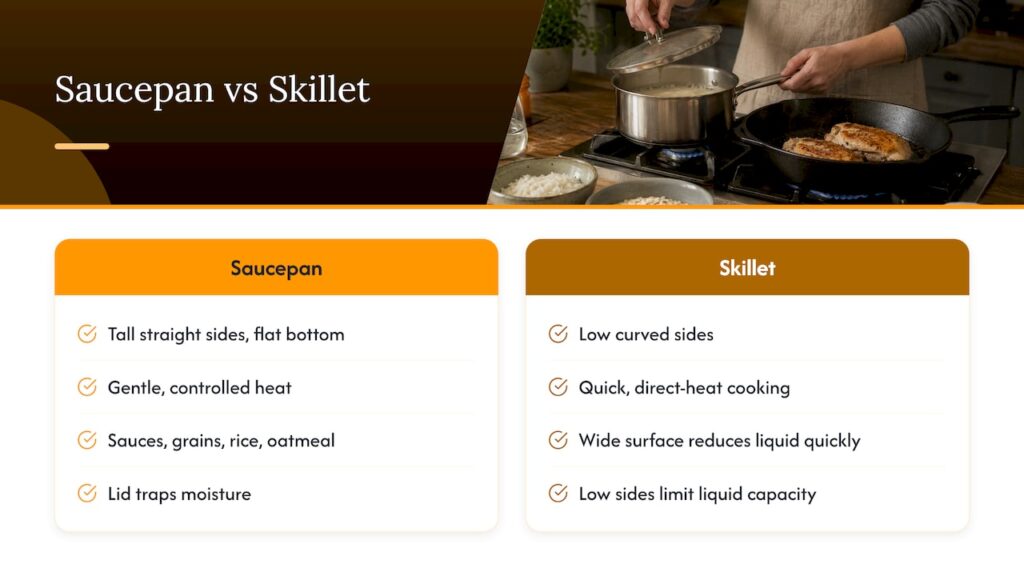
According to the AOL chef feature, a saucepan has tall straight sides, a flat bottom and a lid that traps moisture. It is designed for gentle, controlled heat: sauces, grains, rice, oatmeal and leftover soups. Frying pans and skillets have low curved sides for quick, direct-heat cooking.
Can you make a sauce in a skillet? Matijevich says, “Of course,” but the wide surface area means it reduces very quickly and can thicken or scorch without close attention. A saucepan is the better tool for liquid-based cooking. de Buyer’s guide agrees that for soups, deep sauces or liquid-heavy braises, a skillet’s low sides may not offer enough capacity, and a saucepan, sauté pan, stew pan or stockpot will usually fit better.
The food-service side of the guides says the same thing in different words. Webstaurantstore’s cookware guide describes saucepans as having tall sides and narrow bases that heat liquid from all sides, which promotes reduction. They come straight-sided (wider bottom, more heat conduction) or tapered (smaller bottom, flared sides, easier stirring).
A sauce built on a liquid base, such as a piquillo pepper sauce, is the kind of recipe where tall sides and a lid keep things under control. If you want to go further into the subtleties of sauce pans, I cover the tapered, rounded-corner version in Saucepan vs Saucier.
Saucepan sizes
The AOL chef gives a useful rule of thumb: 1 to 2 quart saucepans suit small-batch sauces, while 3 to 4 quart saucepans work better for grains, small pasta portions or blanching.
Side-by-side comparison
| Pan | Sides | Lid | Best for | Weak spot |
|---|---|---|---|---|
| Skillet | Sloped or flared, shallow | Rarely | Searing, eggs, sautéing, stovetop-to-oven | Large liquid volumes |
| Fry pan / frying pan | Sloped, often lower | Rarely | Fast frying, flipping, sliding food out | Large liquid volumes |
| Sauté pan | Straight, deeper | Usually | Pan sauces, braises, shallow frying | Harder to flip food by wrist |
| Saucepan | Tall, straight, narrow base | Usually | Sauces, grains, simmering, boiling | Poor for browning and searing |
The weak spot column is a matter of shape, not quality. Each pan does its own job well and the wrong job poorly.
Size: the spec that matters more than the name
Diameter decides whether food browns or steams. The AOL chef says 8-inch frying pans are ideal for eggs, pancakes and small sides, while 10 to 12 inch pans give ingredients more space and prevent steaming when searing. Viking says its skillets typically run 8 to 12 inches across.
A simple way to choose:
- 8 inches: one or two eggs, a small portion of sides, a single pancake.
- 10 inches: the all-rounder for one or two people.
- 12 inches: family-size searing, one-pan meals with a lid, batch cooking.
For a closer look at the three common sizes, see Frying Pan Sizes: 8, 10 and 12 Inches Compared. If you are buying a whole set, the Cookware Size Guide shows how pots, pans and Dutch ovens line up.
Material: what the pan is made of changes more than the shape
Made In’s cookware guide sorts pans by material: nonstick, stainless steel, carbon steel and cast iron, each suited to different jobs. Here is how the three most common ones differ in practice.
Cast iron. Made In’s cookware guide says a cast iron skillet handles hard searing, oven roasting, broiling and baking, moving from stovetop to oven. It is heavy and holds heat well. My Cast Iron Skillet Guide covers sizes, brands and care.
Stainless steel. Field Company describes stainless as more reactive to temperature changes and needing little maintenance, while cast iron retains heat better and can last generations. It lists price ranges of $50 to $200 for cast iron and $80 to $300 or more for stainless. Those are the maker’s own ranges, not a promise of what any one pan costs.
Nonstick. Thrillist recommends a nonstick skillet for flipping eggs, pancakes and crêpes and for releasing frittatas. If your cooking leans on delicate foods, my comparison of nonstick vs stainless steel walks through which fits which routine, and Ceramic vs Nonstick Cookware covers the coating question.
Field Company frames cast iron and stainless as complementary, and says most serious cooks end up with both. If you are weighing two iron-like options, Carbon Steel vs Cast Iron and Cast Iron vs Stainless Steel go into more detail.
Oven use
If you plan to start a steak on the stove and finish it in the oven, check the handle and lid first. My guide to whether cookware is oven safe shows how to read handles, lids and glass before you buy.
Can you cook eggs in a skillet?
Yes, and it is one of the classic skillet jobs. Martha Stewart’s site reports that Dan Bearss, a chef-instructor at the Auguste Escoffier School of Culinary Arts, says you can make many types of eggs in a well-seasoned cast iron pan. Eric Rowse of the Institute of Culinary Education recommends low to medium heat with constant movement for scrambles. He suggests a 5-inch skillet for two or three fried eggs and 8 or 10 inch skillets for frittatas or large batches.
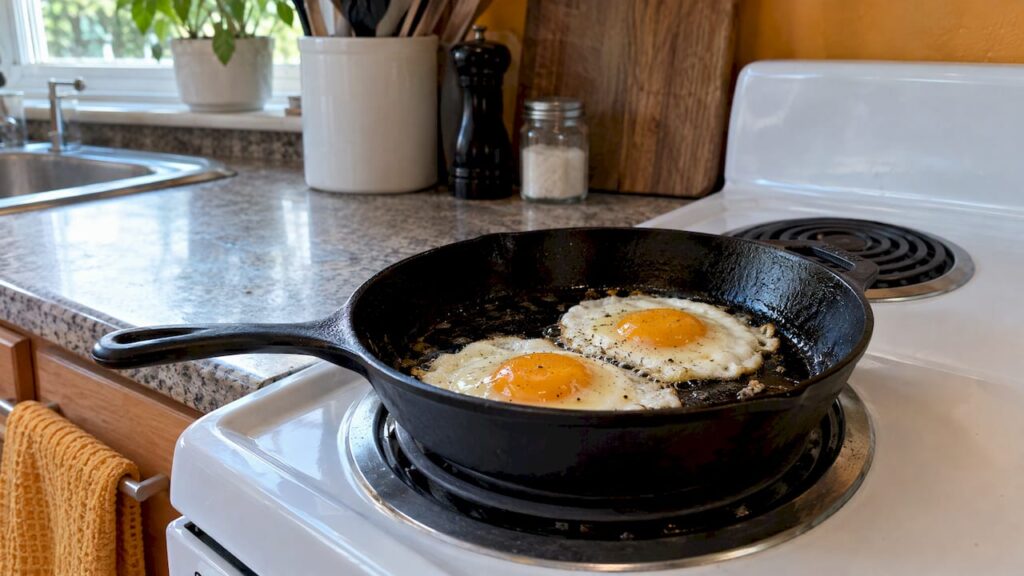
For flipping and sliding, Thrillist points to a nonstick skillet. The same piece suggests a 12-inch skillet with a lid for one-pan protein-and-rice meals, which is a good example of a skillet doing sauté-pan work when the quantity is modest.
Can you use a frying pan instead of a skillet?
In almost every home recipe, yes. They are the same pan under two names. Swap a sauté pan or saucepan in for a skillet and you change the result, because the sides and the surface area change how fast liquid reduces and how well food browns.
Which pan to buy, by reader
First-time buyers. Start with one 10 or 12 inch skillet or fry pan. It is the pan used for the largest share of everyday cooking, and Food & Wine calls a good skillet likely the most-used piece of cookware in your kitchen.
Budget-conscious cooks. Xtrema notes fry pans are among the most affordable cookware because of their simple construction. Put your money into the one pan you will use daily and add a saucepan next.
Gift shoppers. A 10 inch cast iron skillet, or a fry pan in a size that matches the recipient’s household, is a safe gift. If you are unsure about their stove or habits, a set with a skillet, saucepan and lid covers more ground. My kitchen essentials list shows what a new home needs.
Professional and serious home cooks. Made In’s recommended core set is a stainless steel or nonstick frying pan, a cast iron skillet, a stainless steel sauté pan, a saucepan and a stock pot. That covers searing, delicate eggs, liquid-based braises, sauces and large volumes with little overlap.
Compare the actual pans before you buy
When you have decided which shape you need, the next question is which specific pan. I put specifications and owner-reported complaints side by side in my cookware reviews and buying guides, including set reviews such as the NutriChef 18-piece nonstick set.
The usual sale timing for cookware is covered in When to Buy Air Fryers, Cookware and Espresso Machines. My links to retailers are affiliate links, explained on the affiliate disclosure page, and my approach to reviewing is on How I Review Kitchen Equipment.
My take on choosing a pan
I do not own or cook with the pans I write about. What I do is read the spec sheets, compare them line by line, and read what owners report after months of use. That is the lens I bring to this question.
The skillet versus fry pan argument is the least useful part of buying cookware. The names overlap, and the sources I read disagree with each other on the exact line. What decides whether you are happy with a pan is diameter, side height and material, and whether the shape fits the job.
My advice is to buy for the task you repeat most. If that is eggs and pancakes, look at a nonstick fry pan around 8 to 10 inches. If it is steaks and oven finishing, look at cast iron or stainless. If it is sauces and braises, a sauté pan or saucepan will serve you better than stretching a skillet.
Then read the owner complaints, not only the highlights. The weak points owners mention most often tell you more than any product name.
FAQ
Is a skillet the same as a frying pan?
For most cooks, yes. Both are flat-bottomed pans with sloped sides and a long handle, and many brands use the names interchangeably. When a distinction is made, a skillet tends to have slightly higher flared sides and is often cast iron, while a frying pan has lower sides and a wider surface.
What is the difference between a sauté pan and a frying pan?
A frying pan has sloped sides that let steam escape, which suits searing and browning. A sauté pan has tall, straight sides, more depth and often a lid, which suits sauces, braising and shallow frying. Pick the sauté pan when liquid is involved.
Can I use a saucepan instead of a skillet?
Not for browning or searing. A saucepan’s narrow base and tall sides are made for simmering and boiling, so food steams instead of crisping. Use it for sauces, grains and soups, and keep the skillet for direct-heat cooking.
What size skillet should I buy first?
A 10 or 12 inch pan covers most home cooking. An 8-inch pan suits eggs and pancakes, while a larger pan gives ingredients more space, which helps prevent steaming when you sear.
Sources
- Skillet Versus Fry Pan: What’s the Difference? (Viking Culinary)
- The 6 Essential Types of Pots and Pans (Food & Wine)
- Is It A Skillet Or A Frying Pan? (Xtrema)
- Skillet vs. Frying Pan vs. Sauté Pan (Imesh Kitchenware)
- Frying Pan vs Skillet vs Sauté Pan (GreenPan)
- Skillet vs. Pan (de Buyer USA)
- Are You Using Your Pans Correctly? (AOL)
- Different Types of Cookware (Webstaurantstore)
- The Guide to Cookware for an Adult Kitchen (Made In)
- Cast Iron vs. Stainless Steel (Field Company)
- Can You Cook Eggs in Cast Iron? (Martha Stewart)
- Skillet Tips & Recipes for Every Meal of the Day (Thrillist)
Recommended
- Frying Pan Sizes: 8, 10 and 12 Inches Compared
- Saucepan vs Saucier: Which Pan Do You Need?
- Cast Iron vs Stainless Steel: Which Pan for Which Job?
- Nonstick vs Stainless Steel: Which Pan Fits Your Cooking?

I'm Glenn, and I started Kitchenware Compare to cut through conflicting product reviews and help readers pick kitchen gear with confidence. I don't own or test the products I write about — these guides are built from verified-purchase reviews, manufacturer specifications, and independent testing where it exists, with the reasoning shown, not just a rating.
Leave a Reply