Choose stainless steel if you sear meat, build pan sauces and want a pan that can outlast a decade of use. Choose nonstick if most of your cooking is eggs, pancakes and delicate fish, and you want easy cleanup. Most kitchens do best with one of each, because the two surfaces are good at opposite jobs. I’ll walk through where each wins, where each fails, what the safety and heat-limit data say, and how to spend your money.
One note on how I work. I don’t claim to have cooked with any pan mentioned here. Everything below comes from manufacturer specs, owner reviews and the named sources I cite.
TL;DR
- Stainless steel is the better pan for searing, browning, fond and pan sauces, acidic dishes, and oven use. It lasts longest and tolerates high heat.
- Nonstick is the better pan for scrambled eggs, omelets, crepes and breaded fish, and it needs little oil and almost no scrubbing. The coating wears out, so plan on replacing it.
- Ceramic nonstick is a third option with a different coating. Owners often report the slick surface fading sooner than with traditional PTFE pans.
- Best value setup: one 10 or 12 inch stainless skillet plus one inexpensive 8 to 10 inch nonstick pan that you treat as a consumable.
Nonstick vs stainless steel at a glance
| Factor | Nonstick | Stainless steel |
|---|---|---|
| Best for | Eggs, pancakes, crepes, delicate fish | Searing, browning, pan sauces, boiling, simmering |
| Food release | Excellent when new, fades with wear | Needs correct preheating and some fat |
| Heat tolerance | Limited, roughly under 500°F for most coatings | Very high, often oven-safe well beyond that |
| Metal utensils | Avoid, they scratch the coating | Generally fine |
| Acidic foods | Fine for short cooking | Non-reactive, good for tomato sauce |
| Cleanup | Wipe or soft sponge | Soak, scrub, occasional restoration |
| Lifespan | Coating wears, replace when damaged | Can last for decades |
| Typical cost | Low entry price, recurring replacement | Higher upfront, lower over time |
What actually differs between the two surfaces
Stainless steel pans are metal all the way through the cooking surface. Good ones are clad, meaning an aluminum or copper core is sandwiched between steel layers to spread heat. The steel itself has no slick finish. Food releases because of heat, fat and technique.
Nonstick pans are usually aluminum or steel bodies with a polymer coating. The coating does the work, so the pan’s performance is only as good as the coating’s condition. That single fact explains almost everything else: why nonstick is forgiving to cook with, why it has a heat ceiling, why you can’t use metal tools on it, and why it eventually has to be replaced.
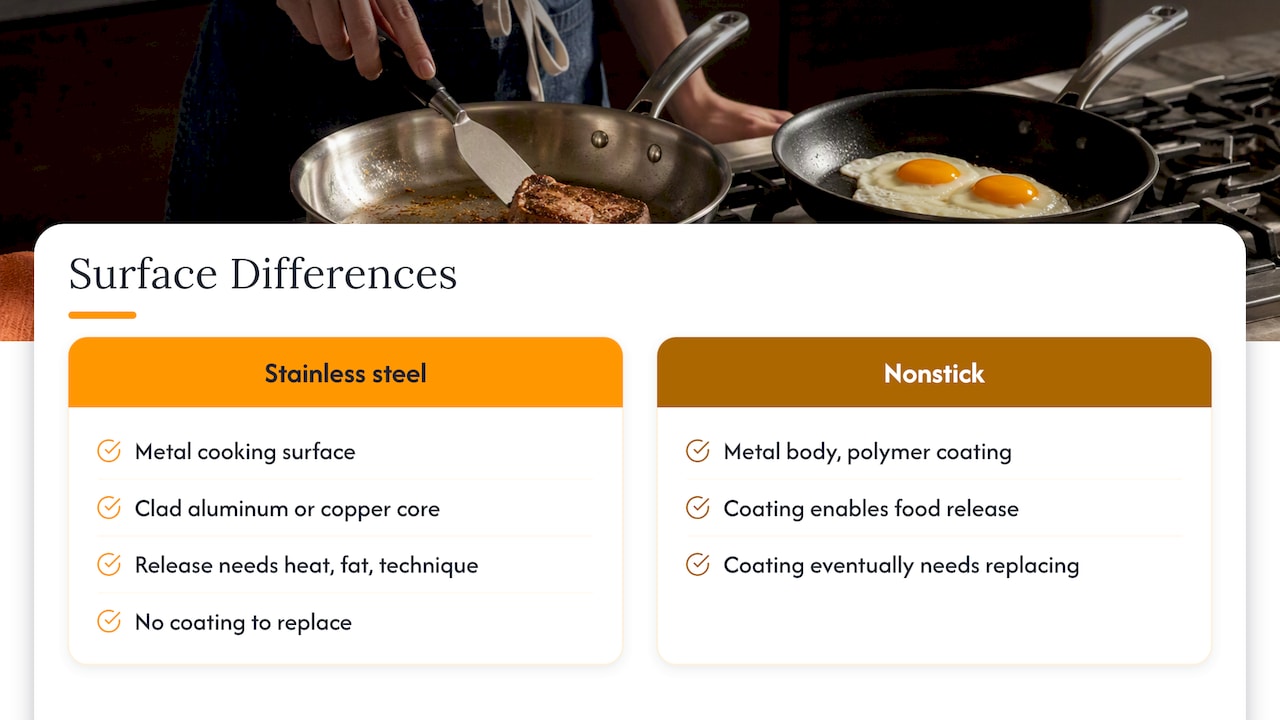
A practical consequence: with stainless, you are buying a tool. With nonstick, you are buying a tool with a use-by date. Neither is wrong, but you should budget for them differently.
When to use a nonstick pan
According to Martha Stewart’s cookware guide, nonstick suits delicate foods such as scrambled eggs and breaded fish. These foods share one trait: the proteins or coatings bond to bare metal and tear when you try to flip them.
Nonstick earns its place in these jobs:
- Eggs of every kind. Scrambled, fried over easy, omelets. If eggs are your daily breakfast, a nonstick pan is the pragmatic choice.
- Pancakes, crepes and French toast. Even browning with minimal fat, and a clean flip.
- Delicate fish fillets and breaded cutlets. The coating stays intact instead of sticking to the pan.
- Quick weeknight reheats. Leftover rice, stir-fried noodles and sticky sauces release cleanly.
If eggs are the main reason you are shopping, my roundup of the best nonstick pans compares five options on size, weight, coating type and owner-reported durability.
Where nonstick falls short
High heat is the enemy. According to a Yahoo Lifestyle report citing cookware experts, nonstick pans are not designed for cooking above about 480°F, prolonged high heat can make the coating peel or chip, and metal utensils can scratch it. That rules out hard searing, broiling in the oven at full blast, and preheating an empty pan on a high burner.
Nonstick also doesn’t build fond, the browned bits that become pan sauce. The surface is designed to prevent exactly that. If you want a steak with a crust and a red wine reduction, you are working against the pan.
When stainless steel is the better pan
The same Martha Stewart guide recommends stainless steel for browning proteins and for acidic foods such as tomato sauce. That matches how the material behaves. Steel tolerates heat that would damage a coating, and it doesn’t react with acid the way some bare metals do.
Reach for stainless when you are:
- Searing steak, chops, scallops or chicken thighs. You want a hard crust, which needs high heat and a surface that bonds a little before releasing.
- Making pan sauces. The fond left behind is the flavor base. Deglaze with wine or stock and you are done.
- Cooking acidic dishes. Tomato sauce, lemon-butter sauces and wine reductions.
- Moving from stovetop to oven. Many stainless skillets go straight into a hot oven, though you should check the maker’s stated limit, especially for handles and lids.
- Boiling and simmering. For pots, the material difference matters less, and stainless is simply durable.
For metal tools, my article on using metal utensils on stainless steel pans explains what is fine and what leaves cosmetic marks.
The learning curve: food sticks if you rush
The common complaint from new stainless owners is sticking. It is usually a heat and timing problem, not a defective pan. Epicurious advises preheating the pan over medium heat until the oil glistens, and notes that food releases once it has browned through the Maillard reaction. In practice, that means:
- Heat the dry pan over medium heat for a minute or two.
- Add your oil and let it shimmer.
- Add dry food. Pat meat and fish dry first, since surface moisture promotes sticking.
- Leave it alone. If it sticks when you try to turn it, it isn’t ready. Give it another 30 to 60 seconds.
Cold food straight from the fridge, a pan that is too hot, and constant poking are the three usual culprits.
Cleaning and cosmetic issues
Stainless is tougher to clean after a burned-on mess, but the surface survives scrubbing. Deglazing with hot water while the pan is still warm lifts most residue. If you see chalky marks after boiling water, that is often mineral deposits rather than damage, which I cover in white spots on stainless steel pans.
Ceramic vs stainless steel
Ceramic cookware comes up constantly in this comparison, so it needs its own section. Most ceramic pans are not solid ceramic. They are metal pans with a sol-gel ceramic-type nonstick coating. That puts them in the nonstick camp for how you use them, even though the chemistry differs from PTFE.
Here is how that plays out against stainless:
- Release: Ceramic is slick when new, which is why it is popular for eggs. Owners frequently report the surface losing slickness sooner than PTFE pans, particularly with high heat, cooking sprays and dishwasher cleaning.
- Heat: Ceramic is often marketed as tolerant of high heat, but sustained searing still stresses coatings. Stainless has no such limit.
- Durability: Both coatings can chip or dull. Stainless has no coating to lose.
- Utensils: Treat ceramic like any coated pan and use wood, silicone or nylon.
The real choice is between ceramic and PTFE nonstick, not ceramic and stainless. I compare the two coatings in ceramic vs nonstick cookware and go deeper on safety, heat limits and lifespan in ceramic vs Teflon pans.
Safety and temperature limits
Coating safety is the question readers worry about most, so here is what the regulator says and where the real risk sits.
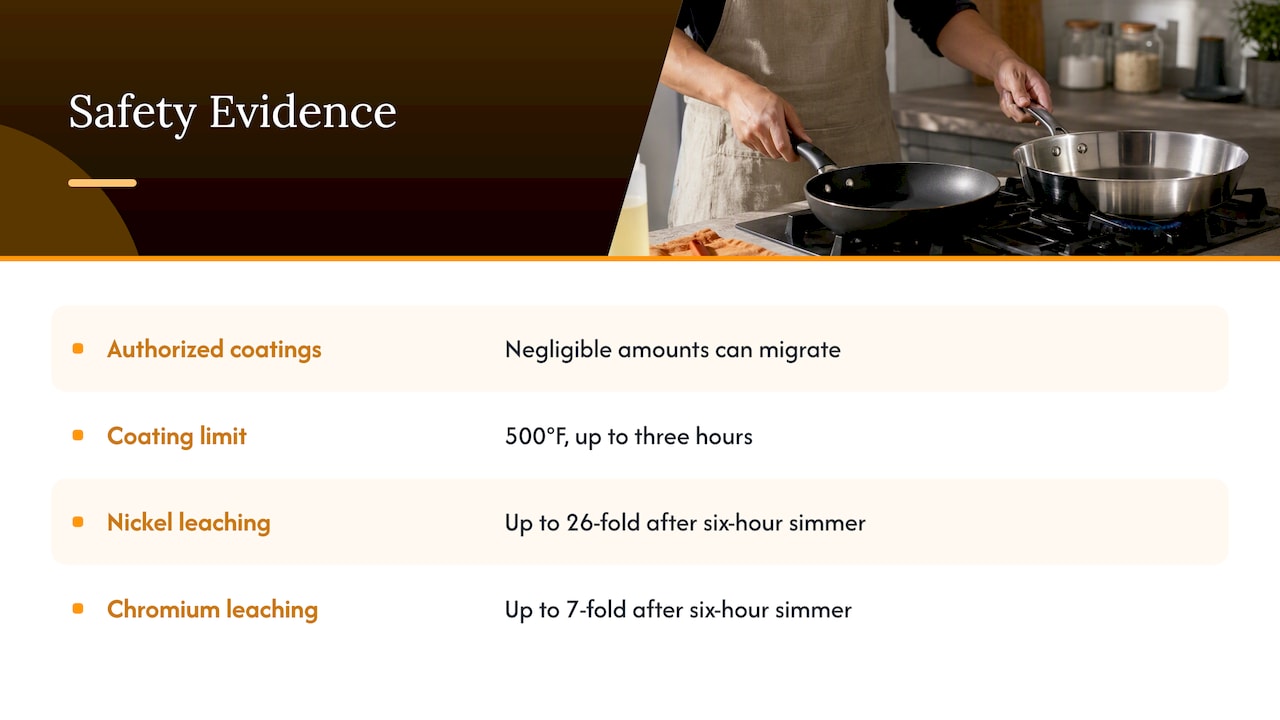
Nonstick coatings. According to the FDA’s page on authorized PFAS uses in food contact, the PFAS molecules in authorized nonstick coatings on pots and pans are polymerized and tightly bound to the cookware surface, and studies show negligible amounts can migrate into food. The practical risk is overheating and damage. The FDA’s inventory entry for food contact notification 1476 lists repeat-use food contact at temperatures up to 500°F for up to three hours, which is a useful reminder that coatings are rated to a ceiling.
So the sensible rules are the ones the cookware experts give: don’t preheat an empty nonstick pan on high, keep it off hard searing, avoid metal tools, and retire it once the surface is flaking. If you prefer to avoid fluoropolymers altogether, PFAS-free tableware options are worth browsing alongside your cookware decision.
Stainless steel. Steel has no coating to degrade, which is its appeal. It isn’t entirely inert, though. A peer-reviewed study on nickel and chromium leaching found that after six hours of simmering tomato sauce, nickel and chromium concentrations rose as much as 26-fold and 7-fold respectively, depending on the steel grade. That was a prolonged-cooking scenario. If you have a diagnosed nickel allergy, ask your doctor or allergist whether stainless is right for you, and consider cooking long acidic dishes in another material.
Durability and long-term value
The cost comparison turns on time. A stainless skillet costs more on day one and can stay in service for many years, because the failure modes are mostly cosmetic: discoloration, scratches, light warping if abused. A nonstick pan’s failure mode is functional. Once the coating is scratched, flaking or no longer releasing food, the pan has done its job.
Owners’ reviews of budget nonstick sets show the pattern consistently: the pans work well at first and decline with heat, dishwasher use and utensil damage. That is a feature of the category rather than a defect in one product. I don’t have a verified lifespan figure that applies to every brand, so treat any claim of a specific number of years as a rough guide only.
Here is a simple way to think about value:
- Stainless: Pay more once. Cost per year drops the longer you keep it.
- Premium nonstick: Costs more than budget nonstick, and owners tend to report better coating durability, but it still wears.
- Budget nonstick: Cheap enough to replace on a schedule. Make peace with that and you will never feel cheated.
My perspective
I read a lot of owner reviews, and the complaints are remarkably consistent. Nobody writes in angry about a stainless skillet being too durable. They write in because food stuck on the first use, and nine times out of ten the fix is patience with preheating. Nonstick complaints run the other way: the pan was wonderful for a while, then it wasn’t.
That tells me the argument is framed wrongly. The question isn’t which material is better. It is which jobs you do most often and which failure you can live with. If you can tolerate a learning curve, stainless rewards you for years. If you can’t tolerate scrubbing eggs off a pan at 7 a.m., a nonstick pan is the honest answer, and you should treat it as a consumable.
I am also skeptical of the “one pan to rule them all” pitch. Marketing language like “metal-utensil safe” or “lasts a lifetime” deserves a close look at the actual coating, the stated heat limit and the warranty terms. A pan that claims everything usually does one thing well. Compare spec sheets, read the one-star reviews first, and decide from there.
— Glenn
Which combination fits your cooking and budget
Different kitchens need different mixes. Use these as starting points.
Tight budget, first apartment
Buy one inexpensive 10 inch nonstick skillet for eggs and one stainless skillet or saucepan if you can afford it. If you can only afford one, think about what you cook most. Eggs and pancakes point to nonstick. Chicken thighs, burgers and pan sauces point to stainless. My kitchen essentials list for a new home covers what else to buy first.
Serious home cook
Get a 12 inch clad stainless skillet, a stainless saucepan and sauté pan, and a small nonstick pan reserved for eggs. If you also like high-heat, long-lived pans, compare stainless with cast iron, which is a different trade-off again.
Gift shopper
A small stainless skillet plus a quality nonstick pan makes a more useful gift than a giant boxed set. Sets often include pieces the recipient will never use. Check my cookware reviews and buying guides for options by price.
Concerned about coatings
If you want to avoid coatings, lean on stainless, and look at carbon steel or cast iron for eggs and searing. Carbon steel vs cast iron explains how they differ. You can also read about titanium cookware labels before buying anything marketed that way.
Where I can help you decide
If you are comparing specific pans, I lay out specs, prices, owner-reported strengths and owner-reported complaints side by side, with no brand pushing me toward a verdict. Start with the Kitchenware Compare cookware hub, or browse the homepage for current deals. If you click a retailer link from my pages, I may earn a commission, at no extra cost to you.
FAQ
Is stainless steel better than nonstick?
Neither is better across the board. Stainless is better for searing, pan sauces, acidic dishes and long-term durability. Nonstick is better for eggs, pancakes and delicate fish, and for easy cleanup. Most cooks end up using both.
Why does food stick to my stainless steel pan?
Usually the pan wasn’t hot enough or the food was too wet or too cold. Epicurious recommends preheating over medium heat until the oil glistens, then letting food brown until it releases on its own. Pat proteins dry, and don’t flip too early.
How hot can a nonstick pan get?
Most coatings are rated below 500°F, and one cookware report puts the practical ceiling for nonstick at about 480°F. Don’t preheat an empty pan on high or use it for hard searing. Always check the limit printed by your pan’s maker.
Is ceramic better than stainless steel?
They solve different problems. Ceramic is a nonstick coating on a metal pan, so it behaves like other nonstick pans: easy release at first, then a coating that gradually wears. Stainless has no coating and handles higher heat, so it suits searing and long use.
Sources
- How to Choose Between Nonstick, Cast-Iron, and Stainless Steel Cookware, Martha Stewart
- 6 Things You Should Never Use Nonstick Pans For, Yahoo Lifestyle
- How to Move On From Nonstick Pans, Epicurious
- Authorized Uses of PFAS in Food Contact Applications, FDA
- Inventory of Effective Food Contact Substance Notifications, FCN 1476, FDA
- Stainless Steel Leaches Nickel and Chromium into Foods During Cooking, ResearchGate
Recommended
- Cast Iron vs Stainless Steel: Which Pan for Which Job?
- Ceramic vs Nonstick Cookware: Which to Buy in 2026?
- Best Non-Stick Pans 2026: 5 Picks Compared
- Ceramic vs Teflon Pans: Safety, Heat Limits and Lifespan

I'm Glenn, and I started Kitchenware Compare to cut through conflicting product reviews and help readers pick kitchen gear with confidence. I don't own or test the products I write about — these guides are built from verified-purchase reviews, manufacturer specifications, and independent testing where it exists, with the reasoning shown, not just a rating.
Leave a Reply