This guide has no affiliate links, but some pages it links to do. If you buy through those, I may earn a commission at no extra cost to you.
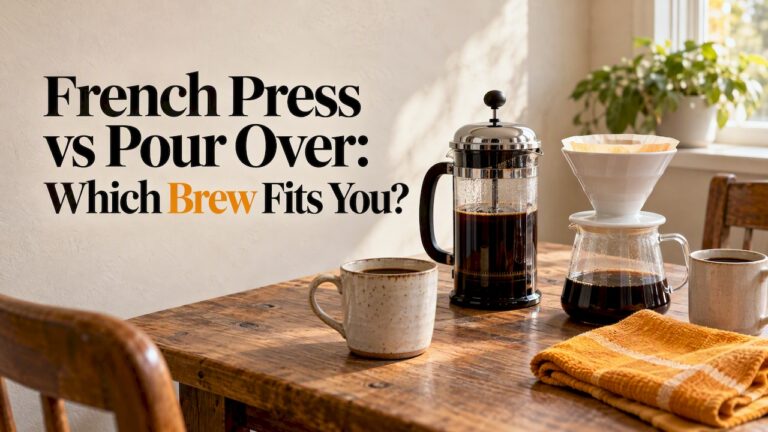
French press gives you a heavier, rounder cup with very little technique. Pour over gives you a cleaner, brighter cup, but it asks for your attention and a paper filter every time. If you want coffee that is forgiving and full-bodied, buy the press. If you want to taste the differences between origins and you don’t mind standing at the kettle for a few minutes, buy the pour-over cone. I don’t own or use either brewer for this comparison. Everything below rests on brewing specs, published research and what owners report, and I attribute each finding to its source.
TL;DR
- French press is immersion brewing with a metal filter: heavier body, more oils, some sediment, forgiving technique, messier cleanup.
- Pour over is drip extraction through a paper filter: cleaner, brighter, lighter body, more control, more attention, easier cleanup.
- Cost: a press needs no recurring filters. Paper filters are single-use, and Fellow gives $5 for a box of 100 as a typical figure.
- Health: unfiltered coffee carries cafestol, which raises LDL cholesterol in studies. Paper filtering removes it, so anyone watching cholesterol should lean toward pour over.
- Pick by habit: one big pot you can walk away from means French press. One careful mug at a time means pour over.
How the two methods actually differ
The real split is immersion versus drip. A 2025 peer-reviewed review in Beverages describes French press as hot water and grounds resting together for typically 2 to 5 minutes before a metal filter is pressed down, while filter coffee passes hot water through the grounds and a paper filter. KitchenAid’s US guide makes the same distinction in plain terms: pour over is drip extraction and French press is immersion extraction, and the press plunger uses a fine metal mesh rather than paper.
Two variables follow from that:
- Contact time. In a press, every ground sits in the water for the whole steep. In a pour-over cone, water moves through the bed, so the pour rate and grind size set how long it stays in contact.
- Filtration. Metal mesh lets oils and fine particles through. Paper traps most of them.
Nearly every difference in the cup, the cleanup and the health debate comes from those two facts. For a deeper look at how steeping and percolation change intensity, clarity and sediment, this breakdown of immersion versus percolation brewing is worth a few minutes.
Taste, body and clarity
This is where most readers decide, and the basic point is simple: the difference is largely texture. If you like more mouthfeel, the press delivers it.
According to KitchenAid US, French press is more intense and grittier because it lacks paper filtration. The same page describes pour over as lighter and cleaner than French press, calls its flavor crisp, vibrant and nuanced, and rates it more robust and flavorful than traditional drip.
Here is how I would translate that into what you taste:
| French press | Pour over | |
|---|---|---|
| Body | Heavy, round, syrupy | Light, tea-like |
| Clarity | Softer, flavors blend | Sharp, flavors separate |
| Sediment | Some silt at the bottom of the cup | Almost none |
| Best with | Medium to dark roasts, chocolatey or nutty beans | Light to medium roasts, fruity or floral beans |
| Flaw to watch for | Bitter, muddy cup if the grind is too fine | Sour or hollow cup if the pour is rushed |
The roast pairing is my own reading of how each filter behaves, not a measured result. A bright Ethiopian coffee can taste muddled in a press, because oils and fines blur the high notes. A dark, roasty blend can taste thin in a cone, because paper strips some of the weight that people like in those beans. If you mostly buy dark roasts, my guide to the best coffee for French press covers which beans hold up to immersion.
Effort and technique
The French press is passive. Backpacking Light’s method comparison explains that French press is a passive immersion brew, while pour over needs an active, controlled pour. That is the main practical difference.
French press routine
Both methods start with weighing coffee, heating water and grinding beans. A press then goes like this:
- Add coarse grounds to the empty carafe.
- Pour in hot water and stir gently.
- Set a timer, usually in the 2 to 5 minute range the Beverages review describes.
- Press the plunger down slowly and pour right away.
Pour right away because coffee left on the spent grounds keeps extracting and turns harsh. Coarse, press-style grounds also suit cold brew, as this home-recipe comparison of brewing steps shows for a New Orleans-style concentrate steeped at room temperature and strained through mesh, then paper.
Pour over routine
Penstock Coffee Roasters’ brew guides show that pour over adds rinsing a paper filter, blooming and several timed pours on top of the shared steps. In practice:
- Rinse the filter with hot water to remove paper taste and preheat the brewer.
- Add medium-fine grounds and level the bed.
- Pour a small amount of water to bloom the coffee, then wait.
- Pour the rest in slow circles or stages until you hit your target weight.
It takes several minutes of your full attention. KitchenAid’s page says the same in milder terms: pour over takes a little longer and the process is more meticulous. On a rushed weekday that is the real cost, more than the gear price.
Grind and ratio
Grind is the biggest lever for both. A press wants a coarse grind, because a mesh filter will pass fine particles into your cup and a long steep will over-extract them. A cone wants a medium to medium-fine grind so the water flows at a steady pace. A burr grinder helps either method, since blade grinders produce a mix of dust and boulders. The National Coffee Association points US readers to its About Coffee brewing guides for method-specific instructions on drip, pour over and French press, and I suggest starting there for ratios and timing.
Cleanup and ongoing costs
Press owners complain about cleanup more than anything else. The National Coffee Association says a French press should be cleaned after every use, including disassembling and washing the filter, because leftover grounds and coffee oil can make the next cup taste bitter. Backpacking Light rates press cleanup as messy and pour over with disposable filters as easy.
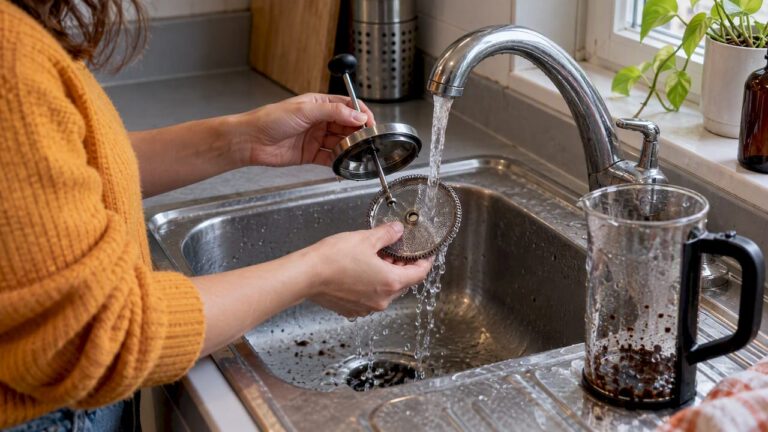
Fellow’s comparison of filter types says the paper-filter routine is simple: fold the used filter and grounds together and throw them out. Reusable metal filters need rinsing after every use and an occasional deeper clean.
There is a trade, though. Paper filters are single-use and have to be restocked. Fellow’s page gives $5 for a box of 100 as a typical figure, which works out to about five cents a cup. A standard press has no recurring filter cost, but the plunger mesh and gasket eventually wear out. One practical point: tip the grounds into a compost bin or a strainer, not down the sink, because they clog drains.
| French press | Pour over | |
|---|---|---|
| Upfront gear | Press, kettle, grinder | Cone, server or mug, kettle, grinder (a gooseneck kettle helps) |
| Recurring supplies | None for the filter | Paper filters |
| Cleanup | Disassemble and rinse the mesh, messy | Toss the filter and rinse the cone, easy |
| Batch size | Several cups at once | Usually one to two mugs per pour |
Owner complaints matter as much as specs. For presses, check reviews for silty cups, a hard-to-clean plunger and glass breakage. My roundup of the best French press coffee makers goes through carafe materials and plunger design with those complaints in mind.
The downsides of a French press
People ask directly about this one, so here it is without the sales pitch:
- Sediment. Even with a good grind, you will get some silt in the last sip. Pouring slowly and leaving the last bit behind helps.
- Over-extraction if you wait. The grounds stay in contact until you pour out. A press left sitting turns bitter.
- Heat loss. A thin glass carafe cools quickly. Insulated steel presses fix that, at a higher price.
- Cleanup. See above. It is the top annoyance.
- Cholesterol. Covered next.
Pour over has downsides too: more gear, a learning curve, small batches, and the paper-filter habit. It is also less forgiving. A slightly off pour can give you a weak, sour cup.
Is French press less healthy?
There is one health point worth taking seriously. A controlled trial in the American Journal of Clinical Nutrition (Urgert and colleagues, 1997) describes cafestol as a compound present in unfiltered coffee brews that raises serum cholesterol, LDL cholesterol and triacylglycerols, with effects that rise with the dose. An earlier paper from the same Wageningen group found that these compounds travel in oil droplets and floating fines, and it measured fines in French press coffee. A paper filter traps both, which is why paper-filtered coffee is the usual choice for anyone watching cholesterol.
Two cautions follow. First, the trial doses were large: 10 men took 61 to 64 mg of pure cafestol a day for 28 days. Second, I am a product reviewer, not a clinician. If you have high cholesterol, heart disease or take a statin, ask your doctor which brew method suits you. If you drink several cups a day from a press, paper-filtered coffee is the conservative choice. A single press mug now and then is a different situation from a daily pot.
Pour over vs drip machine
Many readers are really choosing between a cone and an automatic brewer. Both use paper filters and both extract by drip, so the cup is similar in character: clean and light. KitchenAid US says pour over accessories generally need only a rinse after each use, while automatic machines need more frequent cleaning and descaling, with monthly as a practical schedule.
The trade is control for convenience:
- Pour over lets you change water temperature, pour speed and bloom time. It costs you time and consistency from day to day, because your pouring hand varies.
- Automatic drip repeats the same brew with one button and can make a full pot. It gives you fewer settings and less nuance.
I wrote this up separately in pour over vs drip coffee: control or convenience. For readers weighing machines against each other, the comparison of single-serve and drip coffee makers covers taste, cost and waste.
Which one should you buy?
Use these criteria and ignore the hype:
- How do you drink coffee? A full pot for two people, or a mug you can drink slowly while it cools, suits a press. One careful cup suits a cone.
- How much time do you have? If mornings are chaotic, immersion wins, since you can walk away during the steep.
- What beans do you buy? Dark and medium roasts do well in a press. Light, fruity and floral beans show more through paper.
- How do you feel about cleanup? If you hate washing a plunger, a cone and a filter box is easier.
- Do you watch cholesterol? Choose paper-filtered coffee, and check with your doctor.
- How tight is your budget? Both are cheap to start. The press avoids ongoing filter cost, while the cone needs about five cents of paper per cup.
Some households end up with both: a press for lazy weekends and guests, and a cone for weekday single cups. If you already use a press, I also have a walkthrough on making espresso-style coffee with a French press.
My perspective
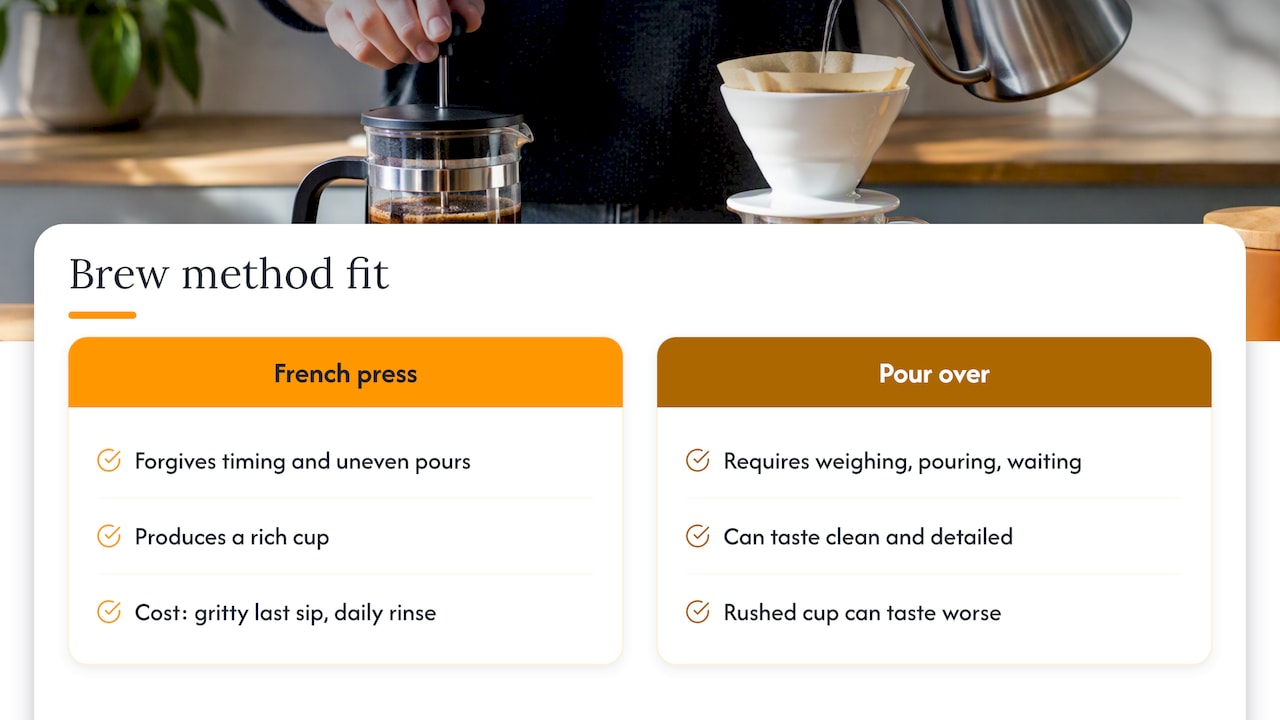
I see French press versus pour over as a question about the person, not the coffee. The press is a tolerant tool. It forgives sloppy timing and uneven pours, and it produces something people describe as rich. Its cost is a gritty last sip and the daily rinse. The cone rewards care. It can taste cleaner and more detailed, but only if you are willing to weigh, pour and wait, and a rushed cup can taste worse than a press would.
Disappointment with either brewer often comes less from the method than from a mismatch between the method and the buyer’s habits: someone who wants a quick pot buys a cone and quits within weeks, or someone who loves clean, bright coffee buys a press and never likes the silt. That is why I put routine ahead of specs. I have not used either brewer for this piece, and I say so because the verdict rests on published research and on what owners report, not on my own cups. You can read how I handle evidence on my page about how I review kitchen equipment.
Where to go next
If you have decided on a press, I rank models by carafe material, plunger design and owner complaints in my French press coffee maker buying guide. For the rest of the brewing category, from cold brew to espresso, browse the coffee equipment reviews and guides on Kitchenware Compare.
FAQ
Which is better, a pour over or a French press?
Neither wins outright. Pour over gives a cleaner, brighter, lighter cup and more control, while French press gives a heavier body with less technique. Choose a press for convenience and richness, and pour over for clarity and for tasting differences between beans.
Do you just put coffee grounds in a French press?
Yes, you add coarse grounds to the empty carafe, then pour in hot water, steep and press the plunger down. The grind size matters. Too fine and silt slips through the mesh and the coffee over-extracts. Pour out right after pressing so the coffee does not keep steeping.
Which is healthier, French press or drip coffee?
Paper-filtered coffee, including drip and pour over, is the lower-risk choice for cholesterol. Research in the American Journal of Clinical Nutrition reports that unfiltered brews such as French press contain cafestol, which raises LDL cholesterol, and paper retains it. If you have high cholesterol, ask your doctor before settling on a daily brew method.
Is pour over harder than French press?
Yes, for most beginners. Pour over needs a controlled pour, timing and a medium-fine grind, so small mistakes show up in the cup. A French press tolerates sloppy technique, as long as you grind coarse and watch the steep time.
Sources
- The Impact of Brewing Methods on the Quality of a Cup of Coffee, Beverages (2025)
- Drip vs pour over coffee, KitchenAid US
- How to Make Coffee in the Backcountry: Gear and Methods, Backpacking Light
- Brew Guides by Method, Penstock Coffee Roasters
- About Coffee, National Coffee Association
- French press coffee, NCA About Coffee
- Paper vs. Metal, Fellow
- Separate effects of the coffee diterpenes cafestol and kahweol on serum lipids and liver aminotransferases, American Journal of Clinical Nutrition (1997), PubMed
- Effects of cafestol and kahweol from coffee grounds on serum lipids and serum liver enzymes in humans, American Journal of Clinical Nutrition (1995), PubMed
Recommended
- Pour Over vs Drip Coffee: Control or Convenience?
- Best Coffee for French Press
- Best French Press Coffee Maker: Reviews + Buying Guide
- Espresso Machine vs Coffee Maker: Which One Fits Your Routine?

I'm Glenn, and I started Kitchenware Compare to cut through conflicting product reviews and help readers pick kitchen gear with confidence. I don't own or test the products I write about — these guides are built from verified-purchase reviews, manufacturer specifications, and independent testing where it exists, with the reasoning shown, not just a rating.
Leave a Reply