This guide has no affiliate links, but some pages it links to do. If you buy through those, I may earn a commission at no extra cost to you.

A food processor can make dough, and for pie crust, pizza dough and small batches of bread it can be faster than any other method. It has limits. Capacity is small, wet doughs are awkward, and the motor takes more strain than the manual suggests. I don’t own or test any of the machines I write about, so everything below comes from manufacturer specs, owner reviews and the named sources I cite, and I say where each claim comes from.
TL;DR
- A food processor is a strong choice for pastry, pie dough, pizza dough and small bread batches. A stand mixer is the better tool for large, sticky or enriched bread dough.
- According to KitchenAid’s guide, the metal blade forms gluten quickly, but it needs close watching to avoid over-kneading.
- Keep batches small. Cooking Manager suggests beginners start with 2 to 3 cups of flour (up to 500 grams).
- Motor wattage matters for stiff doughs like bagels. A low-powered machine is the usual weak point.
- If the motor cuts out mid-knead, turn the power off and unplug it before you do anything else.
Can a food processor really knead dough?
Yes. Wirecutter lists kneading dough among the jobs a food processor can speed up, alongside dicing nuts, ricing cauliflower and chopping vegetables. KitchenAid says breads, pastries, pasta and pie crusts can all be made in one, and that results are similar to other dough-making methods.
The mechanism is different from a mixer’s, though. A dough hook pushes, folds and stretches the dough slowly. A processor blade spins at high speed, and the dough is thrown around the bowl and sheared. KitchenAid’s kneading guide puts it at 30 seconds to a minute, and its mixer comparison says “a minute or two.” That speed is the whole appeal, and it is also the risk: the window between “kneaded” and “overworked” is narrow.
Which doughs suit a food processor
Not every dough is a good fit. Here is how the main types sort out, based on the sources I’ve read and on how the machines are built.
| Dough | Food processor | Notes |
|---|---|---|
| Pie crust and tart dough | Excellent | Short pulses keep the fat cold and the gluten low. |
| Pizza dough | Very good | Fits in one batch; mind the hydration. |
| Basic sandwich or lean bread dough | Good in small batches | Stay within the bowl’s rated flour capacity. |
| Pasta dough | Good | Comes together fast in the bowl. |
| Bagel or other stiff dough | Depends on motor | Allrecipes warns that a 450-watt model may struggle. |
| Very wet dough (ciabatta, high-hydration sourdough) | Poor | Better in a mixer or by hand with folds. |
| Heavy enriched dough (brioche, large batches) | Poor | Butter, eggs and volume overload the bowl and the motor. |
KitchenAid’s own comparison page is more even-handed than a simple split. It calls the choice mostly a matter of preference, gives the food processor a slight edge for speed and weeknight pizza dough, and points to a stand mixer when you are making several loaves at once. For pastry it says either machine works, with some bakers finding the processor more efficient at cutting butter into flour. You can read the full comparison in its food processor vs. stand mixer article.
Metal blade or plastic dough blade?
This is where sources disagree, so it is worth slowing down.
Many processors ship with a plastic dough blade, and KitchenAid’s own two pages pull in different directions. Its mixer comparison says some bakers prefer the metal blade because it slices through dough quickly, which helps keep the dough from overheating. Its kneading guide says the opposite about heat: the metal blade forms gluten faster, but its speed creates heat that can kill the yeast if you knead too long, while the dull plastic blade turns and pulls the dough, takes a little longer and is less likely to overheat it. If you use the metal blade, the guide says to cut the knead time by a third and watch the dough closely.
Cooking Manager sides with the plastic blade: its author recommends it for any kind of dough or batter and says a previous machine was ruined by using the metal blade for pasta. The Hops Trains and Backpacks guide, citing Bread Illustrated, goes the other way and suggests the metal blade, because the dough attachment does not reach the edge of the bowl.
Here is how I read the disagreement:
- Check your manual first. If the manufacturer says to use the plastic blade for dough, that is the safe default, and it protects your warranty.
- Plastic is gentler on the dough. KitchenAid describes it as turning and pulling the dough rather than cutting it, so it is less likely to overheat.
- Metal works fast, so it punishes inattention. If you use it, stop early and check the dough by hand every 10 to 15 seconds.
- Dull metal blades do a worse job. If yours is tired, see my guide on how to sharpen food processor blades before you blame the machine.
How much dough can it handle?
Bowl size sets the real limit. KitchenAid says an average 10- or 12-cup processor makes about 1.5 pounds of dough, a recipe with 2 or 3 cups of flour, or roughly one loaf. Cooking Manager advises beginners to start with a recipe using 2 to 3 cups of flour, up to 500 grams or about a pound. That is roughly one loaf or a single large pizza.
The manufacturer’s rated flour capacity matters more than the headline “cup” number. A 14-cup bowl measures liquid or chopped vegetables to the brim. Dough needs headroom, and it climbs the central pole. If you plan to bake bread regularly, check the manual for a stated maximum flour weight and stay below it. My sizing guide for food processors explains how bowl capacity translates into real batches.
Motor power and heat
Kneading is the hardest job most home processors ever do. Allrecipes, in its roundup of the best food processors, notes that one large budget model at 450 watts is not as powerful as the competition and may not be the best pick for dense bagel dough. That is a useful marker: for stiff doughs, look for a stronger motor, and for soft pizza or sandwich dough, a modest one is likely to do.
Heat is the other issue. Fast blades warm the dough, and warm dough ferments unpredictably and turns gummy. Using cold water helps. So does kneading in short bursts and letting the machine rest.
If the motor shuts off from overheating, Cooking Manager gives advice worth following to the letter: turn off the power, because otherwise the machine could start again once it cools, with nobody nearby, and bounce off the counter. Unplug it, let it cool, and wait before resuming. If the machine won’t start again afterward, my page on a food processor that won’t turn on covers the lid and bowl interlock, which is the most common non-fault cause.
How to knead bread dough in a food processor
This method works for a standard lean dough of about 2 to 3 cups of flour.
- Fit the blade. Use the blade your manual recommends for dough. If you go with metal, stay at the machine.
- Add dry ingredients first. Flour, salt and yeast go in the bowl. Pulse a few times to combine.
- Pour liquid through the feed tube. Use water at a cool or lukewarm temperature, adding it in a steady stream with the motor running.
- Watch for a ball. The dough should gather into a mass that cleans the sides of the bowl. If it is sticky and smears, add flour a spoonful at a time. If it crumbles, add water a teaspoon at a time.
- Knead briefly. Stop after about a minute of kneading and test the dough by hand. It should feel smooth and slightly tacky, not stiff.
- Finish by hand. Turn it out and give it a few folds. This also lets you feel whether the gluten has formed.
- Rest and proof as usual.
The hydration point is worth repeating. The blog Hops Trains and Backpacks, summarizing guidance from Bread Illustrated, notes that dough above 75 percent hydration gets very sticky, and that book recommends a mixer for those doughs so you can stay hands-off while the hook turns them into something manageable. The full guide to kneading with a food processor is worth a read if you want the numbers.
Dividing and shaping afterward
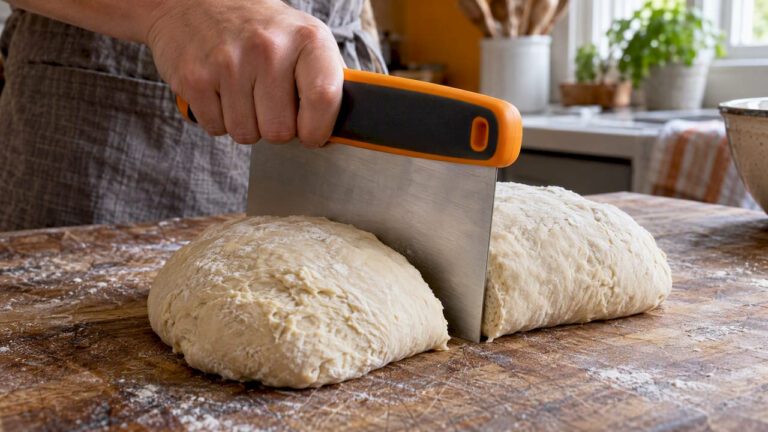
Once the dough is out of the bowl, the next job is portioning it cleanly. A flat, wide blade does this better than a chef’s knife, which tends to drag and compress the dough. A pizza and dough knife is a stainless steel tool with a soft-touch handle, made for exactly this kind of cutting and for slicing the baked pizza as well.
Pastry and pie dough: where the processor wins
For pastry, the processor is hard to beat. The goal is the opposite of bread: you want as little gluten as possible and cold fat in small pieces. The metal blade and short pulses do that in seconds, and a warm hand never touches the dough.
A practical sequence:
- Chill the butter and cut it into cubes.
- Pulse the flour, salt and butter until the mixture looks like coarse crumbs with some pea-sized pieces.
- Add ice water a tablespoon at a time, pulsing until the dough just holds when pinched.
- Press into a disk, wrap and chill before rolling.
The metal blade is the standard answer to the common question of which blade to use for pastry. It is the same blade you use for chopping. Stop as soon as the dough clumps, because over-processing makes the crust tough.
Food processor vs. stand mixer: which should you pick?
People ask this in several forms: mixer or food processor, stand mixer vs. food processor, food processor vs. mixer. The honest answer depends on what you bake.
| Factor | Food processor | Stand mixer |
|---|---|---|
| Speed | A minute or two | Several minutes |
| Batch size | Small (about 2 to 3 cups of flour) | Larger, depending on bowl and motor |
| Wet, sticky dough | Awkward | Better suited |
| Pastry and pie dough | Best | Fine, but slower |
| Gluten development | Fast, easy to overshoot | Gradual, easier to judge |
| Other uses | Chopping, slicing, shredding, purees | Whipping, mixing, attachments |
| Cleanup | Bowl, lid, blade | Bowl, hook |
KitchenAid’s guidance on mixers adds a useful tell: with a mixer, knead until the dough clears the sides of the bowl, and if it starts to climb the hook, it is over-kneaded. A processor gives you no such visible cue, which is why the hands-on check matters.
My view: if you bake bread every week, a mixer is the more forgiving tool, and I compare four options in my guide to the best stand mixer for bread dough. If you bake bread occasionally and also want something that chops, shreds and handles pie crust, a processor gives you more range for the money. Two head-to-heads cover the mixer side: Bosch Universal Plus vs. KitchenAid Artisan and Cuisinart SM-50 vs. KitchenAid Artisan.
What to look for when buying a food processor for dough
If dough is a priority, these are the features I’d weigh, in order:
- Motor power. Dense doughs need a strong motor. A lower-wattage model is fine for pizza and pie crust but is more likely to struggle with bagels, according to Allrecipes.
- A stated flour capacity. Manufacturers that say how much flour the bowl can take are telling you where the limit is.
- A dough blade and a metal blade in the box. Having both gives you the choice discussed above.
- A sturdy, wide base. Dough makes machines walk. A heavy base, or one with suction feet, helps.
- Thermal protection. An overload cutoff protects the motor, though as noted above it means you must unplug the machine when it trips.
- Easy cleaning. Dough sticks. Parts that come apart and go in the dishwasher save time; my cleaning guide for food processors shows how to handle the gummy residue.
Wirecutter’s long-running top pick is a 14-cup Cuisinart model, covered in its review of that machine. Wirecutter describes a great processor as one that slices, chops and shreds efficiently, and mentions kneading among the chores it handles. For my own shortlist across budgets, see best food processor picks.
My perspective
I have a simple bias about dough: the right machine is the one that matches your most frequent bake, not your most ambitious one. Most people who ask about a food processor for dough want pizza on a weeknight, or a loaf now and then, and the processor does that well. The trouble starts when someone buys a processor expecting it to replace a mixer for a double batch of brioche.
I also read owner reviews with a skeptical eye. Reviews praising a dough function usually describe one loaf or one pizza. Reviews complaining about it usually describe heavy or wet dough, or a motor that shut off mid-knead. Both can be true of the same machine, so I look for the batch size and dough type in each review before I weigh the verdict.
And I’d rather you ignore a feature than buy for it. A “dough blade” in the box tells you little. The motor, the bowl, and the manual’s stated flour limit tell you much more. I don’t test products myself, and my review methodology explains how I build comparisons from specs, owner feedback and cited sources.
Where to compare processors, mixers and baking gear
If you are choosing between machines, start with the food processor reviews and buying guides, or browse baking equipment, mixers and bakeware if bread is the main goal.
FAQ
Can I use a food processor instead of a stand mixer for bread dough?
For small batches of lean dough, yes. Stay within the bowl’s rated flour capacity, and check the dough by hand frequently. For very wet, enriched or large doughs, a stand mixer is the more forgiving tool, and the processor can strain its motor.
What blade do I use to make pastry in a food processor?
Use the standard metal blade with short pulses. It cuts cold butter into the flour quickly without warming it. Stop as soon as the dough begins to clump, because too much processing makes the crust tough.
How long should I knead dough in a food processor?
According to KitchenAid, dough comes together in only a minute or two because of the high speed. I would stop around the one-minute mark and check by hand. The dough should feel smooth and slightly tacky. If it feels dense and tight, it has gone too far.
What should I do if the motor stops while kneading?
Turn the power off right away and unplug the machine. Cooking Manager warns that a machine left switched on can restart after the motor cools and may jump around the counter. Let it cool fully before you resume.
Is a food processor or a blender better for dough?
A food processor, by a wide margin. Blenders are built for liquids and have no way to move a stiff mass around. My explainer on food processor vs. blender covers the differences.
Sources
- How to knead dough in a food processor, KitchenAid
- Food processor vs. stand mixer for dough, KitchenAid
- 11 Food Processor Tips for Bakers, Cooking Manager
- A guide to kneading dough with a food processor, Hops Trains and Backpacks
- The 4 Best Food Processors of 2026, Wirecutter
- Cuisinart Custom 14-Cup Food Processor review, Wirecutter
- The 8 Best Food Processors for Any Kitchen, Allrecipes
Recommended
- Food Processor Reviews & Buying Guides
- How to Clean a Food Processor: Full Guide
- Best Food Processor: 5 Picks for Every Budget
- Best Stand Mixer for Bread Dough: 4 Picks Compared

I'm Glenn, and I started Kitchenware Compare to cut through conflicting product reviews and help readers pick kitchen gear with confidence. I don't own or test the products I write about — these guides are built from verified-purchase reviews, manufacturer specifications, and independent testing where it exists, with the reasoning shown, not just a rating.
Leave a Reply