Some links in this guide are Amazon affiliate links. If you buy through them, I may earn a commission at no extra cost to you.
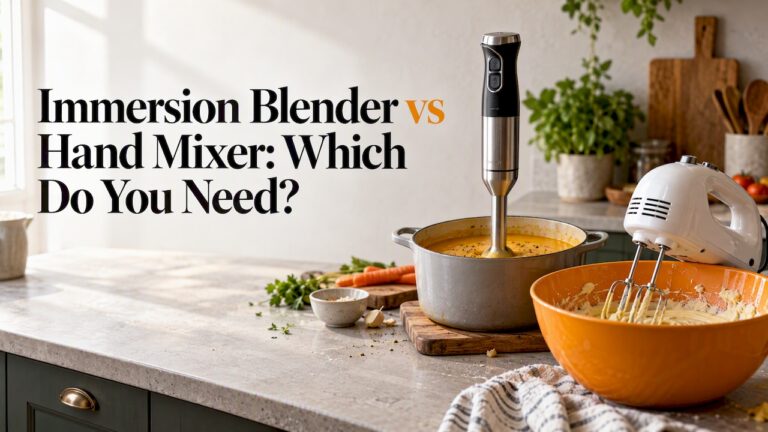
An immersion blender (also sold as a stick or wand blender) purees, blends and emulsifies in the pot or cup. A hand mixer beats, whips and aerates with two beaters. They look similar on a shelf, but they are not interchangeable. If you cook soups, sauces and smoothies, buy the immersion blender. If you bake cakes, cookies and meringues, buy the hand mixer.
I own and test nothing I review, so everything below comes from manufacturer specs, owner feedback and the named sources I cite. Here is how the two tools differ, where they overlap, and how to choose.
TL;DR
- Immersion blender: a single shaft with a blade at the end. Best for hot soups, sauces, vinaigrettes and small smoothies, blended right in the pot.
- Hand mixer: two rotating beaters or whisks. Best for batters, cookie dough, whipped cream and egg whites, because it incorporates air.
- Overlap is real but one-sided: an immersion blender can whip small amounts of cream or egg whites, but a hand mixer cannot puree a soup.
- Buy the one that matches what you cook most. If you do both often, they are cheap enough to own together.
How each tool works
According to KitchenAid’s comparison, a hand mixer combines wet and dry ingredients with two beaters or a whisk, while an immersion blender uses blades to blend, puree or chop.
That design decides everything else:
- A blade cuts and shears. It pulls ingredients into a spinning guard and breaks them down. That is why it turns cooked vegetables into velvet and emulsifies oil into a dressing.
- Beaters fold and aerate. They sweep a wide path through a bowl, pushing air into thick or semi-solid mixtures. That is why they cream butter and sugar and build volume in egg whites.
Wattage is a poor way to compare the two. A blade spinning at speed needs power to cut through food, while a beater moving through batter needs control and torque at low speeds, so a higher number on one tool says little about the other.
Immersion blender vs hand mixer at a glance
| Feature | Immersion blender | Hand mixer |
|---|---|---|
| Working end | One shaft, blade at the tip | Two beaters or whisks |
| Core job | Puree, blend, emulsify | Beat, whip, aerate, combine |
| Best with | Liquids and soft cooked food | Batters, doughs, cream, egg whites |
| Used in | The pot, jar or cup | A mixing bowl |
| Hot food | Yes, with care | Not its purpose |
| Cookie dough and stiff batters | No | Yes, up to a point |
| Storage | A slim wand | A body plus beaters, often in a case |
What an immersion blender does best
Soups and sauces in the pot
The headline argument for an immersion blender is that you skip the transfer. A blended soup normally means ladling hot liquid into a countertop blender in batches. With a stick blender you lower the shaft into the pot and run it until the texture suits you. KitchenAid’s guide names stovetop soups as the job where this saves a step, and lists emulsifying oil and vinegar for dressings among its uses.
Two practical habits help:
- Keep the blade fully submerged before you start. Pulling it up through the surface is how soup ends up on the wall.
- Use a deep, narrow vessel for small amounts. A wide pot with an inch of liquid gives the blade little to work with.
If you would rather use a jar blender for hot liquids, read whether you can blend hot liquids in a blender first. Steam pressure is the problem there, and an immersion blender avoids it because nothing is sealed.
Smoothies, dressings and mayonnaise
Small-batch smoothies work well, especially with soft fruit and yogurt. Emulsions are a real strength: a narrow cup, oil and egg yolk, and the blade pulled slowly upward is the usual method for quick homemade mayonnaise. For large frozen-fruit smoothies, a full-size jar blender still does the better job. My best blender for smoothies roundup compares five of them.
Where it falls short
An immersion blender purees rather than chops. It will cut vegetables down, but not to a uniform size without reducing them toward liquid. If a recipe needs an even dice, salsa texture or shredded cabbage, you want a food processor. My comparison of a food processor vs blender explains where that line falls.
Other honest limits:
- Scratching. A metal blade guard dragged along a nonstick pot can mark the coating. Many owners switch to a plastic guard or blend in a separate container for coated cookware.
- Splatter. Even with good technique, thin liquids can fly.
- Heavy mixtures. Mashed potatoes are the classic example. The blade overworks the starch, and the result turns gluey instead of fluffy.
What a hand mixer does best
Batters, cookie dough and creaming
According to Mom’s Baking Co., hand mixers are commonly used for cake batter, cookie dough, meringues and other desserts, while immersion blenders are for soups, sauces and smoothies. That matches how owners describe them. Creaming butter and sugar until pale is the step a hand mixer was built for, and it sets the texture of cakes and cookies.
The beaters sweep a bowl’s width, so ingredients combine evenly without scraping the bowl constantly. Most models have several speed settings (KitchenAid’s own hand mixer has seven), which lets you start slow to avoid a flour cloud and finish fast.
Meringues and whipped cream
KitchenAid’s guide says an immersion blender can whip, but it describes hand mixers as the tool for incorporating air into batter for fluffy, voluminous results, and lists whipping egg whites to fluffy peaks among hand-mixer jobs. Whisk beaters move more surface area through the egg whites, and volume is the whole point of a meringue.
Where it falls short
- No cooking use. Do not put a hand mixer’s beaters into a pot of hot soup.
- Thick, stiff dough. Bread dough and heavy cookie dough can overheat a hand mixer’s motor. For bread, see my best stand mixer for bread dough comparison.
- Hands-on time. You hold it for the whole job, and a long whip gets tiring. That is the main reason frequent bakers move up to a stand mixer.
Where the two overlap, and where they do not
Overlap exists, and it runs mostly in one direction.
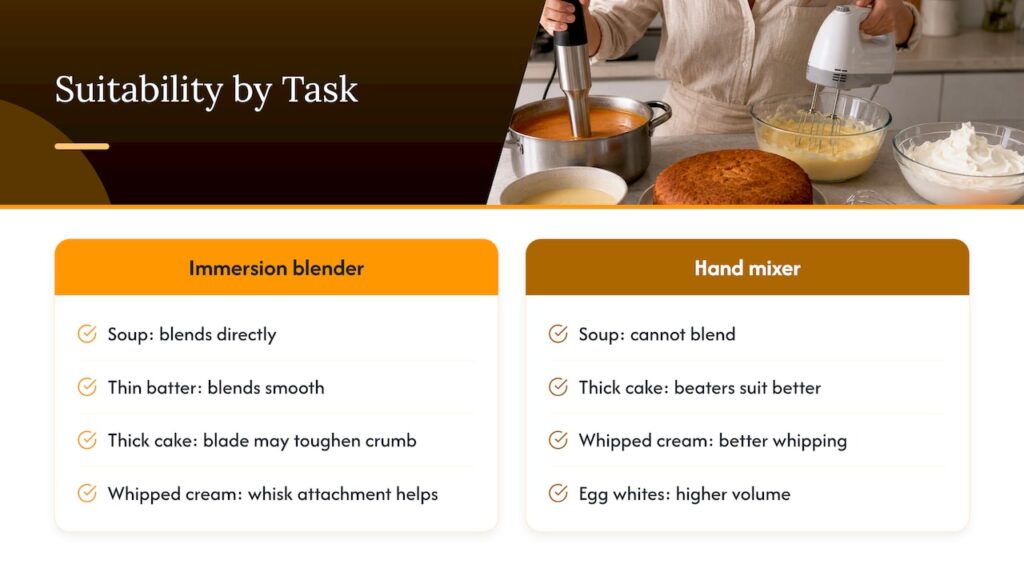
Whipped cream. An immersion blender with a whisk attachment can do it, and a plain blade can whip small amounts of cream in a tall cup. A cookwithrome guide rates the hand mixer the better choice for whipping cream and for egg whites, and calls an immersion blender possible but less effective for both. If your stick blender includes a whisk, you can get away with it occasionally. A blade-only wand is a compromise.
Pancake and crepe batter. Thin batters can be blended smooth in a measuring jug. Thick cake batter is a better match for beaters, because a blade can overwork gluten and produce tougher crumb.
Egg whites. Possible in a tall narrow container, but tricky. Volume is usually lower than with beaters.
Soup. A hand mixer cannot do this at all.
So the answer to the question many readers ask is no: an immersion blender does not replace a hand mixer for baking. A hand mixer does not stand in for an immersion blender at all. Breville’s guide to immersion blenders and hand mixers reaches the same conclusion: both are handheld and compact, but they are not interchangeable.
Price and what to expect
Immersion blender prices span a wide range, and the spread buys you things like a variable-speed trigger, a detachable shaft that goes in the dishwasher, a steel or plastic guard, and attachments such as a whisk or chopper bowl.
Hand mixers cost less at the entry level, and the useful differences are narrower. For either tool, the features that matter in daily use are:
- Variable speed control. A single “on” speed is a splatter machine.
- Detachable shaft or beaters. Cleanup is the difference between a tool you use and a tool in a drawer.
- Cord length. Short cords limit how far you can move from the outlet. Cordless models trade this for battery life and usually less power.
- A storage case or bag for beaters and whisk attachments, so the pieces stay together.
Before paying more, ask whether you cook enough to use the extras. My data study on whether expensive kitchen appliances are worth it looks at where a higher price brings real returns.
How to choose
Use the question “what did I last cook?” instead of the spec sheet.
- Mostly soups, sauces, baby food, smoothies: immersion blender.
- Mostly cakes, cookies, whipped toppings, meringue: hand mixer.
- Both, and counter space is tight: buy both. They are small and each costs well under a decent stand mixer.
- Baking weekly, with bread or big batches: skip the hand mixer and consider a stand mixer. My stand mixer buying guide and best stand mixer comparison cover the options.
- Gift for a new cook: a hand mixer is the safer choice for a baker, and an immersion blender suits someone who cooks dinners. If the recipient is setting up a kitchen from scratch, the kitchen essentials list shows where either fits.
If you are also weighing other countertop appliances, such as a multicooker, this overview of multicooker alternatives shows the features worth comparing before you buy.
Three immersion blenders and three hand mixers worth a look
I have not used any of these. Each pick was chosen by an independent testing team after its own side-by-side tests: Wirecutter’s immersion blender guide, Wirecutter’s hand mixer guide, Serious Eats’ immersion blender guide or Serious Eats’ hand mixer guide. I then checked each Amazon listing on 26 October 2026 for the model number, the product photo, the buy-box price and the rating, and read the ten most helpful critical and ten most helpful positive reviews of each. An owner theme appears below only when at least two separate owners raise it.
| Model | Type | Chosen by | Watts | Speeds | In the box | Amazon rating | Price | Buy |
|---|---|---|---|---|---|---|---|---|
| Braun MultiQuick 7 MQ7035 | Immersion blender | Wirecutter top pick | 500 | Pressure-controlled, no set speeds | Blending shaft, whisk, 2-cup chopper, beaker | 4.5★ (3,773) | $109.95 | Check Price |
| Breville Control Grip BSB510XL | Immersion blender | Serious Eats, best with accessories | 280 | 15 | Blending shaft, whisk, 25 oz chopping bowl, 42 oz jug with lid | 4.6★ (4,067) | $149.95 | Check Price |
| Hamilton Beach 4-in-1 (59765) | Immersion blender | Serious Eats, best under $50 | 225 | 2 | Blending shaft, whisk, 3-cup chopper | 4.4★ (5,694) | $34.97 | Check Price |
| KitchenAid 7-Speed KHM7210 (Empire Red listing) | Hand mixer | Wirecutter top pick | 250 | 7 | 2 beaters, whisk | 4.6★ (10,386) | $74.99 | Check Price |
| Breville Handy Mix Scraper BHM800 (Black Truffle listing) | Hand mixer | Serious Eats, best hand mixer | 300 on the listing, 240 per Serious Eats | 9 | 2 coated beaters, 2 whisks, 2 dough hooks, snap-on case | 4.5★ (3,549) | $159.95 | Check Price |
| Hamilton Beach Professional 5-Speed (62651) | Hand mixer | Serious Eats, best budget | 120 | 5 | 2 beaters, whisk, snap-on case | 4.6★ (5,410) | $44.95 | Check Price |
Prices are the Amazon buy box on 26 October 2026 and change often. Wattage comes from the Amazon listings; for the Breville hand mixer, Serious Eats gives a lower figure than the listing, and both are shown. The KitchenAid and Breville hand mixers are sold in several colours, and each colour has its own listing and price.
What the table shows that the stars do not. All six sit between 4.4 and 4.6 stars across 3,549 to 10,386 ratings, while prices run from $34.97 to $159.95. Star ratings barely separate them, and a higher price does not buy a higher rating here. The critical reviews separate them far better, which is why each pick below lists what owners complain about, not just what they like.
Where the testers agree, and where they do not
- Detachable heads matter. Serious Eats calls a detachable head essential for cleanup, and Wirecutter preferred removable wands that go in the dishwasher. All three immersion picks have one.
- A hand mixer is not a bread machine. Serious Eats notes that its winning Breville hand mixer peaks at 240 watts against 575 watts for its winning KitchenAid stand mixer, and warns that a hand mixer’s motor is likely to fail over time if it is pushed through heavy mixing. Wirecutter’s KitchenAid pick does not include dough hooks at all.
- How many speeds you need. Serious Eats recommends five speeds as a minimum and finds seven or nine give more finesse. The picks range from two (Hamilton Beach immersion) to fifteen (Breville Control Grip), and the Braun has no set speeds at all: pressing harder makes it go faster.
- They split on the best immersion blender. Wirecutter found the Braun pureed fibrous soups and frozen smoothies faster and more thoroughly than any model it tested, including the Breville Control Grip it used to recommend. Serious Eats still names the Breville its pick for a set with accessories.
- They split on KitchenAid’s 9-speed hand mixer. Serious Eats lists it as a long-time favourite. Wirecutter says it works as well as the 7-speed but is harder to control and sometimes flings ingredients out of the bowl.
The immersion blenders
Braun MultiQuick 7 MQ7035: the smoothest purees in Wirecutter’s tests

4.5 stars | 3,773 ratings | $109.95 on Amazon
Wirecutter’s top pick pureed fibrous soups and frozen smoothies faster and more thoroughly than anything else it tested. The listing explains part of why: the blade moves up and down while it spins, which Braun calls ACTIVEBlade. Wirecutter’s caveats are about the extras: mayonnaise made with the whisk came out runny, the chopper can turn vegetables nearly to liquid if you run it more than a few seconds, and the beaker markings are hard to read.
What owners report: among the ten most helpful critical reviews, two found the chopper attachment awkward or weak, and two said a part failed within about two years (one at 21 months, one a cracked plastic drive coupler). Positive reviews keep coming back to the motor’s strength on soups and smoothies.
Breville Control Grip BSB510XL: the fullest set of accessories

4.6 stars | 4,067 ratings | $149.95 on Amazon
Serious Eats picks this one for its kit: 15 speeds, a whisk, a 25 oz chopping bowl, a 42 oz jug with a lid, and a dishwasher-safe head. It was Wirecutter’s pick before the Braun beat it on purees, so both teams rate it, for different reasons. It is the most expensive of the three.
What owners report: three reviewers call it heavy or cumbersome, and two describe plastic internal parts or blades they found fragile. Positive reviewers repeatedly say it is expensive but worth it.
Hamilton Beach 4-in-1: the budget pick

4.4 stars | 5,694 ratings | $34.97 on Amazon
Serious Eats’ best immersion blender under $50 has 225 watts, two speeds, a whisk, a 3-cup chopper and dishwasher-safe attachments, and it weighs 1.75 pounds by Serious Eats’ figure. It is the one to buy if you will blend soup a few times a month.
What owners report: the critical reviews cluster on build quality (three describe it as cheaply made) and on motor life (three report overheating or an early failure). The chopper draws its own complaints. Positive reviews focus on value and smooth soups.
The hand mixers
KitchenAid 7-Speed KHM7210: Wirecutter’s top pick

4.6 stars | 10,386 ratings | $74.99 on Amazon
In Wirecutter’s tests it never slowed down, stalled or heated up, whether creaming butter and sugar or working through chunky cookie dough, and it was among the lightest mixers tested. Wirecutter lists three drawbacks: no dough hooks (KitchenAid sells them separately for about $24), no storage case, and speed buttons that can be hard to press.
What owners report: positive reviews keep calling it light and quiet. The critical reviews disagree with Wirecutter on power: three owners found it weak on egg whites or heavier mixing, and three said their unit stopped working after one to two years.
Breville Handy Mix Scraper BHM800: Serious Eats’ best hand mixer

4.5 stars | 3,549 ratings | $159.95 on Amazon
Serious Eats’ winner comes with rubber-coated beaters, two whisks, two dough hooks and a snap-on storage case, plus nine speeds and a light that shines into the bowl. Serious Eats puts its motor at 240 watts; the Amazon listing says 300. Either way, Serious Eats still advises against using a hand mixer for bread dough.
What owners report: the most consistent complaint is the rubber or silicone coating peeling off the beaters, raised in four critical reviews and two of the positive ones. Two more owners said a beater snapped. Positive reviews describe it as the most powerful hand mixer they have owned.
Hamilton Beach Professional 5-Speed: the budget pick

4.6 stars | 5,410 ratings | $44.95 on Amazon
Serious Eats’ budget choice has five speeds, two beaters, a whisk and a snap-on case, weighs 1.98 pounds by Serious Eats’ figure, stands up on its own, and carries a five-year warranty, the longest of the six.
What owners report: positive reviews call it quiet and like its slow start. The critical reviews say it runs out of strength: four found it too weak for thick batters or cookie dough, and two noticed a burning smell at high speed. It suits cakes and whipped cream more than stiff doughs.
My perspective
The question “immersion blender or hand mixer” is usually the wrong question, because the two tools solve different problems. The confusion usually comes from price and shape: both are cheap, both are handheld, both have a motor and a stick. Buyers assume one must be a cheaper version of the other.
When reading owner reviews, check for the problems each tool is prone to. For immersion blenders that means splatter, scratched pots and motors that overheat on thick food. For hand mixers it means wobbly beaters, motors that struggle with stiff dough, and short cords. None of those are reasons to avoid the category. They are reasons to match the tool to the job, and to read the spec for speed range and detachable parts, not just wattage.
If I had to pick one for a general home cook, I would pick the immersion blender, because soup, sauces and emulsions come up more often in weeknight cooking than creaming butter. If that cook bakes on weekends, the answer reverses. Neither answer holds if you ask me to name a single winner without knowing the recipes.
I do not claim to have used any of these models. My process, including how I weigh owner reviews against specs, is laid out in how I review kitchen equipment.
Compare models before you buy
If you are ready to narrow things down, my Kitchenware Compare homepage links to side-by-side comparisons and buying guides for blenders, mixers and cookware. For a baking setup, the Cuisinart SM-50 vs KitchenAid Artisan comparison shows what a step up from a hand mixer looks like.
Care and storage
A few habits extend the life of either tool:
- Rinse right away. Dried-on soup or batter is harder to remove from a blade guard or beater collar.
- Run the shaft in warm soapy water. Do not submerge the motor housing of an immersion blender. Check your manual for which parts are dishwasher-safe.
- Unplug before changing beaters. It takes a second and rules out the motor starting while your fingers are on the beaters.
- Store beaters with the mixer. A case matters more than it sounds, since losing one beater makes the mixer useless.
For more on looking after baking gear, see my tips for maintaining bakeware and baking tools.
FAQ
Can an immersion blender replace a hand mixer?
Only for small, occasional jobs. It can whip a little cream or thin a batter, but for meringues, cookie dough and creaming butter a hand mixer incorporates air better, according to KitchenAid. If you bake regularly, you will notice the difference in volume and texture.
Can I make mashed potatoes with an immersion blender?
It is not recommended. A fast blade breaks starch cells and can turn potatoes gluey. A hand mixer on low speed, or a masher or ricer, gives a better texture. If you are making a pureed potato soup, the immersion blender is fine.
What are the downsides of an immersion blender?
It purees rather than chops, so it cannot give you an even dice. It can splatter if the blade is not fully submerged, and a metal guard can scratch nonstick pots. It also struggles with heavy or frozen mixtures compared with a full-size blender.
How do I use an immersion blender for soup?
Take the pot off the heat, set the blade to the bottom of the pot with the guard fully under the surface, and then switch it on. Move it slowly up and down and around until the texture suits you. Keep the pot deep enough that the blade stays covered.
Is a stick blender the same as an immersion blender?
Yes. Stick blender, hand blender, wand blender and immersion blender are different names for the same tool. A hand mixer is a different appliance with two beaters, which is why searches for “hand blender” can show both.
Sources
- The Best Immersion Blenders, Wirecutter
- The Best Hand Mixers, Wirecutter
- The Best Immersion Blenders, Serious Eats
- The Best Hand Mixers, Serious Eats
- Hand mixer vs immersion blender, KitchenAid US
- Immersion blender vs. hand mixer: What’s the difference?, Breville US
- Immersion Blender vs Hand Mixer: What’s the difference?, Mom’s Baking Co.
- Can You Use an Immersion Blender Instead of a Hand Mixer?, Cook With Rome
Recommended
- Food Processor vs. Blender: What’s the Difference
- Stand Mixers: Buying Guide, Reviews & Comparisons
- Best Stand Mixer: Reviews + Buying Guide

I'm Glenn, and I started Kitchenware Compare to cut through conflicting product reviews and help readers pick kitchen gear with confidence. I don't own or test the products I write about — these guides are built from verified-purchase reviews, manufacturer specifications, and independent testing where it exists, with the reasoning shown, not just a rating.
Leave a Reply