This guide has no affiliate links, but some pages it links to do. If you buy through those, I may earn a commission at no extra cost to you.
For most home cooks, a PTFE (Teflon) pan gives the most dependable nonstick release. Choose ceramic only if avoiding PTFE and PFAS matters more to you than lifespan. The trade-off is that ceramic coatings can break down when overheated, sometimes within months of purchase, according to The American Ceramic Society. A 2025 lab study compared the durability of ceramic and PTFE coatings. Read on for the details.
TL;DR:
- A 2025 lab study found PTFE coatings kept their nonstick performance longer than the sol-gel ceramic coatings it tested.
- Ceramic coatings contain no PTFE or PFOA, but may include other proprietary polymers, so choosing ceramic does not guarantee a pan without polymers.
- Use cast iron or stainless steel when searing at high temperatures, and check the stated limit before using either nonstick coating.
- Use low to medium heat, soft sponges, and wooden utensils; replace the pan if it flakes, chips, or sticks after proper washing.
How do ceramic and Teflon compare on safety, heat, and durability?
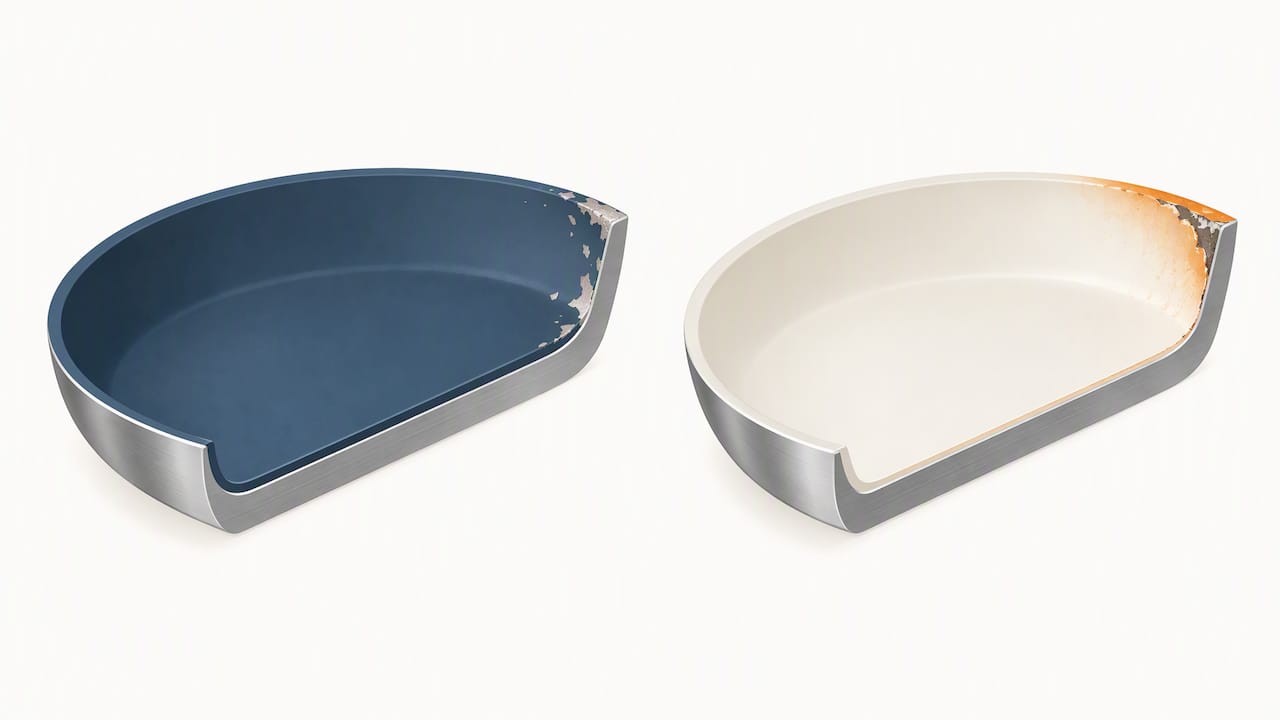
Start with what the coatings are. PTFE is a fluoropolymer, the plastic-like slick layer behind Teflon. Ceramic nonstick is made through a sol-gel process that builds a quasi-ceramic layer on metal. According to The American Ceramic Society, ceramic coatings contain no PTFE or PFOA, but they can include other proprietary polymers, and if overheated they can break down just as PTFE coatings can, sometimes within months of purchase.
On safety, the FDA says certain PFAS-containing substances have authorized uses in food-contact applications, including nonstick coatings. The agency notes that polymerized PFAS in cookware coatings bind tightly, and studies indicate negligible migration to food from properly made fluoropolymer coatings. Public concern about “forever chemicals” is real, though, and the NRDC lays out the environmental and health context that drives many shoppers toward PTFE-free pans.
Here is how the two stack up:
- Chemistry: PTFE is a fluoropolymer. Ceramic is a sol-gel layer with no PTFE, but it is not necessarily polymer-free.
- Heat: The American Ceramic Society advises against cooking with PTFE-coated pans above 570°F and notes that overheated ceramic coatings can break down too. Follow the manufacturer’s maximum temperature for either coating.
- Release: PTFE starts slick and tends to stay that way longer. Ceramic often feels excellent at first, then fades.
- Wear: A 2025 lab study by Guerrero-Vacas and colleagues found that PTFE coatings outperformed the sol-gel ceramic coatings it tested, especially on how long their nonstick performance lasted.
- Cost: Prices overlap widely by brand, and I won’t quote a typical price gap without a source. The cost per year of use depends on the pan’s price and how long it lasts.
The most useful evidence on performance comes from a lab study. A 2025 sol-gel vs PTFE study compared several sol-gel ceramic coatings with PTFE.
According to that study, PTFE outperformed the sol-gel ceramic coatings tested, especially on how long nonstick release lasted. The result covers the coatings in that study, not every ceramic pan on sale.
A lab study does not establish how a pan will perform in every kitchen. The American Ceramic Society notes that overheated ceramic coatings can decompose, sometimes within months of purchase.
Which coating fits the way you cook?
Match the pan to your habits, not to the marketing.
If you mostly make eggs, pancakes, and other low to medium heat foods, PTFE gives the best release. If you want to avoid PFAS and you accept replacing pans more often, ceramic is a fair choice. If you sear steaks or run the burner hot, skip both and reach for cast iron or stainless steel. The American Ceramic Society’s care advice for any nonstick pan is low to medium heat, silicone or wooden tools, hand washing and storage with dividers.
Before you buy, check these on the product page: oven-safe temperature, warranty length, explicit PFAS or PFOA-free labeling, recommended utensils, and the return policy.
Then settle it in three questions:
- Do you cook mostly at low to medium heat? If not, buy uncoated.
- Is avoiding PTFE a firm priority for you? If yes, choose ceramic and budget for earlier replacement.
- Do you want the longest-lasting slick surface? If yes, choose PTFE.
Pro Tip: If a listing never states a maximum temperature, treat that as a warning sign and look for a brand that does.
For a product-level breakdown, I cover specific picks and specs in my guide to ceramic vs nonstick cookware.
How do you keep a nonstick pan working longer?
Heat control does most of the work. Keep burners at low to medium, and preheat gently with a little fat in the pan. If a pan smokes or the oil shimmers hard in seconds, the burner is too high for any nonstick coating.
- Let the pan cool, then rinse and wash with a soft, non-abrasive sponge.
- Soak stuck-on food instead of scrubbing, and skip steel wool and oven cleaners.
- Use silicone, wood, or nylon utensils, never metal.
- Put a paper towel or pan protector between stacked pans.
- Retire the pan when you see flaking, visible chipping, or sticking that returns right after a proper wash.
If food clings even when you follow these rules, it may be residue buildup rather than wear. The explainer on why a nonstick pan keeps sticking walks through the difference. A degraded coating should be replaced, and you should dispose of the pan responsibly rather than keep cooking on a flaking surface.
What should you buy?
Pick PTFE if you want the most reliable slickness for eggs and everyday low-heat cooking. Pick ceramic if avoiding PTFE comes first and you will replace the pan sooner. Pick cast iron or stainless steel if you sear hot. Next, browse my best nonstick pans roundup, or check a pan’s specs on the manufacturer’s page before you commit.
Why I weigh convenience against longevity
I have never cooked on these pans for a review, and I won’t pretend otherwise. What I do is read specs, owner reviews, and published studies, then look for patterns. The pattern here is steady: ceramic wins on peace of mind, PTFE wins on staying power.
Where can you find pans worth buying?
For individual pans, the ceramic vs nonstick cookware comparison and the PTFE-free nonstick picks cover specific models and their coating labels.
FAQ
Is ceramic nonstick safer than Teflon?
Ceramic coatings do not contain PTFE or PFOA, according to The American Ceramic Society, but that fact alone does not establish that ceramic is safer. The FDA, however, reports that properly manufactured fluoropolymer coatings show negligible migration to food. Overheating either coating is the bigger practical risk.
Which lasts longer, ceramic or Teflon?
PTFE usually lasts longer. In a 2025 lab study, PTFE coatings kept their nonstick performance longer than the sol-gel ceramic coatings tested.
Can you use ceramic or Teflon pans for high-heat searing?
Neither is a good fit. Check the manufacturer’s temperature guidance for either coating before searing. Cast iron or stainless steel are alternatives if you prefer an uncoated pan.
When should you throw out a nonstick pan?
Replace it when the coating flakes, chips, or sticks again right after a proper wash. A worn coating no longer does its job, so keeping it is not worth the risk.
Sources
- Authorized Uses of PFAS in Food Contact Applications | FDA
- Towards a greener kitchen: Can sol-gel ceramic non-stick coatings replace polytetrafluoroethylene?
- Ceramic-coated cookware: Investigating the accuracy of this ‘nontoxic’ cookware trend – The American Ceramic Society
Recommended
- Ceramic vs Nonstick Cookware: Which Should You Buy?
- SENSARTE Ceramic 9.5-Inch Pan Review: Clean Label, Short Life
- Best Non-Stick Pan Without Teflon: 5 PFAS-Free Picks That Actually Work
- Most Durable Types of Cookware: Cast Iron, Steel & More

I'm Glenn, and I started Kitchenware Compare to cut through conflicting product reviews and help readers pick kitchen gear with confidence. I don't own or test the products I write about — these guides are built from verified-purchase reviews, manufacturer specifications, and independent testing where it exists, with the reasoning shown, not just a rating.
Leave a Reply