For most US kitchens, a 10-inch or 12-inch frying pan covers the bulk of daily cooking, and an 8-inch pan is the useful third for eggs and single portions. The label on the pan is only half the story, though. It describes the rim, not the surface your food actually touches, and that gap is where most buying mistakes happen. I own and test none of the pans mentioned here, so everything below rests on published specifications, manufacturer guidance and named third-party sources, each attributed where the claim is made.
TL;DR
- 8 inches suits one or two eggs, a single chicken breast or a grilled sandwich. 10 inches is the all-rounder for two to three servings. 12 inches handles three to four servings and big steaks, according to KaTom’s frying pan size guide.
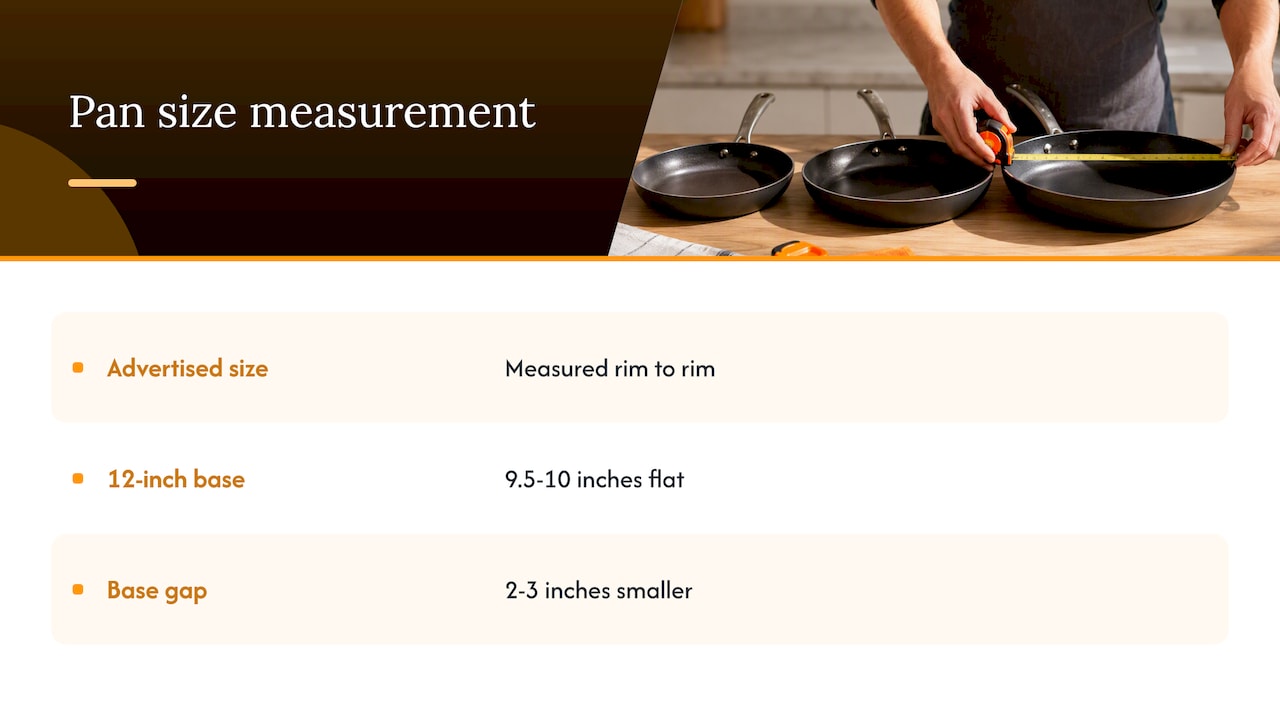
- Pan size is measured rim to rim, so the flat cooking surface is usually 2 to 3 inches smaller than the number on the label.
- Overcrowding is the real reason to size up: food steams instead of browning.
- Match the pan base to your burner. A 14-inch pan on a small burner heats unevenly.
- If you can only afford two pans, a 10-inch and a 12-inch is the pairing most guidance points to.
How frying pan size is actually measured
Manufacturers measure a skillet across the top rim, not across the bottom. According to Made In’s guide to frying pan sizes, sloped sides mean the base can be 2 to 3 inches smaller than the advertised size, so a 12-inch skillet often has a flat base of only 9.5 to 10 inches.
Better Homes & Gardens quotes Kristin Billingsley of Meyer Corp., who says the rule for measuring is rim to rim across the top. In the same piece, BHG’s how-to-measure guide notes that the size is sometimes stamped on the underside of the pan. If it is not, lay a ruler across the widest part of the top edge, inside edge to inside edge, not including the handle or pour spouts.
This matters when you compare two pans. Two “12-inch” skillets can have noticeably different cooking areas. A pan with steeply sloped walls looks roomy and cooks small. A shallower, more vertical-sided pan of the same rim diameter gives you more usable base, per the same BHG guidance. When I compare pans for readers, I look for the base diameter in the spec sheet first and treat the rim number as a starting point.
Sizing words are not standardized
BHG reports that classifications vary by brand and test kitchen. In general a small skillet is 6 inches, medium 8, large 10 and extra-large 12 or more, but some manufacturers, Meyer among them, call anything 12 inches or larger “large.” So “large” on a product page tells you very little. Look for inches or centimeters, and ignore the adjective.
Frying pan sizes at a glance
The figures below come from KaTom’s learning center, which lists typical home sizes from 8 to 14 inches, with cooking surface and servings.
| Rim size | Typical cooking surface | Servings | Best for |
|---|---|---|---|
| 8 inches | 5.5 to 6 inches | 1 | Eggs, one chicken breast, toasting spices |
| 10 inches | 7.5 to 8 inches | 2 to 3 | Everyday sautéing, omelets, pan sauces |
| 12 inches | 9.5 to 10 inches | 3 to 4 | Steaks, batch cooking, one-pan dinners |
| 14 inches | 11 to 12 inches | Large families | High-volume cooking, if your burner fits |
The metric equivalents you will see on imported pans are roughly 20 cm for 8 inches, 24 to 26 cm for 10 inches and 28 to 30 cm for 12 inches, according to TheSize’s cookware chart.
What each size does best
8-inch: eggs and small portions
An 8-inch pan has about 6 inches of flat surface, enough for a two-egg omelet or a single fillet. Its real advantage is that you do not heat a lot of metal for a small job. Made In’s guidance makes the same point: a smaller pan for quick tasks saves energy and time. If you are curious about a cast iron version, my Lodge 8-inch cast iron skillet review goes through the specs and owner-reported complaints.
The limit is obvious: two chicken thighs fill it, and a third makes steam.
10-inch: the most versatile size
KaTom calls the 10-inch the most common frying pan size, with a balance of surface area and manageability. It handles two to three servings, fits most cabinets and is light enough to flip and pour from with one hand. If you buy one pan and cook for two, this is the default answer. Its weakness is steaks and bone-in chicken for a family, where a 10-inch gets crowded fast.
12-inch: the family workhorse
A 12-inch gives you roughly 9.5 to 10 inches of base, enough for three or four servings. It is the pan for searing two steaks side by side, browning a pound of ground meat or cooking a one-pan dinner. The trade-off is weight, especially in cast iron or clad stainless, and the need for a burner that can heat the whole base.
14-inch and larger
KaTom classes 14-inch pans as extra-large, built for high-volume family meals. BHG notes that commercial lines such as Matfer Bourgeat go even larger, with 15¾ and 17¾ inch sizes. A home example is a 14-inch cast iron skillet from Solidteknics, listed at 14 inches (35.5 cm). Before you buy one, check the next section, because most residential burners are the limiting factor.
Why crowding matters more than the number
According to Made In, the point of choosing the right size is to prevent overcrowding. Crowded food releases moisture that cannot evaporate fast enough, so it steams rather than browns or sears, which hurts flavor and texture.
A practical way to apply that: lay your ingredients in the pan cold and look at the gaps. If pieces touch, you need a bigger pan or two batches. Browning in two batches in a 10-inch is often better than one crowded pass in a 12-inch with a weak burner underneath.
Match the pan to your burner
Sitram, a French cookware maker, advises in its frying pan guide that the pan base should be fairly close to the diameter of your cooking zone. According to that guidance, a pan much larger than the burner creates a hot center with cool edges, while one much smaller can overheat the pan body and may damage coatings or cause warping. A 14-inch skillet may not fit smaller standard residential burners at all.
In practice:
- Measure your burner or cooking zone across, since small and large burners on one cooktop often differ.
- Look up the base diameter of the pan, not only the rim.
- Use your larger burner for 12-inch pans.
- On induction, check the induction ring size and make sure the pan is compatible.
If you cook on gas, my guide to the best fry pans for gas stoves covers cast iron, steel and nonstick options, and the best cookware material for a gas stove explains how flame size affects the choice. On a smooth top, see the best frying pan for an electric stove, where flat bases matter most.
Cast iron numbers are not inches
Traditional cast iron skillets are often sold by number, such as No. 8 or No. 10. Field Company explains on its No. 8 skillet page that these numbers historically referred to burner-ring sizes on wood-burning stoves. A No. 8 therefore measures about 10.25 inches across the top, and a No. 10 about 11.6 inches. Always read the inch measurement the maker gives and ignore the model number when you compare.
That also explains why a “10-inch” cast iron skillet and a No. 8 may be the same pan. If you are weighing materials as well as sizes, cast iron vs stainless steel sorts out which pan suits which job.
Build changes how a size behaves
Two 12-inch pans can feel very different on the stove depending on construction. Layered stainless pans are the usual example: the number of layers affects weight and heat spread. Forkward Blog has a useful write-up on tri-ply versus 5-ply pans if you are deciding which build suits your cooking. Coatings matter too, and my comparison of ceramic vs nonstick cookware lays out durability and owner complaints for each.
My perspective: buy for the base, not the label
I review kitchenware by reading specifications, collecting owner reviews and checking third-party sources. I do not claim to have used the products myself, and how I review kitchen equipment explains that method. Pan size is a good example of why that approach matters, because the headline number on a listing is a marketing label, not a measurement of the cooking surface.
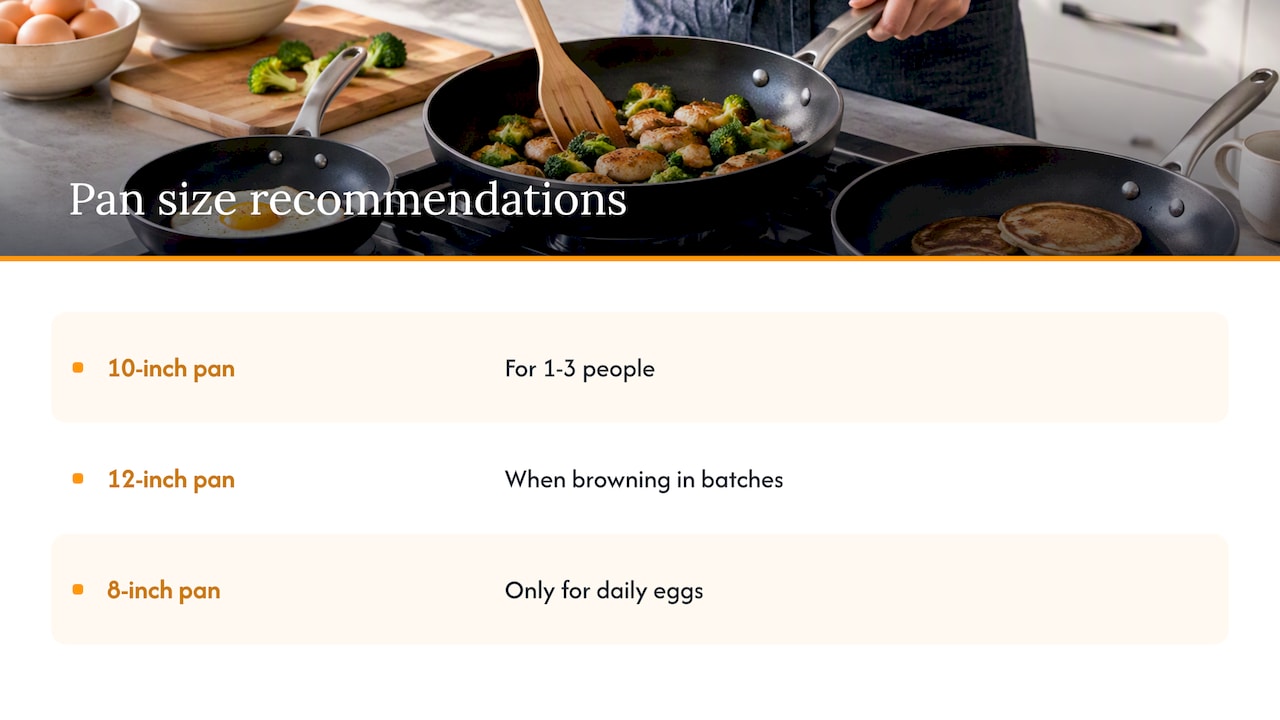
My view is simple. Start with the 10-inch if you cook for one to three people. Add a 12-inch when you find yourself browning in batches. Add an 8-inch only if you cook eggs daily. Be skeptical of big sets: a three-piece 8, 10 and 12-inch set, like the Gotham Steel hard anodized set listed at Walmart, can be a fair way to cover all three sizes, but only if you will actually use all three. Made In’s guidance agrees that prioritizing a versatile 10 or 12-inch pan is the more practical route than buying a set because it is marketed.
One more thing I weigh heavily is storage. A 12-inch pan that lives in a hard-to-reach cabinet gets used less than a 10-inch on the stove.
— Glenn
Which sizes to buy, by situation
- Single cook or couple: one 10-inch, plus an 8-inch if you eat eggs often.
- Family of four: a 12-inch for mains and a 10-inch for sides. Made In’s guide suggests two sizes such as a 10-inch and 12-inch for frequent cooks instead of one pan for every task.
- Small apartment with a small cooktop: a 10-inch first, and check burner diameter before going bigger.
- New kitchen: start with the sizes above and fill gaps from my kitchen essentials list for a new home.
- Gift shopping: a 10-inch is the least risky size, since almost every household can store and use it.
Le Creuset’s UK guide puts a 20 to 24 cm pan (roughly 8 to 9.5 inches) at the right size for cooking for yourself or one other person, with larger pans for meal prep or family cooking, per its cookware size guide. That fits the picture above, though note it is a UK source and metric.
Where to compare pans side by side
If you already know your size and need to choose between specific pans, my cookware reviews and buying guides put specs, pricing, owner-reported strengths and complaints next to each other, so you can see base diameter, weight and material without hunting through listings. Retail links on the site are affiliate links, and that does not change how I describe a pan’s weaknesses.
FAQ
Which size pan is better, 8-inch, 10-inch or 12-inch?
It depends on how many people you cook for. An 8-inch suits one portion, a 10-inch suits two to three servings, and a 12-inch suits three to four, according to KaTom’s size guide. If you can own only one, most households do best with a 10-inch.
Is a 10-inch skillet large?
By most home standards it is mid-sized, not large. BHG reports that brands classify sizes differently: a 10-inch is often called large in test-kitchen terms, while some makers reserve that word for 12 inches and up. Judge by servings and cooking surface instead.
What is a 12-inch frying pan used for?
It is the pan for searing steaks, browning larger batches and cooking one-pan meals for three or four people. Its flat base is typically 9.5 to 10 inches, so it has room for food to brown rather than steam. Make sure your burner is large enough to heat it evenly.
What is the biggest size of a frying pan?
For home use, 14 inches is generally the extra-large size, per KaTom. Commercial lines go further: BHG notes Matfer Bourgeat makes 15¾ and 17¾ inch pans. Few residential burners can heat these well.
Does the size on the pan include the handle?
No. Per BHG’s measuring guidance, the size is the rim-to-rim diameter across the top of the pan, and the handle is excluded. The cooking surface on the base is smaller still.
Sources
- Frying Pan Sizes, KaTom
- Frying Pan Sizes: 8", 10", 12" Compared, Made In
- How to Measure a Skillet, Better Homes & Gardens
- Frying pan guide, Sitram
- Starter Set No. 8, Field Company
- Pots and Pans Sizes chart, TheSize
- 14" Flaming Skillet, Solidteknics
- Gotham Steel skillet set, Walmart
- Cookware size guide, Le Creuset UK
Recommended
- Lodge 8-Inch Cast Iron Skillet Review: Worth It?
- Tramontina Professional 8-Inch Pan Review: Years, Not Months
- Cast Iron vs Stainless Steel: Which Pan for Which Job?
- Best Fry Pans for Gas Stoves 2026: Cast Iron, Steel & Non-Stick

I'm Glenn, and I started Kitchenware Compare to cut through conflicting product reviews and help readers pick kitchen gear with confidence. I don't own or test the products I write about — these guides are built from verified-purchase reviews, manufacturer specifications, and independent testing where it exists, with the reasoning shown, not just a rating.
Leave a Reply