The best way to store pans is the one that matches your cabinet depth, your cooking habits and how heavy your cookware is. For most kitchens that means three things: keep daily pans in a low drawer or base cabinet near the stove, give every piece a fixed spot so nothing slides or scratches, and store lids separately from the pans. Everything else on this page is a variation on those three moves.
I don’t own or handle any of the cookware or organizers mentioned here. This guide is built from published advice by professional organizers and cabinet specialists, plus owner-style practical reasoning, and I attribute each finding to its source where it appears.
TL;DR
- Edit first: remove cookware you don’t use before buying any organizer, so you don’t pay to store clutter.
- Put daily pans beside the oven. Send roasting pans, woks and spare stockpots to a pantry, basement or high cabinet.
- In deep drawers, use dividers or pegs so pans can’t slide. In cabinets, stack largest to smallest with a soft separator between pieces.
- Store lids vertically, on the cabinet door or in a rack, rather than piled on top of the pans.
- Keep heavy cast iron and stainless low, and make sure cast iron is completely dry before it goes away.
Start by editing, not shopping
The most common mistake is buying storage before knowing what needs storing. According to Martha Stewart’s guide to organizing pots and pans, organizer Anna Bauer recommends a first edit: take a full inventory and remove what you no longer use before you invest in products or rearrange anything. Livingetc opens its own list of pan storage ideas the same way, with a declutter.
A practical way to run the edit:
- Pull every pot, pan, lid and baking dish onto the counter or table.
- Sort into three piles: used weekly, used a few times a year, not used in the past year.
- Look for duplicates. Three similar 10-inch skillets rarely earn three spots.
- Check condition. A pan with a warped base or a flaking surface is a donation or recycling candidate, not a storage problem.
If you’re setting up a first kitchen or working in very little space, a beginner’s small kitchen organization plan walks through taking inventory and clearing out unused cookware before you pick storage products.
If the edit leaves you short rather than overstocked, my kitchen essentials list for a new home and the basic cooking tools guide show what a working set actually needs.
Map your cookware by how often you use it
According to CNN Underscored’s reporting on professional organizers, the space flanking the oven is where daily cookware belongs, and holiday roasting pans, woks or secondary stockpots should move to a pantry, basement or high upper cabinet. That is the single idea that changes how a kitchen feels, because it frees prime space for the three or four pans you grab every day.
A simple map:
| Zone | What goes there | Examples |
|---|---|---|
| Prime (beside the range) | Daily cookware | Everyday skillet, saucepan, sauté pan |
| Secondary (lower cabinets, farther away) | Weekly or monthly cookware | Large stockpot, Dutch oven, griddle |
| Remote (pantry, basement, high shelf) | Seasonal or rare | Roasting pan, canning pot, wok you rarely use |
The weight rule matters here. According to a cabinet design firm in Fort Myers, storing heavy cast-iron or stainless-steel pieces in high cabinets or on overhead racks creates a safety hazard, and the firm advises keeping heavy cookware in low, easy-to-reach drawers or base cabinets. So the “remote” zone should be for light, rarely used items, or for heavy ones you can reach without lifting overhead. A large enameled Dutch oven is a good example of something that belongs low; if you’re unsure how big yours is, see the Dutch oven size guide.
Deep drawers: the easiest setup to live with
A wide, deep drawer near the cooktop is the layout most organizers and cabinet makers favor. The Fort Myers cabinet firm describes a wide drawer stack beside the range as a setup that works well in most homes, because it keeps everyday pans within a step of the stove.
The catch is what happens inside. According to CNN Underscored, the biggest drawer mistake is leaving items unsecured: without dividers or pegs, pans slide, scratch each other and make noise every time the drawer moves. The professional organizers it quotes suggest custom-fit pegboards or simple plywood dividers so each piece has a stationary home.
Options, from cheapest to most permanent:
- Adjustable peg organizer. Pegs lock into a grid in the drawer base. Good for renters, since nothing is cut or screwed in.
- Plywood or tension dividers. Cheap and fully custom if you measure your pan diameters first.
- Built-in drawer with fixed slots. The cleanest result, but it makes sense mostly during a remodel.
Measure before buying anything. You need interior drawer depth (front to back), width, and the height from the drawer base to the underside of the countertop or drawer above. Pans stored on edge need clearance for the handle too.
A note on weight
A drawer stacked with cast iron is heavy. Check the load rating on the slides if you know it, and favor full-extension glides so you can see the back row. If a drawer starts to sag or bind, redistribute the heaviest pieces to the bottom of the stack or to a different base cabinet.
Cabinets: stack smart, protect the surfaces
If you have standard base cabinets instead of drawers, vertical stacking is the workable default. According to CNN Underscored, professional organizers advise stacking from largest to smallest so everything stays visible, with felt dividers or even paper towels between pieces to prevent damage to non-stick or seasoned surfaces.
BBC Good Food suggests another approach for saucepans: nest them inside each other as efficiently as you can, after pulling every pan out and working out the best fit for your space.
Things that make a cabinet stack better:
- Pull-out shelves or roll-out trays. They turn a dark, deep cabinet into something you can see from above. Adding one is often the cheapest upgrade to an existing cabinet.
- Expandable racks. A freestanding metal rack lets you stand pans on edge in a cabinet, so you lift one pan instead of unstacking five.
- A felt or cloth liner for non-stick. If you own coated pans, this matters most. For help deciding how long coated pans last, my ceramic vs nonstick comparison goes into the trade-offs.
The tradeoff with stacking is simple: it saves space, but you pay for it in effort whenever you need the bottom pan. That’s why the frequency map above matters. Stack the rarely used pieces, and give the daily ones a spot where they stand alone.
Pegboards, rails and hanging racks
When cabinets are full, walls and ceilings are the next option. Top search results for this topic repeatedly list open backsplash space, pegboards, ceiling pot racks and slatwall panels. They free up cabinet space, but they come with conditions.
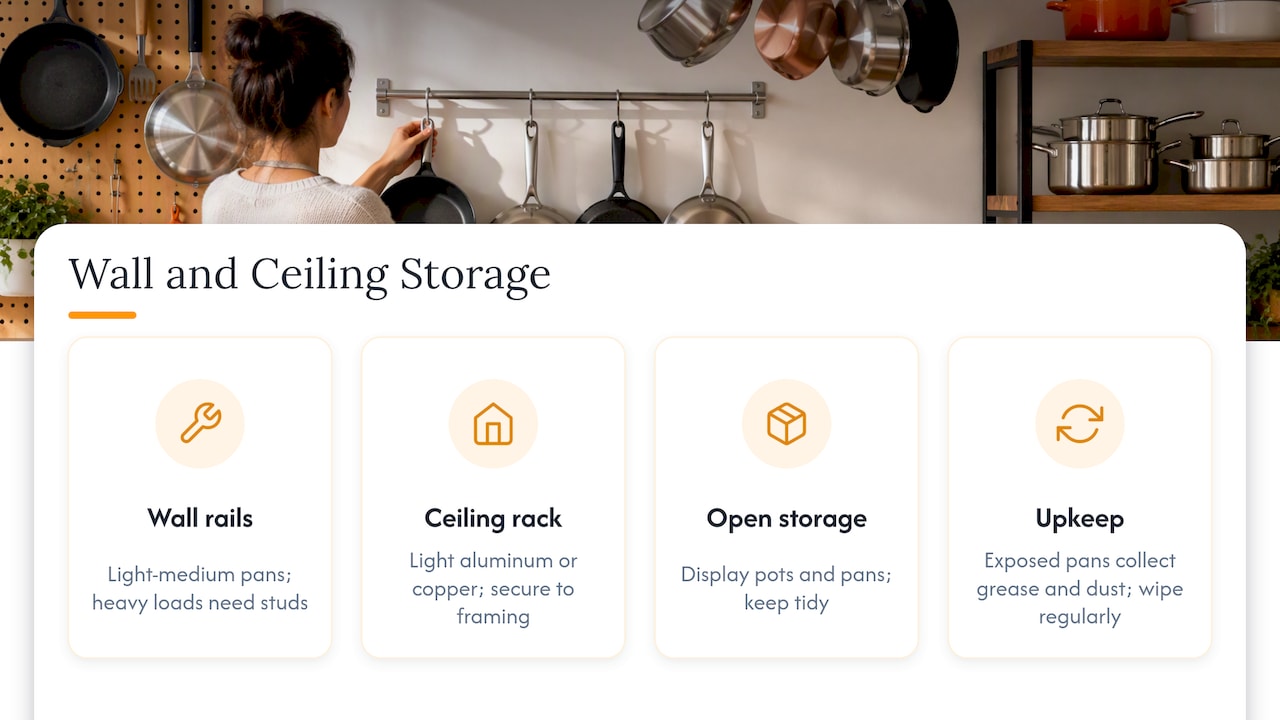
Wall rail or pegboard. Good for light to medium skillets and saucepans. Pegboard in a clean, single color looks deliberate, and you can rearrange hooks as your collection changes. Anchor into studs for anything heavy.
Ceiling rack. Great for ceilings with enough height and for pans you use often. Per the cabinet design source above, overhead storage is a poor place for heavy cast iron or stainless, so keep a ceiling rack to lighter aluminum or copper pieces and make sure it’s installed into structural framing.
Open shelves or an island with open storage. Good Housekeeping features an island with open storage underneath that one blogger reserves for pots and pans. It works if you’re comfortable with cookware on display and keep it tidy.
Hanging has two downsides worth knowing. Pans exposed to cooking vapor in an open kitchen collect a film of grease and dust, so expect to wipe them down. And a wall of hanging metal looks busy in a small room, which defeats the point if you wanted a calmer kitchen.
Lid storage ideas that actually work
Lids create more clutter than pans do, and the CNN Underscored reporting makes the same point: organizers it quotes say lids are often the bigger problem. Their preferred answers are dedicated lid organizers mounted inside cabinet doors, or vertical racks.
Your options:
- Door-mounted rack. Uses dead space, keeps lids visible. Check that the cabinet door is sturdy enough and that the rack doesn’t block shelves when the door closes.
- Vertical rack in a cabinet or drawer. Lids stand like files. Best for a mix of sizes.
- Drawer divider lane. A dedicated slot keeps lids from sliding to the back of a deep drawer and out from under heavy cast iron.
- Lid on its own pan. CNN Underscored notes this is functional when space is tight, but it limits stackability. Flipping lids upside down on the pan gives a flatter surface for stacking, though it’s less space-efficient.
A small practical point: glass lids are the ones most likely to chip, so avoid stacking heavy pans on top of them. Match your rack to the lid style you own. Tall domed lids need more spacing than flat ones.
Cast iron and carbon steel: store them dry
Heavy and seasoned pans need different handling from everything else. According to a Utah State University Extension skillet handout, a cast iron pan should dry completely before storage, and storage areas should be dry so the pan doesn’t rust. A habit worth adopting: after washing, set the pan on a low burner for a few minutes until every trace of moisture is gone, then let it cool before you stack or store it.
A few more practical points:
- Put a paper towel or felt separator between seasoned pans, as the CNN-quoted organizers suggest for protecting seasoned surfaces.
- Don’t store cast iron with the lid on tight in a humid cabinet. A lid trapping moisture can undo your careful drying.
- Keep cast iron in a low drawer or base cabinet, consistent with the weight advice above.
If a pan has already started to rust, see how to fix rusty cast iron. And if you’re deciding which heavy pan earns the prime spot beside the stove, my comparisons of cast iron vs stainless steel and carbon steel vs cast iron are written for exactly that choice.
Small kitchens and awkward spaces
Small kitchens benefit from vertical thinking: the back of a cabinet door, the inside of a pantry door, the toe-kick area, and the top of the fridge.
- Toe-kick drawers. According to Martha Stewart’s organizing guide, toe-kick drawers use the often overlooked space between the floor and the lower cabinets, which suits flat items such as baking sheets, griddles and shallow pans. It’s a remodel-level change, so it suits a renovation better than a quick fix.
- Adjustable shelf dividers. Acrylic or metal dividers on a shelf let you stand pans or trays on edge, according to a popular home forum thread among the top results. You can fit them in minutes.
- Furniture with storage. One reader on a kitchen forum keeps pots, pans and lids in an ottoman that doubles as dining seating. It’s a creative reminder that storage doesn’t have to live in the cabinets.
- Pantry shelves. If your pantry has the depth, it can hold the “remote” pieces from the frequency map. This kitchen pantry design guide covers matching shelf depth to what you actually store, which helps when deciding what the pantry can carry.
If you cook on induction, remember that what you keep matters too. Check my induction cookware guide before you trim your set, so you don’t discard the pan that works on your cooktop.
Which setup fits which kitchen
Organizers quoted by CNN Underscored, including Polasek, stress that no single best method exists. The right answer depends on layout, storage depth and cooking habits. A quick decision table:
| Your situation | Best starting move |
|---|---|
| Deep base drawers near the range | Peg or divider organizer, heavy pans low |
| Standard base cabinets | Pull-out shelf or vertical rack, felt between stacks |
| Wall space but little cabinet room | Wall rail for light pans only |
| Lids everywhere | Door-mounted or vertical lid rack |
| Renting, can’t drill | Freestanding rack, tension dividers, adjustable pegs |
| Cast iron collection | Low drawer, dry storage, separators |
My perspective: store for the cooking, not the photo
I read a lot of owner feedback on cookware, and the same complaints show up again and again: scratched non-stick, rusted cast iron, pans that are too heavy to lift from a high shelf. Almost all of them trace back to storage and handling, not to the pan itself. That’s why I think storage belongs in a buying decision. A beautiful stainless set that won’t fit your cabinet depth is a worse purchase than a plainer set that does.
My rules, drawn from the organizer and cabinet advice I’ve cited above rather than from handling any of these products myself:
- Edit before you buy storage.
- Put weight low and daily pans close to the heat.
- Spend on separation (dividers, felt, racks), because that’s what protects the cookware’s surface.
- Treat lids as their own category.
- Accept that a system will need tweaking after a few weeks of real cooking.
If you’re also deciding which pans deserve the space, I keep a growing set of cookware reviews and buying guides that include owner-reported complaints alongside specs.
— Glenn
Find the right pans for the space you have
Storage is easier when the cookware itself fits your kitchen. On Kitchenware Compare I put specs, pricing and owner-reported strengths and complaints side by side, so you can see what you’re actually buying before you commit cabinet space to it. Start with the cookware reviews and buying guides, or read how I evaluate products on the review methodology page. Some links on the site are affiliate links, as explained in the affiliate disclosure.
FAQ
What is the best way to store pots and pans?
There isn’t one best way. Organizers quoted by CNN Underscored say it depends on your layout, storage depth and cooking habits. For most kitchens, a deep drawer with dividers or pegs near the stove, with lids stored separately, is a strong starting point.
How do I organize pots and pans in a small kitchen?
Edit first, then go vertical: use the back of a cabinet door for lids, a freestanding rack inside a cabinet, and shelf dividers to stand pans on edge. Move rarely used items such as roasting pans and spare stockpots to a pantry or high cabinet. Keep heavy cast iron low.
Should I stack pans or hang them?
Stack if cabinet space is your main resource, with felt or paper towels between pieces to protect surfaces. Hang light to medium pans if you have wall or ceiling space and enough framing support. Avoid hanging heavy cast iron or stainless overhead, which a cabinet design specialist flags as a safety hazard.
Where should I put pot lids?
The organizers CNN Underscored quotes prefer lid racks mounted inside cabinet doors or vertical racks. If you’re short of space, store each lid on its own pan, optionally upside down for a flatter stacking surface, though that’s less space-efficient.
How do I store cast iron so it doesn’t rust?
Dry it completely after washing, ideally by setting it on a low burner for a few minutes, then store it in a dry spot. Utah State University Extension’s skillet handout stresses dry storage areas for this reason. Add a paper towel between stacked pans.
Sources
- How to store pots and pans, according to professional organizers (CNN Underscored)
- How to Organize Pots and Pans (Martha Stewart)
- Pot and Pan Drawer Cabinets (Fort Myers cabinet design firm)
- Skillet Cooking (Utah State University Extension)
- How to store pots and pans (BBC Good Food)
- Pan storage ideas (Livingetc)
- 9 Genius Ways to Organize Your Pots and Pans (Good Housekeeping)
Recommended
- Basic Cooking Tools Every Chef Should Own
- Tips For Maintaining Bakeware And Baking Tools
- Dutch Oven Size Guide: Which Size Should You Buy?
- Cast Iron vs Stainless Steel: Which Pan for Which Job?

I'm Glenn, and I started Kitchenware Compare to cut through conflicting product reviews and help readers pick kitchen gear with confidence. I don't own or test the products I write about — these guides are built from verified-purchase reviews, manufacturer specifications, and independent testing where it exists, with the reasoning shown, not just a rating.
Leave a Reply