The best cookware for a glass top stove is medium to heavy, with a flat, smooth bottom that matches the size of the burner. Stainless steel with a layered aluminum or copper core is the safest all-round choice. Pans with rough, warped or rounded bottoms are the ones that cause scratches, hot spots and cracks. I have not handled these pans myself. Everything below comes from stove and glass-ceramic manufacturers, published guidance and owner feedback, and I name the source each time.
TL;DR
- Choose medium- or heavyweight pans with a flat bottom. Stainless steel with a sandwich-clad aluminum core is the most dependable pick.
- Match the pan diameter to the burner. Overhang is limited to about half an inch.
- Lift pans, never slide them. Skip unglazed ceramic, rough cast iron and thin, warped pans.
- Rainbow tint on stainless is a cosmetic change in the surface, not damage to the pan.
- Wipe aluminum or copper residue off the glass right away, before it is heated again.
Why glass tops are fussy about cookware
A smooth glass-ceramic cooktop heats through radiant elements under the glass. The pan has to sit flat on the surface for heat to pass into it properly. According to GE Appliances, flat-bottom cookware is essential on radiant glass cooktops because the entire base must touch the glass. The same page says warped or non-flat pans may crack the glass.
Two problems follow from this. A pan that does not sit flush wastes heat and cooks unevenly. A pan with a rough or soft-metal bottom can scratch or leave marks on the glass. Most of the buying advice below is about avoiding one or the other.
What to look for in pots and pans for a glass cooktop
Weight and thickness
The GE guidance recommends medium- or heavyweight cookware. The Amana AER6303MFS user guide, as reproduced on manuals.plus, describes ideal cookware as flat-bottomed with straight sides and medium to heavy thickness. It sets a minimum cookware weight of 1 lb. Very thin pans tend to warp, and a warped base is the main reason for poor contact.
A flat bottom, and how to check it
The same Amana guide gives a simple flatness test. Lay a ruler across the bottom of the pan and rotate it. You should see no gap or light between the ruler and the pan. Martha Stewart’s November 2025 article on pans that harm glass cooktops suggests checking that a pan sits flush on a counter before you use it.
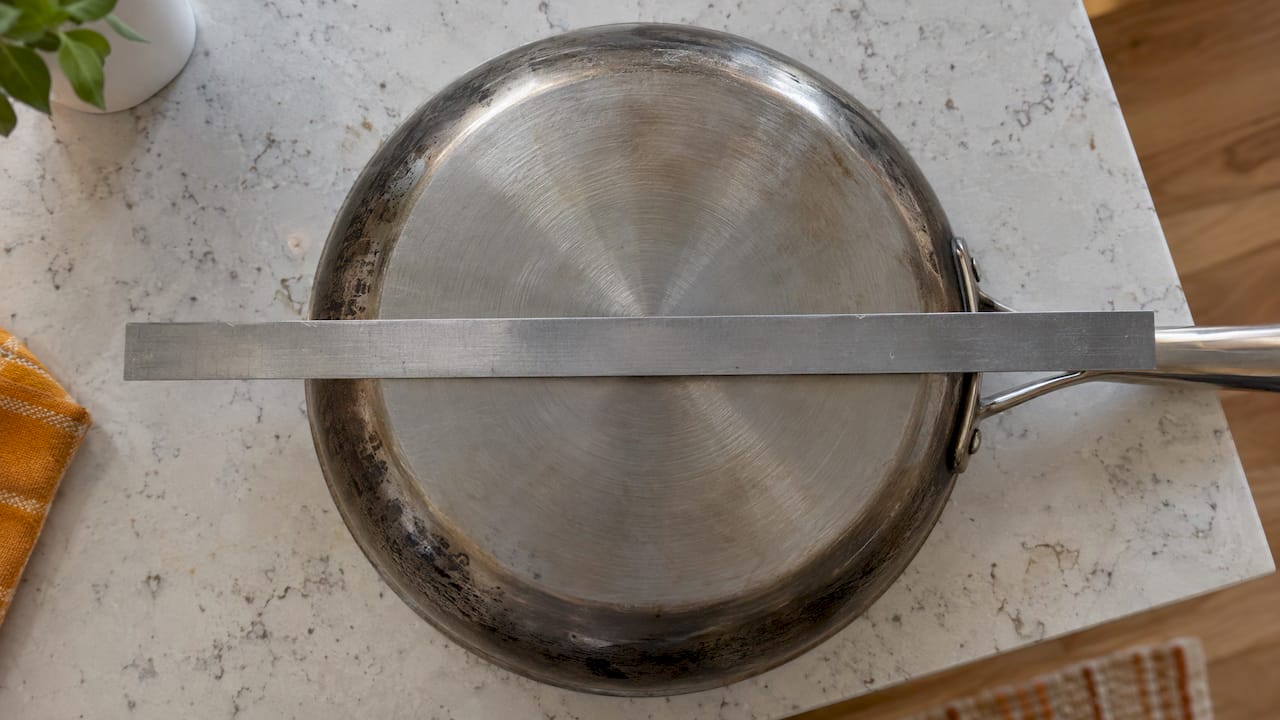
There is a subtlety. The SCHOTT CERAN use and care guide, from the maker of the glass-ceramic panels, says pan bases should be slightly concave at room temperature. Metal expands as it heats, and that slight curve flattens out against the glass. So a pan that is a hair hollow when cold is fine. A pan that rocks because the center bulges downward is not.
Size that matches the burner
Size matters as much as flatness. The Whirlpool WFE525S0JT manual, reproduced on manua.ls, says cookware should not extend more than 1/2 inch (1.3 cm) outside the cooking area. GE’s cookware guidance recommends matching pan diameter to the heating element. For a wok, it recommends a flat-bottom model whose base is the same diameter as the element.
If you are choosing between pan sizes, my comparison of 8, 10 and 12 inch frying pans shows what each one covers. Most radiant elements are sized for the 8 to 10 inch range. A pan whose flat base is much smaller than the pan’s top diameter, or the reverse, will cook unevenly.
Straight sides and a smooth base
A smooth base is a requirement, not a nicety. The Whirlpool manual says rounded, warped, ribbed or dented bottoms cause uneven heating. It also says aluminum or copper bottoms and rough finishes can leave scratches or marks. Run a hand over the base before buying. Exposed rings, ridges or a rough casting texture are all reasons to pass.
Which materials work best
| Material | Fit for a glass top | What to know |
|---|---|---|
| Stainless steel, sandwich-clad | Best all-round | GE names stainless with a sandwich-clad aluminum or copper layer as especially good |
| Heavyweight aluminum | Works | Flat, thick bases only; clean off any residue immediately |
| Flat carbon steel | Works | Smooth, flat bottoms only |
| Enameled steel or thick porcelain enamel | Works | Coating must be smooth; do not let pans boil dry |
| Enameled cast iron | Generally fine | Smooth, sealed finish; lift rather than drag |
| Raw cast iron | Handle with care | Weight and rough texture can scratch or crack glass |
| Glass cookware | Not recommended | Samsung says it may scratch the surface |
| Unglazed stoneware or ceramic | Avoid | Rough bottoms can act like sandpaper |
The material list for stainless, aluminum, carbon steel and porcelain enamel comes from GE Appliances. Samsung’s cookware breakdown lists aluminum and stainless steel as suitable for electric glass cooktops. It allows enamelware only when its coating is smooth.
Stainless steel
Stainless is the pan I would point most buyers toward. Samsung notes that stainless steel is durable, easy to clean, stain-resistant and non-reactive. It also notes that stainless heats relatively slowly and can cook unevenly without suitable construction. That is why the layered base matters: the aluminum or copper core spreads the heat, and the steel faces the glass.
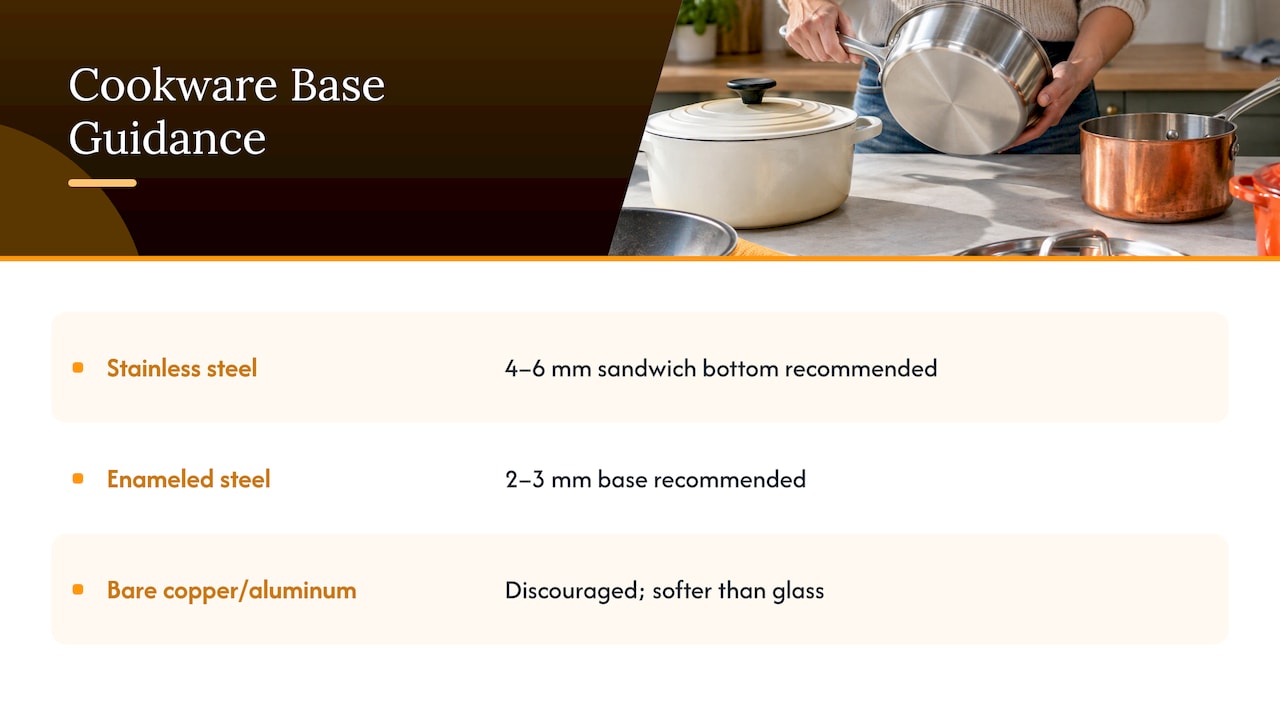
SCHOTT CERAN’s guide is more specific. It recommends stainless steel with a 4 to 6 mm sandwich bottom, or enameled steel with a 2 to 3 mm base. It discourages bare copper or aluminum bases, because they are softer than the glass surface and leave particles that are hard to remove once burned on. If you are weighing stainless against other materials, my guides on hard anodized versus stainless steel and cast iron versus stainless steel go through the cooking differences in detail.
Nonstick and ceramic-coated pans
A nonstick or ceramic-coated pan is fine on glass as long as it has a flat, smooth aluminum or steel base. The coating is on the cooking surface, so the question for the stove is the same as for any pan: is the base flat, heavy enough and smooth? Warping is the usual failure with thin nonstick pans, and it leaves a pan that spins or rocks on the glass. For a closer look at the two coatings, see ceramic versus nonstick cookware. I also wrote a review of the NutriChef 18-piece nonstick set built from owner reports and specifications.
Cast iron and Dutch ovens
Opinions on cast iron vary, and the sources show why. Samsung’s guidance does not recommend cast iron on electric glass cooktops. A popular cooking forum thread says it works fine as long as you lift the pan rather than rub it back and forth. Martha Stewart’s article quotes expert Strout as saying that raw cast iron’s weight and rough texture mean even a gentle slide can cause deep scratches, and a small drop might crack the surface. The same article says enamel-coated cast iron has a smooth, sealed finish that prevents scratches, though it should still be lifted, not dragged.
The practical reading: a smooth enameled Dutch oven is the lower-risk way to get cast iron’s heat retention on glass. Check your own stove manual first, since makers differ. If you are shopping for one, my Dutch oven size guide covers which capacity suits which household. For how long each material tends to last, see the most durable types of cookware.
Materials to leave on the shelf
- Glass cookware. Samsung lists it as not recommended on electric glass cooktops because it may scratch the surface. It is also a slow heat conductor.
- Unglazed stoneware or ceramic. Martha Stewart’s article warns that unglazed bottoms can act like sandpaper and leave permanent marks.
- Raw copper. The same article says it leaves metallic residue that discolors the glass and interferes with heat transfer.
- Warped or rounded pans. They reduce contact, which causes heat loss and stress on the glass.
Using the pans without damaging the glass
Choosing well solves most of the problem. Habits solve the rest.
- Lift, don’t slide. The Whirlpool manual says not to slide cookware across the cooktop. Shake or lift a pan to reposition it.
- Center the pan. GE’s care and cleaning instructions say cookware should be centered on the element.
- Never let certain pans boil dry. GE specifically warns against letting copper-bottom or porcelain enamel pans boil dry.
- Remove food when done. GE notes the cooktop retains heat after shutoff, so taking food off promptly helps avoid overcooking.
- Deal with metal marks quickly. GE advises removing aluminum or copper marks promptly with ceramic-cooktop cleaner and a non-scratch pad, because residue may become permanent if reheated.
For general stovetop grease and residue between deep cleans, this page on kitchen grease cleaning covers how residue builds up around cooking surfaces. If a pan is also going into the oven, check the handle and lid first with my guide to oven-safe cookware.
Rainbow stains and discoloration on stainless steel
If your stainless pans have developed a blue, gold or rainbow sheen, you have not damaged them or the stove. That iridescent tint typically appears when the pan has been heated hard, because high heat changes the thin protective oxide layer on the steel. It is cosmetic, and it does not change how the pan cooks.
If you want the pan to look uniform again, a mild acid is the usual route. Wipe the cooled, empty pan with diluted white vinegar on a soft sponge, rinse well and dry it completely. Avoid steel wool and harsh chemical cleaners, which scratch the finish.
Prevention is mostly about heat. Stainless with a layered base heats evenly, so medium heat is usually enough. Because glass tops hold heat after shutoff, pulling the pan off the element as soon as you finish also helps. Sudden temperature swings, such as cold water into a hot pan, are worth avoiding as well.
A quick buying checklist
- Base is flat when checked with a ruler, with no rocking on the counter.
- Medium to heavy weight, with a clad or thick base.
- Smooth bottom with no ridges, rings or rough casting.
- Diameter that matches your burner, with no more than half an inch of overhang.
- Stainless, aluminum, carbon steel or smooth enameled steel, preferably with a layered core.
- No glass, unglazed ceramic or bare copper bottoms.
If you are budget-minded, buy a few good pans rather than a large thin set. A set is only a bargain if every piece passes the flatness test. For a new home, my list of kitchen essentials shows which pieces matter first, and when to buy cookware covers timing around sales. Gift shoppers should favor a single heavy, clad skillet or an enameled Dutch oven, which suit nearly any stove.
Where to compare pans side by side
I built Kitchenware Compare around side-by-side comparisons of specifications, pricing and owner-reported performance, including the complaints owners raise as well as the strengths. For a glass top, that means looking at base construction, weight and what owners say about warping. You can browse cookware reviews and buying guides to compare pans against the checklist above. If you want to know how I assess products without owning them, how I review kitchen equipment explains the method.
The Kitchenware Compare homepage lists current deals alongside the reviews.
My view on glass tops
Most glass top problems I read about in owner reviews come from one thing: a pan that does not sit flat. Buyers blame the stove, the coating or the brand, when the cause is a thin base that warped after a few months.
That is why I weigh base construction and weight before anything else when I compare pans. A heavy, clad base costs more, but owner reports consistently point to it as the difference between a pan that stays flat and one that spins on the burner.
I also read the stove maker’s own manual before the pan reviews. Makers disagree on cast iron and on a few other materials, so the manual for your range settles questions that no general guide can. Then I compare pans on the points above and the price.
Glenn
FAQ
Can you use stainless steel pans on a glass top?
Yes. Stainless steel is one of the materials Samsung lists as suitable for electric glass cooktops. GE singles out stainless with a sandwich-clad aluminum or copper layer as especially good. Choose a flat, medium to heavy base and lift the pan rather than sliding it.
Can you use ceramic cookware on a glass top?
It depends on the bottom. Ceramic-coated pans with a smooth, flat metal base are fine. Unglazed stoneware or ceramic bottoms are another matter: Martha Stewart’s article warns they can act like sandpaper and leave permanent marks.
Do glass frying pans work on a glass cooktop?
They are not recommended. Samsung says glass cookware is a slow heat conductor and may scratch the cooktop surface. A flat stainless, aluminum or enameled steel pan is a better match.
Can you use Dawn dish soap on a glass stove top?
Yes, on a cool surface. Dawn says its Platinum dish soap can clean glass, ceramic, enamel and stainless steel stovetops. Mix a squirt with warm water, use a sponge, rinse away excess soap and dry immediately. Test a small area first and avoid abrasive tools.
Sources
- GE Appliances: Cookware used on a radiant smooth glass cooktop
- GE Appliances: Radiant range and cooktop cookware
- GE Appliances: Using the range, care and cleaning
- Samsung: cooktop cookware breakdown
- SCHOTT CERAN use and care guide
- Amana AER6303MFS user guide
- Whirlpool WFE525S0JT user manual
- Martha Stewart: The types of pans that can harm your glass cooktop
- Dawn: How to clean your stovetop
Recommended
- Cookware Types for Induction Cooktops: Complete Guide
- Best Cookware for Gas Stove 2026: 5 Sets Reviewed
- Ceramic vs Teflon Pans: Safety, Heat Limits and Lifespan
- Ceramic vs Nonstick Cookware: Which to Buy in 2026?

I'm Glenn, and I started Kitchenware Compare to cut through conflicting product reviews and help readers pick kitchen gear with confidence. I don't own or test the products I write about — these guides are built from verified-purchase reviews, manufacturer specifications, and independent testing where it exists, with the reasoning shown, not just a rating.
Leave a Reply