For most home cooks, a 9 to 10-cup food processor is the right capacity: big enough for a family dinner’s worth of slicing, chopping and dough, small enough to store without a fight. Go down to a 3 to 4-cup mini if you cook for one or two and only need quick jobs. Go up to 12 to 16 cups if you meal prep, bake in bulk or shred produce by the pound. The number on the box is only half the story, though, because the cups a manufacturer prints are not the cups you can use for every task. I explain the difference below, with numbers from real instruction manuals.
TL;DR
- Most households: 9 to 10 cups handles everyday work, according to Good Housekeeping. Choose 12 to 16 cups for meal prep, heavy slicing or large dough batches.
- Cook for one or two, or only chop small amounts: a 1 to 4-cup mini is enough and stays on the counter.
- The label is the bowl’s total volume, not what it holds per task. One 11-cup manual allows only 4 cups of chopped vegetables.
- Bigger is not always better: an oversized bowl processes small amounts less evenly, and it costs more cabinet space.
- Check the manual’s per-task maximums before you buy. They tell you more than the headline cup number.
What “capacity” actually measures
Food processor capacity is the volume of the work bowl, measured in cups. Good Housekeeping’s guide says models typically hold 1 to 16 cups and that the cup figure refers to the work-bowl volume.
That is a ceiling, not a working amount. Sliced lettuce takes up the whole bowl. A thin liquid has to stay below the blade’s seal line or it leaks out of the center. Heavy dough strains the motor long before the bowl is full. So the same bowl has several different real capacities depending on what goes in it. If you want the short version of this, my food processor sizing guide covers it, and this article goes further into the numbers.
Food processor sizes: small, medium and large
There is no industry standard for these words. Retailers and guides draw the lines in different places, so “small” can mean 3 cups in one store and 9 cups in another. Always read the cup number, not the tier name.
Homes and Gardens published a US shopping breakdown in 2024 that pairs capacity with motor power and typical price:
| Tier (Homes and Gardens) | Capacity | Motor | Typical price |
|---|---|---|---|
| Small | 3 to 6 cups | 250 to 300 watts | $30 to $150 |
| Medium | 7 to 10 cups | 500 to 800 watts | $80 to $150 |
| Large | 11+ cups | 800+ watts | $150 to $500 |
Source: Homes and Gardens, 2024. Prices move, so treat these as ranges for that year, not today’s shelf prices.
Two patterns stand out. Wattage rises with capacity, which matters because a big bowl with a weak motor struggles with dough and dense vegetables. And the medium tier is the value sweet spot: its price range overlaps the small tier’s and sits well below the large tier’s.
Match the cup size to your household
Here is how I would sort the common situations, using the published guidance.
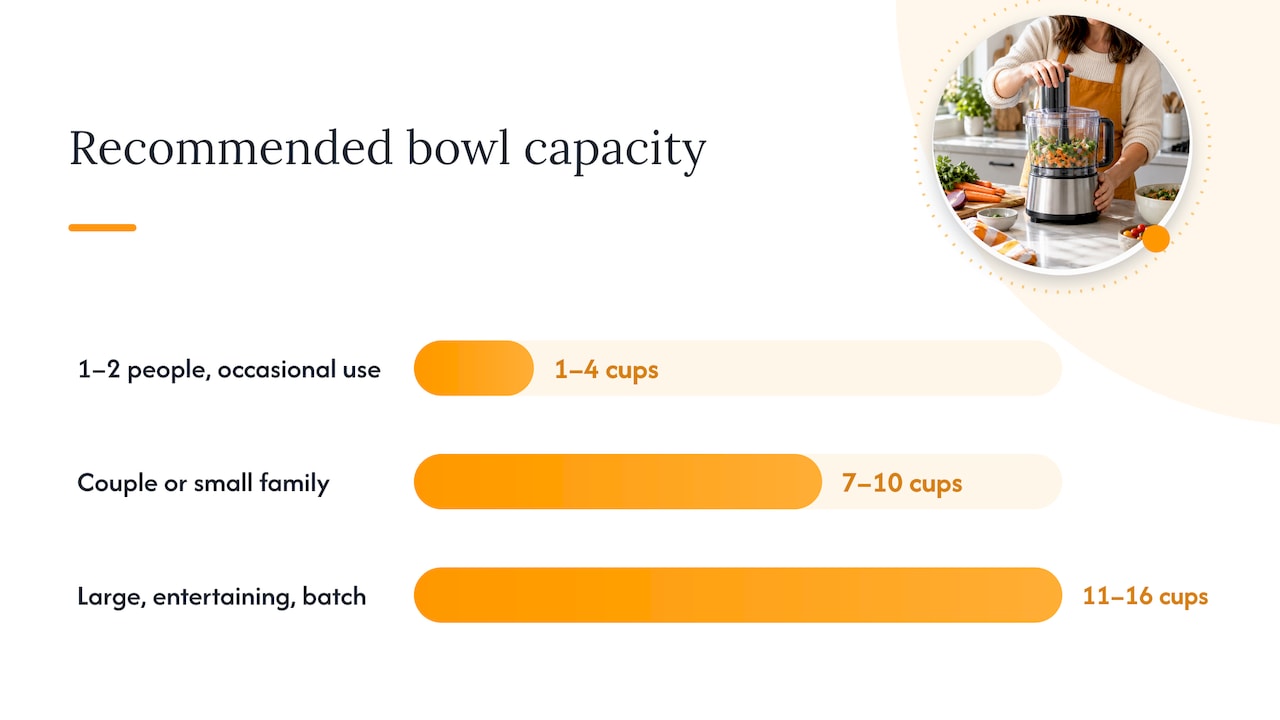
One or two people, occasional use: 1 to 4 cups. Good Housekeeping says a 1 to 4-cup mini suits quick jobs. Think a handful of onions, a pesto, breadcrumbs or a vinaigrette. A mini is easy to store and easy to grab, which means it actually gets used.
A couple or small family, regular cooking: 7 to 10 cups. Homes and Gardens says 7 to 10 cups is enough for a couple or small family. Good Housekeeping agrees that 9 to 10 cups is sufficient for most everyday tasks. This is the size to start from if you are not sure. My BLACK+DECKER 8-cup review looks at one budget model in this range through its specs and owner reviews.
Large household, entertaining or batch cooking: 11 to 16 cups. Homes and Gardens says large homes making big batches of dips, sauces and nut butters need at least 11 cups. Good Housekeeping recommends 12 to 16 cups for meal prepping, heavy produce slicing or big dough batches. If you are shopping at this end, the Cuisinart DFP-14BCNY review breaks down a 14-cup model in detail.
Is 7 cups enough? Is 11 cups enough? A 7-cup model covers a couple’s daily cooking and an occasional batch of salsa or slaw. An 11-cup model covers a larger family and most batch cooking. Epicurious reviewed the Breville Sous Chef 12-cup, which has a 1,000-watt motor, and says its 12-cup dry capacity, with 8½ cups for liquid, is big enough for most tasks unless kitchen space is a major constraint. That suggests the 11 to 12-cup range is the practical upper limit for most households, and 14 to 16 cups is for people who know they need it.
Stated capacity versus usable capacity
This is the part most size charts skip. The cup number is the bowl’s full volume. Instruction manuals list much smaller recommended maximums for individual tasks, and those maximums vary a lot from model to model.
Here are three Cuisinart manuals, each from a different size class.
| Task | 14-cup (FP-14N) | 11-cup (Elemental FP-11) | 9-cup (Premier Series) |
|---|---|---|---|
| Sliced or shredded produce or cheese | 14 cups | 10 cups | Not listed |
| Chopped fruit, vegetables or cheese | 12 cups | 4 cups | 8 cups |
| Chopped or puréed meat | 2¼ pounds | 1½ pounds | 1¼ pounds (chilled, cubed) |
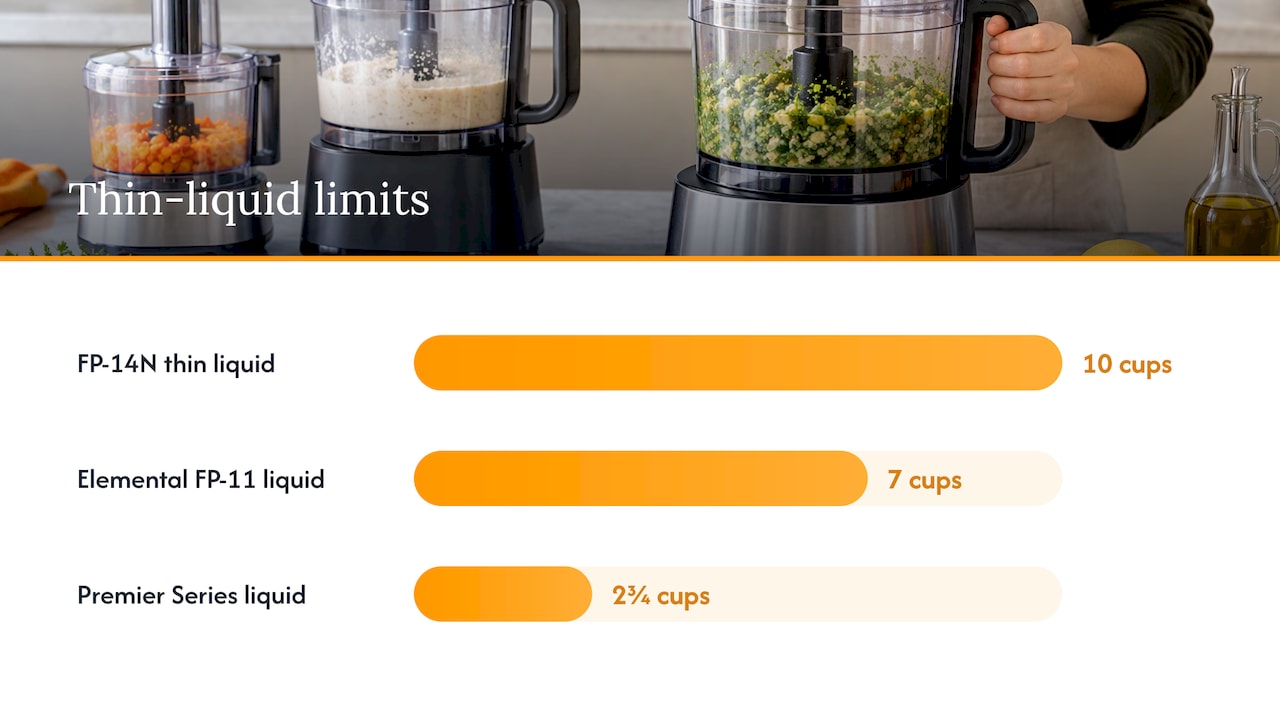
| Thin liquid | 10 cups | 7 cups | 2¾ cups |
| Bread dough flour | 6 cups | 2.5 cups (bread or pizza) | 4 cups |
| Nuts for nut butter | 4 cups | 3 cups | 4 cups |
Sources: the Cuisinart FP-14N instruction booklet, the Cuisinart Elemental 11-cup booklet (2015) and the Cuisinart Premier Series 9-cup booklet.
What this shows:
- Two numbers can be a bad guide. The 11-cup Elemental allows 4 cups of chopped vegetables, while the 9-cup Premier allows 8. A bigger label did not mean more chopping capacity.
- Liquids are the tightest limit. The 9-cup Premier manual caps thin liquids at 2¾ cups. If you make soups or purées, that limit matters more than the bowl size.
- Dough is limited by the motor and the bowl together. The 14-cup manual allows 6 cups of flour for white bread dough and 4 cups for whole wheat. The 11-cup manual allows 2.5 cups. If bread or pizza dough is a regular plan, read the dough line before the cup count. I cover this further in food processor for dough.
- Egg-based liquids need extra room. The FP-14N manual says to reduce the thin-liquid maximum by 2 cups for egg-based mixtures such as a quiche custard base. It also says never to fill the bowl above the marked maximum fill line.
These limits come from the manufacturers’ own booklets for those specific models. Other brands set their own, so the table is a demonstration of the gap, not a rule for every machine. The practical step is simple: before you buy, find the manual (most brands post it on the product page), and look for the table of maximum quantities. Match the lines to what you cook.
Why a bigger bowl is not automatically better
It is tempting to buy the largest size “just in case.” Homes and Gardens warns that when you size up, the blades won’t process as thoroughly when the bowl isn’t very full. If you mostly chop one onion or a handful of herbs, a 14-cup bowl spreads that food thin across a wide base, and you spend time scraping down the sides.
The opposite mistake is just as real. The same guide says sizing down means you run chopping, dicing, slicing and blending in multiple batches. A 3-cup chopper that makes a family’s coleslaw in four rounds quickly stops being a convenience.
There is a cost angle too. Using the price ranges above, medium models cost less than large ones, and they overlap with small models on price. If you only need 8 to 10 cups, paying for a 14-cup bowl and a bigger motor is money that does nothing for you.
Feed tube width and counter space
Capacity is not the only dimension that scales with size. Two others matter in daily use.
Feed tube. A wider feed tube means less pre-cutting. Large models generally have wider tubes that take whole potatoes or zucchini. If you slice a lot of produce, that saved prep time is often the main benefit of a larger machine, more than the bowl volume.
Footprint and storage. Homes and Gardens notes that footprint grows with capacity, and it suggests two checks: confirm the accessories store inside the bowl, and measure under your wall cupboards to be sure the machine fits with the lid and feed chute attached. A 14-cup machine that lives in a closet gets used less than a 9-cup machine that stays on the counter. Be honest about where it will sit.
Capacity for meal prep and holiday cooking
Batch cooking is where capacity pays off most. If your plan is to cook once and eat all week, you will probably hit the 10-cup mark when slicing cabbage, shredding carrots or processing a double batch of hummus. These holiday meal prep tips for busy home cooks show how much of a holiday menu can be prepped ahead, which is exactly when the extra cups save time.
A useful rule: size the bowl to your largest regular job, not your average one. If the biggest thing you do is a double batch of pie dough once a year, the manual’s dough maximum should fit that one job, and a medium machine will handle everything else.
Quick picks by type of buyer
- First-time buyer: start with 9 to 10 cups. It covers the widest range of recipes, and you can see what you actually use before spending more.
- Budget-conscious shopper: the medium range, 7 to 10 cups, sits in the $80 to $150 band in Homes and Gardens’ breakdown, and that is where price and capacity balance best. My best food processor roundup sorts picks by budget.
- Home cook who prepares large meals: 12 to 14 cups, with the per-task maximums checked for dough and chopping.
- Professional or semi-professional cook: 14 to 16 cups gives the throughput for repeated large batches, and Epicurious’s review of a 12-cup, 1,000-watt model shows the motor power to look for at that level.
- Gift shopper: a 9 to 10-cup model suits almost any home kitchen. A mini works as a smaller gift for someone with limited space.
Perspective
I read food processor capacity as a question about your biggest regular job, not your average one. Most guides stop at the cup number, and that is where buyers go wrong.
The manuals show why. A bowl labeled 11 cups can allow 4 cups of chopped vegetables, while a 9-cup bowl from the same brand allows 8. The label is a size class, not a promise. When I compare models, I put the specifications, the price and the owner-reported experience side by side, and the per-task maximums are the line I look for first.
I don’t use or test any of these machines. What I do is read the specs and the instruction booklets, and I read what owners report after months of use. For capacity, that is enough to point most people to 9 to 10 cups, and to point heavy bakers and meal preppers to 12 to 14. My full approach is on the how I review kitchen equipment page.
Glenn
Compare food processors side by side
Once you know your cup range, the next job is choosing a model inside it. My food processor reviews and buying guides put specifications, pricing and owner-reported strengths and complaints for each model in one place, so you can compare bowl size, motor power and feed tube width without opening ten tabs. If you buy through a link, the affiliate disclosure explains how the site earns.

For a head-to-head example of two large machines, see my Cuisinart DFP-14BCNY vs. Ninja BZ601 comparison.
FAQ
What capacity food processor do I need?
For most households, 9 to 10 cups is the safe choice, according to Good Housekeeping. Pick 12 to 16 cups if you meal prep, slice a lot of produce or make large batches of dough. A 1 to 4-cup mini is enough for one or two people doing small jobs.
What is a high-capacity food processor?
There is no fixed line. Homes and Gardens counts 11 cups and up as large, with motors of 800 watts or more. Good Housekeeping treats 12 to 16 cups as the range for heavy use. In practice, high capacity means a bowl of 11 to 16 cups and a stronger motor to match.
Is a 7-cup food processor big enough?
Yes, for a couple or small family. Homes and Gardens says 7 to 10 cups covers that kind of household. It handles daily chopping, slicing and sauces. It will mean extra batches if you often cook for a crowd or make large amounts of dough.
Is an 11-cup food processor big enough?
For most people, yes. Check the manual first, because per-task limits differ. One 11-cup Cuisinart booklet lists 4 cups for chopped vegetables and 2.5 cups of flour for bread dough. If you do either often, compare that against your usual quantities.
How do I know the usable capacity of a food processor?
Find the instruction booklet on the manufacturer’s product page and look for the table of maximum quantities. It lists limits for slicing, chopping, liquids, meat, dough and nuts. Those figures are the usable capacity for each task, and they are almost always lower than the cup number on the box.
Sources
- Good Housekeeping: Your Full Food Processor Guide
- Homes and Gardens: How to choose a food processor
- Epicurious: Best Food Processor (2025)
- Cuisinart FP-14N instruction and recipe booklet
- Cuisinart Elemental 11-cup instruction and recipe booklet
- Cuisinart Premier Series 9-cup instruction and recipe booklet
Recommended
- What Size Food Processor Do You Need? (Sizing Guide)
- Food Processor vs. Blender: What’s the Difference
- 10 Creative Uses for a Food Processor Beyond Chopping
- How to Clean a Food Processor: Full Guide

I'm Glenn, and I started Kitchenware Compare to cut through conflicting product reviews and help readers pick kitchen gear with confidence. I don't own or test the products I write about — these guides are built from verified-purchase reviews, manufacturer specifications, and independent testing where it exists, with the reasoning shown, not just a rating.
Leave a Reply