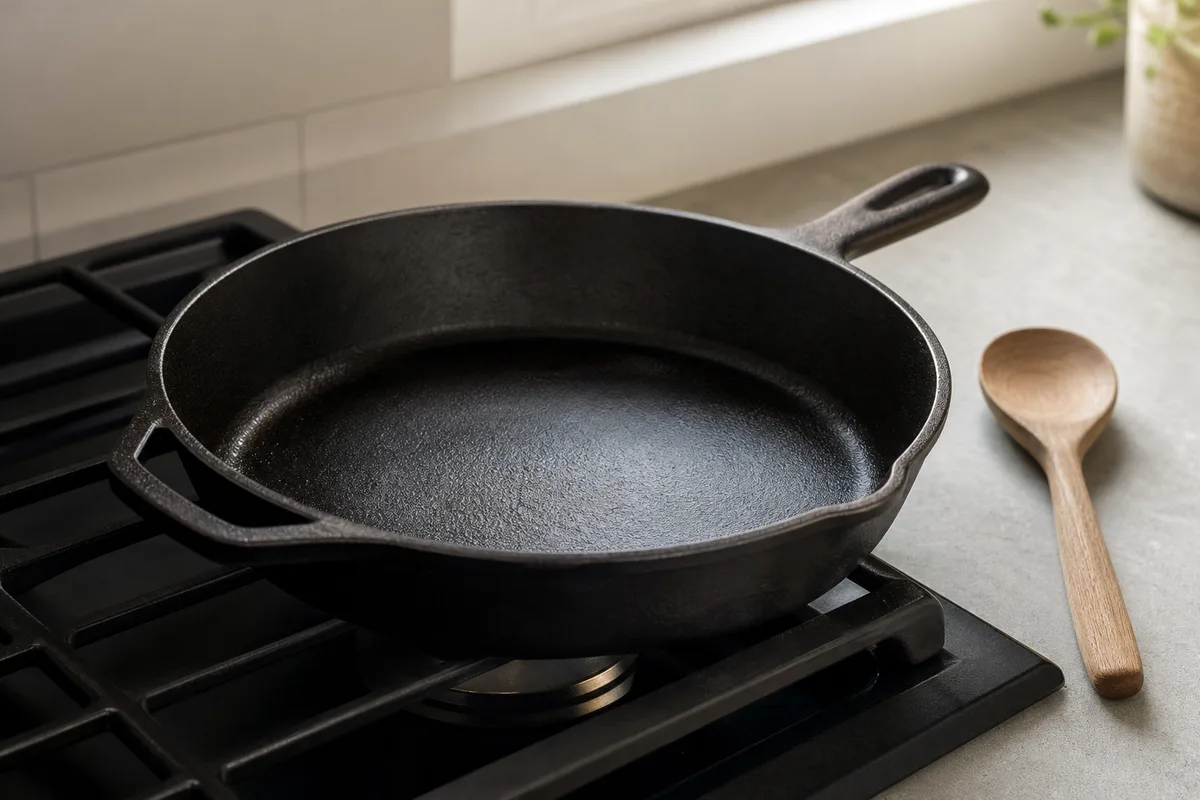
Cast iron smokes when the oil in it goes past its smoke point, and the first thing to suspect is a pan that is too hot. Lodge says that if a pan is too hot, the oil in it will start to smoke, and that the fix is to take it off the heat for a minute or two. A low smoke point oil or too much oil makes it worse.
On enamel, makers also warn that heating the pot empty can damage the coating. Smoke while seasoning bare iron is different: there it is the point.
Why Is My Cast Iron Smoking? The Causes to Check
1. The pan is too hot
Check this first. Lodge’s water test says that if drops of water dance on the pan, it is at the right temperature, and if they evaporate quickly or the oil starts to smoke, it is too hot. Le Creuset says cast iron retains heat so efficiently that overheating will cause food to burn or stick.
2. The oil cannot take the heat
Lodge says the cooking temperature should be below the smoke point of the oil, so the bottle matters as much as the burner. Le Creuset says olive oil may cause excessive smoking on its grill pans and recommends vegetable, groundnut or corn oil. ThermoWorks’ smoke-point chart puts butter at 302°F and extra virgin olive oil at 374°F, against 435°F for canola and 520°F for refined avocado oil. Those are one chart’s figures, so treat them as approximate and check the bottle.
3. Too much oil
N.C. Cooperative Extension’s Polk County Center says oven seasoning should never produce flames or heavy smoke, because only a small layer of oil is used. By that reasoning, heavy smoke points to a coat that is too thick. Field says too much oil, whether from seasoning or just cooking with a lot of it, can leave a sticky residue of oil that did not fully polymerize; the fix for that is in why cast iron goes sticky after seasoning.
4. Enamelled cast iron: smoking oil and empty heating
Enamel makers treat smoke as a mistake. Lodge says not to heat empty enameled cast iron on the stovetop, and to start with low heat and water or oil inside; it says an empty preheat in the oven is safe. Staub says to heat enameled cast iron slowly, never empty, and to always add a drop of cooking oil to prevent damage from overheating. Le Creuset says oil hot enough to start smoking, or butter that starts browning, is too hot, and the quickest fix is to lift the pan off the heat for a few moments.
If something has already burnt onto the enamel, the guide to cleaning enameled cast iron covers getting it off.
5. You are seasoning, or the pan is new
Smoke during seasoning is expected on bare iron. Smithey’s stovetop method heats a thin coat of oil until faint wisps of smoke rise and holds it there for about 60 to 90 seconds, with an exhaust fan on or a window open. Finex fixes patchy seasoning by heating a light coat of oil over medium heat until the oil begins to smoke. The full method and oven temperatures are in the guide to how to season a cast iron pan.
A brand-new pan is a gap in the sources. Lodge says its pans are seasoned at the foundry with soy-based vegetable oil and need only a rinse and dry before cooking, and that dark residue on a towel can appear on brand-new cookware and is normal and safe. No maker I read says whether a new pre-seasoned pan should smoke on its first heats, or for how long.
What Each Maker Says About Heat and Smoke
Each row comes from the maker’s or agency’s own care, seasoning or FAQ page.
| Source | Finish | Heat for cooking | What it says about smoke or overheating |
|---|---|---|---|
| Lodge | Bare | Preheat slowly with oil; the skillet is ready when the oil shimmers and ripples. | If the oil begins to smoke, the pan is too hot; take it off the heat for a minute or two. |
| Lodge enameled | Enamel | Use low to medium heat and a generous amount of oil. | Do not preheat it empty on the stovetop, as that could damage the enamel coating. |
| Le Creuset | Enamel | Medium or low heat gives the best results, including for frying and searing; never preheat on high. | Oil that starts smoking is too hot; on grill pans, olive oil may cause excessive smoking. |
| Staub (Zwilling) | Enamel | Heat slowly, never empty; on induction, preheat on low for 5 minutes before turning up. | Always add a drop of oil to prevent damage from overheating. |
| Smithey | Bare | Keep the burner no higher than the 50% mark; the pan is ready when the handle is warm. | Seasoning takes oil to faint wisps of smoke; very high heat can burn off existing seasoning. |
| Field | Bare | Preheat at low to medium heat for up to 5 minutes on any burner. | Season just below the oil’s smoke point; too long above it risks burnt carbon. |
| Stargazer | Bare | Preheat on low for 5 to 10 minutes before turning up the heat. | Season with high smoke point oils such as grapeseed or avocado. |
Bare vs Enamelled Cast Iron: Opposite Rules on Smoke
On bare iron, smoke is part of seasoning; on enamel it is a warning. Lodge says none of its enameled pieces need seasoning, even those with a black interior. The exception is Le Creuset’s grill pans: Le Creuset says to heat the empty grill on medium for several minutes and not to add oil to the cold pan, because the oil may become too hot and smoke. For its other enamelled pans, it says the oil, fat or liquid should completely cover the base before heating begins.
Oven limits split the same way. Le Creuset gives 260°C for pans with cast iron handles and Staub gives 250°C/500°F, while N.C. Cooperative Extension seasons bare iron at 550°F, so that temperature is for bare iron only.
How to Stop Cast Iron Smoking
- Take the pan off the heat for a minute or two, as Lodge advises. If the smoke keeps building, go to the fire section below.
- Preheat lower and longer: low to medium, for the times in the table above, never on high. Smithey’s check is the handle: once it is warm to the touch, the pan is ready.
- Watch the oil. Add food when it shimmers and ripples, before it smokes.
- Give the oil headroom. ThermoWorks says to pick an oil whose smoke point is well above your cooking temperature.
- Never heat enamel dry. The oil or liquid goes in before the heat goes on.
- Ventilate. The ductless range hood guide covers what a hood without outside venting can and cannot clear.
When Smoke Turns Into a Fire Risk
The U.S. Fire Administration says fires start when the heat is too high, and that if you see any smoke or the grease starts to boil, you should turn the burner off. It says to keep a pan lid or baking sheet nearby and use it to cover the pan if it catches fire. ThermoWorks makes the same link from the oil side: push an oil too far beyond its smoke point and it will ignite.
On fumes, the sources are thin. Zwilling, which owns Staub, says in its cookware FAQ that butter, fats and oils start to smoke at 204°C and that the vapours can irritate the eyes, nose and throat and possibly cause respiratory problems, but that answer sits in its non-stick section and is not specific to cast iron. I found no cast iron maker in these sources that gives a health threshold for oil smoke.
Where the Sources Disagree
- Past or below the smoke point when seasoning. Smithey, Finex and N.C. Cooperative Extension take oil to the smoke point or beyond. Field says the ideal is just below it, and that oil held above it too long can skip the polymer stage and turn to burnt carbon.
- Seasoning oven temperature. Field finishes at 400°F after stages at 200°F and 300°F, Lodge uses 450-500°F, Stargazer 475°F and N.C. Cooperative Extension 550°F. None of them says how much smoke its temperature produces.
- How hot to sear. Le Creuset says medium or low heat is enough even for searing and Smithey caps the burner at the 50% mark, while Smith & Clark says medium-high heat gives the best results. If your pan smokes, start from the lower settings.
- Beef tallow. Smithey lists beef tallow among fats that work for seasoning; Lodge advises against beef tallow, lard or ghee for seasoning because they can go rancid, though it says cooking with them is fine. ThermoWorks’ text says animal fats such as beef tallow begin to smoke around 375°F, while its own table lists beef tallow at 480°F.
- Burnt-off seasoning. If black flakes come off after a smoky session, see why cast iron seasoning flakes off.
How This Page Was Researched
This page is based on the makers’ own care, seasoning and FAQ pages, an extension-service seasoning guide, federal cooking-fire advice and one published smoke-point chart, all named where they are used. It is built from reading those sources, not from testing pans.
What could not be established: smoke points for specific oils from any cast iron maker (the figures above are one secondary chart’s), how long a new pre-seasoned pan may smoke on its first heats, how much smoke each seasoning temperature produces, a health threshold for oil smoke from cast iron, and whether a single smoking-hot episode damages enamel.
The Verdict
In the makers’ guidance, smoke while cooking means the pan is too hot for the oil in it. Turn the burner down, preheat low and slowly, use a thin film of an oil with headroom above your cooking heat, and never heat enamel empty on the stovetop. If the pan itself is past saving, the best cast iron skillet guide compares replacements, and the cookware hub covers the rest of the range.
Frequently Asked Questions
Is it normal for cast iron to smoke?
Only when seasoning bare iron, where Smithey and Finex heat a thin coat of oil until it smokes. While cooking, Lodge says oil that starts to smoke means the pan is too hot and should come off the heat for a minute or two. Enamelled pans should not smoke.
Why does my cast iron smoke when I preheat it?
The heat is probably too high for the oil in the pan. Field recommends low to medium heat for up to 5 minutes, and Stargazer low for 5 to 10 minutes. Le Creuset says high heat should never be used to preheat a pan.
Why is my enameled cast iron smoking?
The oil got too hot; enamel makers also warn against heating it empty. Lodge says not to preheat empty enameled cast iron on the stovetop, and Staub says never heat it empty and always add a drop of oil. Le Creuset says smoking oil is too hot.
What oil smokes least in a cast iron pan?
A refined oil with a high smoke point. ThermoWorks’ chart lists refined avocado oil at 520°F and canola at 435°F, against 374°F for extra virgin olive oil and 302°F for butter. No cast iron maker in these sources publishes smoke points for individual oils, so check the bottle.
Is smoke from cast iron dangerous?
It can become a fire. The U.S. Fire Administration says to turn the burner off if you see any smoke or the grease starts to boil, and to cover a burning pan with a lid or baking sheet. Zwilling says oil vapours can irritate the eyes, nose and throat.
Does smoking damage cast iron seasoning?
It can. Smithey says super high heat can burn off existing seasoning. Lodge says dark residue on a towel after really high heat is normal and safe, and that it works itself out as you keep cooking. Re-season if bare iron or flaking appears.

I'm Glenn, and I started Kitchenware Compare to cut through conflicting product reviews and help readers pick kitchen gear with confidence. I don't own or test the products I write about — these guides are built from verified-purchase reviews, manufacturer specifications, and independent testing where it exists, with the reasoning shown, not just a rating.
Leave a Reply