There are two mechanisms and two power sources. A grinder either chops beans with a spinning blade or crushes them between burrs, and it is either turned by hand or driven by a motor. Pick the mechanism first, because it decides how even your grounds are. Pick the power source second, because it decides how much effort and counter space the grinder costs you each morning. This guide walks through each type, who it suits and how to match it to the way you brew.
A note on scope: I review kitchen equipment from specifications, owner reviews and cited third-party sources. I do not own or use the products I write about, and where a claim comes from someone else, I name them.
TL;DR
- Burr grinders crush beans between two abrasive surfaces and give you adjustable, more uniform grounds. They are the default recommendation for anyone who brews every day.
- Blade grinders chop beans like a tiny food processor. They are cheap and compact, but you control the result only by timing.
- Manual grinders cost less for a given burr quality and need no outlet. Electric grinders trade that for speed and convenience.
- Match the grinder to your brew method: coarse for immersion, medium for drip, fine for espresso, and the finer you go, the more adjustment range you need.
- If you are unsure, a burr grinder with many clearly stepped settings is the safest first buy.
The two mechanisms: blade versus burr
Every coffee grinder breaks beans into smaller pieces. What differs is how it does it, and that difference shows up in the cup.
According to Out-In’s grinder buying guide, a burr grinder crushes beans between two abrasive surfaces, one fixed and one rotating, so the gap between them sets the grind size. The same guide describes a blade grinder as a spinning metal blade that chops beans into progressively smaller pieces, much like a small food processor.
That single distinction explains most of the trade-offs:
| Feature | Burr grinder | Blade grinder |
|---|---|---|
| How it works | Crushes beans between two burrs | Chops beans with a spinning blade |
| Grind consistency | More uniform particles | Mixed particle sizes |
| Adjustability | Multiple precise settings | Timing only |
| Heat | Minimal | More heat from the spinning blade |
| Price | Higher | Budget-friendly |
| Size | Usually larger | Compact |
| Learning curve | A few settings to learn | One button |
The comparison above follows the points Out-In’s guide lays out. The practical reading is simple. If you want to change your brew method, dial in a new bag of beans or fix a cup that tastes sharp or bitter, you need a grinder that lets you move the grind size in repeatable steps. A burr grinder does that. A blade grinder cannot, because you are guessing with a timer.
Why even particles matter
When grounds are a mix of dust and chunks, water extracts from them at different rates. The fine particles over-extract and add bitterness while the large ones under-extract and taste thin or sour. A burr grinder narrows that spread. This is why nearly every serious coffee equipment review starts with the grinder before the brewer.
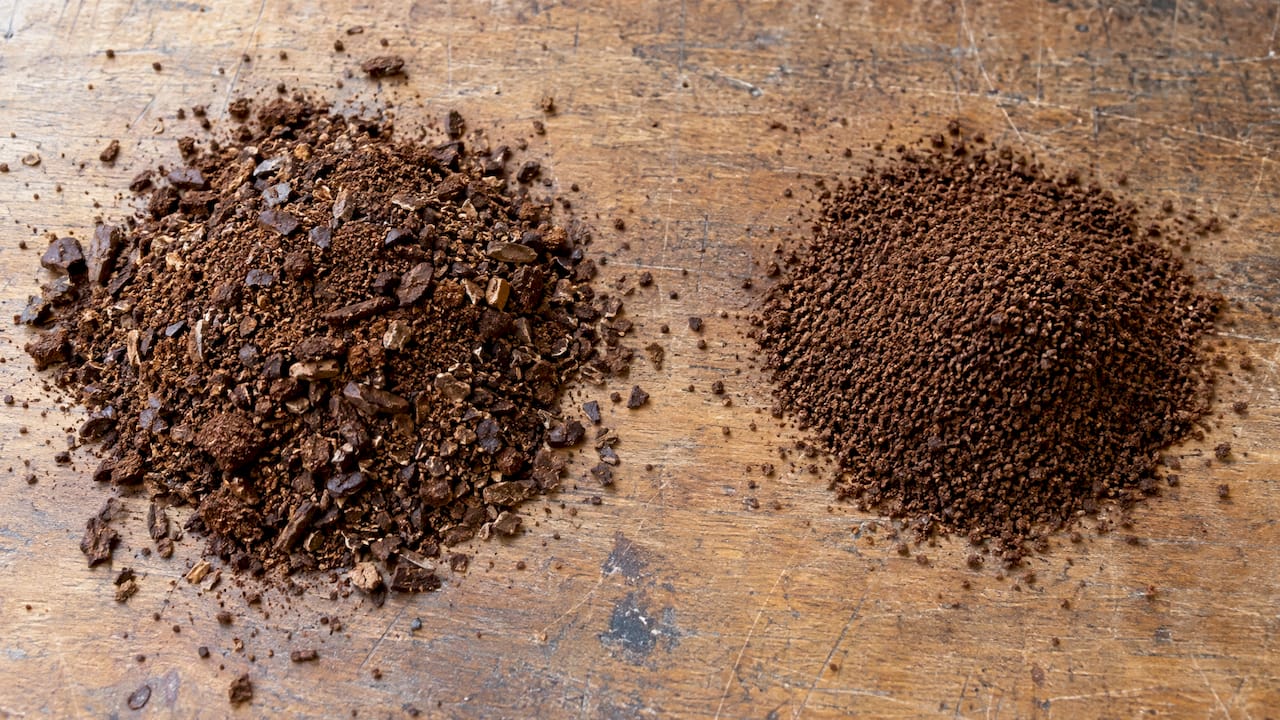
I would not call a blade grinder useless. For a coarse grind that goes into a French press, where small inconsistencies are more forgiving, or for someone who drinks coffee occasionally and wants the lowest entry price, it does the job. It is a poor match for espresso, where fine, even particles are essential.
Burr grinder subtypes: flat and conical
Once you settle on burrs, you will see two shapes in the product specifications: flat and conical.
Conical burrs have a cone-shaped inner burr that turns inside a ring-shaped outer burr. Most home grinders use this design. It tends to suit compact motors and quieter operation, and it is the layout you will find in the majority of mid-priced home machines.
Flat burrs use two ring-shaped discs facing each other. They are more common in higher-end home grinders and café equipment, and enthusiasts often prefer them for a particular flavor profile.
For most home cooks, the burr shape matters less than three other things listed on the spec sheet:
- Number of settings. More steps mean finer control, which matters most for espresso.
- Burr material. Steel and ceramic are the usual options. Check which one the manufacturer states.
- Motor and build. A sturdy motor and a stable body reduce wobble and noise.
If you want a worked example of a burr grinder with a wide range of settings reviewed from specs and owner feedback, my Breville Smart Grinder Pro review covers what owners praise and what they complain about.
Manual versus electric grinders
The second split is about power. It is independent of the mechanism: you can find manual burr grinders and electric burr grinders, and blade grinders are almost always electric.
Manual grinders
A manual grinder has a hand crank. Because there is no motor, the money goes into the burrs and body, so a manual grinder usually gives you better burr quality per dollar than an electric model at the same price. It is also small, quiet and independent of an outlet, which makes it a natural fit for travel, camping, a small apartment kitchen or an office desk.
The cost is effort. Grinding for one or two cups is quick. Grinding for a full carafe, or for fine espresso-style grounds, takes noticeably more work. If you make coffee for a household every morning, think about whether you will still want to crank every day after the first few weeks.
Electric grinders
An electric grinder does the work for you. You press a button or set a timer and walk away. Many models add features such as a built-in timer, dosing controls or a hopper that holds a few days’ beans. The downsides are the ones you expect: they take counter space, need an outlet, are louder and usually cost more for equivalent burr quality.
For a deeper side-by-side look at the buying decision, I have a dedicated page on manual versus electric grinders.
Which grinder type fits which brewing method
Grind size is the link between your grinder and your brewer. A rough guide, which is a general convention rather than a rule:
| Brew method | Typical grind | What the grinder needs |
|---|---|---|
| French press, cold brew | Coarse | Almost any grinder; a blade grinder is workable |
| Drip coffee maker, pour-over | Medium | A burr grinder for even extraction |
| Moka pot | Medium-fine | A burr grinder with fine steps |
| Espresso machine | Fine | A burr grinder with a wide range and small adjustment steps |
The pattern is that the finer your target, the more the grinder’s precision matters. A coarse grind forgives a lot. A fine grind does not. If you own or plan to buy an espresso machine, budget for the grinder as seriously as for the machine, since an inexpensive machine paired with a good grinder will usually serve you better than the reverse.
How to choose: a short decision path
Work through these questions in order.
- Do you brew mostly coarse coffee, once in a while? A budget blade grinder can work, though a manual burr grinder often costs about the same and gives you more control.
- Do you brew daily with a drip machine or pour-over? Choose a burr grinder. Electric if you value speed, manual if you value size and quiet.
- Do you make espresso? Choose a burr grinder with many fine adjustment steps. Check the specifications for the number of settings and read owner reviews for complaints about steps being too coarse at the fine end.
- Do you travel or have no counter space? A manual burr grinder is the natural pick.
- Do you grind for several people at a time? Look at electric models with larger hoppers and faster motors.
What to read in the spec sheet
I compare grinders on the figures that predict day-to-day use:
- Settings range and step size. Are the steps labeled and clearly spaced, or is there a continuous dial that is hard to repeat?
- Burr type and material. The manufacturer should state both.
- Hopper and grounds capacity. This matters for batch brewing.
- Footprint and height. Measure the gap under your cabinets before you order.
- Warranty length. A longer warranty on the motor is a sign the maker expects the unit to last.
- Owner-reported complaints. Look for patterns, such as noise, static or a particular part failing, rather than single bad reviews.
This is the same method I describe on my page about how I review kitchen equipment: specifications, pricing, owner review data and named third-party sources, never claims of personal use.
Common mistakes when buying a grinder
Spending on the brewer and skimping on the grinder. Whatever you brew, the grounds start at the grinder. A good grinder improves a modest brewer more than the reverse.
Buying for a method you do not use. Some people buy an espresso-capable grinder for a drip habit and pay for range they never touch. Others buy a coarse-only model and later buy an espresso machine. If you might change methods, buy for the finer method.
Assuming more settings always means better. A long list of settings helps only when the steps are small and repeatable at the end of the range you use most.
Ignoring noise and counter space. Both appear in owner reviews often, and both decide whether a grinder gets used every morning.
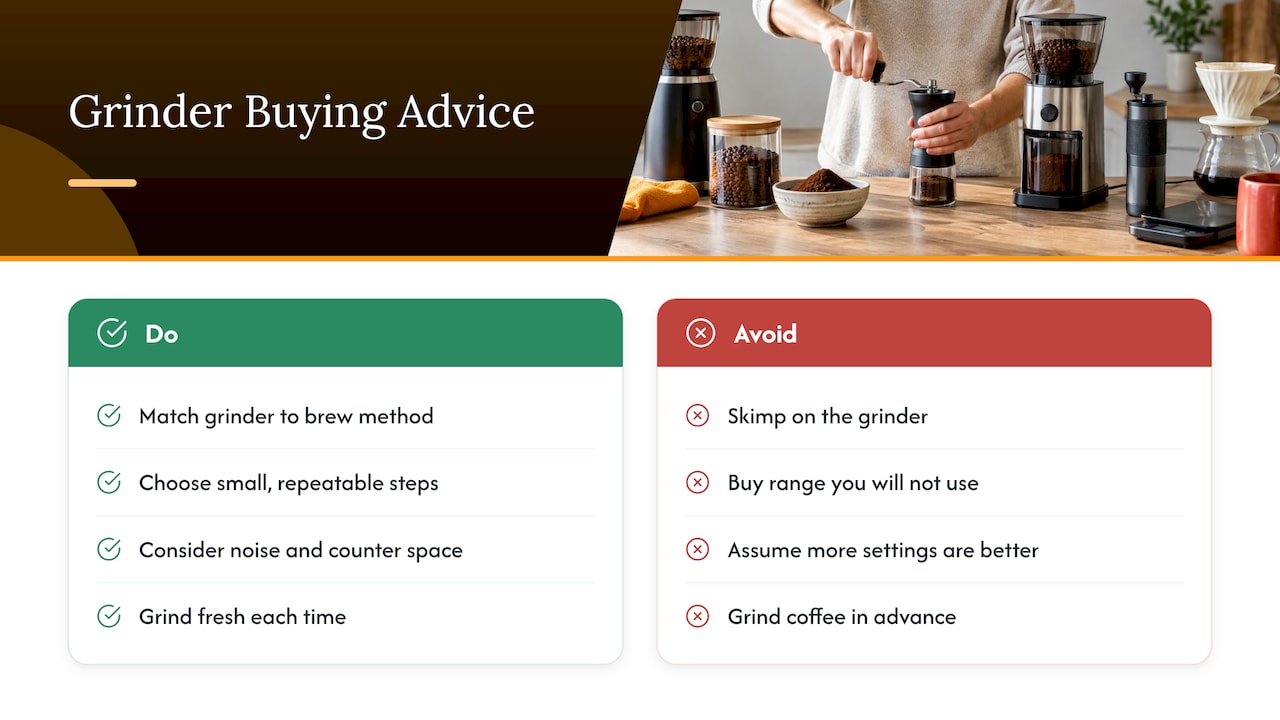
Grinding in advance. Ground coffee has far more surface area than whole beans, so it goes stale faster. A grinder that is quick enough to use fresh each time tends to be used fresh each time.
My take on grinder types
I start every coffee equipment recommendation with the grinder, and I recommend a burr grinder for anyone who brews daily. The reasoning is mechanical: burrs let you set a size and repeat it, and a blade leaves you adjusting by the clock.
The manual versus electric question is a lifestyle question, not a quality ranking. A manual grinder is a very good answer for one or two cups a day, travel, or a small kitchen. An electric grinder is the better answer when speed and volume matter. I read specifications, pricing and owner reviews side by side so you can see both the strengths and the complaints owners report, and I do not claim to have used any of these products myself.
If you take only one thing from this page: decide your brew method first, then buy the simplest burr grinder that covers its grind range with steps you can repeat.
Glenn
Compare grinders and brewers side by side
If you are ready to narrow down a shortlist, my comparisons set specifications, pricing and owner feedback next to each other, with current deals where retailers offer them. Start from the Kitchenware Compare homepage and browse the coffee equipment reviews. Some links on the site are affiliate links, which I explain on the affiliate disclosure page.

If you also need pans to go with your morning setup, my cookware reviews and buying guides cover sets, pans and cast iron the same way.
FAQ
Is a burr grinder really better than a blade grinder?
For most brewing, yes. A burr grinder crushes beans between two surfaces, so the gap sets the grind size and the particles come out more even. A blade grinder chops by time, which gives mixed sizes. Coarse brewing such as French press is the one case where a blade grinder is a workable budget choice.
Are manual grinders as good as electric ones?
They can be. Without a motor, a manual grinder puts the budget into burrs and body, so it often has better burr quality than an electric model at the same price. The trade-off is effort, especially for larger batches or fine grinds. If you brew one or two cups, a manual burr grinder is a strong option.
Do I need a different grinder for espresso?
You need a burr grinder with fine, small adjustment steps and a range that reaches the fine end. Many grinders made for drip coffee stop short of that range. Check the number of settings and read owner reviews about the fine end before buying.
Flat or conical burrs: which should I pick?
For most home use, either works well, and the spec details matter more than the shape. Look at the number of settings, burr material and build quality. Conical burrs are common in compact home grinders, while flat burrs are more often found in higher-end models.
Sources
Recommended
- Manual vs Electric Grinder: Which Should You Buy?
- Coffee Grinder Not Grinding? Three Different Faults
- How to Clean a Coffee Grinder: What Makers Say
- Breville Smart Grinder Pro Review: Worth $200?

I'm Glenn, and I started Kitchenware Compare to cut through conflicting product reviews and help readers pick kitchen gear with confidence. I don't own or test the products I write about — these guides are built from verified-purchase reviews, manufacturer specifications, and independent testing where it exists, with the reasoning shown, not just a rating.
Leave a Reply