PFAS-free cookware is made without any member of the PFAS chemical family, which includes the PTFE coating used on most traditional nonstick pans. That is a broader promise than “PFOA-free,” which only rules out one chemical. If you want a pan with no PFAS, your realistic options are stainless steel, cast iron, carbon steel, enameled cast iron, and nonstick pans that use a ceramic-type coating instead of PTFE. I haven’t handled any of these products myself, so everything below rests on published specifications, owner reviews, and the named sources I cite.
TL;DR
- PFAS-free is not the same as PFOA-free. A PFOA-free pan can still carry a PTFE coating, and PTFE is itself a PFAS.
- Uncoated metals and enameled cast iron avoid PFAS coatings altogether. Ceramic-type nonstick is the main PFAS-free option if you want a slick surface, and it works best with gentle heat and care.
- Aluminum safety depends on the pan. Anodized or sealed aluminum is a different proposition from worn, pitted, or unbranded imported aluminum, which the FDA has flagged for lead.
- Check the claim, not just the headline. Look for PFAS-free or fluorine-free wording on the product page, a named coating material, and a seller who answers plainly.
What PFAS-free cookware actually means
PFAS stands for per- and polyfluoroalkyl substances. According to ASAI Cookware (2026), it is an umbrella term for more than 12,000 synthetic chemicals. PFOA (perfluorooctanoic acid) is only one of them.
In cookware, the PFAS that matters most is PTFE, the fluoropolymer coating that makes a pan slick. As C&EN reported in 2025, PTFE-based coatings have been the gold standard for nonstick for about 70 years. A pan sold as PFAS-free is meant to contain none of this family, PTFE included.
Two practical points follow:
- “PFAS-free” is a claim about the whole product, coating and any other fluorinated components. It is a stronger statement than any single-chemical claim.
- “Fluorine-free” and “PTFE-free” point the same direction, but PTFE-free alone says nothing about other fluorinated substances. The wording on the page is worth reading closely.
PFOA-free vs PFAS-free vs PTFE: untangling the labels
This is where most shoppers get caught. PFOA was phased out of U.S. nonstick manufacturing years ago, so “PFOA-free” is now close to standard on PTFE pans. It tells you very little.
The Ecology Center’s Still Cooking report explains that PFAS is a broad family while PFOA is just one member, so a PFAS-free claim covers far more than a PFOA-free claim. The same organization’s analysis of undisclosed PFAS coatings found that 79% of 14 nonstick cooking pans and 20% of 10 nonstick baking pans it examined were coated with PTFE. It also found that most products labeled PFOA-free were still PTFE-coated.
| Label on the box | What it rules out | Can it still have PTFE? |
|---|---|---|
| PFOA-free | PFOA only | Yes |
| PTFE-free | PTFE coating | No, but read what the coating is |
| PFAS-free | The whole PFAS family | Not intended to |
| Fluorine-free | Fluorinated coatings | Not intended to |
If a product page says only “PFOA-free,” treat that as the beginning of the question. For a plain-language look at the two main nonstick coating families, see my comparison of ceramic vs Teflon pans, which covers heat limits and lifespan.
Materials that are PFAS-free
Not every PFAS-free pan is a nonstick pan. Here is how the common categories line up, based on how each is made and what owners report.
| Material | PFAS coating? | Typical strength | Typical owner complaint |
|---|---|---|---|
| Stainless steel (clad) | None | Browning, sauces, durability | Food sticks without good technique |
| Cast iron (seasoned) | None | Searing, heat retention, decades of use | Weight, seasoning upkeep |
| Carbon steel | None | Lighter than cast iron, high heat | Needs seasoning, can rust |
| Enameled cast iron | None | Braising, acidic dishes | Price, chipping if dropped |
| Ceramic-type nonstick | Not PTFE-based | Easy release for eggs and fish | Coating wears faster |
| Titanium-labeled pans | Depends on the coating | Varies by product | Label can mean very different things |
Ceramic-type nonstick
This is the category most people mean when they search for PFAS-free nonstick. The Ecology Center notes that ceramic coatings offer a relatively nonstick surface without the toxic chemical load, although they are known for short useful lifespans. That is a reason to buy with care, not a reason to avoid them: lower heat, soft utensils, and hand washing are the habits owners most often credit when a ceramic pan lasts.
If you are choosing between the two coating families, ceramic vs nonstick cookware lays out the trade-offs side by side. If you have already decided to leave PTFE behind, my roundup of the best non-stick pan without Teflon compares five PFAS-free picks on specs, price, and owner-reported results. For one specific set, the GreenPan Lima review walks through what it offers and the conditions attached to its PFAS-free claim.
Stainless steel, cast iron, and carbon steel
These have no coating to wear off, so the PFAS question disappears. The learning curve is technique: preheat properly, use enough fat, and let food release on its own. My guide to cast iron vs stainless steel explains which pan suits which job, and nonstick vs stainless steel helps if you are weighing a switch from a slick surface to bare metal.
Titanium-labeled cookware
“Titanium” on a box can describe a reinforced coating, a base metal, or a marketing name. Because the label alone does not tell you whether a PFAS-containing coating is involved, read the product’s stated coating material. I break down the terminology in what titanium cookware labels mean.
Is aluminum cookware safe?
Aluminum is the core of a huge share of pans because it heats quickly and evenly. The safety question depends on which kind you own.
Bare, worn, or imported aluminum
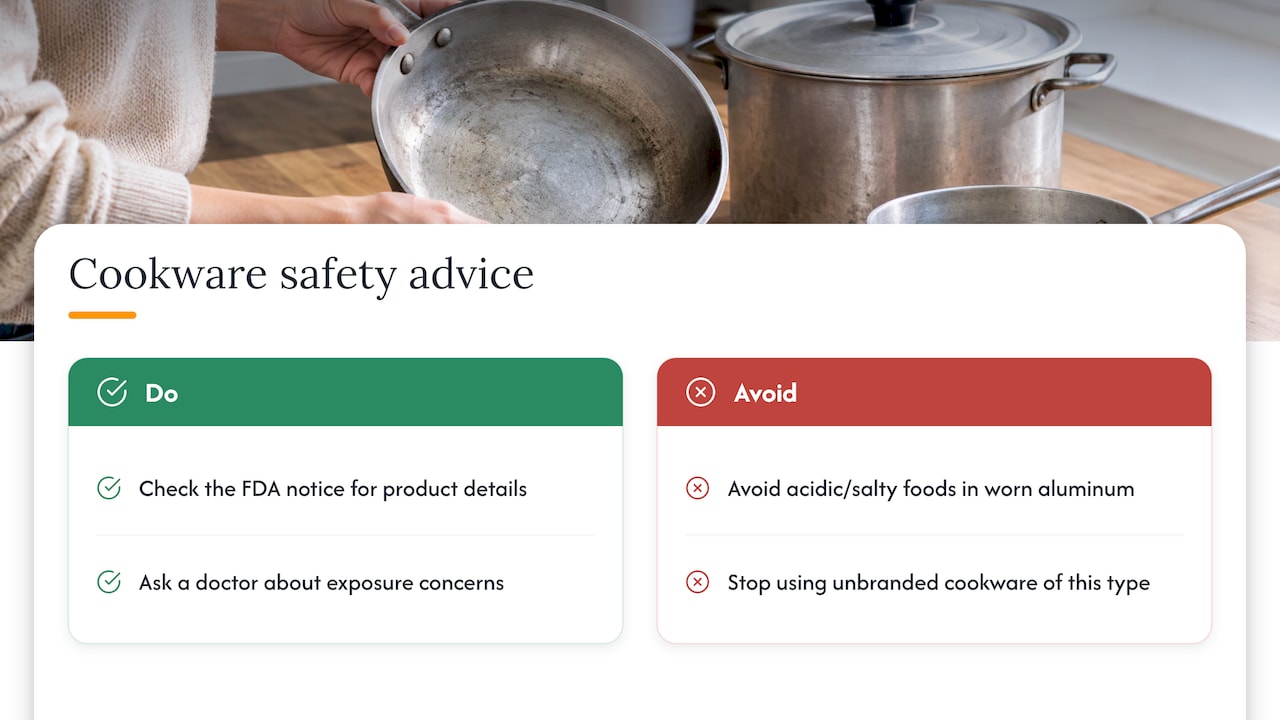
Health Canada’s guidance on the safe use of cookware says that worn or pitted aluminum cookware, and cooking acidic or salty foods in it, can increase the transfer of aluminum or lead into food. That is the practical reason many cooks keep tomato sauces and long braises out of old bare aluminum.
The lead issue is more specific. In 2025 the FDA warned about certain imported aluminum, brass, and aluminum alloy cookware, including products sold under names such as Hindalium or Indalium, that could leach lead into food. The agency told consumers not to use or sell those products and advised anyone worried about lead exposure to talk to a healthcare provider. If you own unbranded cookware of that type, stop using it for food and check the FDA notice for the product details. For questions about your own exposure, a doctor is the right person to ask.
Anodized aluminum
Anodizing is an electrochemical process that hardens the surface. Health Canada states that anodized aluminum reduces aluminum transfer and is scratch-resistant. That makes hard-anodized pans a reasonable base for cookware where the cooking surface is either bare anodized metal or a PFAS-free coating. The caveat is that many anodized pans also carry a nonstick layer, and that layer, not the aluminum, is what decides whether the pan is PFAS-free.
Coated aluminum
Most nonstick pans have an aluminum body under the coating. In an intact PFAS-free pan, the coating sits between the food and the metal. Retire any pan whose coating is deeply scratched or flaking, because that exposes the base metal and the coating no longer does its job.
PTFE pan safety: heat limits and when to replace
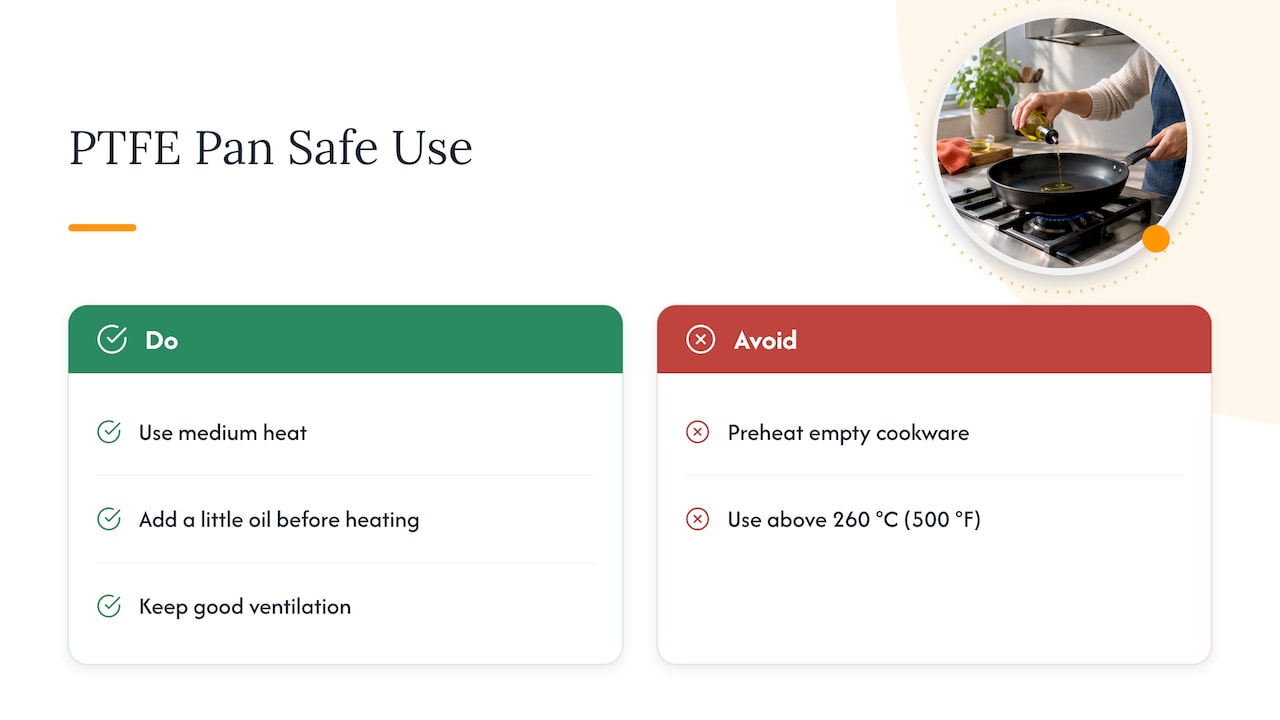
If you already own PTFE-coated pans, the main safe-use point is heat. Health Canada notes that many nonstick coatings contain PFAS, most commonly PTFE, and advises not preheating empty nonstick cookware or using it above 260 °C (500 °F). Medium heat, a little oil in the pan before it goes on the burner, and good ventilation keep you well inside that range.
Whether to replace working PTFE pans is a personal call. If you are replacing them anyway, a PFAS-free pan is the straightforward swap. The best non-stick pan guide compares five current options if you want to stay with a nonstick surface.
How to check whether a PFAS-free claim holds up
No single label settles it. These are the checks I would run before buying, all doable from a product page and a manual:
- Read the exact wording. “PFAS-free,” “PTFE-free,” and “fluorine-free” are meaningful. “PFOA-free” alone is not.
- Find the named coating. A product page should say what the cooking surface is: ceramic-type sol-gel, enamel, seasoned iron, bare stainless. Vague phrases like “natural nonstick” without a material name are a flag to keep looking.
- Look at the whole product. Handles, lids, and rivets matter less than the cooking surface, but a brand confident in a claim usually states it for the whole piece.
- Check origin claims separately. Under FTC guidance, companies generally cannot advertise “Made in the USA” unless all or almost all parts, processing, and labor are of U.S. origin, according to the FTC’s consumer alert on a 2023 case. A PFAS-free claim is a different matter, but both are marketing statements worth reading with the same care.
- Mind your state. Minnesota’s Amara’s Law restricts products with intentionally added PFAS, and per Arnold & Porter’s summary, cookware is among the categories covered. Other states have their own rules, so what is for sale can differ by location.
Perspective
I read cookware claims for a living, and the pattern I see most is a gap between the headline and the fine print. “PFOA-free” is the clearest example: it sounds like a safety claim and says almost nothing about the coating.
My advice for most home cooks is to decide what you cook first. If you sear, roast, and make pan sauces, a stainless or cast iron pan removes the PFAS question completely. If eggs and delicate fish are your daily cooking, a ceramic-type nonstick pan is the realistic PFAS-free route, and the sensible way to buy one is to read owner reviews for how the surface holds up after a year, not just the first month.
That is how I build comparisons on this site: specifications, price, and owner-reported strengths and complaints side by side, with no firsthand-use claims dressed up as testing. I would rather show you what owners say and let the specs speak.
Glenn
Where to start comparing
If you are ready to shop, my cookware reviews and buying guides collect side-by-side comparisons of sets and single pans, with specifications, pricing, and owner feedback in one place. I note current deals where they exist, so you can weigh value alongside coating and material.
For a fast shortlist, start with the Teflon-free nonstick picks if you want a slick surface, or the cast iron vs stainless steel guide if you are open to bare metal.
FAQ
What does PFOA-free mean on cookware?
It means PFOA, one specific PFAS chemical, was not used. The Ecology Center found that most products labeled PFOA-free were still coated with PTFE, so the label does not tell you the pan is free of PFAS. Look for explicit PFAS-free, PTFE-free, or fluorine-free wording instead.
Is PTFE the same as PFOA?
No. PTFE is the fluoropolymer coating that makes a pan nonstick, and PFOA is a separate chemical historically used in making it. PTFE is itself part of the PFAS family. A pan can be PFOA-free and still have a PTFE coating.
Is anodized aluminum cookware safe?
Health Canada says anodized aluminum reduces aluminum transfer and is scratch-resistant. The nonstick layer on top, if there is one, determines whether the pan is PFAS-free, so check the coating description as well as the metal. Keep worn or damaged pans out of rotation.
Is PFAS-free nonstick as durable as traditional nonstick?
Ceramic-type coatings are known for shorter useful lifespans than PTFE, according to the Ecology Center. Owners who report good longevity usually cite medium heat, soft utensils, and hand washing. Stainless steel and cast iron, which have no coating, can last far longer.
Are all aluminum pots unsafe?
No. The FDA’s 2025 warning targets specific imported aluminum, brass, and alloy products that may leach lead. Health Canada’s broader advice is to watch for worn or pitted aluminum and to limit acidic or salty foods in it. If you are concerned about lead exposure, speak with a healthcare provider.
Sources
- Still Cooking: An Update on Toxic PFAS in Cookware Products, Ecology Center
- Undisclosed PFAS coatings common on cookware, Ecology Center
- How does nonstick cookware work, and should you switch? C&EN
- PFOA-Free Meaning Explained, ASAI Cookware
- The safe use of cookware and bakeware, Health Canada
- FDA Issues Warning About Imported Cookware That May Leach Lead
- Pyrex “Made in the USA” claims didn’t measure up, FTC
- Important Year-End Developments in PFAS State Law, Arnold & Porter
Recommended
- Titanium Cookware: What the Label Means and What to Buy
- Best Non-Stick Pan Without Teflon 2026: 5 PFAS-Free Picks
- GreenPan Lima 12-Piece Review: PFAS-Free, With Conditions
- Ceramic vs Teflon Pans: Safety, Heat Limits and Lifespan

I'm Glenn, and I started Kitchenware Compare to cut through conflicting product reviews and help readers pick kitchen gear with confidence. I don't own or test the products I write about — these guides are built from verified-purchase reviews, manufacturer specifications, and independent testing where it exists, with the reasoning shown, not just a rating.
Leave a Reply