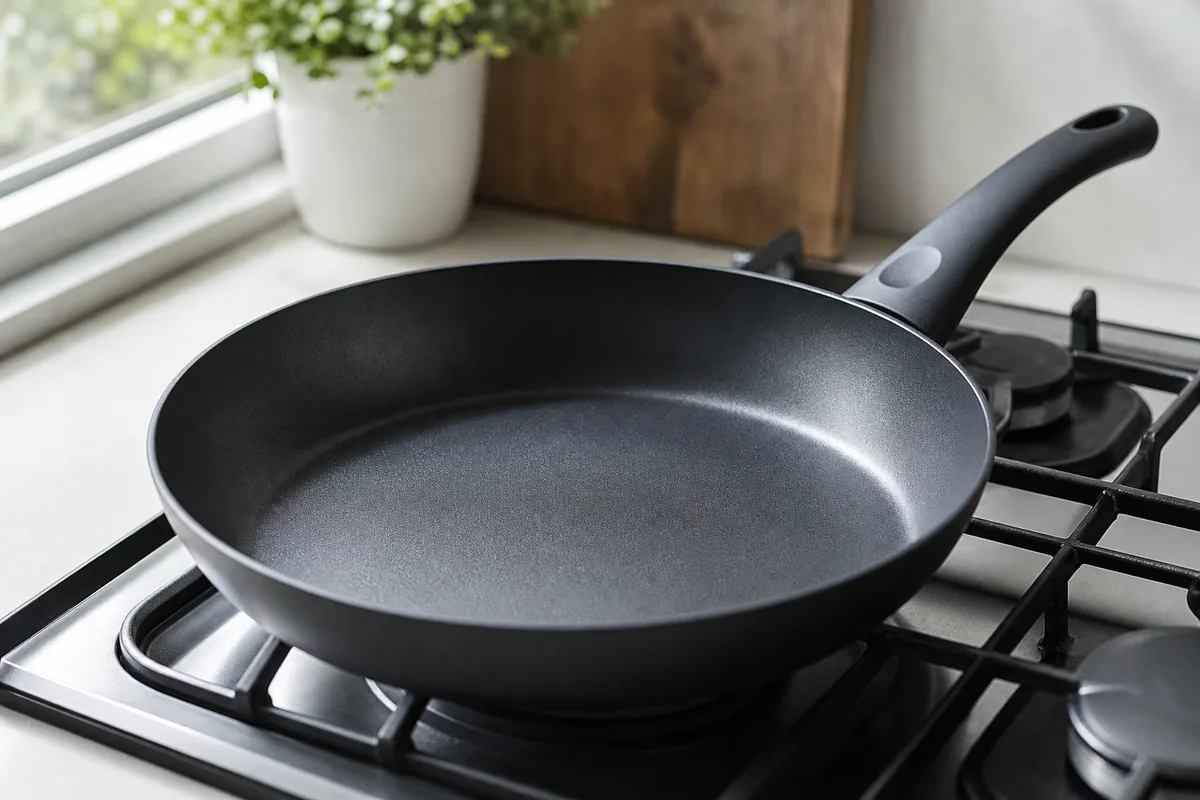
A lightly scratched pan is unlikely to hurt you, according to the BfR, Germany’s risk institute, though Singapore’s food regulator says not to cook on damaged coatings. Peeling, flaking or bare metal is different: replace the pan, as MedlinePlus, Circulon and Made In advise.
If your nonstick pan scratched in ordinary use, this page separates two questions most advice blurs: is it safe, and is it finished? The answer also depends on the coating, and some makers treat peeling as a warranty defect.
Nonstick Pan Scratched or Peeling: What Regulators and Makers Say
These sources do not all give the same instruction. Regulators and health bodies come first, because makers have pans to sell.
| Source | What it says | Applies to |
|---|---|---|
| BfR, Germany | Tiny particles from a scratched coating, if swallowed, are not expected to harm health, because PTFE is inert and the particles are excreted unchanged. | PTFE |
| FDA, United States | “Polymerized or large molecule PFAS are not absorbed by the human body when ingested.” Negligible amounts can migrate from the bound coating. The FDA pages I read do not discuss scratches or flakes. | Nonstick coatings |
| SFA, Singapore | Damaged pans should not be used, because food can be contaminated by PFAS, micro- and nanoplastics. Replace pans with “excessive scratches, peeling, flaking, and chipping.” | PTFE nonstick |
| MedlinePlus, NIH | “Never use cookware if the coating has started to peel or wear away.” MedlinePlus gives no reason for this. | Coated cookware |
| Verbraucherzentrale, German consumer body | Swallowing larger PTFE particles is not considered harmful, but very small ones are not yet researched, so swap heavily scratched pans as a precaution. | PTFE |
| Tefal | A scratched pan can no longer do its job properly, “even though it will still be as safe to use.” Its Q&A also says to replace it if the coating is damaged. | All its coatings |
| Circulon | Minor surface scratches are not a safety concern. Replace if heavily chipped, blistering, peeling in large pieces, or if base metal is visibly exposed. | PTFE |
| GreenPan | Chips of 1 to 2 mm are normal for ceramic, the pan remains perfectly safe, and no replacement is needed. | Thermolon ceramic |
The disagreement is real, and my line is simple: light scratches are a performance problem, and coating that is coming away is the end of the pan. The BfR expects no harm from swallowed particles, the SFA says not to use a damaged pan, and Tefal says a scratched pan is as safe but no longer works properly.
Tefal also notes that regulators assessed “normal use of intact kitchenware,” so its reassurance on scratches goes beyond that assessment.
What If You Swallowed a Flake?
The direct statements are calm. The BfR says particles are not digested and pass out unchanged. A paper proposing PTFE as a food bulking agent quotes no toxicologically significant effects in rats fed PTFE for up to 90 days, with negligible absorption, though those trials were run by du Pont in the 1960s.
The main challenge is a recent cell study (PMID 41167152). Human intestinal cell models exposed to PTFE particles of about 250 nm and 2 µm showed mitochondrial damage, inflammation, oxidative stress and DNA damage, and the authors say this challenges the idea that the particles are inert. These were cells in a dish at 50-200 µg/mL over 24-48 hours, not people eating from a pan, and the authors ask for low-dose studies.
Particle counts get quoted too. Luo and colleagues estimated that a surface crack could leave about 9,100 particles and a broken coating may release 2,300,000. That is an imaging estimate from a mimic cooking process, not a health finding.
Be careful with maker attribution. T-fal says PTFE is “totally harmless in case of ingestion” and credits ANSES, EFSA and FDA. The FDA and EFSA pages I read do not use that language. If you feel unwell after swallowing something or breathing fumes, call a doctor; this page cannot assess that.
Which Damage Is Cosmetic and Which Means Stop
- Light surface marks: keep cooking. Calphalon says minor surface markings with recommended utensils are normal and release should be unaffected.
- Food starts sticking through scratched areas: it is finished as a nonstick pan. Tefal says if you can no longer use it without adding fat, it’s time to replace it. If nothing looks damaged, the cause may be residue, which why a nonstick pan starts sticking covers.
- Metal showing: replace it. Circulon and Made In both draw the line here, and Made In adds rust as a sign to stop.
- Peeling, flaking or blistering: stop using it. MedlinePlus says never use a pan once the coating has started to peel, and Misen says to replace immediately if it is flaking into food.
- Deep discoloration or warping: Made In says replace it. It calls light discoloration normal, but deep, dark discoloration that does not wash out means the coating is wearing, and a pan warped so it no longer sits flat should go, though Made In says warping is not necessarily dangerous, only bad for even cooking.
Apart from GreenPan’s 1 to 2 mm for ceramic chips, nobody I read puts a number on minor versus excessive. These are practical lines, not measured ones.
Ceramic Is a Different Question
GreenPan says chipping up to 1 to 2 mm is normal, and that a film on the pan is usually starch rather than peeling. That is the seller’s position. It conflicts with Made In’s general rule that a chipped coating means replacement, and sits awkwardly with MedlinePlus’s “never use cookware if the coating has started to peel or wear away,” which is not limited to PTFE. No regulator I read addresses scratched or chipped ceramic coatings, and with no independent evidence either way, I would treat a chip as GreenPan’s opinion and replace the pan if you would rather not rely on a seller, and in any case if pieces keep coming away.
Is the Metal Underneath a Hazard?
I could not establish that it adds meaningful exposure, or that it does not. ATSDR says very little aluminum enters your body from cooking utensils, and MedlinePlus says uncoated aluminum cookware leaches a very small amount into food. Neither statement is about aluminum under a failed coating, and I would not quote a leaching number from anywhere else. Bare metal is still a clear signal that the coating has gone.
Overheating Is the Better-Documented Risk
The figures vary. The SFA puts fumes above 260°C (500°F) and breakdown beyond 350°C, Anolon says PTFE can begin to degrade above 570°F (300°C), and the BfR says decomposition starts at around 360°C. The BfR, the SFA and Circulon all say not to heat a pan empty, and the SFA notes an empty pan can reach high temperatures within minutes.
The BfR adds that illness has only been reported from industrial PTFE manufacture, not private households. The SFA is less reassuring: it says the gases from a pan overheated beyond 350°C can be lethal in extreme cases. ABC News, citing America’s Poison Centers, reports a record of over 265 suspected cases of polymer fume fever in one year and more than 3,600 over two decades, though not all were at home and many were occupational. Pet birds are especially vulnerable: Circulon says fumes above 500°F can be fatal to them.
Does the Age of the Pan Matter?
Older pans are a separate concern because of PFOA, which the SFA says most manufacturers have since replaced. Misen says to discard any pan made before 2015 regardless of condition, while Tasting Table puts the cut-off at 2013. None of the regulator pages I read sets a cut-off date, so treat any hard year as one company’s or one writer’s opinion.
Can a scratched pan give you cancer? None of the regulator pages I read links a scratched coating to cancer. The SFA says some studies have linked PFAS, the chemical group PFOA belongs to, to health issues including an increased risk of certain cancers. The BfR says the amounts of fluorinated substances a PTFE pan may release are so small that adverse health effects are not expected, as long as the pan is used as intended.
Can a Scratched Pan Be Repaired or Recoated?
Not by any home method in the maker pages I read. T-fal says the coating must be applied during the initial manufacturing process, and Stellar says it cannot be replaced or recoated once worn out. Made In says sometimes, if your manufacturer offers the service, though many find a new pan more cost-effective.
Tasting Table passes on a spray-and-bake method at 500 degrees Fahrenheit, sourced to another site. No maker page I read endorses a home repair, and I would not rely on it.
Will the Warranty Cover a Peeling Pan?
Same symptom, opposite answers. Circulon treats peeling under normal use as a defect, while Calphalon excludes coating loss after use. Terms can differ by line and region, and Scanpan’s EU terms exclude scratches and normal wear, so check your own paperwork before you bin the pan.
| Maker | Scratches and utensils | Peeling or coating loss |
|---|---|---|
| Circulon | Depends on the line; ScratchDefense A1 and C1 accept metal utensils | Peeling under normal use is a manufacturing defect and covered; needs proof of purchase and photos; Halo ceramic coating: two years |
| Farberware | Not mentioned in the pages I read | Peeling under normal use may be a defect and could be covered |
| Scanpan US | Stratanium scuffs described as cosmetic | Stratanium: peeling, pitting and bubbling are defects, limited lifetime; LEAP has a 2-year warranty |
| Calphalon | Scratches excluded as normal wear; its help page says metal utensils void nonstick cover, though its care page calls several lines metal-utensil safe | Non-stick coating loss after use is excluded, from wear or misuse |
| All-Clad | Scratches and damage from metal or sharp utensils excluded | Normal wear excluded, plus non-stick deterioration from misuse or abuse |
| Tefal and T-fal | Scratching and slight surface marks excluded | Says it is formulated not to chip or peel; the pages I read do not say whether peeling is covered |
How Long a Coating Lasts and How to Slow the Wear
The makers do not agree. Made In says most pans last an average of two to three years, Misen says to replace every 5-7 years, GreenPan says “for years,” and T-fal says it is difficult to give a number. I found no independent measurement, and each of these companies sells pans.
T-fal says most wear shows evidence of overheating, scratching or abrasive cleaning, and Scanpan says most damage comes from overheating. So keep to medium or low heat and wash with a soft sponge, as the SFA advises, and stack with a protector between pans, as Made In advises.
Metal utensils are a real split, so check your line. T-fal strongly recommends plastic or wood even where metal is allowed, while Scanpan’s Stratanium and HexClad allow metal.
Common Mistakes
- Binning a pan over one scratch. Even the SFA’s replacement test is “excessive” scratches, not a single mark.
- Keeping a flaking pan because PTFE is inert. The BfR’s inertness point is about swallowed particles, not whether the pan is worth cooking on, and a recent cell study disputes it for very small ones.
- Worrying about scratches while preheating empty. Heat has the clearer warnings.
What to Use Instead
A coating is a consumable. The best non-stick pan guide covers replacements, best non-stick pans without Teflon covers leaving PTFE behind, and nonstick vs stainless steel helps if you are done with coatings. The cookware hub has the wider picture, and air fryer basket coating flaking covers the same question for an appliance.
How This Page Was Put Together
This page is based on regulator, health-body and maker pages and published research abstracts. It is not based on testing; I do not own or test these pans. Warranty wording is as read at the time of writing, and the cell study and particle-count paper were read as abstract or highlights only.
What I could not establish:
- Whether long-term swallowing of very small PTFE particles from real pan use harms people. I found no human study, and cell results and old rat data do not settle it.
- Whether exposed aluminum under a failed coating adds meaningful exposure.
- Whether scratched ceramic sheds anything of concern. I found maker statements only.
- How often household pans release the particle counts in the Luo estimate.
The Verdict
Keep cooking on a lightly scratched pan if food still releases. Replace it once the coating is peeling or flaking, metal shows, or food sticks through the wear, and check the warranty first because some makers cover peeling. Then keep the next one at medium heat and never heat it empty. For a replacement, start with the best non-stick pan guide.
Frequently Asked Questions
Is it safe to use a scratched nonstick pan?
For light scratches, the BfR expects no harm from swallowed PTFE particles, and Circulon says minor scratches are not a safety concern. The SFA says not to use damaged pans. I would keep cooking on light marks and replace the pan once the coating is coming away.
What happens if you eat a piece of nonstick coating?
The BfR says tiny PTFE particles are not digested and are excreted unchanged, and it does not expect harm. A recent cell study questions whether very small particles are truly inert, at high doses in a dish. If you feel unwell, call a doctor rather than relying on this page.
When should you throw out a nonstick pan?
Replace it when the coating is peeling or flaking, or metal shows through. Made In draws that line at any peeling, Circulon at large pieces or exposed metal, and MedlinePlus says never to use cookware once coating starts to peel. Tefal’s test: replace it if food sticks without added fat.
Does the warranty cover a peeling nonstick pan?
It depends on the maker. Circulon treats peeling under normal use as a defect, and Scanpan US lists peeling as a defect on Stratanium. Calphalon excludes coating loss after use. Scratches are generally excluded, so check your own warranty wording before you throw the pan away.
Is a chipped ceramic pan safe?
GreenPan calls 1 to 2 mm chips normal and safe, a seller’s view, while MedlinePlus’s peeling rule covers all coated cookware. No regulator I read addresses chipped ceramic coatings. I would replace it unless you are happy to rely on a seller, and always if pieces keep coming away.
How long should a nonstick pan last?
No independent figure turned up. Made In says an average of two to three years, Misen says to replace every 5-7 years, and T-fal says it is difficult to give a number. Heat and abrasive cleaning shorten it, so medium heat and a soft sponge are the sensible habits.

I'm Glenn, and I started Kitchenware Compare to cut through conflicting product reviews and help readers pick kitchen gear with confidence. I don't own or test the products I write about — these guides are built from verified-purchase reviews, manufacturer specifications, and independent testing where it exists, with the reasoning shown, not just a rating.
Leave a Reply