This guide has no affiliate links, but some pages it links to do. If you buy through those, I may earn a commission at no extra cost to you.
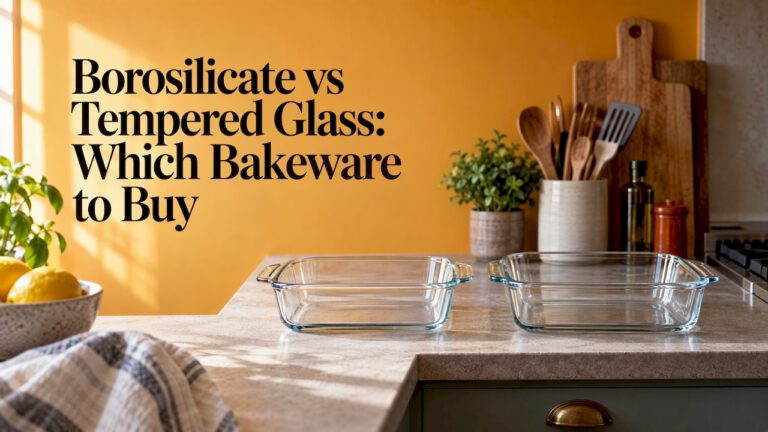
Borosilicate glass tolerates sudden temperature changes better. Tempered soda-lime glass survives drops and knocks better. Neither is a clear winner, because each one fails in a different way. The right pick depends on whether your kitchen is more likely to see a hot-to-cold mistake or a slip of the hands. I have no hands-on experience with any of these dishes. Everything below comes from manufacturer instructions, university extension guidance and ceramics-industry publications.
TL;DR
- Borosilicate resists thermal shock (rapid temperature change) better. Tempered soda-lime resists impact better.
- Most Pyrex sold in the U.S. today is tempered soda-lime, not borosilicate, according to a museum glass library.
- Neither type belongs on a stovetop, under a broiler, or in a toaster oven, and neither should go from freezer to hot oven.
- Chips, nicks and scratches weaken both types. Retire any damaged dish.
- Check the manufacturer’s care sheet before you buy, and match the glass to how you actually cook.
Quick verdict: borosilicate vs tempered soda-lime
| Factor | Borosilicate | Tempered soda-lime |
|---|---|---|
| Main ingredients | Silica plus boron oxide | Silica plus sodium and calcium oxides |
| Thermal shock | Better | Worse |
| Drop and impact | Worse | Better |
| Typical cost | Higher | Lower |
| Typical U.S. source | Imported or specialty bakeware | Modern U.S. Pyrex and similar |
| Stovetop or broiler | No | No |
The cost and impact rows come from Iowa State University Extension’s AnswerLine, which says soda-lime glass is cheaper and is what modern U.S. Pyrex kitchenware uses. The same page says tempered soda-lime handles heat less well than borosilicate but withstands breakage when dropped better.
What each glass is made of
Borosilicate
Borosilicate glass is built mainly from silicon dioxide and boron oxide. A Kopp Glass technical guide describes borosilicate as having good thermal-shock, abrasion and chemical resistance. At the structural level, a conference presentation on glass properties explains that borosilicate has a highly connected network of SiO2 and B2O3. Soda-lime glass instead carries sodium and calcium modifiers that loosen that network. A tighter network is why borosilicate expands less when heated, which is the whole story behind its thermal-shock advantage.
Soda-lime
Soda-lime is the ordinary glass of windows and bottles. According to the Glass Association of North America, typical soda-lime float glass is 69 to 74% silicon dioxide, 5 to 12% calcium oxide and 12 to 16% sodium oxide. It is cheap to make, which is why it dominates mass-market kitchenware.
Tempered is a process, not a recipe
This is the point most comparison pages blur. Tempering is a heat treatment applied to soda-lime glass, not a separate kind of glass. The Kopp guide explains that the rapidly cooled surface ends up in compression: heat-strengthened glass carries 3,500 to 7,500 psi of surface compression, while tempered glass carries at least 10,000 psi. That compressed skin makes it harder to start a crack from an impact. So “borosilicate vs tempered” really means “a chemistry advantage vs a surface-treatment advantage.” Borosilicate can be tempered too, but the bakeware most readers compare is untempered or lightly treated borosilicate against tempered soda-lime.
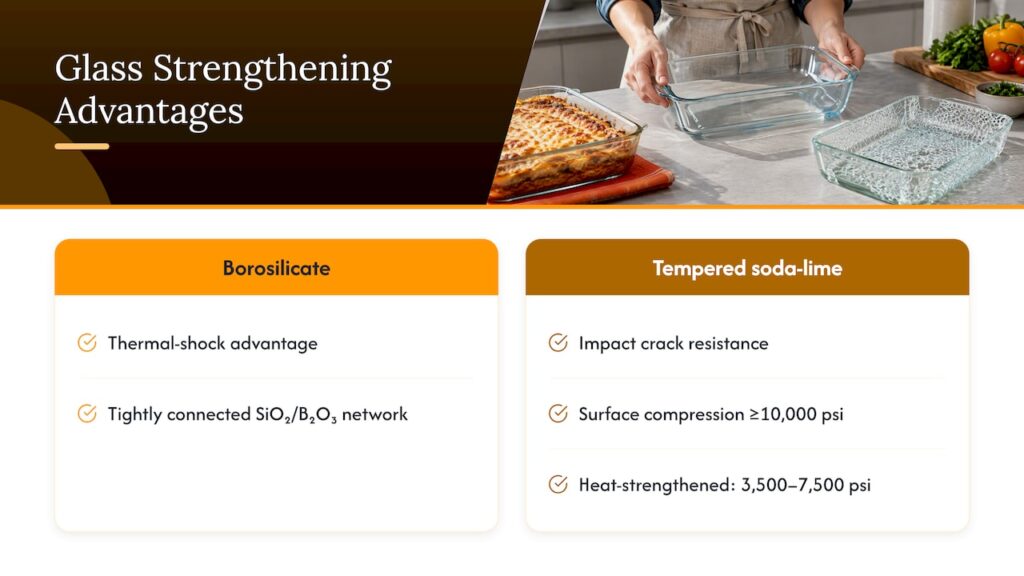
One maker of tempered soda-lime-silicate bakeware, Anchor Hocking, says its glass is thermally strengthened and breaks into relatively smaller pieces when it fails. That is a manufacturer’s claim about its own product, so treat it as design intent. The same page goes further and says its tempered soda-lime has equal or greater thermal shock resistance than annealed borosilicate. That is the maker’s claim for its own tempered product, and it does not match the general figures below, which compare the two glass types rather than one brand’s process.
Heat: where borosilicate earns its price
Heat damage to glass is about the size and speed of a temperature change, not the number on the oven dial. The American Ceramic Society’s discussion of glass cookware notes that time-dependent heat transfer and nicks or scratches affect whether a dish fails, so an oven’s maximum temperature cannot predict every outcome.
The same article cites calculations putting the fracture-stress temperature differential at under about 100°F for soda-lime and about 330°F for borosilicate. Those are approximations, not a safe-use rating, but they show why the gap is real. Borosilicate has roughly three times the margin before thermal stress becomes a problem.
Practical translation:
- A hot dish set on a wet counter, or hit with cold water, is the classic failure for either type.
- Borosilicate forgives more of that, but it does not forgive all of it.
- Soda-lime dishes need more discipline: preheat fully, no liquid into hot glass, no cold surface under a hot dish.
The American Ceramic Society’s bulletin also reports that thermal-stress fracture is the primary explanation for explosion-like cookware breakages, and that substituting higher-expansion soda-lime for borosilicate contributes to the problem. That is a useful reminder that how you use the dish matters as much as which glass it is.
Impact: where tempered soda-lime wins
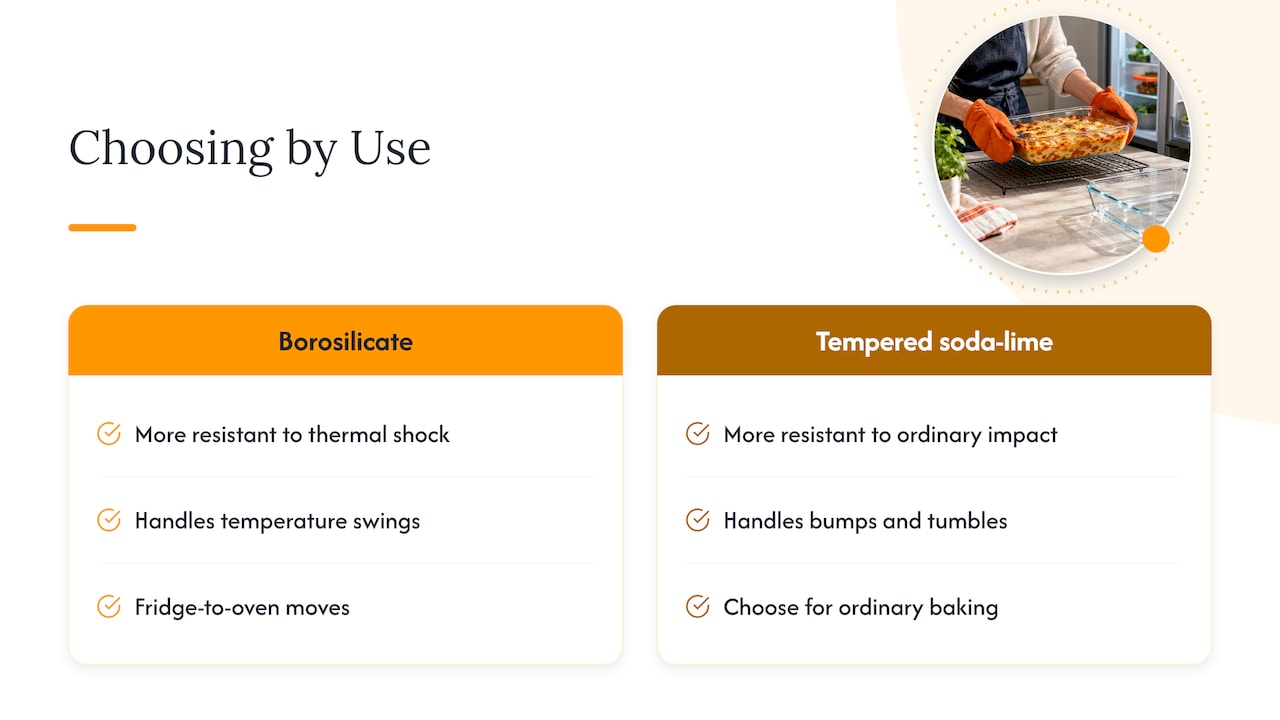
Iowa State’s AnswerLine summarizes the trade-off plainly: borosilicate is preferable for thermal-shock resistance, tempered soda-lime for resistance to ordinary impact. If you have ever seen a casserole dish slip off a counter, you can see why this matters. A dish that survives a bump into the sink or a tumble off a stove top is a real advantage in a busy kitchen.
So is high-borosilicate glass “fragile”? Not in the sense of being weak. It is simply less impact-tolerant than tempered glass, and more heat-tolerant. Pyrex’s own FAQ frames it the same way, saying soda-lime is slightly more resistant to impact breakage and borosilicate slightly more resistant to extreme thermal changes, and that both suit home cooking when instructions are followed.
If you want a quick rule: choose tempered soda-lime if you are hard on dishes and sticking to ordinary baking. Choose borosilicate if your habits involve moving dishes between fridge, counter and oven, or if you cook in a way that creates temperature swings.
Is Pyrex borosilicate?
It depends on the product, the era and the market. Here is how the research sorts it out:
- Corning’s original PYREX began as borosilicate, according to Iowa State’s AnswerLine, while U.S. kitchenware later changed to tempered soda-lime.
- The Corning Museum of Glass library says Corning sold its consumer products division in 1998, and that more than 150 glass compositions have carried the Pyrex name since 1915, including borosilicate, aluminosilicate and tempered soda-lime.
- A Corning Museum of Glass library answer says U.S.-licensed Pyrex tableware is primarily tempered soda-lime today.
So the Pyrex name on its own, in capitals or not, does not prove the glass type. The museum notes that Corning identified the glass with date codes of dots and dashes stamped on the product. Check the care sheet or the manufacturer’s website for the specific item. If you are shopping for borosilicate bakeware, look for the product page or packaging to state the glass type outright, and treat vague wording as a reason to ask.
On soda-lime and Pyrex safety more broadly, the brand’s own FAQ says its soda-lime and borosilicate products are suitable for microwave and conventional or convection oven use, and dishwasher friendly, when safety and usage instructions are followed. It also says not to use its bakeware on direct heat or under a broiler.
Is borosilicate safe for cooking?
Yes, within the limits the manufacturer sets. Glass is inert, and the real risks are mechanical and thermal. Pyrex names three: breakage from sudden temperature change, breakage from impact, and burns from handling hot cookware.
One borosilicate bakeware maker states its dishes can go from a 0°F freezer to a preheated 450°F oven. Treat that as the limit for that specific product, not a rule for all glass. The same care sheet lists things to avoid: direct flame, broilers, stovetops, grills, toaster ovens, cold water or cold wet surfaces while hot, and any use when chipped or cracked.
Safe-use habits for any glass bakeware
- Preheat the oven fully. Pyrex says its bakeware can be used in a completely preheated conventional or convection oven, not on a stovetop, under a broiler, in a toaster oven or on a grill.
- Add a little liquid for juicy foods. The OXO care sheet advises covering the dish bottom with a small amount of liquid when food may release liquid.
- Never add liquid to hot glass. Pyrex’s usage guidance also says not to put hot glass on a wet or cool surface, or move it straight from freezer to hot oven.
- Cool on a rack, dry potholder or dry cloth.
- Don’t microwave an empty dish and don’t use the lid in the oven or microwave, per the OXO sheet.
- Discard chipped, cracked or scratched pieces. Iowa State’s guidance on glass kitchenware cautions says the same.
That last point is worth explaining. Surface flaws concentrate stress, so a small chip can turn a normal temperature change into a break. A guide on how chips fracture glass shows the same principle on decorative glass. If a dish has a chip along the rim or a scar on the base, retire it rather than gamble.
For broader guidance on handles, lids and other materials, my guide on whether cookware is oven safe covers the checks, and the page on maintaining bakeware and baking tools covers care.
Borosilicate vs soda-lime: how to choose
Use these criteria rather than a blanket “best.”
Choose borosilicate if
- You move dishes between fridge and oven often.
- You want the larger thermal margin and are willing to pay more.
- You handle dishes carefully and rarely drop them.
Choose tempered soda-lime if
- Drops and knocks are your main worry.
- You want a lower price per dish.
- You follow the preheat, dry-surface and no-liquid rules without fail.
Check before you buy
- Read the product page or the box for the stated glass type.
- Check the underside marking, as Iowa State advises, and read the manufacturer’s care sheet.
- Note the stated temperature limits and any restrictions on lids, broilers and stovetops.
- Read the warranty to see whether it covers breakage from a temperature change.
The failures the sources above describe are sudden breakage after a temperature mistake and breakage that starts at a chip or scratch. I treat those as reasons to buy on stated glass type and clear care instructions rather than on price alone. For how I weigh reviews and specs, see how I review kitchen equipment.
My take
Most readers asking this question want one word: which is better. The honest answer is that the two glasses fail differently, and that is the useful part.
I would pick borosilicate for a kitchen where dishes go from fridge to oven and back, because the thermal margin cited by the American Ceramic Society is the one that protects against the most common mistake. I would pick tempered soda-lime for a household where a dropped dish is the likelier accident.
Whichever you choose, the habits matter more than the label: preheat, dry surfaces, no liquid into hot glass, and retire anything chipped. I don’t own or use any of these dishes, so my comparisons rest on specs and cited research.
Find bakeware that fits how you cook
If you are ready to compare dishes, my baking equipment section collects my bakeware guides. For pans and pots beyond glass, the cookware reviews and buying guides cover materials and heat limits.
FAQ
Is borosilicate glass stronger than tempered glass?
It depends on the kind of strength. Iowa State’s AnswerLine says borosilicate handles heat better, while tempered soda-lime withstands breakage when dropped better. Borosilicate wins on thermal shock and tempered soda-lime wins on impact.
Is Pyrex borosilicate or tempered glass?
Both, depending on era and market. Corning’s original PYREX was borosilicate, and the Corning Museum of Glass says U.S.-licensed Pyrex tableware today is primarily tempered soda-lime. Check the manufacturer’s page for the specific dish.
Can I put borosilicate glass on the stovetop or under the broiler?
Not bakeware. Manufacturer care sheets from both Pyrex and OXO say to avoid stovetops, broilers, toaster ovens and grills. Use only a completely preheated oven or the microwave, as the instructions allow.
Is soda-lime glass safe for cooking?
Yes, when used as directed. Pyrex’s FAQ says its soda-lime products suit conventional ovens and microwaves when the safety instructions are followed. The main risks are thermal shock, impact and burns, so avoid sudden temperature changes and chipped dishes.
Should I keep using a chipped glass dish?
No. Iowa State’s guidance says to discard chipped, cracked or scratched glass. The American Ceramic Society notes that nicks and scratches affect whether a dish fails, so a damaged dish is a risk in any oven.
Sources
- Glass Kitchenware Cautions, Iowa State University Extension AnswerLine
- Hell’s kitchen: Thermal stress and glass cookware that shatters, American Ceramic Society
- Shattering glass cookware, American Ceramic Society Bulletin
- Typical soda lime float glass properties, Glass Association of North America
- Structure-property correlations in borosilicate compared to soda-lime glass
- The Properties of Glass, Kopp Glass
- Pyrex frequently asked questions
- Pyrex product warranties, safety and usage
- Glass use and care, OXO
- Pyrex stamp question, Corning Museum of Glass library
- Glass bakeware, Anchor Hocking
- Why glass laser engravings look fractured or chipped
Recommended
- Tips For Maintaining Bakeware And Baking Tools
- Is Cookware Oven Safe? How to Check Handles, Lids and Glass
- Best Non-Toxic Baking Sheets: 5 Picks by Material

I'm Glenn, and I started Kitchenware Compare to cut through conflicting product reviews and help readers pick kitchen gear with confidence. I don't own or test the products I write about — these guides are built from verified-purchase reviews, manufacturer specifications, and independent testing where it exists, with the reasoning shown, not just a rating.
Leave a Reply