This guide has no affiliate links, but some pages it links to do. If you buy through those, I may earn a commission at no extra cost to you.
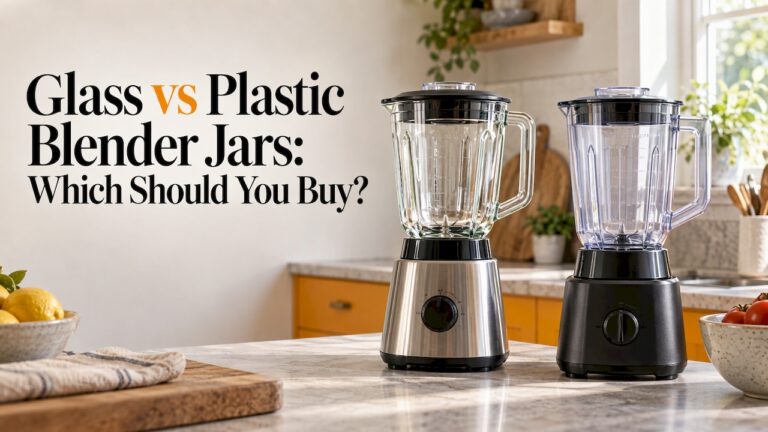
Choose glass if you mostly blend soups, sauces and smoothies, and you want a jar that stays clear and does not hold odors. Choose plastic if you blend frozen fruit and ice daily, or if the jar will be lifted, carried and dropped a lot. I have not used any of these blenders myself. What follows comes from manufacturer specs, owner manuals and government agencies.
TL;DR
- Glass is heavier and breakable, but it resists scratching, stays transparent and does not absorb odors, according to the maker of CleanBlend blenders.
- Plastic (usually Tritan copolyester) is light and impact-resistant. Blendtec says it uses it because glass can shatter under high-speed impacts from hard ingredients such as frozen fruit.
- Safety: the FDA says current approved uses of BPA in food packaging are safe. NIEHS still suggests glass, porcelain or stainless steel for hot food and liquids when possible.
- Hot liquids: neither material makes it safe to fill a jar to the brim and run it. Follow the manual for your model.
- Rule of thumb: match the jar to your habit, not to a fear. Daily frozen drinks point to plastic. Mostly hot-ish soups and low-plastic preferences point to glass.
Glass vs plastic blender jars at a glance
This is the short version before the detail. The weight, scratch and odor points come from the CleanBlend comparison. The impact points come from Breville and Blendtec.
| Factor | Glass jar | Plastic jar (Tritan or similar) |
|---|---|---|
| Weight | Heavy, harder to grip, pour and store | Light and easy to handle |
| Dropped on a hard floor | Can break | Usually survives; higher grades take multiple falls |
| Scratches and clouding | Resists scratches, stays clear longer | Prone to scratches over time |
| Odors | Does not absorb them | Can hold onto strong smells |
| Frozen fruit and ice | Less vulnerable to abrasion, but can shatter on hard impacts | Engineered for high-speed impacts |
| Hot ingredients | Often preferred by health agencies, but still limited by pressure rules | Safe grades exist, but still follow the manual |
| Price | Often a bit more for the jar alone | Generally cheaper |
The table hides a lot of variation. A glass jar on a weak base and a plastic jar on a high-powered base behave very differently, so read the rest before deciding.
Weight, handling and breakage
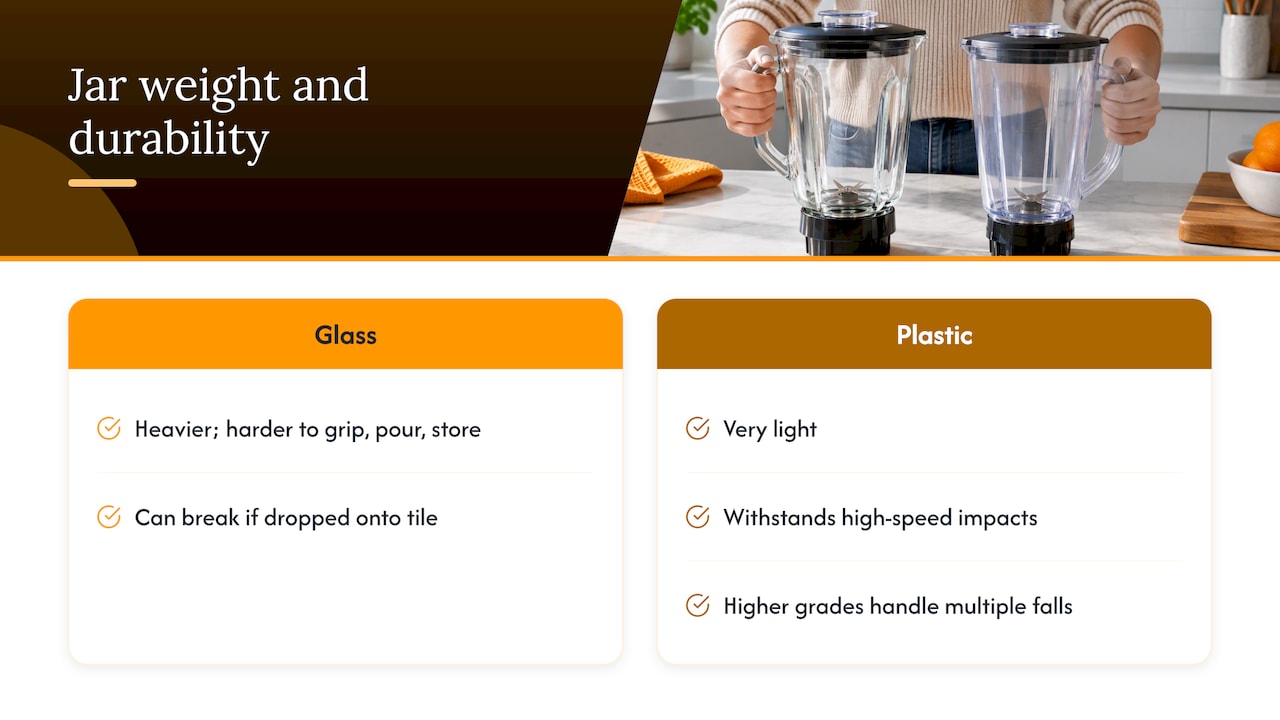
Weight comes first. Blendtec says glass jars are heavier and harder to grip, pour and store, while its Tritan copolyester jars are very light and engineered to withstand high-speed impacts. That is a manufacturer making a case for its own product, so treat it as a design argument rather than a neutral verdict. Still, the weight point is simple physics: a full 48-ounce glass jar is a lot to lift one-handed over a glass of smoothie.
Breakage is the other side of the trade-off. Breville notes that plastic jars can take the impact of tumbles and falls, and that higher plastic grades last longer and can handle multiple falls without cracking. Glass does not forgive a slip onto tile.
One caution on safety recalls. The U.S. Consumer Product Safety Commission announced in 2013 that Frigidaire Professional blenders were recalled because the blade shaft assembly could break during use, creating a laceration hazard. That blender had a 56-ounce glass jar, but the CPSC attributes the problem to the blade shaft, not the glass. The practical lesson is that jar material is only one part of build quality. That is why I would check the recall database for any blender model before buying it.
Is a plastic blender jar safe?
This question deserves a calm answer.
According to the FDA, current approved uses of BPA in food containers and packaging are safe, though very small amounts may migrate from packaging into food or drinks. That is the agency’s position as published in 2014, and it is worth rereading on the FDA page if you want the full reasoning.
Most modern blender jars are not old-style polycarbonate anyway. Eastman, which makes Tritan, states that Tritan is BPA-free and free of BPS and other bisphenol compounds, phthalates, halogens and chlorine, as shown by third-party testing. Hamilton Beach lists a 48-ounce Tritan jar as BPA-free in food zones, dishwasher-safe and shatter-resistant.
So a “BPA-free” label tells you one specific thing: that bisphenol A was not used in the food-contact material. It does not say anything about scratches, clouding or how long the jar will last. If you want to reduce plastic contact for personal reasons, glass is a legitimate preference, and the National Institute of Environmental Health Sciences suggests choosing glass, porcelain or stainless steel containers, particularly for hot food or liquids, when possible. That is a precaution, not a statement that plastic jars are unsafe.
My practical take: if the jar is a recognized BPA-free copolyester from a known maker, plastic is a reasonable choice for cold and room-temperature blending. If you want to avoid plastic for hot foods, glass fits that preference better, with the heat limits covered next.
Hot soups and liquids
Glass looks like the obvious winner for hot liquids, and it often is, but the real limit is pressure, not material.
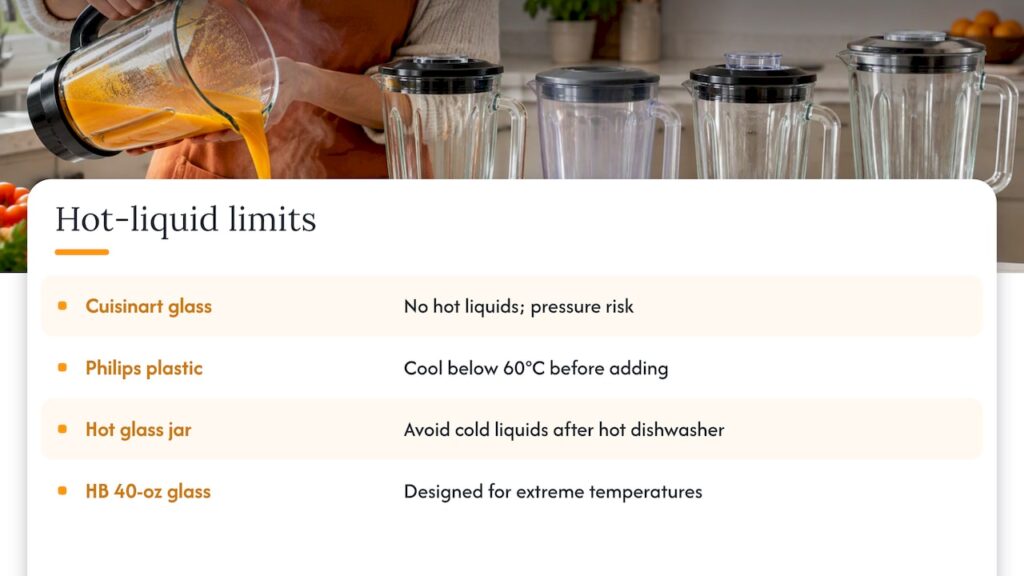
The Cuisinart Hurricane glass-jar manual says not to blend hot liquids because of excessive pressure and the risk of thermal burns. It also warns against boiling liquids and against adding ice, frozen foods or cold liquids to a jar straight out of a hot dishwasher. That last point is easy to miss: glass can suffer thermal shock in both directions.
Plastic has its own limit. Philips says not to pour very hot ingredients into its jar and to let ingredients cool below 60°C (140°F) before adding them. Breville says plastic grades are safe with hot food, so the rules differ by brand and model. That is the point: your manual beats any general rule, including mine.
Some glass jars are built for it. Hamilton Beach describes a 40-ounce glass jar on one 3-in-1 model as designed to withstand extreme temperatures, with dishwasher-safe jar, lid, bowl and blades. Hamilton Beach also sells a range of glass-jar models, which it lists as dishwasher safe.
If hot blending is your main use, read my guide on blending hot liquids safely before you fill a jar. The short version: cool the soup first, fill well below the max line, and vent the lid as your manual directs.
Ice, frozen fruit and hard ingredients
This is where plastic earns its place. Blendtec says its high-speed blenders use Tritan copolyester rather than glass because glass can shatter when dropped or under high-speed impacts from hard ingredients like frozen fruit. Blendtec is a plastic-jar maker, so weigh that accordingly, but the engineering point is credible: a spinning blade hurling frozen chunks creates repeated impacts.
Breville adds the other side: glass is less vulnerable to abrasion from ice, while plastic is lighter and more durable when dropped. In plain terms, ice will slowly scuff a plastic jar, and a hard drop will break a glass one. Which failure you would rather risk depends on your kitchen.
For a smoothie drinker, a few things matter more than the jar material:
- Liquid first, then soft items, then frozen. This reduces the impact load on any jar.
- Do not overfill. Overfilled jars put stress on lids and seals.
- Let frozen fruit sit a minute. Slightly softened fruit blends with less hammering.
If you want a use case, a blue spirulina smoothie recipe shows the kind of frozen-fruit blend that puts a jar through its paces. For picks of whole machines, see my best blender for smoothies roundup.
Cleaning, staining and odors
Here glass has a real edge. The CleanBlend comparison says glass stays transparent longer, resists scratches and does not absorb odors, while plastic is prone to scratches. Garlic, curry and turmeric are the usual culprits for odor and color in plastic.
Cleaning, however, is nearly identical. Blendtec recommends adding a cup of water and a drop or two of dish soap, replacing the lid, running the Clean cycle, and rinsing. Without a Clean cycle, pulse a few times and rinse. That works for either material. Dishwasher safety varies by model, so check the jar rather than assuming. Hamilton Beach lists both its Tritan jar and its glass-jar 3-in-1 as dishwasher-safe, which is a reminder that dishwasher use is a model detail, not a material rule.
To limit staining in plastic:
- Rinse right after blending, not at the end of the day.
- Run the soap-and-water cycle above before strongly colored sauces dry.
- Keep abrasive scrubbers away from the jar, since scratches hold stains.
If you are also deciding between a blender and a food processor for chopping tasks, my comparison of food processor vs blender explains where each one works best.
Why most blenders ship with plastic
It comes down to cost, weight and risk. According to Blendtec, its Tritan jars are lighter and easier to grip and store, and they withstand high-speed impacts. A maker shipping millions of jars also has to think about shipping weight, returns for broken jars and warranty claims. Plastic reduces all three.
That does not make plastic the better choice for every buyer. It makes it the safer default for the manufacturer. A buyer who handles the jar carefully, blends mostly soups and sauces and dislikes scratched, cloudy jars may prefer glass, and a number of makers do sell glass-jar models for that reason.
Compact personal blender systems usually use plastic cups. My Ninja Compact Kitchen System review covers that trade-off between power and fragile jars in detail.
Perspective
I look at this question as a buyer’s problem, not a materials debate. Neither jar is the villain. The decision gets made by three things: what you blend most, how you handle the jar, and how you feel about plastic contact.
The sources above point the same way: glass is the riskier jar when ice and drops are routine, plastic scratches and holds smells over time, and the makers’ manuals warn about hot liquids in both. Most of those are habit problems, not material problems.
I have not used these jars myself, and I will not pretend otherwise. What I can do is read the specs, compare what makers say against what owners report, and point out where a claim comes from a company selling the product. That is why every sourced claim above names who said it.
If I had to give one rule: buy the jar your habits suit, check the manual for heat limits, and look for the model’s real-world complaints before the star rating.
How to choose: a quick decision guide
Use these criteria in order.
- What goes in most often? Frozen fruit, ice and nuts point to plastic. Soups, sauces and batters point to glass.
- How careful are you with the jar? If it gets knocked around, carried to the sink one-handed or washed by kids, plastic is more forgiving.
- How do you feel about plastic contact? If you want to avoid it, buy glass and follow its heat rules. If you accept a BPA-free copolyester, plastic is a reasonable choice based on the FDA and Eastman positions above.
- Do you blend hot food? Read the manual first, whichever material you buy.
- How strong is the motor? A powerful base puts more stress on any jar. Match the jar to what the maker says the base is designed for.
- Is the jar replaceable? A cracked glass jar or a clouded plastic one is only a small problem if you can buy a replacement.
Two typical buyers show how it plays out. A parent making green smoothies with frozen mango every morning is better served by a lightweight plastic jar, replaced when scratches build up. Someone who makes soup and nut sauces, stores them in the jar and wants a clear, odor-free surface should look closely at glass-jar models.
Where to compare models
If you are ready to compare specific machines, my blender guides are collected on one page: blenders reviews and buying guides.
Some links on the site are affiliate links, and the affiliate disclosure explains how that works. To see how I evaluate products from specs and owner feedback, read how I review kitchen equipment.
FAQ
Why doesn’t Vitamix use glass?
I cannot speak for any brand’s internal reasoning, but another maker explains its own choice. Blendtec says glass can shatter when dropped or under the impact of hard ingredients like frozen fruit, and that its Tritan jars are lighter and easier to grip. High-power blenders put more stress on the jar, so plastic copolyester is a common design answer.
Is glass always safer than plastic in a blender?
Not always. NIEHS suggests glass, porcelain or stainless steel for hot food and liquids when possible, but the FDA says current approved BPA uses in food packaging are safe. Glass also carries a breakage risk, and the Cuisinart manual still warns against blending hot liquids in its glass jar because of pressure.
Can I put a glass blender jar in the dishwasher?
Often yes, but it depends on the model. Hamilton Beach lists the jar on its 40-ounce 3-in-1 as dishwasher-safe, while the Cuisinart manual warns against adding cold items to a jar fresh from a hot dishwasher. Check your manual, and let the jar cool before filling it.
What is the best type of blender to buy?
It depends on use. For smoothies and ice, a high-powered base with a durable plastic jar is the common choice. For soups and sauces, a glass jar suits many buyers. My best blender for smoothies comparison lays out five picks side by side.
Sources
- Blendtec help center
- FDA: Questions and Answers on Bisphenol A (BPA) Use in Food Contact Applications
- Hamilton Beach: Smoothie Blenders
- Eastman: Tritan Safety
- CPSC: Frigidaire Recalls Professional Blenders
- Hamilton Beach: Glass Jar Blenders
- Breville: What are the different types of blenders?
- CleanBlend: Glass vs. Plastic Blender Jars
- Hamilton Beach: 3-in-1 Blender and Food Processor 58163
- NIEHS: Bisphenol A (BPA)
- Cuisinart Hurricane 48-oz. Glass Jar Blender manual
- Philips: Can I pour boiling hot liquids into the jar of my blender?
- Blue spirulina smoothie recipe
Recommended
- Can You Blend Hot Liquids in a Blender? (Is It Safe?)
- Food Processor vs. Blender: What’s the Difference
- Best Blender for Smoothies 2026: 5 Picks Compared
- Ninja Compact Kitchen System Review: Power vs Fragile Jars

I'm Glenn, and I started Kitchenware Compare to cut through conflicting product reviews and help readers pick kitchen gear with confidence. I don't own or test the products I write about — these guides are built from verified-purchase reviews, manufacturer specifications, and independent testing where it exists, with the reasoning shown, not just a rating.
Leave a Reply