This post contains affiliate links. If you buy through my links, I may earn a commission at no extra cost to you.
A $200 chef’s knife with a dull edge cuts worse than a $30 knife with a sharp one. That’s the entire economics of knife sharpeners: the cheapest meaningful upgrade to every knife you own is the tool that maintains them. Worth knowing before you buy: if sharpening already leaves your knife sharp for one cut and then dull, the tool may not be the problem. Across the five approaches — an electric sharpener, a guided system, a whetstone, a pull-through and a honing rod — here’s what each actually delivers on German and Japanese edges alike, and which one fits how you cook.
Best Knife Sharpeners — Quick Comparison
| Product | Best For | Price | Rating | Buy |
|---|---|---|---|---|
| Chef’sChoice 15XV Trizor | Best Overall (Electric) | $165.99 | 4.6★ (14,365) | Check Price |
| Work Sharp Precision Adjust | Best Guided System | $69.95 | 4.5★ (11,553) | Check Price |
| Sharp Pebble 1000/6000 Whetstone | Best Whetstone | $39.99 | 4.6★ (25,673) | Check Price |
| KitchenIQ 50009 Edge Grip | Best Budget | $10.07 | 4.4★ (97,703) | Check Price |
| Utopia 12″ Honing Rod | Daily Maintenance | $15.99 | 4.7★ (8,368) | Check Price |
If you are still choosing the knife itself rather than the sharpener, the knives section collects every guide, review and comparison on the site in one place.
How These Picks Were Chosen
Plainly: this is a research-based guide, not a hands-on test. I have not run these through a cook, and nothing here should be read as a report from my own kitchen.
What the picks rest on: abrasive type and grit progression, whether the angle guide is fixed or adjustable and what angle it holds, whether that angle suits Japanese or German edges, and how much steel each mechanism removes per pass; plus the complaint patterns in verified-purchase reviews, which for sharpeners are unusually informative — the recurring one is a device that sharpens quickly by grinding away far more blade than it needs to.
What I could not establish: the consistency of the edge angle each device actually produces. That is the measurement that would separate these properly, and I found no independent test of it covering these units. The angles quoted here are the manufacturers’ stated guides, not verified output.
The Best Knife Sharpeners of 2026, Reviewed
1. Chef’sChoice 15XV Trizor EdgeSelect — Best Overall

The Trizor XV is the pick for anyone who wants sharp knives without learning a technique. Its spring guides hold the angle through two diamond-abrasive stages and a polishing stage, so the technique is a light, steady pull, though owners report scratched blade faces and, on early attempts, duller edges. It converts traditional 20-degree factory edges to Chef’sChoice’s 15-degree Trizor XV edge, which its manual describes as a triple bevel with 14-degree major facets.
Trade-offs: $165.99 is real money, it takes counter space, and the first sharpening removes noticeable metal while it re-bevels. A stone gives more control, for anyone willing to learn it.
Verdict: if you want every knife in the house sharp this afternoon and never want to think about burr angles, this is the simplest answer. 4.6★ across 14,365 owners agrees. More in my Chef’sChoice 15XV review.
2. Work Sharp Precision Adjust — Best Guided System

The Precision Adjust clamps the knife and rides an abrasive on a guided arm at your chosen angle — 15 to 30 degrees, click-adjustable. It’s the middle path: stone-like control and edge quality without stone-like skill demands. Setup per knife takes a couple of minutes, and the results on the Japanese blade in particular beat what the electric produced — you can match the factory angle exactly instead of converting it.
Trade-offs: it’s slower per knife than the Trizor, the clamp fights very tall or very short blades, and it lives in a drawer between sessions, which for some people means it lives there forever.
Verdict: the enthusiast pick. If you own knives with different edge angles and care about keeping each one authentic, this does at $69.95 what systems twice the price do.
3. Sharp Pebble 1000/6000 Whetstone — Best Whetstone

The traditional answer, and still the best edge available at any price — once you’ve put in the practice. The 1000 grit side rebuilds an edge; the 6000 side polishes it to the kind of sharpness that makes tomatoes surrender. This kit’s angle guide, non-slip bamboo base, and instructions make it a beginner-friendly on-ramp, and 25,673 owners at 4.6★ back that up.
Trade-offs: honesty required — your first five or so sessions will produce edges worse than the KitchenIQ manages in thirty seconds. Budget fifteen minutes per knife and a YouTube evening. Water-soak before use, flatten the stone occasionally.
Verdict: buy it if the skill appeals to you — it’s genuinely satisfying and the ceiling is the highest here. Skip it if you just want sharp knives with zero ceremony.
4. KitchenIQ 50009 Edge Grip — Best Budget

Pull-through sharpeners get sneered at, and the sneering is half-right: carbide pull-throughs are aggressive, remove more steel than necessary, and leave a coarser edge than any other method here. Now the other half: this $10.07 gadget takes a dull knife to genuinely useful sharpness in under a minute with little skill, and its 97,703 ratings — the most of any product in this guide — are overwhelmingly from people it made happy. My 602-product study found this pattern everywhere: cheap workhorses out-satisfy premium gear.
Trade-offs: fixed angle, coarse edge, steel removal. Don’t use it on an expensive Japanese blade — ever. For the $20–$60 knives that do most kitchens’ work, none of that matters.
Verdict: the right answer for beater knives, rentals, and anyone who was never, ever going to use a whetstone.
5. Utopia Kitchen 12″ Honing Rod — Daily Maintenance

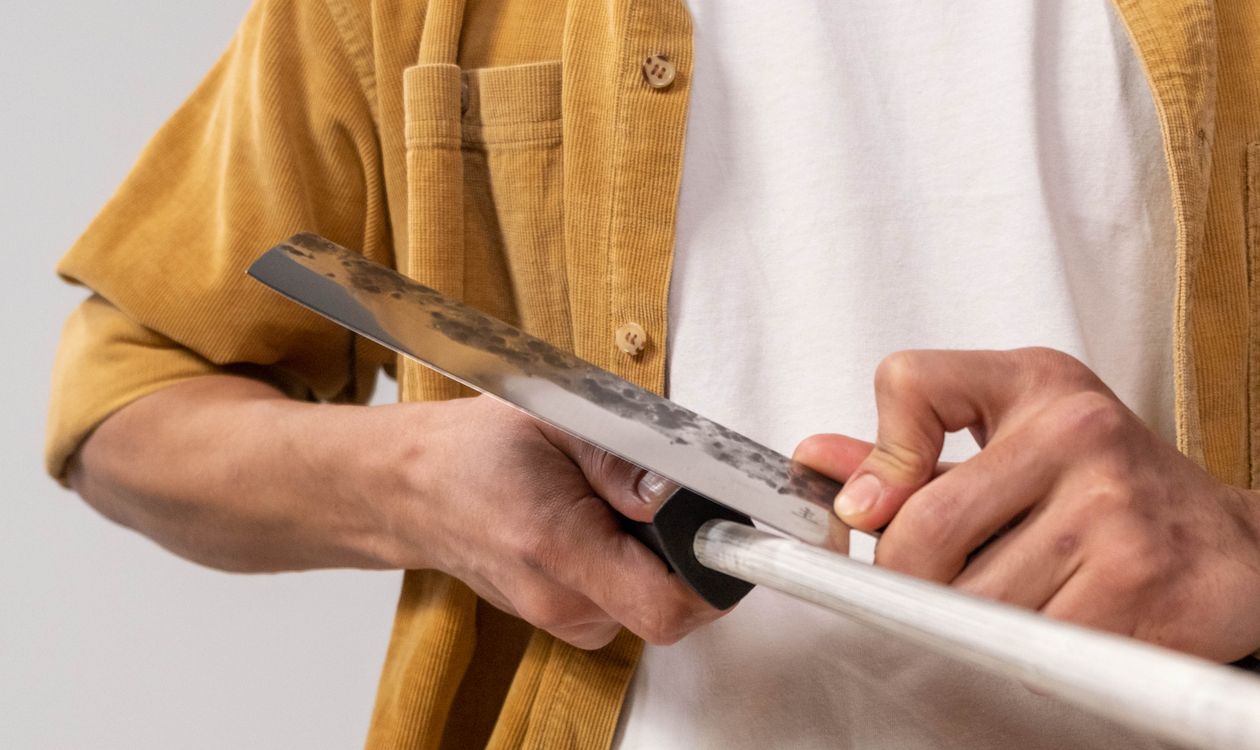
Not a sharpener — and that’s the point. A honing rod realigns the microscopic rolled edge that daily cutting produces, which is why a knife that “went dull” often springs back after eight strokes on steel. Hone weekly and you’ll sharpen a quarter as often, which means every other tool in this guide lasts longer and your knives keep more of their steel. Twelve inches handles any kitchen blade; the hanging hook means it actually stays near the cutting board.
Verdict: the $15.99 accessory every kitchen should own regardless of which sharpener you pick. Highest rating in this guide (4.7★) for the simplest tool in it.
How to Choose: Electric vs Guided vs Stone vs Pull-Through
Electric (Trizor XV): fastest route to consistently sharp knives, little skill, highest price. Right for most busy kitchens.
Guided system (Work Sharp): stone-quality edges with training wheels; per-knife angle control.
Right for mixed German/Japanese collections.
Whetstone (Sharp Pebble): best possible edge, cheapest per use, real learning curve.
Right if the craft appeals.
Pull-through (KitchenIQ): adequate edges instantly, hardest on blades. Right for inexpensive knives only.
Honing rod (Utopia): not a sharpener — buy one alongside whichever you choose and use it weekly.
Honing vs Sharpening: The 30-Second Version
Sharpening removes steel to create a new edge. Honing bends the existing edge back into line without removing anything. A knife needs honing weekly and sharpening only a few times a year — if you’re sharpening monthly, you’re either skipping the honing rod or slicing on glass boards (please stop — see my cutting board guide for what your edge wants to land on). If you want the full step-by-step whetstone technique rather than just the summary, see my guide to sharpening a knife with a whetstone.
Frequently Asked Questions
How often should I sharpen my kitchen knives?
For a knife used daily: hone weekly, sharpen every 2–4 months. The tomato test tells you when — if the skin dents before it slices with no pressure, it’s time.
Do electric sharpeners ruin knives?
They can mark them. Owners of the Trizor XV report scratched blade faces and, on early attempts, duller edges, though most describe very sharp results once they follow the manual. Any electric removes more steel than a stone, so a knife sharpened electrically for twenty years wears visibly narrower.
Can I sharpen Japanese knives with these?
The Work Sharp (set to 15°) and the whetstone are the right tools. The Trizor XV works — its manual covers 15-degree Asian knives and has a separate method for single-bevel ones — but skip the KitchenIQ entirely: harder Japanese steel chips rather than folds, and carbide pull-throughs cause exactly that.
Are whetstones worth the learning curve?
If you enjoy the process, unambiguously yes — best edges, lowest lifetime cost, works on every blade shape. If you know you won’t practice, buy the electric and never look back. Be honest with yourself; the drawer full of abandoned whetstones is a cliché for a reason.
What angle should I sharpen my knives at?
German/Western knives: 20° per side traditionally, though 15–17° holds fine on modern steel. Japanese knives: 12–15°. When in doubt, match the factory edge — the guided Work Sharp makes that trivial.
Related Reading
- Best Chef’s Knife 2026: Reviews + Buying Guide
- Best Cutting Board for Japanese Knives
- Are Expensive Kitchen Appliances Worth It? I Analyzed 602 Products

I'm Glenn, and I started Kitchenware Compare to cut through conflicting product reviews and help readers pick kitchen gear with confidence. I don't own or test the products I write about — these guides are built from verified-purchase reviews, manufacturer specifications, and independent testing where it exists, with the reasoning shown, not just a rating.
Leave a Reply