
This post contains affiliate links. I may earn a commission if you buy through them, at no extra cost to you.
Quick Verdict
- Rating: 8.5/10 — a genuinely capable countertop oven, held back only by a real (if minority) durability complaint
- Best for: households who want oven-quality results — even browning, accurate temperatures, real capacity — without heating a full-size oven for everyday cooking
- Not ideal for: single-person households or tight counters; at 18.9″ wide and 0.49 cubic feet of interior, this is one of the larger toaster ovens on the market, and that size is wasted if you’re not using most of it
- Current price: ~$269.95 on Amazon (verified 2026-09-24)
- Bottom line: The Element iQ System does what Breville claims — it measurably evens out hot spots other countertop ovens struggle with — but check the durability section below before buying if you expect a decade of daily use.
Introduction
The Breville Smart Oven Pro’s defining feature isn’t any single cooking function — it’s the Element iQ System, five independently controlled quartz heating elements that redirect power to wherever a dish needs it most. That claim is backed by an Amazon’s Choice badge with over 10,400 ratings at 4.5 stars — a genuinely large sample for a $270 countertop appliance.
This is a research-based review, built from Breville’s specifications, Amazon’s compiled customer-review data, and a direct comparison against its closest current competitors in my toaster oven comparison. What it surfaces that a spec-sheet skim won’t: a specific, recurring durability pattern worth knowing before you spend $270, and exactly how much real capacity you’re buying over a standard 4-slice toaster oven.
Specifications
| Dimensions | 18.94″W x 15.91″D x 10.94″H |
| Interior capacity | 0.49 cubic feet (13.5″ x 11.5″ x 5.5″) |
| Wattage | 1800W (1800W preheat) |
| Heating system | Element iQ — 5 independently controlled quartz elements |
| Cooking functions | 10: Toast, Bagel, Bake, Roast, Broil, Pizza, Cookies, Reheat, Warm, Slow Cook |
| Convection | Yes — claimed up to 30% faster cook times |
| Fits | 6 slices of bread, a 13″ pizza, a whole roast chicken, a 9-cup muffin tray, or a 4.4-quart Dutch oven for slow cooking |
| Slow cook duration | Up to 10 hours, then auto-switches to keep-warm |
| Finish | Brushed stainless steel |
| Amazon ASIN | B00XBOXVIA |
Who It’s For
- Households of 2–4 who want to skip preheating a full-size oven for weeknight cooking — roasting a chicken or baking a full tray of cookies without a 20-minute oven preheat
- Anyone replacing an underpowered basic toaster oven and frustrated by uneven browning — the Element iQ System’s independent zone control is specifically built to fix that
- Bakers who want a dedicated slow-cook option without tying up a separate slow cooker or the main oven for 8+ hours
- Kitchens with the counter space to spare — this is a genuinely large countertop oven, and the size is the point
- Buyers who value a long, large sample of real owner feedback (10,400+ ratings) over a newer, less-proven model

Who Should Look Elsewhere
- Anyone with limited counter space — at nearly 19″ wide and 11″ tall, this needs real clearance; a compact model is the better fit for small kitchens
- Single-person households who mostly toast bread or reheat leftovers — the 0.49 cubic foot interior is overkill, and the BLACK+DECKER TO3250XSBD in my comparison covers that use case for under half the price
- Anyone who specifically wants air frying as a named function — this model doesn’t badge one the way the Ninja DT201 Foodi XL Pro does, even though its convection setting achieves a similar result
- Buyers planning to run it daily for years and who are especially cost-sensitive to a repair or replacement — see the Durability section below before committing
- Anyone who wants the absolute largest capacity available in this comparison set — the Oster XL 42L French Door model holds meaningfully more
Performance
Breville’s central performance claim is the Element iQ System: five quartz elements the oven’s algorithm powers independently rather than as one uniform heating circuit, aimed at eliminating the classic toaster-oven problem of a scorched top and a pale bottom on the same bake. Amazon’s compiled review-attribute data backs this up directly — “cooking performance” is one of the most frequently and positively mentioned attributes across the 10,400+ rating sample, alongside consistently good results specifically called out for toast and pizza, two of the hardest things for a small oven to get evenly browned.
The 1800W preheat is also a real, measurable spec advantage over cheaper convection ovens in this category, most of which sit at 1400–1600W and take noticeably longer to reach baking temperature — relevant if you’re using this to skip preheating a full-size oven on a weeknight.
Where the review data gets more mixed is heat consistency over time and across the interior: “heat output” appears as a mixed-sentiment attribute in Amazon’s summary, with some owners reporting uneven heating alongside others reporting it heats exactly as expected. That split is worth taking seriously rather than picking the version that fits a pre-decided verdict — it’s consistent with what you’d expect from any single-fan convection oven at this size once you’re using the full interior (a 13″ pizza right at the edge of the rated capacity), rather than a defect specific to this unit.
The slow-cook function — up to 10 hours before auto-switching to keep-warm — is a genuine differentiator against basic toaster ovens, which almost never offer it, and against dedicated slow cookers, which can’t toast, broil, or bake.

Design and Build Quality
The brushed stainless steel exterior is standard for Breville’s Smart Oven range and matches most modern kitchen appliances without looking like a plastic budget unit. At 18.94″ wide and 15.91″ deep, it’s built more like a compact wall oven than a typical toaster oven, and the weight (Breville doesn’t publish an exact figure on this listing, but it’s a substantial two-hands-to-lift unit based on its dimensions and 1800W element mass) reflects that.
The interior oven light automatically turns on at the end of a cooking cycle — a small but genuinely useful detail for checking doneness without opening the door and losing heat. Breville also specifically markets the internal components (racks, pans) as “replaceable, like your regular large oven” rather than proprietary parts you’d need to special-order — a meaningfully consumer-friendly design choice if a rack or pan eventually wears out.
This is where the durability pattern in the review data becomes relevant to design assessment: “reliability” and “durability” are two of the most frequently mentioned attributes in Amazon’s compiled review summary, and both carry mixed sentiment — some units are reported failing after a few years of regular use. For an appliance running an 1800W heating system daily, that’s a real consideration, not a rare fluke; it’s common enough across a 10,400-rating sample to be a pattern rather than noise.
One design detail worth flagging separately: Amazon’s listing includes Breville+ membership with purchase — free recipes, guided cooking classes, and usage guides tied to the oven’s functions. It’s a genuine value-add over a basic toaster oven with no companion content, though it’s a manufacturer program rather than a guarantee of ongoing support.

Cleaning and Maintenance
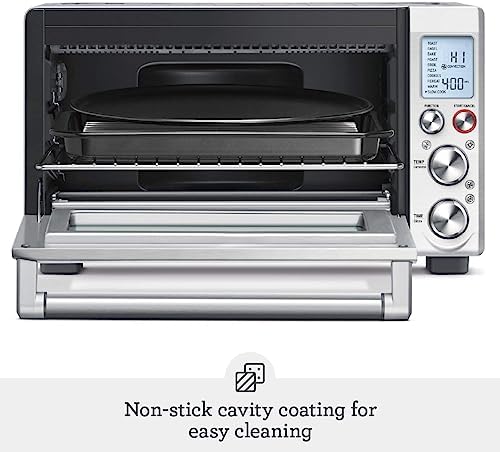
Breville doesn’t list the interior racks or crumb tray as dishwasher-safe on this listing — treat them as hand-wash items. The interior cavity itself carries a non-stick coating specifically for easier cleaning (confirmed in Breville’s own product photography, not just marketing copy) — wipe it down after use once cool. Convection ovens with fan circulation tend to spread crumbs and splatter further into the cavity than a basic toaster oven, so more frequent interior wipe-downs are worth building into a routine than you’d need with a smaller unit.
No specific self-clean function is listed among the 10 cooking modes, which is standard for this appliance category — full self-cleaning cycles are mostly reserved for built-in wall ovens. For a full routine covering crumb trays, glass doors, and stuck-on grease, see my toaster oven cleaning guide.
Value
At ~$269.95, the Smart Oven Pro sits in the middle of the field in my four-model comparison — more expensive than the BLACK+DECKER TO3250XSBD budget pick, but well under the Oster XL 42L French Door model’s larger-capacity price point. What you’re paying the premium over a basic toaster oven for is specifically the Element iQ System and the 1800W preheat speed — both measurable, real differences, not just badge value from the Breville name.
Where the value case weakens slightly is the durability pattern noted above: if a meaningful share of units need replacing after a few years, the effective cost-per-year is higher than the sticker price suggests. Buyers who want to hedge that risk without giving up the Element iQ feature set should also weigh Breville’s protection plan options, visible on the Amazon listing at checkout (3-year and 4-year plans are offered directly).
Durability
This is the section worth reading closely before buying. Amazon’s compiled review-attribute breakdown flags both “Reliability” (over 1,100 mentions) and “Durability” (nearly 500 mentions) as high-volume, mixed-sentiment attributes across the 10,400+ rating sample — meaningfully more review volume on this specific theme than on most other attributes tracked, including cooking performance itself. The pattern described is units that perform well initially but see some owners reporting breakdowns after a few years of regular use, rather than early defects caught in the return window.
Two things are worth weighing against that: first, this is a large, complex countertop appliance with five independently controlled heating elements and an 1800W draw — more moving parts and more electrical load than a basic single-element toaster oven, which inherently gives it more that can eventually fail. Second, the 4.5-star average across that same 10,400+ sample means the durability complaints are a real minority pattern, not the dominant experience — but they’re common enough, and specific enough (multiple independent owners citing “a few years” as the failure point, not days or weeks), to be worth factoring into a purchase decision rather than treating as noise.
Breville’s standard warranty on this model is 1 year, with the option to extend via Amazon’s third-party protection plans (3-year for $36.99, 4-year for $47.99, visible at checkout on the listing) — worth considering specifically because of the durability pattern above, not as a generic upsell.
What Owners Report
KitchenwareCompare doesn’t own or test this oven, so instead of claiming hands-on impressions, here’s what Amazon’s AI-generated summary of the verified-purchase review text (10,400+ ratings) actually says, attribute by attribute:
- Cooking performance (524 mentions, positive): owners consistently report it functions like a full-size oven rather than a toaster-oven compromise, specifically calling out good results for toast and pizza
- Ease of use (503 mentions, positive): the function dial and controls are reported as straightforward, without a steep learning curve across 10 cooking modes
- Size (467 mentions, positive): owners appreciate the compact-for-its-capacity footprint relative to what it replaces
- Heating speed (367 mentions, positive): fast cooking times are a recurring, specific compliment, consistent with the 1800W preheat spec
- Value for money (733 mentions, mixed): some owners consider it worth the price; others report it feels overpriced relative to a basic toaster oven — a split that tracks with how much of the feature set (slow cook, convection, 10 functions) a given buyer actually uses
- Heat output (392 mentions, mixed): most report even heating; a minority report uneven results, most likely tied to using the full rated capacity (see Performance above)
- Reliability (1,100+ mentions) and Durability (498 mentions, mixed): the pattern covered in detail in the Durability section above — the single most-discussed theme in the review data, and the one most worth reading before buying
Both sides are worth taking at face value: this is one of the better-reviewed countertop ovens on Amazon by volume and average rating, and it also has a specific, recurring durability theme that a purely positive summary would leave out.
What Comes in the Box
Breville’s listing doesn’t publish an itemized box-contents list separately from the product description, but based on the product photography and Breville’s own description of “replaceable componentry like your regular large oven,” the oven ships with its interior accessory set — the racks and pan needed to use all 10 cooking functions out of the box — rather than requiring separate accessory purchases to bake, broil, or roast. If a specific accessory (a broil rack, a pizza pan) isn’t included, replacement parts are sold directly through Breville rather than requiring an off-brand substitute, per the “replaceable componentry” language in the listing.
Alternatives
If the Smart Oven Pro’s size or price doesn’t fit, three real alternatives from my toaster oven comparison are worth a look:
- Cheaper: the BLACK+DECKER TO3250XSBD is the budget pick in the same comparison — a fraction of the price, with a smaller interior and none of the Element iQ zone control, but enough for toast, reheating, and basic baking for one or two people.
- More expensive / larger: the Oster XL 42L French Door model trades the countertop footprint for meaningfully more interior capacity via a French-door opening design, at a higher price point — the pick if you regularly cook for a larger household.
- Similar price, different strength: the Ninja DT201 Foodi XL Pro sits close to the same price bracket but leads with a dedicated, badged air-fry function rather than Breville’s convection-only approach — the pick if air frying specifically, not just convection baking, is the priority.
Breville Smart Oven Pro Review: Final Verdict
The Breville Smart Oven Pro earns its position as the top pick in my convection toaster oven comparison on the strength of a real, specific advantage — the Element iQ System’s independent-zone heating measurably shows up in owner-reported cooking results, not just in Breville’s marketing copy. The 1800W preheat, 10 cooking functions, and genuinely large interior (13″ pizza, whole chicken, 9-cup muffin tray) make it capable of replacing a full-size oven for most weeknight cooking.
The honest caveat is durability: a recurring, well-documented minority of the 10,400+ review sample reports failures after a few years of regular use — common enough to weigh seriously, not common enough to be the majority experience. Buyers who plan to use this daily for years should factor in an extended protection plan.
Buy it if: you want oven-quality, evenly-cooked results in countertop form and have the counter space for an 18.9″-wide appliance. Consider the alternatives above if: you’re cooking for one, tight on counter space, or specifically want a badged air-fry function. For the full head-to-head against its closest competitors, see my full toaster oven comparison, and for the category overview, start at my toaster ovens hub.
How This Review Was Put Together
This is a research-based review, not a hands-on test. I don’t own or test the products covered on this site. What’s above is built from Breville’s published specifications and product photography, Amazon’s AI-generated summary of the verified-purchase review text (10,400+ ratings, attribute-by-attribute), and a direct comparison against three competing models I’ve already ranked in my toaster oven comparison.
What I could not establish: how the Element iQ System’s even-heating claim holds up specifically at the outer edge of its rated capacity (a full 13″ pizza) versus a half-loaded interior — the review data supports that most owners get consistent results, but not a controlled, side-by-side measurement of edge-versus-center browning. I also could not verify an exact unit weight, since Breville doesn’t publish one on this listing.
Frequently Asked Questions
Is the Breville Smart Oven Pro worth it over a basic toaster oven?
If you regularly bake, roast, or slow-cook and want to skip preheating a full-size oven, yes — the Element iQ System and 1800W preheat are measurable advantages a basic single-element toaster oven doesn’t offer. If you mostly toast bread and reheat leftovers, a basic model or the BLACK+DECKER budget pick covers that need for a fraction of the price.
Does the Breville Smart Oven Pro have an air fry setting?
Not as a separately badged function — it relies on its Convection setting, which reduces cook time by up to 30% and produces a similar crisping effect. If a dedicated, badged air-fry mode matters to you specifically, the Ninja DT201 Foodi XL Pro in my comparison offers one at a similar price point.
How long does the Breville Smart Oven Pro typically last?
Most owners report years of reliable use, reflected in the 4.5-star average across 10,400+ ratings — but reliability and durability are also the most frequently discussed attributes in the review data, with a recurring minority reporting failures after a few years. See the Durability section above for the full breakdown.
What size pizza fits in the Breville Smart Oven Pro?
Up to a 13-inch pizza, per Breville’s specifications — one of the larger capacities in its class, also enough interior room for a 9-cup muffin tray, a whole roast chicken, or a 4.4-quart Dutch oven for slow cooking.
Is the Breville Smart Oven Pro dishwasher safe?
The interior racks and pan are not listed as dishwasher-safe on the current Amazon listing — treat them as hand-wash items. The interior cavity itself has a non-stick coating for easier wipe-down after use once cooled.
What’s the difference between the Breville Smart Oven Pro and the Smart Oven Air?
They’re different models in Breville’s lineup — this review covers the Smart Oven Pro (BOV845BSS) specifically, which is the model featured as the top pick in my toaster oven comparison. Always confirm the exact model number on the listing before buying, since Breville’s naming across its oven range is easy to conflate.
Can I use the Breville Smart Oven Pro instead of a microwave-toaster combo?
They solve different problems — a microwave-toaster combo prioritizes speed for reheating and defrosting, while this oven prioritizes even, convection-baked results. See how a microwave toaster oven combo works if speed and multi-function reheating matter more to you than baking quality.

I'm Glenn, and I started Kitchenware Compare to cut through conflicting product reviews and help readers pick kitchen gear with confidence. I don't own or test the products I write about — these guides are built from verified-purchase reviews, manufacturer specifications, and independent testing where it exists, with the reasoning shown, not just a rating.
Leave a Reply