This guide has no affiliate links, but some pages it links to do. If you buy through those, I may earn a commission at no extra cost to you.

Most shoppers should expect to pay between $60 and $150 for a genuinely usable air fryer, with budget models starting under $75 and better-built, higher-capacity units landing in the $75 to $150 “good value” zone. Upper midrange dual-basket and oven-style models run $150 to $300, and premium multi-function units climb past $300. Capacity, features, and sale timing all shift a given model between these bands.
TL;DR:
- A 2 to 3 serving basket usually costs under $100; family sized 8 quart dual basket models typically cost $150 to $250 before sales.
- A sale can move a $200 dual basket into the $150 range, especially around Prime Day, Black Friday, and end of season clearances.
- Typical air fryer sessions use about 0.70 kWh versus 1.70 kWh for comparable oven cooking, but savings narrow for large roasts and baking batches.
- Build quality and warranty coverage predict longevity better than smart features, while hand washing nonstick baskets helps limit coating wear from dishwasher cycles.
Price bands explained: what you get at each level
Air fryer pricing breaks into four fairly consistent bands, and knowing what each one buys helps you avoid overpaying for features you will not use.
Under $75 gets you a compact, single-basket unit, usually 2 to 4 quarts, with dial or basic digital controls. The budget picks from Bon Appétit run from about $68 to $100, all of them basket-style models, so a capable machine is available there with fewer extras. The $75 to $150 band is where build quality and capacity both improve, often landing you a 6-quart single basket with sturdier housing. Mashed notes that for a good-quality air fryer, expect to spend between $100 and $200.
From $150 to $300, dual-basket and larger-capacity models dominate, letting you cook two foods at different temperatures at once. Above $300, oven-style multi-function units take over, combining air frying with rotisserie, dehydrating, and toaster-oven functions in one footprint.
- A compact 2 to 3-serving basket fits singles or couples and typically sits under $100.
- An 8-quart dual-basket model suits families and usually falls in the $150 to $250 range before sales.
Sale events can temporarily drop a $200 dual-basket model into the $150 range, so timing matters as much as the sticker price. For a side-by-side look at current picks across every tier, the best air fryers guide breaks down specific models by budget.
What actually drives price: capacity, features, and construction
Quart size is one of the biggest price drivers. A 2 to 4-quart basket suits one or two servings, a 5 to 6-quart handles a family meal, and anything above 8 quarts starts overlapping with countertop oven territory, pushing price up accordingly.
Beyond size, several features reliably add cost:
- Dual-zone or dual-basket designs that let you cook two items independently.
- Convection toaster-oven hybrids with rotisserie or dehydrate settings.
- App connectivity or voice control integration.
- Built-in temperature probes for meat doneness.
- Stainless steel exteriors instead of painted steel or plastic housings.
Materials and warranty length also shape long-term value more than any smart feature does. Mashed calls better build quality a proven contributor to an air fryer’s lifespan and notes that smart features are not needed for well-cooked food, so shoppers focused on years of use should weigh materials and warranty coverage over app extras.
Pro Tip: Many makers rate their baskets dishwasher-safe (Mashed lists dishwasher-safe parts on the Ninja AF101 and the Instant Pot Vortex Plus), but Clean Eating advises hand-washing anyway, because hot water, high pressure and harsh detergent are hard on baskets. The two sources differ; hand-washing is the cautious option, and either way skip abrasive brushes on a nonstick basket.
Operating cost: what it costs to run one versus an oven
A one-time price tag only tells part of the story. According to Appliance Running Cost, a typical air fryer session, a 4-minute preheat at 1,500 watts plus 37 minutes at 65% power, uses about 0.70 kWh, compared to roughly 1.70 kWh for a comparable 1-hour oven session. At $0.17 per kWh, that works out to about $0.12 per air fryer use versus $0.29 per oven use.
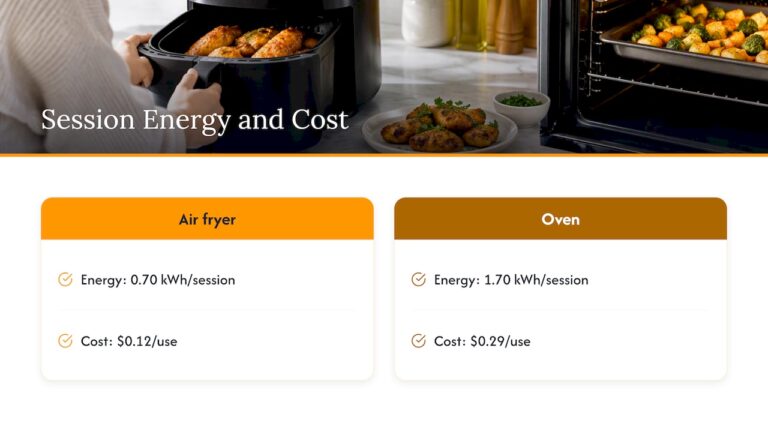
Appliance Running Cost puts the yearly saving at about 260 kWh, or roughly $44 at $0.17 per kWh, if the air fryer replaces the oven five days a week, and $65 to $78 a year at the $0.25 to $0.30 rates found in states such as California and Massachusetts.
That gap favors short, frequent cooks where oven preheat eats up a large share of total energy. Large-batch roasts or baking jobs narrow the savings, since an oven’s per-batch efficiency improves with bigger loads. If you are weighing which appliance fits your routine, the air fryer vs convection oven comparison walks through use cases where each one wins. At that rate a $75 air fryer would cover its own price in electricity savings in under two years; the site puts payback at one to four years for a $60 to $150 model.
Where to buy and when prices actually drop
National big-box retailers tend to carry the broadest model selection and the most predictable return policies, while warehouse clubs often beat them on per-unit price for bulk-style multipacks or house-brand units. Online marketplaces frequently show the lowest sticker prices but vary more on return windows and seller reliability, so check the fine print before buying.
Sale timing matters more than hunting for a hidden discount code. Prime Day, Black Friday, and end-of-season clearances are the windows where midrange and premium models most often drop into lower price bands.
- Compare the exact model number across retailers since “similar” models can have different capacities.
- Confirm the warranty length and what it covers before adding to cart.
- Check the return policy window, especially for marketplace sellers.
- Read a handful of recent owner reviews to catch recurring complaints.
The best cheap air fryer picks page compares the budget models worth a look.
How to choose the right air fryer for your budget
Matching your budget to your actual cooking habits, rather than to a feature list, is the fastest way to avoid buyer’s remorse, and the same rule applies to bigger home projects such as choosing the best budget kitchen cabinets.
- Count your household size and typical portion needs: a couple rarely needs an 8-quart basket.
- Measure your counter space before shopping, since oven-style units take up significantly more room.
- Decide if dishwasher-safe parts matter to you, keeping in mind that hand-washing still extends nonstick life.
- List any must-have features, like dual-basket cooking or app control, and price those separately.
- Set a hard budget cap and treat anything above it as a sale-only purchase.
- Ask the retailer listing whether the basket is nonstick-coated, dishwasher-rated, and what the warranty term actually covers.
At a budget under $75, prioritize capacity and basic reliability over any smart feature. In the $75 to $150 range, build quality and basket coating start to matter more. Above $150, dual-basket or oven-style functionality becomes the main thing you are paying for.
Pro Tip: If you are torn between two models, pick the one with the longer warranty rather than the one with more digital presets.
How Kitchenware Compare helps you find value
Comparisons here rely on side-by-side spec tables, aggregated owner reviews, and current retailer pricing rather than hands-on testing. This approach helps identify which features justify their price and which ones rarely change actual cooking results. For deeper model-by-model detail, the air fryer reviews and buying guides hub rounds up current picks across every price tier. What these sources cannot settle is how long a basket’s nonstick coating lasts at each price tier; no published durability test covers it, so the longevity advice above leans on build quality and warranty length instead.
Balancing price and features when you shop
I lean toward spending more on capacity and build quality, less on connected features. The common overspend trap is paying extra for app controls or voice integration you will use once and forget.
FAQ
How much does a cheap air fryer cost?
A cheap but usable air fryer typically costs under $100; the budget picks Bon Appétit recommends run from about $68 to $100. At that price you get a compact single basket with basic controls rather than dual-zone cooking or oven-style functions.
Can you use oil in an air fryer?
Yes, a small amount of oil, usually a light spray or a teaspoon mixed in, helps food crisp and brown without the heavy oil volume deep frying requires. Many manufacturer manuals advise against using aerosol cooking sprays directly on nonstick coatings, since certain propellants can damage the surface over time.
Which is the best air fryer or oven for everyday cooking?
It depends on what you cook most: an air fryer wins for short, frequent cooks since its preheat and cook cycle use less energy overall, according to Appliance Running Cost. A conventional or convection oven tends to perform better for large-batch roasting or baking where per-batch efficiency favors a bigger cavity.
What price range is best for a family-size air fryer?
An 8-quart dual-basket model, which cooks two dishes at once, suits most families. Mashed puts a well-reviewed one, the Ninja Foodi 8-quart, at close to $200, and says premium models with smart features run well over $200.
What are some common uses for an air fryer?
Beyond frozen fries and chicken wings, an air fryer handles roasting vegetables, reheating leftovers without sogginess, and baking small batches of items like muffins or bacon. Its short preheat time makes it a practical choice for quick weeknight sides and single-serving meals.
Sources
- Air Fryer vs Oven Electricity Cost: Which Is Cheaper to Run?
- The best air fryers under $100 can crisp with the best of them | Bon Appétit
- How much you should spend on a good air fryer in 2026 | Mashed
- Stop putting your air-fryer basket in the dishwasher
Recommended
- Air Fryer vs Deep Fryer: Which Should You Buy?
- Best Cheap Air Fryer 2026: Top Picks Reviewed
- Best Air Fryers 2026: 5 Picks for Every Budget
- Air Fryer vs Convection Oven: Which Should You Buy?

I'm Glenn, and I started Kitchenware Compare to cut through conflicting product reviews and help readers pick kitchen gear with confidence. I don't own or test the products I write about — these guides are built from verified-purchase reviews, manufacturer specifications, and independent testing where it exists, with the reasoning shown, not just a rating.
Leave a Reply