This site earns a commission if you buy through the Amazon links below, at no extra cost to you.
Good espresso at home no longer requires a $500 investment. A new wave of well-engineered machines has pushed quality espresso into the sub-$200 bracket — machines that can pull a proper shot with real crema, steam milk for lattes, and hold up to daily use. I’ve pulled shots on all five of these to see which ones actually deliver real crema at this price, not just marketing claims. This guide covers the five best espresso machines under $200 in 2026, from beginner-friendly pod machines to semi-automatic pump espresso makers.
Part of our complete coffee guide — all reviews, comparisons, and buying advice in one place.
Best Espresso Machines Under $200 — Quick Comparison
| Product | Best For | Price | Rating | Buy |
|---|---|---|---|---|
| De’Longhi Stilosa EC260 | Best Overall Under $200 | $149.95 | 4.2★ (13,751) | Check Price |
| De’Longhi Dedica EC685 | Easiest for Lattes | $149.95 | 4.0★ (4,805) | Check Price |
| Nespresso Essenza Mini | Best for Convenience | $184.99 | 4.6★ (6,057) | Check Price |
| Gevi 20-Bar | Best Budget Semi-Auto | $126.99 | 4.4★ (3,016) | Check Price |
| Casabrews 3700 | Solid Starter Machine | $99.99 | 4.3★ (3,564) | Check Price |
Reviews
1. De’Longhi Stilosa EC260 — Best Overall Under $200

The Stilosa is a compact, fully manual pump espresso machine that punches well above its price. It uses a 15-bar pump (the standard for proper espresso extraction), a chrome-plated brass portafilter, and a traditional steam wand for milk frothing. It is not automatic — you control the shot and steam yourself — but that control means you can actually dial in your espresso rather than accepting a preset.
Pros: Genuine pump espresso, brass portafilter, compact design, available under $150
Cons: Manual operation has a learning curve; steam wand needs practice
Best for: Anyone who wants real espresso without spending $300+
2. De’Longhi Dedica EC685 — Easiest for Lattes

The Dedica EC685 is De’Longhi’s slim-line semi-automatic machine — just 6 inches wide — designed for kitchens where counter space is limited. Its Panarello steam wand automatically introduces air into the milk as you steam, making decent froth significantly more forgiving than a traditional wand. This is the machine for daily latte drinkers who want real espresso without a steep learning curve on the milk side.
The 15-bar pump produces proper crema, and the three-filter system accepts single dose, double dose, or E.S.E. pods if you want the convenience option. Heat-up is fast — under 40 seconds. At $149.95 it sits in the same price bracket as the Stilosa but trades the brass portafilter for beginner-friendly milk steaming.
Pros: Very slim design (6 inches wide), Panarello wand simplifies frothing, E.S.E. pod compatible, fast heat-up
Cons: Panarello wand gives less control than traditional wand; smaller water tank than some competitors
Best for: Daily latte drinkers, small kitchens, beginners
3. Nespresso Essenza Mini — Best for Convenience

The Nespresso Essenza Mini is the smallest and most convenient option in this list. Insert a capsule, press a button, get espresso. There is no grinding, no tamping, no learning curve. The trade-off is flavour control — you are limited to Nespresso’s capsule range — but the convenience is unmatched for busy mornings. Pair it with a Nespresso Aeroccino milk frother for lattes.
Pros: Tiny footprint, one-touch operation, very fast, consistent results
Cons: Proprietary capsules (ongoing cost); less flavour control than ground coffee
Best for: Convenience-focused users, small kitchens, office environments
4. Gevi 20-Bar — Best Budget Semi-Auto
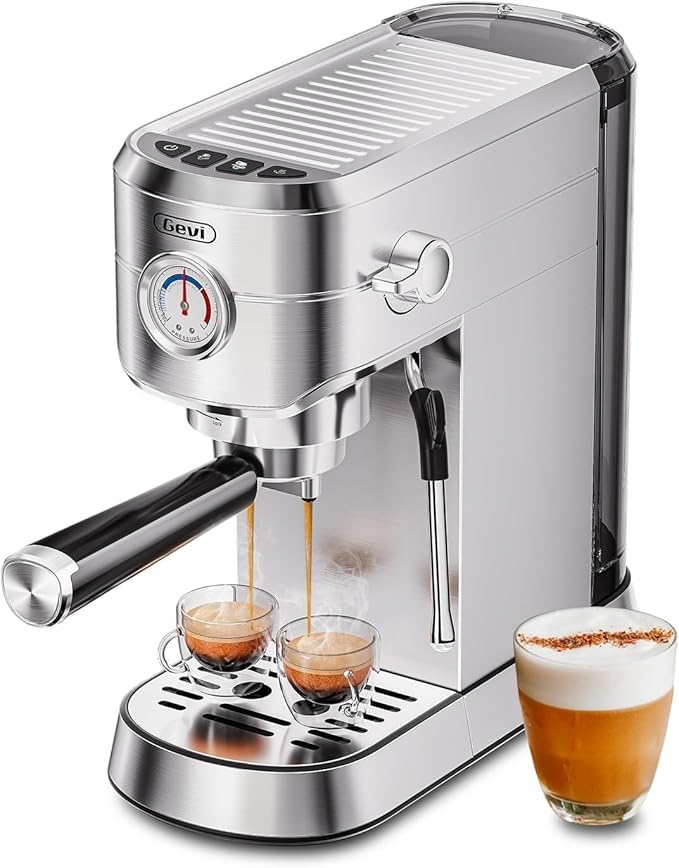
The Gevi 20-Bar offers a 20-bar pump (higher pressure than many competitors), a stainless steel body, and a steam wand at a price consistently under $120. Results are genuinely good for the price — proper crema, decent extraction — though it lacks the refinement of De’Longhi. For a first semi-automatic machine on a tight budget, it is hard to beat.
Pros: Very affordable, 20-bar pump, stainless construction
Cons: Smaller water tank; steam wand takes longer to heat than premium models
Best for: Tightest budgets, first espresso machine buyers
5. Casabrews 3700 — Solid Starter Machine

The Casabrews has gained a loyal following among home barista beginners for good reason: it is accessible, comes with a milk frothing pitcher, and the 20-bar pump produces respectable results. It is not as refined as the De’Longhi options above, but as an introduction to manual espresso it teaches you the basics without a major financial commitment.
Pros: Comes with accessories, 20-bar pump, large water reservoir
Cons: Build quality is plastic-heavy; steam wand pressure lower than competitors
Best for: Complete beginners, gift buying
Espresso Machine Buying Guide
Do I need a pump espresso machine or will a stovetop Moka pot do?
A pump machine produces true espresso — pressurised extraction at 9–15 bar that creates the characteristic crema on top. A Moka pot brews strong, concentrated coffee but at lower pressure, so there is no crema and the flavour profile is different. If espresso taste and crema matter to you, get a pump machine. If you want strong coffee on a very tight budget, a Moka pot is fine.
Do I need a built-in grinder?
A built-in grinder (called a “bean-to-cup” machine) is convenient but pushes most machines well above $200. For the best espresso quality on a budget, buy a separate burr grinder — even a manual hand grinder around $30–$50 will outperform the built-in grinders on budget machines.
What is the difference between 15-bar and 20-bar?
Both are more than sufficient for espresso extraction. The ideal extraction pressure is 9 bar — both 15-bar and 20-bar pumps deliver this via a pressure regulator. The higher bar rating is largely a marketing figure. Focus on build quality and user experience rather than pump bar ratings.
Bottom line: For most people wanting real espresso on a budget, the De’Longhi Stilosa is the best value. If lattes and ease of use matter most, the De’Longhi Dedica makes milk steaming significantly more forgiving. If convenience is the priority, go Nespresso.
Two of the machines above — the Stilosa and Dedica — are compared against the more expensive Breville Bambino Plus in our Bambino Plus vs De’Longhi Stilosa head-to-head. Worth reading if you want to understand what an extra $340 actually buys you. And if you’re already leaning toward spending more, our Breville Bambino Plus review covers whether the ~$490 price is justified.
If your budget stretches further, our best espresso machine under $500 guide covers the next tier up — the Breville Bambino Plus and Gaggia Classic Pro are both significant upgrades worth considering if the price difference is workable.
Frequently Asked Questions
Can you make good espresso for under $200?
Yes, but with trade-offs. Machines like the De’Longhi Stilosa and Gevi 20-Bar pull a respectable shot — better than pod coffee, not as consistent as a £400+ machine. Expect good espresso most of the time with occasional channelling. Dialling in your grind matters more than the machine at this price.
Do you need a separate grinder for a budget espresso machine?
If you want the best results, yes. Pre-ground coffee loses freshness quickly. A decent burr grinder ($50–80) paired with the Stilosa or Dedica will outperform a $300 all-in-one machine using stale pre-ground. It is the single biggest upgrade you can make at any budget.
Is 15-bar or 20-bar better for espresso?
Neither is inherently better — this is mostly marketing. Real espresso extracts at 9 bar. Both 15-bar and 20-bar machines regulate pressure down to a working level. What matters is how consistently they hold that pressure through extraction. The Gevi and Casabrews rate at 20 bar; both produce decent shots.
How long do budget espresso machines last?
With regular descaling, 3–5 years is realistic for a $100–200 machine. The Stilosa and Dedica have better reputations for longevity than lesser-known brands. Descale every 2–3 months with hard water, every 4–6 months with soft water. Skipping descaling is the number one cause of early failure.
Which machine is easiest for a complete beginner?
The De’Longhi Dedica — its narrow footprint, simple controls, and panarello steam wand make it the least intimidating option under $200. The Nespresso Essenza Mini is even simpler if you do not mind pods. The Casabrews takes more practice to dial in and is better suited to someone who enjoys tinkering.
Can these machines steam milk for lattes and cappuccinos?
All five machines include a steam wand, but results vary. The Dedica’s panarello produces decent microfoam for beginners. The Stilosa’s wand takes more practice to get smooth texture. At this price point, expect flat-white quality rather than latte art competition foam.
If the sub-$200 bracket feels like a compromise, it isn’t: our price-vs-satisfaction study of 158 espresso machines found the priciest machines actually rate lower than the cheapest ones.

Glenn is the founder of Kitchenware Compare and has spent years researching, testing, and reviewing kitchen appliances, cookware, and gadgets. A lifelong home cook raised in a family that treated every meal as an occasion, Glenn started this site to cut through the noise of conflicting product reviews and give readers honest, practical guidance. When he is not testing the latest air fryer or digging into the specs of a new espresso machine, he can usually be found experimenting with new recipes or hunting for the perfect cast iron skillet at a flea market.