Disclosure: As an Amazon Associate I earn from qualifying purchases. This costs you nothing extra and helps keep this site running.
A small chest freezer is one of the most practical appliances you can add to a kitchen, garage, or basement. Chest freezers run more efficiently than upright models, keep food frozen longer during power outages, and cost less to operate year-round. The problem is finding one that actually fits your space and budget without compromising on performance.
I’ve looked at the current Amazon bestsellers in small chest freezers — sized from 1.8 to 5.0 cubic feet — and picked the five worth buying in 2026. Each earned its place based on verified ratings, real review volume, and a clear reason someone would choose it over the others.
The short answer: the Kismile 3.2 cu ft is the safest pick for most people, because 2,181 ratings stand behind it, the most on this list. If the freezer is going into an unheated garage or a basement, the Midea 3.5 cu ft has the strongest stated specifications for it.
Quick Comparison: Best Small Chest Freezers 2026
| Product | Best For | Price | Rating | Buy |
|---|---|---|---|---|
| Kismile 3.2 cu ft | Best Overall | $209.99 | 4.4★ (2,181) | Check Price |
| Midea 3.5 cu ft Convertible | Best for a Garage or Basement (on specs) | $219.00 | 4.3★ (808) | Check Price |
| BLACK+DECKER 2.0 cu ft | Best Ultra-Compact | $222.95 | 4.5★ (511) | Check Price |
| EUHOMY 1.8 cu ft | Best Budget Pick | $169.99 | 4.4★ (291) | Check Price |
| Ultra Quiet 5.0 cu ft | Lowest Cost per Stated Cubic Foot | $199.99 | 4.2★ (852) | Check Price |
1. Kismile 3.2 Cu Ft — Best Overall

The Kismile is the most-reviewed pick on this list: 2,181 ratings at 4.4 stars, a far larger owner base than any other listing here. Amazon’s listing gives it 3.2 cubic feet in a cabinet 20.67 inches wide, 17.12 inches deep and 31.89 inches tall (model BD-80), with two baskets included.
The listing describes a 7-level thermostat dial (1 warmest, 7 coldest, 0 off), a hinged door that stays open at 45 to 90 degrees, and noise below 40 dB, which is the seller’s figure and one I could not verify. At $209.99 it costs about $40 more than the cheapest pick, the EUHOMY 1.8 cu ft at $169.99, and the offer on Amazon was from a third-party seller (ICE DRAM), not from Amazon itself. The listing mentions no drain port and no garage or ambient-temperature rating, so check both if you need them.
Pros:
- 2,181 ratings at 4.4★ — the largest review base on this list
- 3.2 cu ft with two baskets included
- 7-level thermostat dial
Cons:
- The listing states no drain port and no garage temperature rating
- Mid-priced for the capacity
2. Midea 3.5 Cu Ft Convertible — Best for a Garage or Basement (on specs)
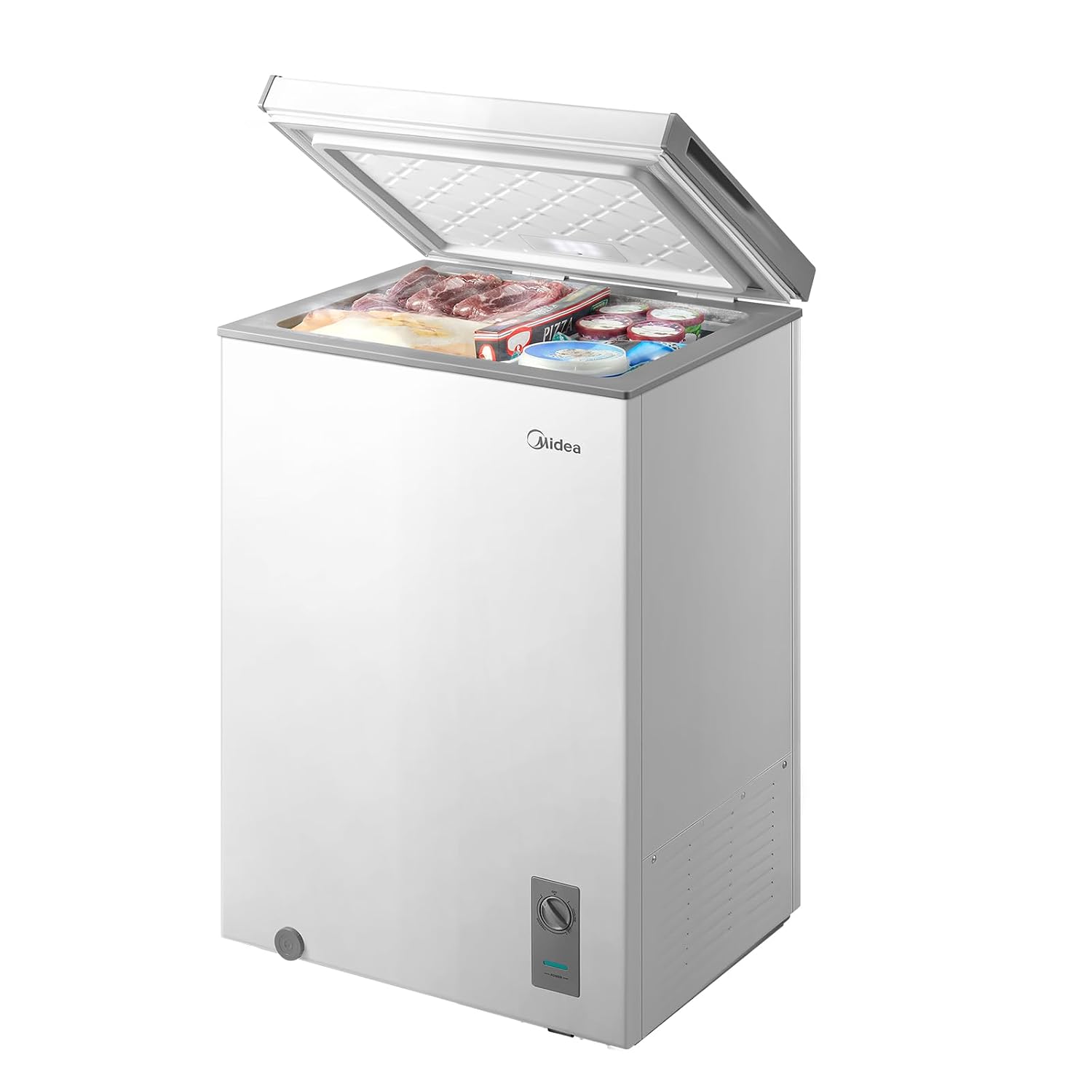
The Midea is the one to look at for an unheated garage or a basement, on its specifications alone. Midea’s listing says it converts between freezer and fridge modes, is “garage ready” for non-climate-controlled spaces (0°F to 110°F in freezer mode, 38°F to 110°F in fridge mode), and keeps items frozen for up to 48 hours after a power loss.
It is 3.5 cubic feet (17.6 inches deep, 21.5 wide, 33.5 tall) with an LED light and a removable basket, and its regular price is $219.00; Amazon also showed a $185.09 deal price open to Prime members only. The catch is the evidence: 808 ratings at 4.3 stars is a smaller base than the Kismile has, so read the garage and power-outage claims as the manufacturer’s, not as owner-proven.
Pros:
- Convertible freezer/refrigerator mode
- Stated garage-ready range of 0°F to 110°F in freezer mode
- Up to 48 hours of power-outage protection (Midea’s claim)
- LED interior light
Cons:
- Only 808 ratings at 4.3★ against the Kismile’s 2,181
- A single removable basket
3. BLACK+DECKER 2.0 Cu Ft — Best Ultra-Compact
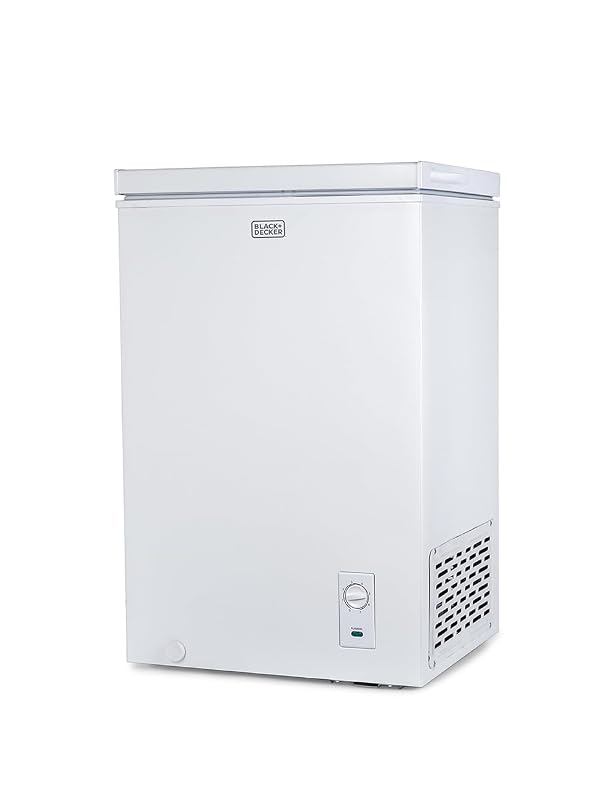
If space is the constraint, the BLACK+DECKER BCFK206 is a compact cabinet at 17.3 inches deep, 20.9 wide and 27.6 tall, close to the footprint of the EUHOMY 1.8 cu ft below, and it has 511 ratings at 4.5 stars. Its listing puts the capacity at 2.0 cubic feet, which it describes as holding 70 pounds of food.
The listing describes a mechanical temperature dial with an indicator light, a removable storage basket, and manual defrost with an easy-access drain. At $222.95 it is the most expensive pick here and the most expensive per cubic foot, so it earns its place only if the compact size matters.
Pros:
- Compact footprint, 17.3 inches deep
- 511 ratings at 4.5★
- Drain for manual defrost
Cons:
- Highest price, and the highest cost per cubic foot (about $111, against $63 to $66 for the Midea and Kismile)
- Only 2.0 cu ft
4. EUHOMY 1.8 Cu Ft — Best Budget Pick

The EUHOMY is the lowest-priced pick here at a regular price of $169.99 for 1.8 cubic feet, and Amazon.com sold it directly. Amazon also showed a $144.49 deal price open to Prime members only, so the regular price is the one to plan around. The listing gives the cabinet as 20.7 inches wide, 17.5 deep and 23.6 tall, with a built-in mesh basket, a 7-stage thermostat, a drainage port in the bottom for melted water, and a compressor rated at about 0.45 kWh per day.
The trade-offs are capacity and evidence. At 1.8 cubic feet it is the smallest freezer here and holds roughly 63 pounds by the rule of thumb below, so it suits one or two people rather than bulk buying, and 291 ratings at 4.4 stars is the smallest review base on this list. EUHOMY’s larger 3.5 cubic foot model was out of stock on Amazon when I checked on 6 October 2026, so this pick is the 1.8 cubic foot version.
Pros:
- Lowest regular price on the list, $169.99
- Drainage port for defrosting
- Built-in mesh basket and a 7-stage thermostat
- Sold by Amazon.com
Cons:
- Only 1.8 cu ft, the least capacity here
- Only 291 ratings at 4.4★
5. Ultra Quiet 5.0 Cu Ft — Lowest Cost per Stated Cubic Foot

This listing claims 5.0 cubic feet for $199.99, which would make it the cheapest per cubic foot here, with 852 ratings at 4.2 stars, the lowest rating of the five. It states a noise level below 40 dB, a fast-freeze function, and 0.36 kWh per 24 hours, the lowest energy figure on the list. Amazon showed it as sold by a third-party seller (Kazigak), not by Amazon.
One caution: its listed outside dimensions (20.47 inches wide, 16.14 deep, 31.69 tall) are slightly smaller than the Kismile’s 3.2 cubic foot cabinet, so I would treat the 5.0 figure with care and check the interior measurements before buying it for bulk storage.
Pros:
- Lowest price per stated cubic foot
- 852 ratings
- Lowest stated energy use, 0.36 kWh per 24 hours
Cons:
- Lowest rating on the list, 4.2★
- The 5.0 cu ft claim does not match the outside dimensions
What to Look for in a Small Chest Freezer
What Size Do You Actually Need?
Rough rule of thumb: one cubic foot holds around 35 lbs of frozen food. A 2.0 cu ft freezer holds about 70 lbs — fine for a single person buying in moderate bulk. A 3.5 cu ft model handles around 120 lbs, which suits a couple or small family.
Five cubic feet gets you close to 175 lbs of storage, which is what you want if you’re doing serious bulk buying or storing seasonal meat. Don’t overestimate your needs: a half-full chest freezer is less efficient than one that’s well-stocked.
Chest Freezer vs. Upright Freezer
Chest freezers are 10–25% more energy-efficient than upright models at the same capacity. The physics are simple: cold air is denser than warm air and sinks to the bottom. When you open a chest freezer lid, almost no cold air escapes. When you open an upright door, a large amount of cold air pours out and warm air rushes in.
Chest freezers also maintain temperature longer in a power outage. The trade-off is access — you have to dig for items at the bottom. For a guide to other kitchen prep tools, see my best food processors roundup.
Garage-Ready vs. Standard Models
Standard chest freezers are typically rated for 60–90°F ambient temperatures. If your garage gets hot in summer or cold in winter, you need a garage-ready model tested for a wider range. The Midea 3.5 cu ft on this list is stated to operate from 0°F to 110°F in freezer mode — essential in an uninsulated garage. Cold garages can also be a problem: most standard freezers stop working properly when ambient temps drop below 35°F, because the compressor doesn’t kick on when it already senses cold air.
Defrosting: Manual vs. Frost-Free
Every freezer on this list is manual defrost — standard for chest freezers at this size and price range. Frost builds up over time and needs to be cleared once or twice a year (more often in humid climates). Models with a bottom drain port — the BLACK+DECKER and EUHOMY on this list — make the job significantly easier: drain the meltwater directly rather than scooping and mopping. Budget about 30–60 minutes when defrost day comes.
Energy Efficiency
Chest freezers run continuously, so even small differences in consumption add up. The listings that state an energy figure range from 0.36 kWh per day (Ultra Quiet 5.0) to 0.68 kWh per day (Kismile), all of them manufacturer figures. At the U.S. average of around 13 cents per kWh, that is roughly $17 to $32 a year to run, which is not a major cost but does add up if you are running more than one appliance.
ENERGY STAR-certified models sit at the low end of that range. The Ultra Quiet 5.0 cu ft listing states the lowest energy figure on this list, 0.36 kWh per 24 hours. For other energy-conscious kitchen picks, see my best air fryers guide.
Gaskets, Interiors, Locks and Alarms
Reviewed’s chest freezer buying checklist (best chest freezers, updated August 2025) names the features that decide how a freezer ages: a replaceable rubber lid gasket, an aluminum interior, heavy-duty or counterbalanced hinges, a child safety lock and a temperature alarm. None of the five listings’ bullet points here mention a lock, an alarm, a replaceable gasket or the interior material, so I cannot tell you which of these freezers have them.
If any of those matters to you, check the full product page and the questions section before ordering, and treat a missing detail as unconfirmed rather than absent.
Frequently Asked Questions
What is the smallest practical chest freezer?
The smallest chest freezers hold around 1.1–2.0 cubic feet. The BLACK+DECKER 2.0 cu ft model on this list is at the compact end of what’s genuinely useful for household food storage. Anything smaller becomes awkward for real quantities of frozen food.
Are chest freezers more efficient than upright freezers?
Yes — typically 10–25% more efficient at the same capacity. Cold air is denser than warm air and stays at the bottom of a chest freezer when you open the lid. Upright freezers lose a large amount of cold air every time the front door opens.
Can I put a chest freezer in my garage?
It depends on the model. Standard chest freezers work in moderate temperatures (60–90°F). If your garage gets hotter in summer or colder in winter, you need a garage-ready model like the Midea 3.5 cu ft, which Midea rates for 0°F to 110°F in freezer mode. Cold garages are also a problem: many standard freezers stop cooling when ambient temps drop below 35°F, because the compressor reads the surrounding air as already cold enough.
How long does a chest freezer stay frozen during a power outage?
A full, well-insulated chest freezer stays frozen for 24–48 hours without power. The Midea 3.5 cu ft is listed at up to 48 hours. Keep the lid closed — every time you open it, you let warm air in and shorten the window considerably.
Do small chest freezers need to be defrosted?
Yes. All five freezers on this list are manual defrost, which is standard for this size range, and the frost should be cleared once or twice a year. The BLACK+DECKER and EUHOMY models list drain ports, which make the process much cleaner. Expect to spend 30–60 minutes and have towels ready.
What is the best small chest freezer for a basement?
On its stated specifications the Midea 3.5 cu ft is the best choice for a basement or garage: convertible fridge/freezer mode, a garage-ready temperature range and up to 48 hours of power-outage protection, though it has 808 ratings, well below the 2,181 behind the Kismile. If budget is the priority, the EUHOMY 1.8 cu ft is the lowest-priced pick here at $169.99, with less capacity.
One thing a chest freezer quietly solves: pint storage for a Ninja CREAMi, whose containers need 24 hours frozen dead level before processing. My CREAMi Deluxe review has the full workflow.
How These Picks Were Chosen
Plainly: this is a research-based guide, not a hands-on test. I have not run these side by side, and nothing here should be read as a report from my own kitchen.
What the picks rest on: usable capacity in cubic feet against external footprint, stated annual energy consumption in kWh, whether the unit is manual-defrost, the temperature range and whether there is a proper thermostat rather than a numbered dial, and drain design; plus the complaint patterns in verified-purchase reviews, which for chest freezers concentrate on lid seals failing, thermostats drifting, and units running warm in an unheated garage.
What I could not establish: real energy use and real temperature stability. The kWh figures quoted here are the manufacturers’ own, measured in conditions they do not publish, and garage or outbuilding placement – which is where most small chest freezers end up – changes both substantially. No independent test covers these models in that setting.
Prices, ratings and stock above were read from Amazon.com on 6 October 2026 and change often. The Midea and EUHOMY listings showed deal prices open to Prime members only, so the figures above are their regular prices; the Kismile and Ultra Quiet offers were from third-party sellers, not from Amazon.
The Verdict
For most people, the Kismile 3.2 cu ft is the safest small chest freezer to buy: 2,181 ratings at 4.4 stars is the largest owner base on this list, and it comes with two baskets and a 7-level thermostat. If you need a garage or basement freezer, the Midea 3.5 cu ft has the strongest stated specifications (convertible mode, a garage-ready range and up to 48 hours of power-outage protection), but 808 ratings back it, far fewer than the Kismile has.
If space is the main constraint, the BLACK+DECKER 2.0 cu ft has a compact footprint, at the highest price. For the lowest price, the EUHOMY 1.8 cu ft is $169.99 with a drainage port, but it is the smallest freezer here and has 291 ratings. The Ultra Quiet 5.0 cu ft claims the most capacity for the money, but check its interior measurements first.
For other kitchen appliance guides, see my best blender food processor combos and best air fryers roundups. Tight on counter space too? See my countertop dishwasher guide. A chest freezer also pairs well with a countertop ice maker — bag each batch and you have party ice without store runs.
If the problem is ice rather than frozen food, a chest freezer is the wrong tool — the Silonn countertop ice maker review covers what a dedicated ice machine does instead.

I'm Glenn, and I started Kitchenware Compare to cut through conflicting product reviews and help readers pick kitchen gear with confidence. I don't own or test the products I write about — these guides are built from verified-purchase reviews, manufacturer specifications, and independent testing where it exists, with the reasoning shown, not just a rating.