This guide has no affiliate links, but some pages it links to do. If you buy through those, I may earn a commission at no extra cost to you.
Most home microwaves sit between 700 and 1,200 watts, and most package directions assume something near the top of that range. If your oven is weaker than the recipe’s, food comes out cold in the middle. If it is stronger, the edges overcook. This guide shows where to find your wattage, how to measure it when the label is missing, and how to convert any cook time with a chart and worked examples.
TL;DR
- Look for the wattage inside the door, on the serial number plate on the back, in the manual, or on the manufacturer’s site. It is the output figure that matters, not the electrical draw.
- No label? Run the water test: according to USDA FSIS, the time one cup of cold water takes to boil sorts ovens into power classes.
- To convert a time, multiply the stated seconds by the stated wattage, then divide by your wattage.
- Treat converted times as a starting point. Check safe internal temperatures with a food thermometer, especially for poultry and leftovers.
What microwave wattage actually measures
Wattage is the power a microwave puts into your food on high. More watts means more energy per second, so the same food heats faster. Anyday describes wattage as the oven’s horsepower and puts most home microwaves between 700 and 1,200 watts.
Two numbers cause confusion. Cooking (output) power is what reaches the food. Input power is what the oven pulls from the wall, and it is always higher because the magnetron and electronics waste some energy.
A label that reads 1,500 watts of input may be a 1,000-watt oven in cooking terms. Cook times depend on the output figure only, so if a label lists both, use the lower one.
That is why a recipe’s wattage matters. As Epicurious points out, a recipe developed on an 800-watt machine will not behave the same way in a 1,200-watt one. The recipe is not wrong. The assumption behind it is different from your kitchen.
How many watts is my microwave? Four ways to find out
1. Check inside the door and the plate on the back
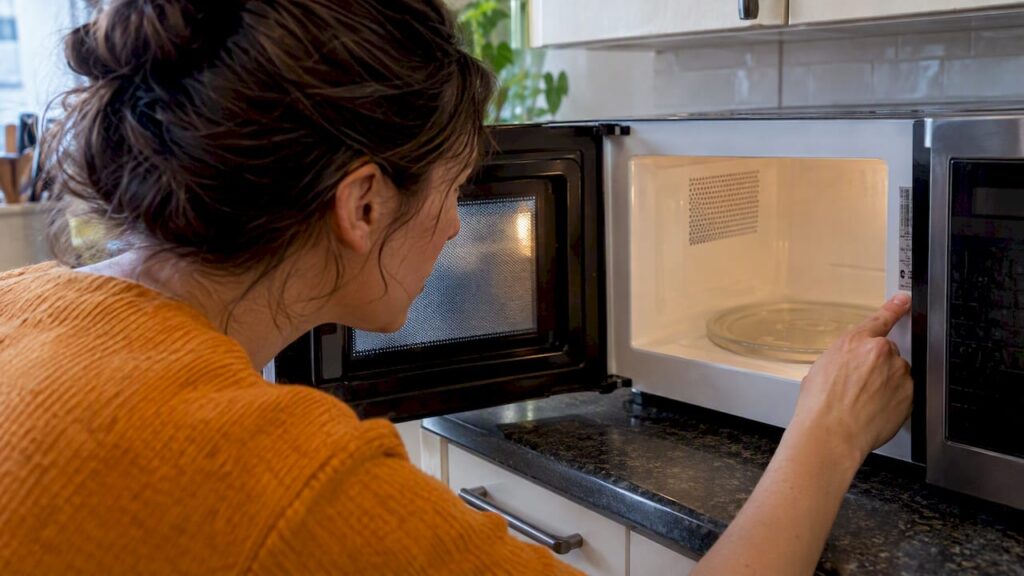
USDA FSIS says to look on the inside of the oven’s door or on the serial number plate on the back of the oven. Open the door and check the frame and the edge of the cavity first, then read the plate on the back. If the label lists both input and output power, the output (cooking) figure is the one that sets cook times.
2. Read the manual or the model page
Search the model number from the plate along with the word manual. Manufacturer spec pages list output power, often rounded to the nearest 50 or 100 watts. A model number is usually enough, even for older units.
3. Look at the model name
Many brands include a wattage in the product name or in the spec sheet at purchase. Treat that as a hint, then confirm with the manual, because some listings quote input rather than output power.
4. Run the water test
If the plate is missing or unreadable, the water test is the fallback. According to USDA FSIS, the Time-to-Boil classes are:
| Class | Approximate wattage | One cup of ice-cold water |
|---|---|---|
| Very high | 1,000W or more | Boils in under 2 minutes |
| High | 800W or more | About 2.5 minutes |
| Average | 650 to 700W or more | About 3 minutes |
| Slow | 300 to 500W | More than 3 minutes, or no boil within 4 minutes |
This is a rough sort, not a lab reading. The result shifts with the starting water temperature, the cup, and where it sits on the turntable. Use it to decide which row of the conversion chart below is closest to your oven. If your water boils at 2 minutes 20 seconds, you are between the very high and high classes, so try the 900W or 1,000W column first.
Common microwave wattages and who they suit
Published ranges differ a little. The sources cited here describe typical models anywhere from 600 to 1,200 watts, with larger or premium ovens higher. Here is a practical way to think about it.
| Wattage | Typical oven | What to expect |
|---|---|---|
| 600 to 700W | Compact, dorm and office models | Slow but fine for reheating small portions; stir often |
| 800 to 900W | Mid-size countertop | Works for most reheating; package times usually need a boost |
| 1,000W | Common baseline for recipes | Closest match to many recipe and package assumptions |
| 1,100 to 1,200W | Larger countertop and many over-the-range units | Fast; watch delicate foods and shorten times |
This Old House reports that built-in microwaves run from around 900 watts to 1,100 or more, while countertop models are small and portable. Size and power tend to go together, but not always, so confirm the number.
Is a 1,000-watt microwave better than a 900-watt one?
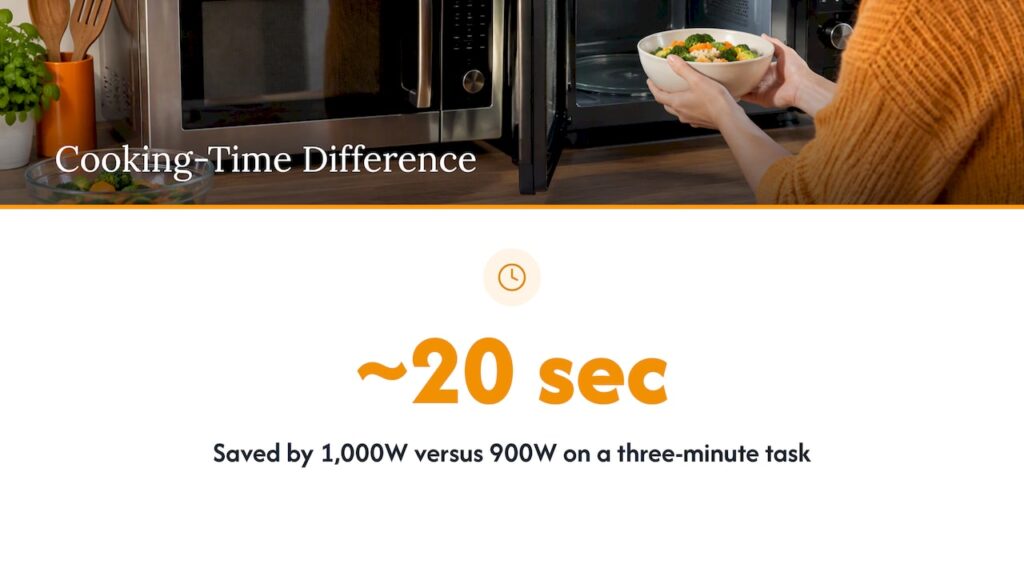
For most households the gap is modest. A 1,000-watt oven cooks about 11 percent faster than a 900-watt one, which is roughly 20 seconds saved on a three-minute job. Even-heating design, turntable quality and cavity size affect results as much as the raw number.
If you cook from scratch and follow recipes, 1,000 watts or more spares you the conversion. If you mostly reheat coffee and leftovers, 700 to 900 watts is workable.
Is a 750-watt microwave good enough?
Yes for reheating, softening butter and steaming a single bowl of vegetables. It will feel slow on frozen dinners and large casseroles. Expect to add 30 to 40 percent to times written for 1,000 watts, and stop to stir or rotate.
How to convert cooking times
The math is simple. Omni Calculator gives it as: multiply the label time in seconds by the label’s wattage, then divide by your own wattage.
Your time = (label seconds × label watts) ÷ your watts
Worked examples
- Frozen entrée, 3 minutes at 1,000W, your oven is 700W. 180 × 1,000 = 180,000. Divide by 700 and you get about 257 seconds, or 4 minutes 17 seconds.
- Soup, 90 seconds at 1,100W, your oven is 800W. 90 × 1,100 = 99,000. Divide by 800 and you get about 124 seconds, or just over 2 minutes.
- Casserole slice, 2 minutes at 1,200W, your oven is 900W. 120 × 1,200 = 144,000. Divide by 900 and you get 160 seconds, or 2 minutes 40 seconds.
Microwave wattage chart for cooking times
This chart is my own arithmetic from the formula above, using a 1,000-watt label as the starting point. If your package states a different wattage, use the formula.
| Label time at 1,000W | 700W | 800W | 900W | 1,100W | 1,200W |
|---|---|---|---|---|---|
| 1 minute | 1:26 | 1:15 | 1:07 | 0:55 | 0:50 |
| 2 minutes | 2:51 | 2:30 | 2:13 | 1:49 | 1:40 |
| 3 minutes | 4:17 | 3:45 | 3:20 | 2:44 | 2:30 |
| 5 minutes | 7:09 | 6:15 | 5:33 | 4:33 | 4:10 |
The Cata Appliances blog makes the same basic point: a lower-powered oven needs more time, a higher-powered one needs less.
Three rules that keep conversions honest
- Convert, then undershoot. Run 80 to 90 percent of the calculated time, stir or rotate, and add 10 to 15 seconds at a time.
- Dense or frozen foods drift from the math. Heat is not perfectly proportional to power for thick items, so standing time matters.
- Round up when in doubt only for reheating. For raw meat, poultry and eggs, use temperature to decide, not the clock.
Microwave power levels explained
Most ovens run the magnetron at full power and cycle it on and off to simulate lower settings. According to USDA FSIS, at settings below high the magnetron cycles off and on, so a 50 percent setting does not produce half-strength waves continuously. That is why low power is gentler on food: the pauses let heat spread inward.
When to use each level:
- High (100%): boiling water, reheating soup, cooking vegetables with a splash of water.
- Medium-high (70%): reheating dense leftovers and casseroles without rubbery edges.
- Medium (50%): defrosting and cooking tough or thick items evenly. The USDA’s turkey guidance in its blog post on cooking a turkey lists about 9 minutes per pound at 50 percent power for a 12 to 14 pound bird, with a rotation every 15 minutes, and warns that timing varies.
- Low (10 to 30%): softening butter, melting chocolate, keeping something warm.
Power levels scale with your oven’s top wattage. 50 percent on a 1,200-watt oven delivers about 600 watts on average, so it still runs hotter than 50 percent on a 900-watt model. If a recipe says medium and was written for a different oven, treat the time as a guide.
Safety: the clock is not a thermometer
Wattage conversion gets you close. It does not tell you the food is safe. USDA FSIS advises using a food thermometer to confirm safe internal temperatures even when you followed the microwave instructions.
Poultry, for example, needs to reach 165°F. Microwaves heat unevenly, so check several spots, especially in irregular shapes like drumsticks or stuffed items.
The USDA’s advice on package instructions adds another point: use the appliance named on the package, because some products look done but are not. If a frozen meal says conventional oven only, a microwave is not a substitute. If you are cooking for infants, older adults, pregnant people or anyone with a weakened immune system, follow the package and USDA guidance strictly and ask your doctor about specific food-safety concerns.
A few related checks:
- Stir, rotate and let food stand as directed so heat evens out.
- Cover food to hold steam, with a vent.
- Be careful about containers. If you are unsure whether a package belongs in the oven, see my page on whether you can microwave cardboard.
Choosing a wattage when you buy
If you are shopping, these are the questions I would work through:
- What do you cook? Frozen meals and recipe cooking favor 1,000 watts or more. Coffee and leftovers are fine on 700 to 900.
- How much counter space do you have? Small ovens are usually lower wattage. A look at multipurpose appliances in small kitchens can help you decide whether one device should do more than one job.
- Do you want a combo? Some units add grilling or convection, which changes how you use the power. My explainer on how a microwave toaster oven combo works covers the trade-offs, and my toaster oven guide helps if you are weighing a separate appliance.
- Is the wattage stated as output? Product pages sometimes list input power. Look for cooking or output power in the spec sheet.
One maintenance note: grease and splatters absorb microwave energy and can make an oven feel weaker or smell burnt. Follow the steps in how to clean a microwave according to the USDA.
My take on wattage
I don’t own, run or test microwaves, and I won’t pretend otherwise. What I do is read manufacturer specs, owner reviews and public guidance, and compare them. On wattage, the pattern is consistent.
The headline number is less useful than most shoppers think. Once you know your oven’s real output, a one-line conversion removes most of the guesswork. Most timing problems come from a mismatch: package directions written for one power level, and an oven that runs at another.
A 700-watt oven is perfectly usable if you know to add time. A 1,200-watt oven is only better if you also know to cut it.
So my advice is simple. Find your number, write it on a piece of tape inside a cabinet door, and keep the conversion formula handy. If you are buying, choose for how you cook, then check that the listing states output wattage and not input.
Find more kitchen comparisons
If you are replacing other appliances, I compare specs, prices and owner-reported problems across categories on Kitchenware Compare. The way I research products is laid out on How I Review Kitchen Equipment, and the affiliate disclosure explains how the site earns from links.
FAQ
How do I know my microwave wattage if there is no label?
Search the model number plus manual, or run the water test. USDA FSIS classes ovens by how fast one cup of cold water boils: under 2 minutes suggests 1,000W or more, and around 3 minutes suggests 650 to 700W. Use the result to choose a column in the conversion chart.
What wattage do most recipes assume?
Many recipes and packages are written for about 1,000 watts, though some use 1,100 or 1,200. Check the package for a stated wattage. If it lists none, 1,000W is a reasonable assumption, and then you adjust with the formula.
Can I use a higher power level to cook faster?
Only for foods that tolerate it, such as water or soup. Dense foods heat unevenly at full power, leaving cold centers and hot edges. A lower setting with a longer time is usually better for thick items.
Does a higher-wattage microwave use more electricity?
It draws more power while running, but it runs for less time, so the energy used per task can be similar. Input power on the label is higher than cooking power, so use the cooking wattage for timing and the input figure for circuit and electricity questions.
Sources
- USDA FSIS: Cooking with Microwave Ovens
- USDA: Read and Follow Package Cooking Instructions
- USDA: There’s More than One Way to Cook a Turkey
- Anyday: Find Your Wattage and Change Your Power Level
- Epicurious: How to Find the Wattage Power of Your Microwave
- Omni Calculator: Microwave Wattage Converter
- This Old House: Microwave Buying Guide
- Cata Appliances: Microwave Wattage Conversion Chart
Recommended
- How to Clean a Microwave: What the USDA Actually Says
- How Does a Microwave Toaster Oven Combo Work?
- Can You Microwave Cardboard? What the USDA Says

I'm Glenn, and I started Kitchenware Compare to cut through conflicting product reviews and help readers pick kitchen gear with confidence. I don't own or test the products I write about — these guides are built from verified-purchase reviews, manufacturer specifications, and independent testing where it exists, with the reasoning shown, not just a rating.
Leave a Reply