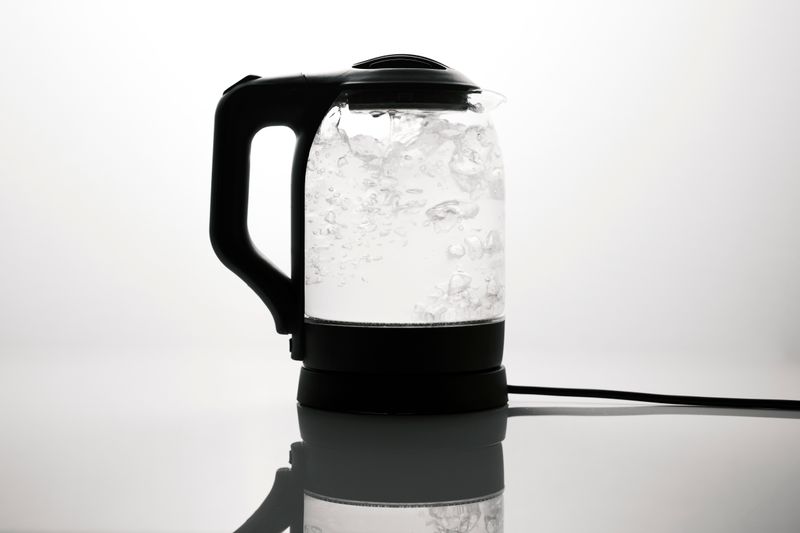
To descale an electric kettle, unplug it and pour out the water, add the acid or descaler your kettle’s maker names, boil it, let it stand, pour it out, then rinse and boil fresh water before you drink from it. The acid, the ratio and the soak time depend on the maker, and they disagree.
Below is what nine kettle makers prescribe, model by model, and where they contradict each other. This guide is part of the coffee equipment section, which covers kettles, grinders and brewers.
How to Descale an Electric Kettle: What Each Maker Prescribes
Each row comes from the named model’s manual or support page. Check your model number first: two makers change the recipe between their own kettles.
| Maker and model | What to use | Amount and heat | Soak and rinse | How often | Warnings and warranty |
|---|---|---|---|---|---|
| Cosori CO117-DK, CDK-SE151, CO171-GK2, CS108-NK, GK172-CO (CO117-DK manual) | Half a lemon or 1/2 cup (118 mL) distilled vinegar | Plus 2 cups (473 mL) water; boil | No soak; pour out, wipe, repeat as needed | At least weekly if used frequently | No steel wool; glass CO117-DK, GK172-CO and CO171-GK2: do not remove the lid filter |
| Cosori CO171-GK, CO108-NK (older manuals) | 1 cup (237 mL) distilled vinegar or lemon juice | Plus 2 cups water (1:2); boil | Soak 2 hours, pour out, then rinse | At least weekly if used frequently | Never immerse the kettle or base |
| Breville BKE820XL (manual, copy on archive.org) | Kettle descaler, or vinegar | Two-thirds full, 1 part vinegar to 2 parts water; boil | Overnight; then boil and discard clean water twice | Regularly (no number) | No alkaline cleaning agents, steel wool or abrasives |
| OXO Brew Adjustable Temperature Kettle | Descaling solution (OXO names its own) | Boil and discard a MAX fill of water; refill to MAX with solution and warm water | Unplugged, at least 5 minutes; rinse the spout filter | Every 60 uses | Only water and descaling products inside; warranty void if descaling is not done per the instructions |
| OXO Brew Pour-Over Kettle, gooseneck (manual, copy on Home Depot) | Descaling solution | Boil water to about 2/3 of max, top up with solution | 15 minutes, then discard and rinse | Every 60 uses | Same warranty wording |
| Fellow Stagg EKG (instruction guide) | A scale/lime remover; the manual names no acid | Per the remover’s directions | Per the remover’s directions | Depends on use and water hardness | Warranty excludes not following cleaning and descaling-agent instructions |
| Fellow blog (not the manual) | Equal parts white vinegar and water, or 500 mL water with 2 spoonfuls citric acid | Boil, switch off | At least 30 minutes; rinse, boil and discard fresh water | Monthly in hard water, every 2-3 months in soft | No steel wool |
| Hamilton Beach 40798, 40978, 40998 (use and care guide) | 1/2 teaspoon cream of tartar | Fill half full of water; boil | Cool, then rinse several times | Empty after each use (no number) | Heating coffee or tea voids the warranty |
| Cuisinart PerfecTemp CPK-17 (manual, copy on archive.org) | Kettle descaler; if none, undiluted white vinegar | About 1/2 inch of vinegar, boiled | Repeat with cooled vinegar until clean; rinse several times | From time to time, by water hardness and use | Rinse and brush the scale filter |
| KitchenAid electric kettle (support page; model not named) | Commercial descaler; if none, white vinegar | Vinegar to 0.5 L, water to 1 L; boil | Overnight; boil and drain fresh water three times | By water hardness (no number) | — |
| Bonavita BV382518V, BV382510VAUS (copy of the manual on manualshive) | Full Circle Descaler (BV382518V); advises against vinegar | 1 packet in 32 oz lukewarm water; boil | Cool 15 minutes, discard, rinse | When build-up is visible | No abrasive cleansers |
| Mueller Ultra M99S (copy of the manual on manualshive) | White vinegar, citric acid, or a descaler for plastic kettles | Vinegar 1/2 L unheated; or 25 g citric acid in 1/2 L boiled water | Vinegar 1 hour, citric 15 minutes; rinse 5 or 6 times | At least monthly | Use only the methods it lists |
Where the Makers Disagree
- Vinegar. Bonavita says vinegar may not descale effectively, can be hard to rinse fully and may leave an odor. The OXO and Hamilton Beach manuals read for this page do not mention vinegar. Elsewhere strength runs from undiluted (Cuisinart, Mueller) to about one part in five (current Cosori).
- Cream of tartar. Hamilton Beach uses 1/2 teaspoon of cream of tartar, and it is the only maker here that does.
- Baking soda. Cosori gives a quick descale of baking soda with vinegar for thin scale; Breville and OXO both say not to use alkaline cleaning agents, and baking soda is alkaline.
- Same brand, different recipe. Current Cosori manuals pour the mixture out after boiling; the older CO171-GK and CO108-NK manuals soak it for 2 hours. OXO’s two kettles stand for 5 and 15 minutes.
- Manual versus blog. The Stagg EKG manual says to use a scale/lime remover and follow its directions; Fellow’s blog gives vinegar and citric acid recipes, and its EKG Pro gear guide allows vinegar, prefers citric acid and recommends Urnex Dezcal. Because the EKG warranty refers to descaling-agent instructions, I would use a commercial remover on an EKG under warranty.
Steps When Your Manual Gives No Recipe
If the manual is lost, search the maker’s site for your model number. These steps are the common ground across the makers above, not a recipe of my own.
- Unplug, empty and let the kettle cool. Cosori’s current manuals start this way.
- Add a descaler at its label ratio, or an acid at one of the ratios in the table above, under the max line.
- Boil, switch off and let it stand as long as your manual says.
- Pour out and wipe loose scale with a soft sponge, never steel wool. Fellow’s blog says to repeat the treatment rather than scrub harder.
- Rinse, then boil fresh water and discard it. Breville does this twice and KitchenAid three times.
- Clean the filter, but Cosori warns that the lid filter on its glass kettles breaks if removed.
- Never put the kettle or its base in water. The Cosori, Breville, OXO, Fellow, Hamilton Beach, Cuisinart, Bonavita and Mueller manuals all say this.
How Often to Descale, and the Signs It Is Due
Cosori says at least once a week with frequent use, OXO every 60 uses and Mueller at least monthly. Cuisinart, KitchenAid and Fellow’s manual tie the interval to water hardness without a number, and Breville says only that the kettle should be descaled regularly. The Green Pods says most manufacturers recommend every three months, but Cosori and Mueller give shorter intervals, OXO counts uses rather than months, and only Fellow’s blog reaches three months, for soft water.
The USGS classes 0 to 60 mg/L as calcium carbonate as soft and more than 180 mg/L as very hard (USGS water hardness page), and it points to your local water utility for a home figure. Espresso machines run on their own schedule; see how often to descale an espresso machine.
Fellow and Hamilton Beach both say a kettle that heats but will not boil may need descaling, and Bonavita says scale can affect temperature consistency and slow the boil. Breville says lime scale shows as white or rusty-looking build-up on the inner walls, and that phosphate scale, though not visible, can make the water look cloudy when heated.
Common Mistakes
- Copying a web recipe. Bob Vila uses equal parts water and vinegar and Coolblue a 50/50 mix for 15 minutes; neither cites a kettle manual.
- Leaving water standing. Breville, Hamilton Beach and Mueller all say to empty the kettle after use.
Coffee makers follow different rules; see coffee maker descaling for drip, espresso and pod machines.
How This Page Was Researched
This page is research from kettle makers’ manuals and support pages, not hands-on testing. I do not own or test electric kettles. The Bonavita and Mueller instructions come from copies of the manuals on a third-party site, manualshive, not from the makers’ own websites.
What Could Not Be Established
- I found no independent test comparing vinegar, citric acid, cream of tartar and commercial descalers on kettles, so this page does not rank them.
- Of the makers that mention vinegar, only Bonavita advises against it, for effectiveness, rinsing and odor, not damage to the kettle.
- The original Stagg EKG manual names no acid, but Fellow’s EKG Pro gear guide says vinegar can be used, prefers citric acid and recommends Urnex Dezcal, in an answer written for Fellow electric kettles in general.
- The two Hamilton Beach manuals read do not mention vinegar; other models are unknown.
- Manuals for the Bodum Bistro Gooseneck, Hario Buono and XIRGS kettles were not obtained.
- None of the kettle manuals read says filtered or distilled water prevents scale.
The Verdict
Follow your own model’s manual, even where it differs from the web’s usual vinegar mix. If it names only a descaler, use one; on an OXO or Fellow EKG the warranty wording depends on it. Without a manual, use a commercial kettle descaler as its label says.
If scale has already cost you a kettle, the gooseneck kettle guide compares current models. The plastic-free kettle guide covers which kettles keep water away from plastic parts.
Frequently Asked Questions
What is the best thing to descale an electric kettle with?
Whatever your kettle’s maker names. Cosori, Breville, Cuisinart, KitchenAid and Mueller give vinegar methods, Hamilton Beach uses cream of tartar, and OXO and Bonavita point to a descaler. I found no independent test comparing these on kettles, so check your manual rather than a ranking.
Can you descale an electric kettle with vinegar?
Most makers read allow it, at different strengths: Cuisinart undiluted and boiled, Mueller undiluted without heat, KitchenAid about half and half, Breville one part to two of water. Bonavita advises against vinegar, saying it may not descale effectively, can be hard to rinse and may leave an odor.
How often should you descale an electric kettle?
It depends on the maker and your water. Cosori says at least weekly with frequent use, OXO every 60 uses, Mueller at least monthly, and Fellow’s blog monthly in hard water or every two to three months in soft. Bonavita says when build-up is visible.
How do you get rid of the vinegar smell after descaling?
Rinse, then boil fresh water and pour it away. Breville and KitchenAid repeat that boil, and Fellow’s blog says to boil and discard fresh water again if a vinegar scent remains. Bonavita’s manual warns that vinegar can be hard to rinse fully and may leave an odor.
Is limescale in a kettle harmful?
Breville’s manual calls lime scale a harmless mineral. The makers’ concern is the kettle itself: Breville says scale build-up can affect the performance and life of the kettle, and OXO says its kettle will not work properly if it is not descaled regularly.
Does skipping descaling void a kettle warranty?
On some kettles it can. OXO’s manuals say the warranty is voided if descaling is not carried out per their instructions. Fellow’s warranty excludes failure to follow cleaning instructions for the kettle and descaling agents. Hamilton Beach voids its warranty if the kettle heats anything but water.

I'm Glenn, and I started Kitchenware Compare to cut through conflicting product reviews and help readers pick kitchen gear with confidence. I don't own or test the products I write about — these guides are built from verified-purchase reviews, manufacturer specifications, and independent testing where it exists, with the reasoning shown, not just a rating.
Leave a Reply