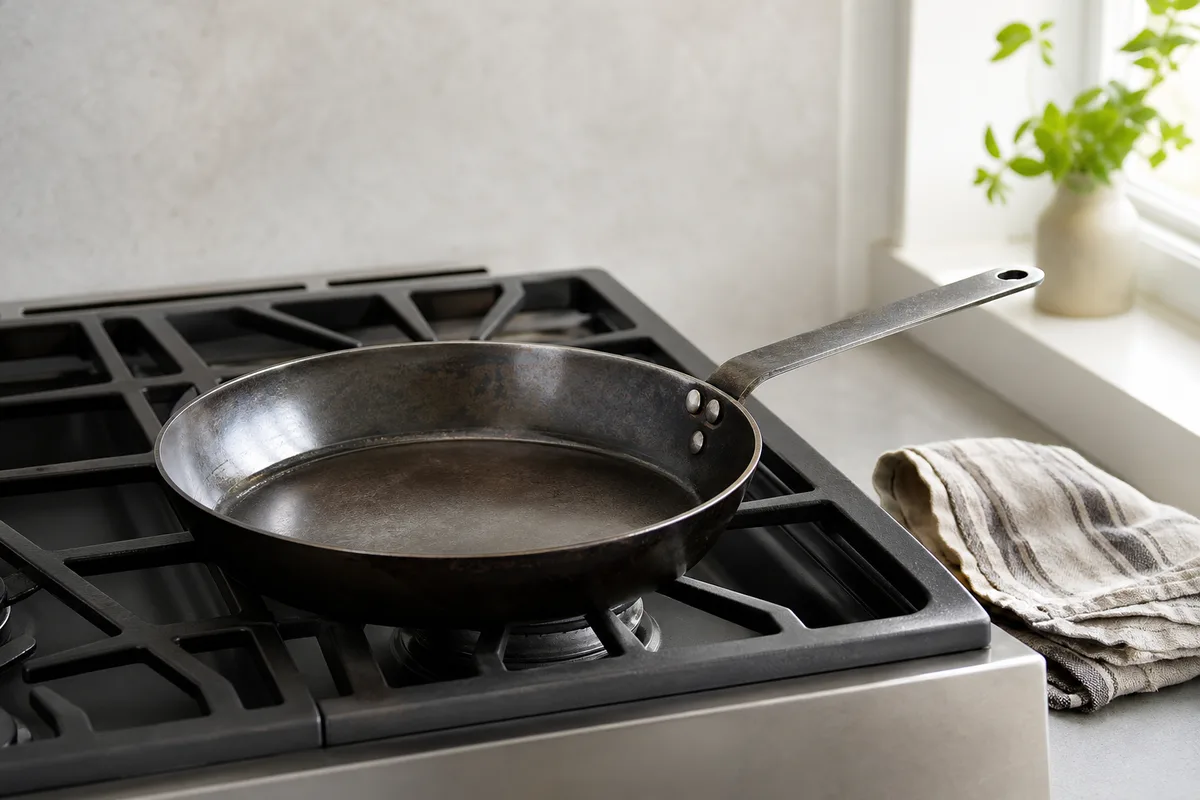
A carbon steel pan rusting is usually a surface problem, not a ruined pan. Carbon steel is almost pure iron under a thin layer of seasoning, and water left on it rusts it. Scrub the rust back to grey steel, dry the pan completely, re-season it, and oil it after every wash.
Below is what nine cookware makers tell owners to do about rust, where they contradict each other, and how to tell rust from normal seasoning colour.
Why Carbon Steel Pans Rust
Mauviel describes carbon steel as bare metal, roughly 99% iron, protected by oil bonded to the steel. Where that seasoning is thin, scratched or stripped, moisture reaches the iron. The usual causes:
- Soaking or the dishwasher. Lodge says soaking carbon steel will likely cause rust, and that a dishwasher will remove the seasoning and likely cause rust. The dishwasher-safe cookware guide covers which pans can go in.
- Humidity and damp storage. Made In lists a humid climate, a pan not dried thoroughly before storing, and a pan not seasoned properly.
- Scratches from stacking. de Buyer USA says even minor scratches can encourage rust formation.
- A new pan with its coating washed off. New pans ship with beeswax or oil against rust in transit, and Mauviel warns that bare carbon steel can begin to flash-rust while wet.
Rust or Seasoning Colour: How to Tell
Not every mark is rust. Mauviel says blotchy colour, brown here, black there, rainbow near the walls, is completely normal. Matfer says spotty, streaky or darker seasoning is okay and the best thing to do is keep cooking. Strata says carbon steel heated high enough changes from silver to blue, and that this is ok.
White marks after cooking tomatoes or wine are the acid stains de Buyer’s leaflet describes, and the fix is re-seasoning. A practical check for rust: it is orange and rough, and it leaves orange residue on a damp paper towel.
When a Rusty Carbon Steel Pan Is Ruined
Surface rust is not the end of the pan. Mauviel calls rust “cosmetic, not fatal” and says that after removal and re-seasoning the pan will be as good as before. The line is pitting: Matfer’s black steel guide says that if rust has pitted the steel, the nonstick properties will be compromised and you should consider replacing the pan. de Buyer USA says to retire a pan if you can’t keep rust off, if the handles are falling off or if it heats unevenly.
Do not cook on it while it is rusty. An Ask Extension answer quotes the USDA as saying rust is not a food-safe material and should be removed before a utensil is used. Made In adds that you should not cook straight after removing rust: dry the pan over low heat, apply a thin film of oil and let it cool first.
What Carbon Steel Makers Say About Removing Rust
The makers agree on the outline: get the rust off, dry the pan, then oil or re-season it. They disagree on the tools.
| Maker and source | Light rust | Heavier rust |
|---|---|---|
| Made In, rust page | Coarse salt and neutral oil, about 1:1, rubbed in with a paper towel | A scouring pad, steel wool, abrasive sponge or fine-grit sandpaper; or boil equal parts water and white vinegar in the pan |
| de Buyer, printed leaflet | Scrub the pan with a hard brush to remove the rust | No separate step |
| de Buyer USA, FAQ | A rust cleaner and a non-abrasive scrub brush | Same |
| de Buyer USA, rust page | Coarse salt and oil with a soft cloth or paper towel | Steel wool; a vinegar boil, or a 50/50 distilled vinegar soak for one hour, up to five hours |
| Matfer Bourgeat | Warm water, a few tablespoons of salt and a sponge | If the steel is pitted, consider replacing the pan |
| Mauviel, M’STEEL guide | Hot water and an abrasive pad or steel wool, back to grey steel | Same |
| Lodge, seasoned steel care sheet | Scour the affected area with steel wool, rinse, dry, rub with vegetable oil | Re-season if problems persist |
| Misen | A little steel wool to buff out a rusty spot | Same |
| Strata | Soap and an abrasive sponge | Steel wool for deeper rust, and Bar Keepers Friend for stubborn rust; Strata warns that Bar Keepers Friend removes seasoning, so re-season after |
| Merten & Storck, via GreenPan US | Scrub it off with steel wool, rinse, dry, and re-season | Its re-season routine: scrub off any rust with vinegar and a brush, then a 450°F oven |
| Smithey (care pages written for cast iron) | Steel wool or a chainmail scrubber and soapy water | A full strip and 2–3 oven layers of seasoning |
Steel wool is the most common tool. Matfer’s fix uses salt and a sponge instead, and de Buyer USA’s FAQ asks for a non-abrasive scrub brush, although its own rust page lists steel wool.
How to Remove Rust From a Carbon Steel Pan
- Try salt first. de Buyer USA calls the salt scrub the least invasive way to remove rust: coarse salt and a little oil, rubbed in small circles.
- Move to steel wool for stubborn spots. Lodge, Mauviel, Misen, Strata and Made In’s rust page use steel wool on rust. Scrub until you are back to grey steel, then dry the pan over low heat.
- Use vinegar only for heavy rust. Made In boils equal parts water and white vinegar in the pan; its strip guide soaks the pan for 30 minutes instead. Vinegar strips most or all of the seasoning, so a full re-season follows.
- Re-season straight away. Made In warns that a fully stripped pan can start to rust if it is not re-seasoned right away. For the method, see how to season carbon steel.
Where the Makers Disagree
Steel wool. Made In’s re-seasoning guide says not to start with steel wool because it will backfire and cause more rust, then uses steel wool on a baking soda and vinegar paste. de Buyer USA’s wash page says to avoid steel wool, yet its rust page lists it. Lodge’s care sheet calls metal scouring pads a no-no that harms seasoning, then scours rust with steel wool, which reads as steel wool being a rust tool, not an everyday scrubber.
Vinegar time. The times run from a boil to 30 minutes (Made In) to one to five hours (de Buyer USA). Mississippi State and NC State extension pages, written about cast iron, say to check a vinegar soak every 15 minutes. Vollrath warns against prolonged exposure to acidic products, but none of the carbon steel care pages I read says how long is too long, so I would keep soaks short and check often.
Salt. Made In, de Buyer USA and Matfer scrub rust with salt, but Vollrath’s care sheet warns that direct contact with salt can cause pitting. A quick scrub is not salt left sitting on steel, so rinse it away and dry the pan.
How to Stop a Carbon Steel Pan Rusting Again
- Dry it on the burner. Made In and Mauviel both dry the pan over low heat, and Strata says not to leave it to air dry.
- Oil it while it is warm. Lodge and Mauviel finish with a thin layer of oil before the pan is put away.
- Store it dry and unstacked. de Buyer USA suggests a pot rack or pot protection cloths, and Smithey puts a paper towel inside the pan when it is especially humid.
- Season the outside if you cook outdoors. Made In suggests seasoning the exterior of your pan to decrease the amount of surface iron.
Carbon steel woks rust for the same reasons. If a wok is past saving, the best wok for induction and electric stoves guide covers replacements.
Nitrided and Enamel-Coated Carbon Steel
Strata says nitriding makes the surface more rust-resistant, but very aggressive scrubbing with harsh abrasives like steel wool can wear the nitrided layer away. Its answer is a maintenance seasoning, since the bare steel underneath seasons like the rest of the pan. Enamel-coated carbon steel is a different case, and none of the care pages I read covers rust on it.
How This Page Was Put Together
This page is built from makers’ own care pages and printed sheets, plus three extension sources. It is research, not testing: I do not own any of these pans and have not removed rust from one.
What I could not establish: how long bare carbon steel can sit in vinegar before the acid etches it, and how deep rust can go before a pan is past saving, beyond Matfer’s “pitted”. The USDA wording is quoted second-hand in the Ask Extension answer, and I did not find it on a USDA page. Smithey’s rust instructions are written about cast iron.
The Verdict
A rusty carbon steel pan is almost always a repair job: scrub the rust back to grey steel, dry it over heat, re-season, and oil it after every wash. Replace it if the steel is pitted, as Matfer advises, or if you can’t keep rust off it. If the pan is actually cast iron, how to fix rusty cast iron covers those makers; if you are weighing a switch, carbon steel vs cast iron compares the two, and the cookware guide hub covers the rest.
Frequently Asked Questions
Is it safe to cook in a carbon steel pan with rust on it?
Not until the rust is gone. An Ask Extension answer quotes the USDA as saying rust is not a food-safe material and should be removed before a utensil is used. Scrub it off, dry the pan over heat, re-season it, then cook as normal.
Can you use steel wool on a carbon steel pan?
For rust, most makers say yes: Lodge, Mauviel, Misen, Strata and Made In’s rust page use steel wool on rust. de Buyer USA’s FAQ prefers a non-abrasive scrub brush, and Strata warns that steel wool can wear away a nitrided layer. Re-season afterwards, because steel wool strips seasoning.
Does vinegar damage a carbon steel pan?
Vinegar strips most or all of the seasoning, which is why Made In says a reseasoning is all but required afterwards. None of the carbon steel care pages I read says how long is too long, so keep soaks short, then rinse, dry and re-season.
Why did my new carbon steel pan rust after I washed it?
New pans ship with a protective coating, often beeswax or oil, that keeps the bare steel from rusting in transit. Once it is washed off, bare carbon steel can begin to flash-rust while wet, Mauviel warns. Dry the pan at once, warm it briefly on the burner, and season it.
How do I know if my carbon steel pan is ruined?
Look for pitting. Matfer says that if rust has pitted the steel, the nonstick properties will be compromised and you should consider replacing the pan. de Buyer USA adds that a pan you can’t keep rust off is done. Surface rust alone is repairable with a scrub and re-season.
Is the blue or brown colour on my pan rust?
Usually not. Strata says carbon steel heated high enough changes from silver to blue, and Mauviel and Matfer say patchy brown and black seasoning is normal. Rust is orange and rough, and it leaves orange residue on a damp paper towel. Seasoning colour leaves no orange residue.

I'm Glenn, and I started Kitchenware Compare to cut through conflicting product reviews and help readers pick kitchen gear with confidence. I don't own or test the products I write about — these guides are built from verified-purchase reviews, manufacturer specifications, and independent testing where it exists, with the reasoning shown, not just a rating.
Leave a Reply