This post contains affiliate links. If you buy through them, I earn a small commission at no extra cost to you. Full disclosure here.
If you’re making espresso with a blade grinder — or even a basic burr grinder not calibrated for espresso — the grinder is almost certainly the weak link. Uneven particle sizes cause channeling and inconsistent extraction, and none of that is the espresso machine’s fault. Seven grinders are compared below across different price points and burr styles, on the specifications and owner reports that actually separate them for home espresso in 2026. My main pick is the Breville Smart Grinder Pro — 60 settings, a dose timer, and portafilter grinding for around $200.
Quick Comparison
| Product | Best For | Price | Rating | Buy |
|---|---|---|---|---|
| OXO Brew Conical Burr Grinder | Best Budget Electric | ~$110 | 4.3★ (23,346) | Check Price |
| Breville BCG820BSS Smart Grinder Pro | Best Overall (electric) | ~$200 | 4.5★ (6,993) | Check Price |
| Timemore Chestnut C2S | Best Budget Manual | $75 | 4.7★ (986) | Check Price |
| Timemore Chestnut C3S Pro | Best Manual for Travel | $95 | 4.7★ (1,715) | Check Price |
| Capresso Infinity Plus | Best for Multi-Style Brewing (electric) | $99 | 4.4★ (1,685) | Check Price |
| Baratza Encore ESP | Best Espresso-First Electric | $199.95 | 4.0★ (1,407) | Check Price |
| Eureka Mignon Specialita | Best Step-Up (Stepless) | $549 | 4.2★ (202) | Check Price |
Why the Grinder Matters More Than People Expect
Espresso is unforgiving. Hot water pushes through a compressed coffee puck at 9 bars of pressure in roughly 25 seconds. If grind consistency is off — even by a small amount — water finds the path of least resistance through the puck (called channeling), and you get uneven extraction: part of the puck over-extracts and turns bitter, part under-extracts and tastes sour. The espresso machine itself isn’t the culprit.
A good espresso grinder needs two things a standard coffee grinder often lacks:
Precise, fine adjustment. Espresso sits at the finest end of the grind range — between powdered sugar and fine table salt. A single step on the adjustment dial can shift your shot time by several seconds. Cheap grinders have wide stepped adjustments with limited positions; proper espresso grinders have many fine steps, or true stepless adjustment.
Burrs, not blades. Blade grinders chop beans randomly, producing a wide range of particle sizes. Burrs slice beans cleanly into consistent particles.
For espresso, burrs are non-negotiable — and the best results come from burrs specifically designed for fine grinding. If you already own a burr grinder and it has stopped performing, start with why a coffee grinder stops grinding properly before replacing it — the cause is usually bridging beans or a mis-seated burr rather than wear.
Manual hand grinders deserve more credit than most people give them. A quality hand grinder with conical steel burrs — like the Timemore models reviewed below — produces grind consistency that rivals electric grinders at twice the price. The obvious trade-off: you grind by hand for 45–60 seconds per shot. For one coffee that’s fine; for a morning round of two or three, it adds up.
The Best Espresso Grinders (2026)
1. OXO Brew Conical Burr Grinder — Best Budget Electric

Price: ~$110 | Rating: 4.3★ (23,346 reviews)
The OXO Brew Conical Burr is where most people should start if they’re upgrading from a blade grinder and want to stay near the $100 mark. With more than 23,000 reviews it’s the most-reviewed burr grinder in this price range, and the 4.3-star average reflects broad satisfaction across different coffee setups.
Forty grind settings cover drip, pour-over, and espresso. For espresso, you’ll be working at the fine end of the dial where small step differences have a surprisingly large effect — dialling in takes patience, and the sweet spot sometimes falls between two adjacent settings. The one-touch timer is the standout practical feature: set your grind duration once and it repeats, which helps keep dose weight consistent from shot to shot.
Stainless steel burrs, a removable grounds container, and a hopper that holds enough beans for a week of daily shots. The body is plastic, which is appropriate for the price. The limitation is that the stepped adjustment isn’t as precise as dedicated espresso grinders — but at $109.95, this is a real burr grinder that will meaningfully improve your espresso over any blade alternative.
Best for: first-time burr grinder buyers, budget-conscious home espresso setups
- ✅ 23,000+ reviews (highly proven)
- ✅ 40 grind settings, one-touch timer
- ✅ Stainless steel burrs
- ❌ Stepped adjustment — imprecise at fine espresso range
- ❌ Plastic body
2. Breville BCG820BSS Smart Grinder Pro — Best Overall

Price: ~$200 | Rating: 4.5★ (6,993 reviews)
The Breville Smart Grinder Pro covers the widest range of brew methods of any electric grinder here. Sixty grind settings, a digital timer display with 0.2-second increment control, and the ability to grind directly into the portafilter — the last of which makes a real difference to your workflow, since you lose fewer grounds in the transfer.
Sixty settings means there’s nearly always a position to land between any two steps as you dial in. The digital timer lets you set your dose by duration and repeat it consistently — important for espresso where a gram or two of dose weight affects extraction. The stainless steel conical burrs perform reliably at fine espresso grind sizes. If you’re using a Breville Bambino Plus or another Breville machine, the portafilter cradle fits 54mm baskets directly, which is a genuine convenience during a morning routine.
At around $200 the Smart Grinder Pro is the most expensive pick here, and the case for it rests on grind adjustment rather than on price. The caveats: the portafilter cradle doesn’t fit all basket sizes, so verify the fit if you have a non-Breville machine, and the exterior is plastic. Neither affects the core grinding performance.
Best for: home espresso enthusiasts who want precise dosing control, Breville machine owners
- ✅ 60 grind settings — maximum espresso precision
- ✅ Digital dose timer (0.2-second increments)
- ✅ Grinds directly into portafilter
- ✅ Exceptional current value for the specification
- ❌ Portafilter cradle fit varies by machine
- ❌ Plastic exterior
3. Timemore Chestnut C2S — Best Budget Manual Grinder

Price: $75 | Rating: 4.7★ (986 reviews)
Manual grinders split opinion. If you’ve never used one, grinding by hand for 45 seconds before your morning espresso sounds tedious. In practice, it becomes routine quickly — and the grind quality from a $75 Timemore often matches electric grinders costing twice as much.
The C2S uses Timemore’s S2C conical burr set, designed with espresso in mind. The stainless steel burrs produce notably consistent particle sizes at fine settings. The double bearing positioning system keeps the burr assembly centred during grinding — any wobble in the burr gap creates larger, irregular particles. Eliminate the wobble and you get a more even coffee bed, more predictable extraction, and better shots.
The C2S is simpler than the C3S Pro (no foldable handle, more compact body), which makes it the better choice for home countertop use where travel portability isn’t a priority. If you make one or two espresso shots per day and don’t mind the hand grinding, this is the best precision-to-cost ratio on this list. I have written it up in full: read the Timemore C2S review, which covers the click scale, the top cover Timemore says it fixed, and what owners report after a year.
Best for: home single-shot brewers, anyone who values precision over speed
- ✅ S2C espresso-optimised burrs
- ✅ Double bearing positioning for consistency
- ✅ 4.7★ rating
- ✅ Silent — no motor noise
- ❌ Hand grinding (~45 sec per double shot)
- ❌ Lower throughput than electric models
4. Timemore Chestnut C3S Pro — Best Manual Grinder for Travel

Price: $95 | Rating: 4.7★ (1,715 reviews)
The Timemore Chestnut C3S Pro is the C2S’s more capable sibling, and its 4.7-star average on 1,715 reviews is one of the strongest ratings I’ve seen for any grinder at this price. The core improvements: a foldable handle that collapses for packing, a wider grind adjustment range, and better ergonomics during grinding.
For espresso drinkers who travel — anyone who packs a portable coffee setup — this is the obvious choice. It pairs naturally with an AeroPress or a portable espresso maker, and in that combination you have a genuinely capable espresso-style setup that fits in a carry-on. At home, the foldable handle is a mild inconvenience, but the improved adjustment precision over the C2S makes it worth the $20 premium if you’re serious about espresso dialling.
The grind range covers fine espresso through coarser AeroPress grind, so one grinder handles everything if you brew different ways on different days. The S2C burrs produce the same clean, consistent grounds as the C2S. For a hand grinder at $95, the C3S Pro sets a high bar. I have written it up in full: read the Timemore C3S Pro review, which covers the transposed grind chart and what owners report about the top cover.
Best for: travellers, campers, home brewers who want maximum manual grinder quality
- ✅ Foldable handle — genuinely travel-ready
- ✅ 4.7★ on 1,715 reviews
- ✅ Wide grind range (espresso through coarse)
- ✅ S2C conical burrs
- ❌ Hand grinding (~45–60 sec per double shot)
- ❌ Slightly slower grinding rate than the C2S
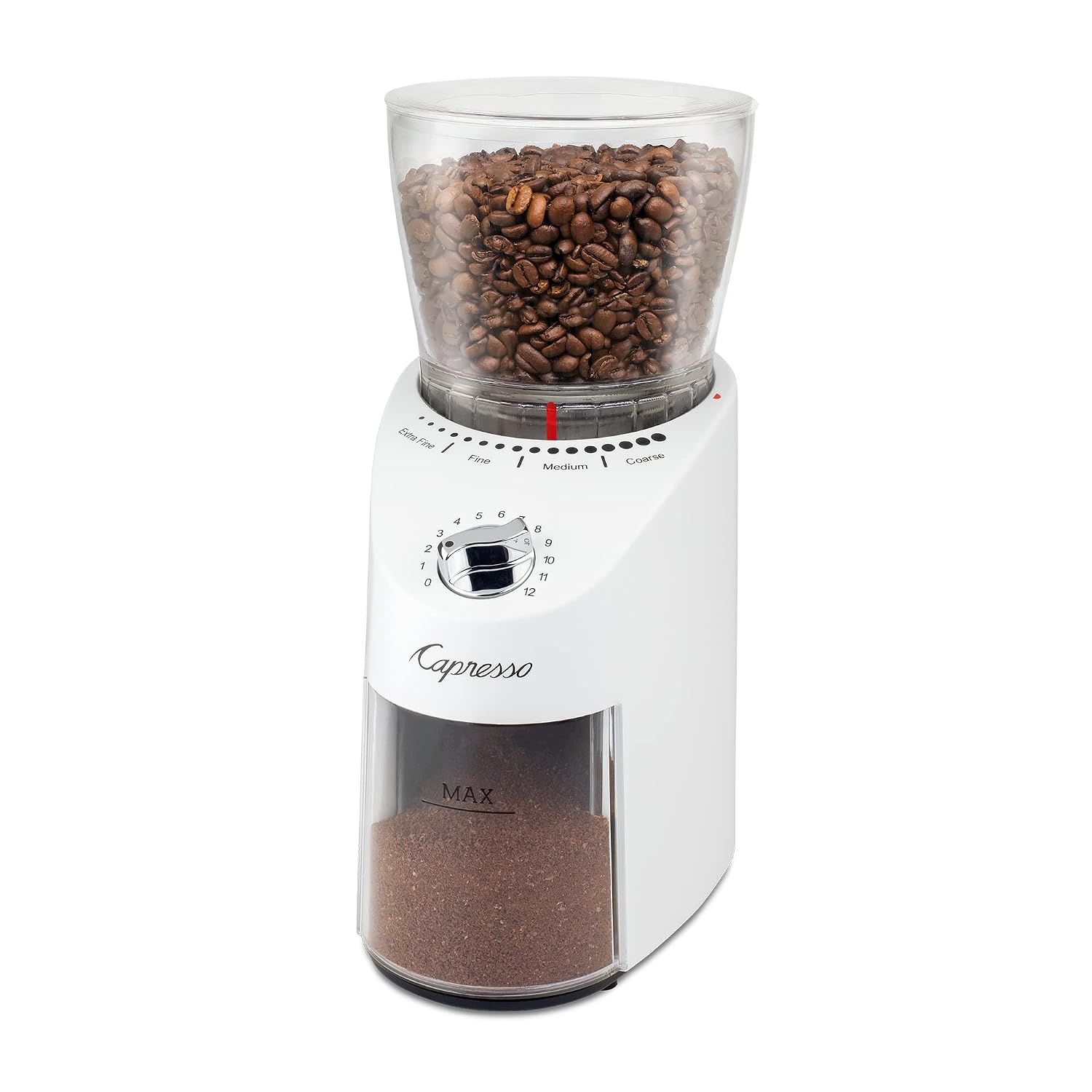
5. Capresso Infinity Plus — Best for Multi-Style Brewing
Price: $99 | Rating: 4.4★ (1,685 reviews)
Capresso has been making burr grinders for decades, and the Infinity Plus reflects that experience. Its motor runs at 450 RPM — significantly slower than most electric grinders. Lower speed generates less heat, and potentially better flavour preservation in lighter roasts where volatile aromatics matter most. It does not, on the evidence of owner reviews, mean less mess: static is the single most common complaint about this grinder, including from one household on their third Capresso who call it by far the messiest they have owned.
Sixteen grind settings is fewer than the Breville’s sixty, but they’re well-spaced: dedicated positions for fine espresso, medium drip, coarser pour-over, and French press. The conical burrs produce consistent results across all of them. Amazon lists the housing material as plastic, and two owners who previously had an aluminium-bodied Infinity report the current build as lighter and cheaper. At four pounds it is not a heavy machine.
The Infinity Plus earns its place in households where different people want different brewing methods. One person wants espresso; another wants drip; a third wants French press. For pure espresso enthusiasts who want maximum dialling precision, the Breville’s 60 settings win on flexibility — but for variety across brewing styles, the Capresso is the stronger choice. I have written it up in full: read the Capresso Infinity Plus review, which covers the static reports, the housing change and how the grind collar differs from the timer dial.
Best for: multi-method households, anyone who wants range across brewing styles rather than the finest espresso adjustment
- ✅ Slow 450 RPM motor — less heat, and quieter than the model it replaced
- ✅ 16 settings covering espresso through French press
- ✅ 4.4★ on 1,685 reviews
- ✅ Large 11 oz hopper and 4 oz grounds container
- ❌ Fewer settings than Breville (less fine-tuning at espresso range)
- ❌ Stepped adjustment only
- ❌ Static is the dominant owner complaint, and the housing is plastic
6. Baratza Encore ESP — Best Espresso-First Electric Under $200

Price: $199.95 | Rating: 4.0★ (1,407 reviews)
Baratza sells the Encore ESP as the espresso-capable version of its long-running Encore. The listing describes a dual-range dial: micro-steps numbered 1–20 for fine espresso adjustment and wider macro-steps from 21 to 40 for filter brewing, driven by 40 mm hardened steel conical burrs and a DC motor. Where the Breville spreads 60 settings across everything, the Baratza puts half of its dial into the espresso end.
What it leaves out matters. The listing describes a front pulse button and an on/off switch rather than a timer, so you dose by eye or by scale, not by programmed seconds, and it mentions no portafilter cradle.
Its 4.0 stars from 1,407 ratings is the lowest rating on this list, which is a reason to read the recent critical reviews before buying rather than a verdict. Coffee Bros, a coffee retailer, names it both its beginner pick and its best espresso grinder under $200, and that is a seller’s opinion, not a test. I compare it directly with the Breville in my Smart Grinder Pro review.
Best for: beginners who want an espresso-weighted dial and are happy to dose with a scale
- ✅ 40 mm steel conical burrs; the dial is split into 20 espresso steps and 20 filter steps
- ✅ Same $199.95 typical price as the Breville
- ✅ Quick-release burr for cleaning, per the listing
- ❌ No timer or programmable dose, only a pulse button and an on/off switch
- ❌ Stepped adjustment, not stepless
- ❌ 4.0★, the lowest rating on this list
7. Eureka Mignon Specialita — Best Step-Up (Stepless Flat Burr)

Price: $549 | Rating: 4.2★ (202 reviews)
The Specialita is the one pick here that is not a budget machine. Its listing describes 55 mm hardened steel flat burrs with stepless adjustment, a touchscreen that sets grind time for single, double and continuous modes, a sound-insulated case, and an adjustment made from below the motor mount so the grind setting survives taking the grinder apart. Stepless adjustment means you are not limited to preset positions at the fine end, where espresso is dialled in, which is the limitation I flag on every stepped grinder in this guide.
It costs nearly three times the Breville’s usual price, it is sold on Amazon by Seattle Coffee Gear rather than by Amazon itself, and its 4.2 stars rests on only 202 ratings, so the sample is small. Coffee Bros names it its best flat burr espresso grinder, again a retailer’s ranking rather than a test. Dosing is by time, so it does not weigh the dose either.
Best for: someone who has outgrown a stepped grinder and expects to keep one machine for years
- ✅ 55 mm flat burrs with stepless adjustment
- ✅ Sound-insulated case, per the listing
- ✅ Touchscreen timer with single, double and continuous modes
- ✅ Grind setting is kept when you take it apart to clean
- ❌ $549, nearly three times the Breville’s usual price
- ❌ Timed, not weighed, dosing
- ❌ 4.2★ on only 202 ratings, sold by a third-party retailer
What Is GBW (Grind by Weight) and Why Does It Matter for Espresso?
Grind by weight (GBW) grinders use a built-in scale to stop dosing once a target weight is reached, instead of running for a set time. That weight-based cutoff produces more repeatable doses than timed dosing, since bean density varies and a fixed grinding time doesn’t compensate for it.
None of the seven grinders above dose by weight. The Breville, OXO and Eureka use timed dosing and the Baratza has only a pulse button and an on/off switch, so none of them will adjust for a denser or staler batch of beans the way GBW does. If dose accuracy matters more to you than price, that’s the gap to weigh against the Breville’s other advantages.
What to Look for When Buying an Espresso Grinder
Burr type: conical vs flat
Both conical and flat burrs work well for espresso. Conical burrs (used in six of the seven grinders above; the Eureka is the flat-burr exception) are slower, quieter, and tend to produce a bimodal distribution — a mix of fine and coarser pieces — that some espresso brewers prefer for body and mouthfeel. Flat burrs grind faster and produce more uniform particle sizes. Below about $200, conical is the norm and performs well.
Number of grind settings
More settings means finer adjustment. For espresso this matters: the gap between “perfectly dialled in” and “slightly too fine” is small. Sixty settings (Breville) gives more room to manoeuvre than sixteen (Capresso). Manual grinders with stepless adjustment can often be dialled in more precisely than either, but require more patience to find and return to a consistent position.
Electric vs manual
Electric is faster and more convenient. Manual produces better grind consistency at a given price. If you make one or two shots per day and want the best quality under $100, a hand grinder will outperform an electric in that range. If you prioritise convenience or make multiple rounds, go electric.
Hopper or single-dose
A hopper grinder holds beans for days and is the convenient choice. A single-dose grinder is loaded with just the beans for one shot, which keeps the rest of the bag sealed and makes switching beans painless, at the cost of more fiddling per shot. Every electric grinder here is hopper-fed, and the two Timemore hand grinders are single-dose by nature because you load each dose.
The usual argument for single-dosing is retention, the grounds left in the chute after a shot, which can mix stale grounds into the next dose and matters more the more often you change beans. These makers do not publish retention figures, so it appears in this guide only through owner complaints.
Noise
Hand grinders make the least noise. Among the electric ones the evidence is uneven: the Eureka’s listing advertises a sound-insulated case, the Capresso’s slow motor is described in my review as quieter than the model it replaced, and TechGearLab’s 2019 test scored the Breville 8.0 out of 10 for noise against a 5.6 average, describing a relatively high-pitched but steady sound. I found no noise measurement for the OXO or the Baratza.
Grinding directly into the portafilter
Transferring grounds from a container into the portafilter distributes them unevenly and causes spills. Grinders that can grind directly into the portafilter — the Breville being the main example here — reduce that problem. It’s a small practical benefit that matters more than it sounds during daily use.
Pairing with your espresso machine
The grinder and machine work together, and portafilter size is an important factor for compatibility. Most home machines use one of two basket sizes:
| Machine | Basket size | Notes |
|---|---|---|
| Gaggia Classic Pro | 58mm | Works with stock pressurized or unpressurized baskets; grind consistency matters more once you switch to unpressurized |
| Breville machines (Bambino Plus and similar) | 54mm | Portafilter cradle on the Breville Smart Grinder Pro is sized for this range |
| DeLonghi home machines | Commonly 51mm or 54mm, depending on model | Check the basket stamped on your portafilter before buying a grinder marketed for direct dosing |
A budget espresso machine will still benefit from a proper burr grinder, but there’s a ceiling to what it can extract regardless of grind quality. Move up to a mid-range espresso machine and the grinder becomes more critical, and on a semi-automatic espresso machine, grind precision is the single biggest variable you control.
Of the seven grinders above, the Breville Smart Grinder Pro is the one whose listing confirms portafilter grinding: it ships with two cradles, 50–54 mm and 58 mm, which covers most domestic machines, so check your machine’s basket size against those two. The Eureka is built for espresso but its listing does not say how it holds a portafilter, so check before buying. The OXO, the two Timemore hand grinders, the Capresso and the Baratza all dispense into a container or dosing cup, meaning you transfer grounds into the portafilter by hand rather than grinding straight into it.
To check compatibility before buying:
- Measure your basket. The size is usually stamped on the rim of the portafilter basket itself; 54mm and 58mm are the two most common home sizes.
- Check the grinder’s dosing method. A grinder that lists a portafilter cradle or fork will state which basket diameters it fits; anything without that spec should be assumed to require a dosing cup.
- Match unpressurized baskets to grind consistency. A Gaggia Classic Pro running an unpressurized 58mm basket needs even grounds to avoid channeling, which pushes you toward a grinder with fine, repeatable adjustment rather than wide stepped settings.
- Plan for a workaround if there’s no direct fit. A dosing cup or funnel closes the gap between grinder and portafilter when the grinder doesn’t cradle your basket size, and it adds a step to the routine rather than blocking the pairing entirely.
Frequently Asked Questions
Do I need a special grinder for espresso?
Not technically — any burr grinder that reaches fine enough settings can work. But espresso-specific grinders have more fine-adjustment positions in the espresso range, which makes dialling in easier. The ideal extraction often falls between two positions on a general-purpose burr grinder with no way to split the difference.
What’s the difference between a burr grinder and a blade grinder for espresso?
Blade grinders chop beans randomly, producing a wide mix of particle sizes that extract unevenly under espresso pressure — fine particles over-extract (bitter) while coarse ones under-extract (sour) simultaneously. Burr grinders slice beans between two rotating surfaces into consistent particles that extract evenly. For espresso, a burr grinder is non-negotiable.
Is a manual hand grinder good enough for espresso?
Yes — often better than comparably-priced electric grinders. Hand grinders like the Timemore C2S and C3S Pro use the same quality burr materials as electric grinders at twice the price. The trade-off is time: 45–60 seconds of hand grinding per shot. For single-cup mornings it’s workable; for multiple shots or a busy household, an electric grinder is more practical.
How fine should I grind for espresso?
Fine enough that a double shot (about 36g of liquid) takes 25–30 seconds to pull, with an 18g dose. If your shot runs in under 20 seconds, grind finer. If it takes longer than 35 seconds, grind coarser. Exact grind size varies by roast level, so dialling in is a continuous process rather than a one-time setting.
How often should I clean my espresso grinder?
Brush out the grounds chute and burr chamber every 1–2 weeks if you grind daily. Give the burrs a proper clean using a cleaning tablet or a brush every month or so. Stale coffee oils build up on the burrs and transfer a rancid taste to fresh grounds — this matters more for espresso because high-pressure extraction concentrates everything, including off-flavours.
Does a more expensive grinder make noticeably better espresso?
Up to a point, yes — and that point is roughly $100–150. Within this range, each price step brings real improvements in burr quality, adjustment precision, and consistency. Beyond $200–300, the improvements are more subtle. For home use with a machine under $500, the Breville at $200 or a Timemore at $75–95 delivers results close to what much more expensive grinders produce.
How These Picks Were Chosen
Plainly: this is a research-based guide, not a hands-on test. I have not run these machines side by side, and nothing here should be read as a report from my own kitchen.
What the picks rest on: burr type and diameter, whether adjustment is stepped or stepless and how fine the steps actually are, motor speed, and how much ground coffee the chamber retains between doses; plus the complaint patterns across verified-purchase reviews, which for grinders concentrate tightly on retention, static clinging, clumping, and whether a setting repeats reliably after you change it and come back. For the Baratza and the Eureka the evidence adds the Amazon listing specifications and a coffee retailer’s published ranking (Coffee Bros), which is a seller’s opinion and is labelled as such.
What I could not establish: grind consistency, which is the whole point of a grinder and the one property that cannot be read off a specification. Measuring it properly needs sieve analysis or particle imaging, and the only independent grind-consistency measurement I found for these seven is TechGearLab’s 2019 sieve test of the Breville, which used a pour-over grind rather than an espresso one. Burr size and type are a reasonable proxy and that is how they are used here, but a proxy is not a measurement.
A grinder that cannot go fine enough is the most common reason a machine stops building pressure at all — if your shots are gushing rather than pouring, start with the guide to what to do when your espresso machine is not building pressure before buying anything.
The Bottom Line
For most home espresso setups, the Breville Smart Grinder Pro is the pick. Sixty settings, a digital dose timer, and the ability to grind directly into the portafilter at around $200 is worth the money if grind precision is the bottleneck in your setup. It pairs particularly well with a semi-automatic espresso machine where grind precision directly controls shot quality.
If you prefer manual grinding — or want the best grind quality under $100 regardless of convenience — the Timemore Chestnut C3S Pro at $95 is the other standout, with its 4.7-star average reflecting genuine satisfaction across a large number of espresso brewers.
The OXO is the sensible starting point if you’re not ready to commit over $60. The Capresso is for households that need one grinder to cover drip and espresso. The Timemore C2S splits the difference if travel portability isn’t a priority. The Baratza Encore ESP is the alternative if you want an espresso-weighted dial at the same typical price, and the Eureka Mignon Specialita is the step-up for anyone who wants stepless adjustment and will pay about $549.
Grinding for pour-over instead of espresso? The other half of that setup is water control — my best gooseneck kettle guide covers flow and temperature, the two variables a grinder can’t fix.
The full Breville Smart Grinder Pro review goes into what its 60 stepped settings actually give you, and why dosing by time rather than weight is the real limitation.
The full OXO Brew Conical Burr review unpacks what the headline 43-settings figure actually is, and where that resolution runs out at the espresso end.

I'm Glenn, and I started Kitchenware Compare to cut through conflicting product reviews and help readers pick kitchen gear with confidence. I don't own or test the products I write about — these guides are built from verified-purchase reviews, manufacturer specifications, and independent testing where it exists, with the reasoning shown, not just a rating.
Leave a Reply