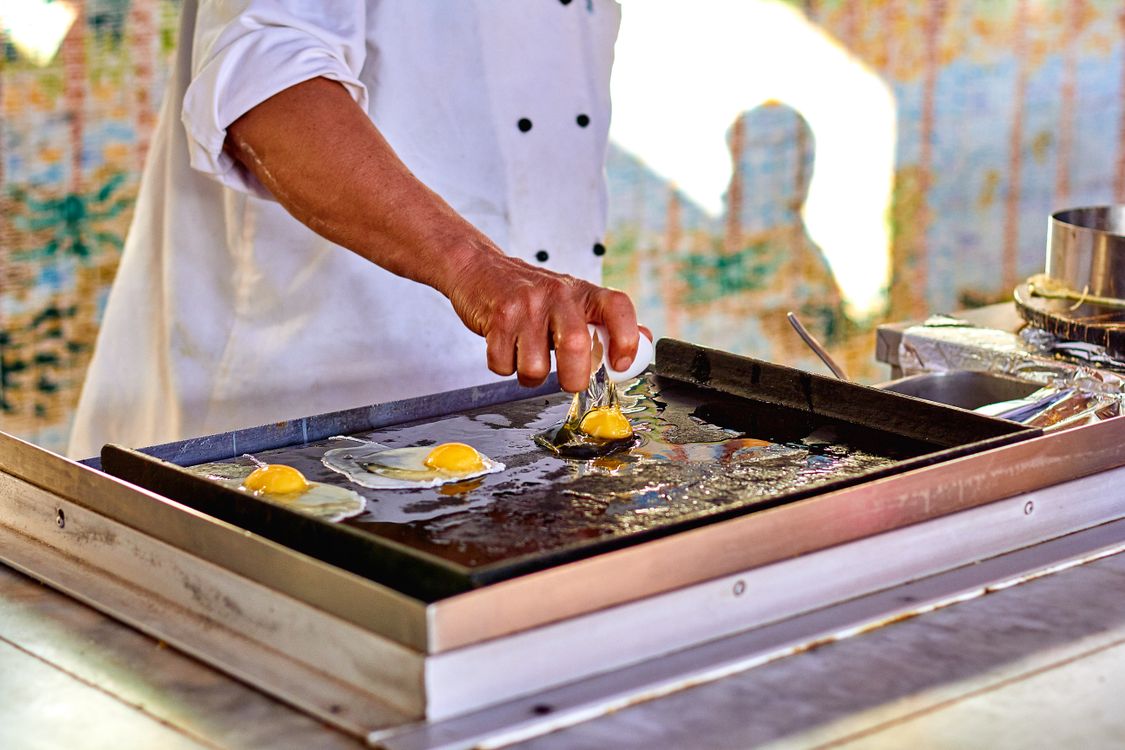
Photo by Bulat Khamitov from Pexels
Short answer: “sticking” on a flat top grill is actually three different problems that get lumped together, and the fix depends entirely on which one you have. A brand-new griddle that’s sticky before you’ve cooked anything is a factory coating issue. A griddle that’s gummy or tacky after you season it is an oil problem.
Food sticking to a griddle that’s otherwise properly seasoned is almost always a technique problem, not a seasoning problem. Treating all three the same way is why a lot of fixes don’t actually work.
Problem 1: Brand-New Griddle, Sticky Right Out of the Box
This one has nothing to do with seasoning. Most griddles ship with a thin protective coating — sometimes a wax, sometimes a food-safe rust inhibitor — applied at the factory to keep the bare steel from corroding in the warehouse and during transit. It’s meant to come off before you season, not to be cooked on top of.
Scrub it off with hot, soapy water and a nonabrasive pad before you do anything else. This is the one and only time dish soap belongs on your griddle — it’s cutting a factory coating, not stripping seasoning you’ve built up, so the usual no-soap rule doesn’t apply yet. Dry it completely, then season it following my guide to seasoning a Blackstone griddle before the first real cook.
Problem 2: Sticky or Gummy After Seasoning
If the surface feels tacky, gummy, or pulls at a paper towel after you’ve seasoned it, the seasoning itself didn’t cure properly. It’s almost always too much oil applied per coat rather than too little — a thick layer can’t fully polymerize into a hard finish, so part of it stays soft and sticky instead. Using a low-smoke-point oil (olive oil is the most common mistake here) or not getting the surface hot enough for long enough produces the same gummy result.
The fix is more heat, not more oil: run the griddle hot until the sticky layer breaks down and starts to release, scrape it off, then re-season with a genuinely thin coat — wipe oil on, then wipe most of it back off before heating. My seasoning guide covers this exact failure mode and the full correction steps in more detail; the short version is that a proper coat should look matte and feel smooth, never glossy. University of Illinois Extension’s guide to cast iron cookware describes the same underlying principle on a different but chemically similar surface: seasoning exists specifically to keep food from sticking, and once food starts sticking to a surface that used to release cleanly, that’s the signal it needs to be re-seasoned rather than scrubbed harder.
Problem 3: Food Sticks Even Though the Griddle Is Well-Seasoned
This is the one that catches people off guard, because the griddle itself is fine. A properly seasoned griddle can still make food stick if the surface isn’t hot enough, there isn’t enough cooking oil at the time of cooking, or the food is flipped before it’s ready to release. Seasoning creates a non-stick surface for storage and general use; it doesn’t mean every food will glide off with zero added oil at every temperature.
The Preheat Test That Actually Tells You Something
A cold or lukewarm griddle is the single most common cause of food sticking on an otherwise well-seasoned surface. Heat it for a genuine 10-15 minutes before cooking, not just until it feels warm to the hand. The classic test: flick a few drops of water onto the surface. If they sit and slowly evaporate, it’s not ready.
If they bead up and skitter across the surface before disappearing, it’s hot enough to cook on. Cooking too early on a griddle that only feels hot is one of the most common reasons a “properly seasoned” surface still grabs food.
Seasoning Isn’t a Substitute for Cooking Oil
A well-seasoned griddle needs less oil than a bare pan, not none at all. Add a small amount of oil to the specific section you’re cooking on, right before the food goes down, every time — this is separate from the maintenance oil coat applied after cleaning. Skipping this step because “it’s seasoned, it shouldn’t need oil” is a common and avoidable cause of sticking.
Some Foods Are Just Stickier, and Timing Matters More Than Seasoning
Eggs, thin fish, and cheese are the worst offenders, and for the same underlying reason: proteins bond to hot metal as they cook and only release cleanly once a proper crust has formed underneath. Try to flip or move the food before that crust sets and it tears instead of lifting free — which then feels like the griddle is the problem, when it’s actually a timing problem. Give these foods slightly more oil than you’d use for something like a burger, and don’t force a flip; if it’s not releasing on its own with a gentle nudge from the spatula, it isn’t ready yet.
Is This Ever an Actual Griddle Defect?
Rarely, but it happens. A warped surface or a factory hot spot that never seasons evenly can cause persistent sticking in one specific area no matter what you do everywhere else. If food sticks consistently in the exact same spot regardless of oil, preheat time, or food type — while the rest of the surface behaves normally — that’s worth a warranty conversation with the manufacturer rather than more troubleshooting. It’s the exception, not the rule; most sticking complaints trace back to one of the three causes above, not the griddle itself.
What this guide is based on
Plainly: this is research-based, not a hands-on test. I do not own this griddle and nothing here is a report from my own cooking.
What it rests on: the mechanics of seasoning, where polymerised oil forms the release layer and an under-heated or under-seasoned surface grips food; manufacturer guidance on preheating times and seasoning routine; and the pattern of what owners report, in which insufficient preheating and moving food too early account for most sticking complaints, well ahead of any genuine surface defect.
What I could not establish: a preheat time that holds for every griddle. Burner output, plate thickness and ambient temperature all move it, so the guidance above is directional rather than a specification.
For the cleaning routine that keeps a surface working, see the guide to cleaning a flat top grill. If the surface is corroding rather than sticking, there is a separate guide to griddle rust, and the flat top grill buying guide covers replacements.
Frequently Asked Questions
Why is my brand-new Blackstone griddle sticky before I’ve even cooked on it?
That’s the factory protective coating, not seasoning. Scrub it off with hot soapy water and a nonabrasive pad, dry completely, then season it before your first cook.
Why is my griddle sticky after I seasoned it?
Almost always too much oil applied per coat, which prevents it from fully polymerizing. Re-season with a much thinner coat, wiping most of the oil back off before heating.
Why do eggs stick to my griddle even though it’s seasoned?
Usually the griddle wasn’t hot enough, there wasn’t enough oil added at cooking time, or the eggs were moved before a crust formed enough to release on their own. Give it more preheat time and a gentle nudge test before flipping.
Does food sticking mean I need to re-season the whole griddle?
Not necessarily. If it’s isolated to specific foods or moments when you flip too early, it’s a technique issue. If the whole surface feels gummy or dull everywhere, that’s a sign the seasoning itself needs to be redone.

Glenn is the founder of Kitchenware Compare and has spent years researching, testing, and reviewing kitchen appliances, cookware, and gadgets. A lifelong home cook raised in a family that treated every meal as an occasion, Glenn started this site to cut through the noise of conflicting product reviews and give readers honest, practical guidance. When he is not testing the latest air fryer or digging into the specs of a new espresso machine, he can usually be found experimenting with new recipes or hunting for the perfect cast iron skillet at a flea market.
Leave a Reply