
This post contains affiliate links. If you buy through a link here, I may earn a commission at no extra cost to you.
Quick verdict:
- Gaggia Classic Pro wins for: anyone serious about learning real espresso on equipment worth keeping and repairing for a decade
- De’Longhi Stilosa wins for: a genuinely tight budget, or a first machine to find out if espresso is a habit worth investing in
- My pick for most people asking this question: the Gaggia — but only if $449 is actually in the budget. If it isn’t, the Stilosa is a sensible place to start, not a consolation prize.
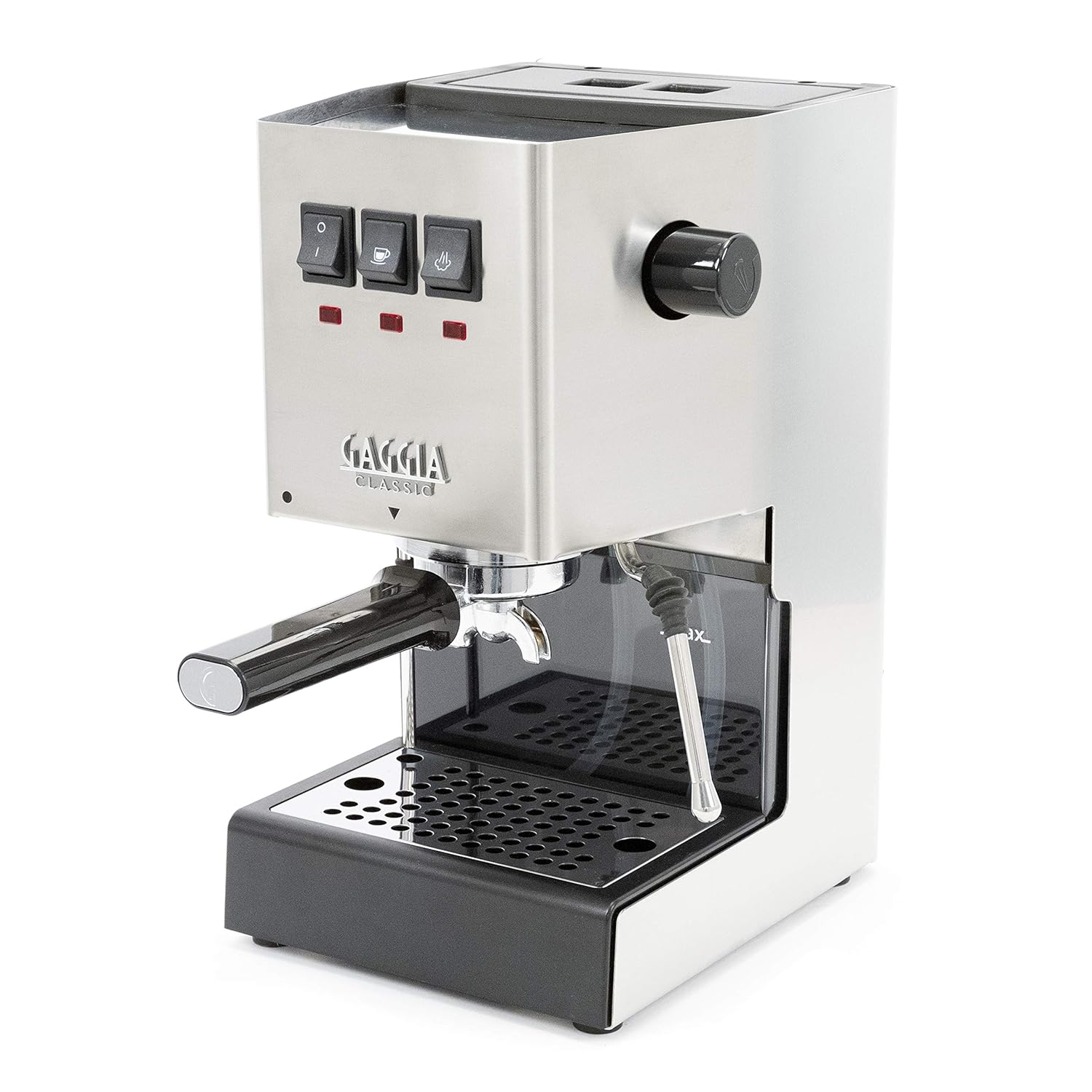
These two get compared a lot more than their price tags suggest they should. The Gaggia Classic Pro ($449) is a 58mm commercial-style machine built to be learned on, modded, and repaired for decades. The De’Longhi Stilosa (~$150) is a genuinely different category of product — a compact, mostly-plastic entry machine aimed at someone who isn’t sure yet whether they’ll stick with espresso.
My Gaggia Classic Pro review covers that machine on its own, and a separate comparison sets the Stilosa against the Breville Bambino. My De’Longhi Stilosa review covers the Stilosa on its own. This one puts the Gaggia and the Stilosa head-to-head on the things that actually change your morning: shot quality, steam, build, and what each one costs you beyond the sticker price.
Gaggia Classic Pro vs Stilosa — Specs Side by Side
| Spec | Gaggia Classic Pro | De’Longhi Stilosa |
|---|---|---|
| Price | $449.00 | $149.95 |
| Rating | 4.4★ (3,162) | 4.2★ (13,831) |
| Portafilter | 58mm commercial | 51mm |
| Heat-up time | ~5 min to fully warm | ~45 seconds |
| Steam wand | Manual commercial-style wand | Manual pannarello |
| Temperature control | Thermostat (PID moddable) | Small stainless steel boiler, no PID |
| Housing | Steel, made in Italy | Mostly plastic, stainless accents |
| Water tank | 2.1 L | 1 L |
| User-repairable | Yes — full parts availability | No — largely sealed, budget internals |
| Buy | Check Price | Check Price |
Shot Quality
There’s no real contest here once a decent grinder is in the picture. The Gaggia’s 58mm commercial basket spreads the puck thinner and more evenly than the Stilosa’s 51mm pressurized basket, which caps how good a shot the Stilosa can pull no matter how well you dial in the grind — the pressurizing screen does some of the work for you, and it shows up as flatter, less complex espresso. The Gaggia has a real shot ceiling; the Stilosa has a shot floor that’s decent for the price and doesn’t move much past that.
To be fair to the Stilosa, it’s not making bad coffee — with fresh beans and a real burr grinder, it pulls a perfectly drinkable shot, and 13,831 people rating it 4.2 stars isn’t nothing. It just isn’t trying to compete on this axis, and shouldn’t be judged like it is.
Steam Wand and Milk Drinks
The Gaggia’s commercial-style wand produces genuinely better microfoam once you’ve learned it, with enough power for real latte art. The Stilosa’s pannarello wand is better than its price suggests — it makes usable foam for a cappuccino or latte without much drama — but it can’t match the Gaggia’s texture ceiling, and neither machine automates the process for you (see my milk frothing guide if you want the manual technique either way). If your household leans hard on milk drinks and you want the best result the manual route can give, that’s the Gaggia. If you just want workable foam without spending much, the Stilosa clears that bar.
Temperature Stability and the “15 Bar” Number
Neither machine has a PID out of the box, but they get there differently. The Gaggia’s aluminum boiler cycles around a basic thermostat — experienced owners “temperature surf” (flush water, time the shot off the heating light) to land it consistently, and a PID mod (~$100 in parts) closes the gap for good if you want to go there. The Stilosa’s small stainless steel boiler heats fast (owners report about a minute or less) but has no meaningful temperature stability strategy beyond that — it’s built to get hot quickly, not to hold a target precisely.
One number worth clearing up: both machines are commonly listed at “15 bar pump pressure.” That’s marketing, not the number that matters. Espresso extracts properly around 9 bar, and both machines regulate down to roughly that at the group head — the 15-bar figure just describes the pump’s maximum capacity before regulation. Don’t use it to compare these two, or any two espresso machines.
Build Quality and Long-Term Ownership
This is where the price gap earns itself. The Gaggia is steel, made in Italy, and fully user-serviceable — gaskets, thermostats, even the boiler are documented and available, and forty-year-old Classics are still pulling shots on their original frames. It carries a 1-year warranty, but the real story is that it doesn’t need one for long; it’s designed to be opened up.
The Stilosa is mostly plastic with a stainless-look front, and it’s built for its price point rather than for the long haul — I wouldn’t expect the portafilter fit or the internals to feel as tight in year three as they did on day one. That’s not a knock on it as a starter machine; it’s a reason to think of it as a two-to-three-year appliance rather than a lifetime purchase.
Value for Money
These aren’t really competing for the same dollar, which makes the “value” question different depending on what you’re solving for. At $449, the Gaggia is genuinely one of the better values in home espresso — commercial-grade hardware and a decade-plus lifespan for less than half what a comparable machine cost a few years ago. At $149.95, the Stilosa is the cheapest machine I’d actually recommend for real espresso; anything meaningfully less than that and you’re buying a machine with inconsistent pressure and temperature, not just a smaller version of the same thing.
If you’re stuck between the two prices and don’t strictly need either extreme, the Breville Bambino sits in between — faster and more consistent than the Stilosa, more automated (and less repairable) than the Gaggia. My full Gaggia vs Bambino comparison covers that middle path in depth.
Who Should Buy Each
Buy the Gaggia Classic Pro if:
- You want to actually get better at espresso, not just own an espresso machine
- You’re comfortable spending $449 on equipment you’ll still be using — and repairing — in ten years
- You want standard 58mm commercial baskets, bottomless portafilter options, and a PID mod down the road
- You already have or plan to buy a real burr grinder
Buy the De’Longhi Stilosa if:
- Your budget is genuinely close to $150, not $450
- You’re not sure yet whether espresso is going to be a regular habit
- You mostly want milk drinks and can live with manual steaming that’s good, not great
- You’d rather find out what you actually want from a machine before committing real money
Check Gaggia Price on Amazon Check Stilosa Price on Amazon
The Honest Take
I’d buy the Gaggia every time if the budget allows it — not because the Stilosa is bad at what it does, but because the 58mm basket and the repairability aren’t small conveniences, they’re the difference between a machine you outgrow and one you keep. But I don’t think everyone should spend $449 on a first espresso machine, and the Stilosa is an honest way to find out if you’re going to be someone who cares about this before you commit real money to it.
Verdict
For anyone serious about the craft and able to spend $449, the Gaggia Classic Pro is the better machine, full stop — higher shot ceiling, real steam performance, and hardware built to outlast the coffee habit it’s making possible. For a genuinely tight budget or a first machine, the De’Longhi Stilosa is an honest, capable starting point that won’t embarrass itself, as long as you go in knowing it’s a stepping stone rather than a destination.
Full deep-dives: my Gaggia Classic Pro review, and my Breville Bambino vs De’Longhi Stilosa comparison if the Stilosa’s price point is right but you want a stronger machine at it. Comparing more machines? Start with best semi-automatic espresso machines or browse all coffee equipment guides.
How This Comparison Was Put Together
Plainly: this is a research-based comparison, not a hands-on test. I have not run these side by side.
What it rests on: the published specification for both – a stainless boiler and 58mm commercial portafilter against a compact machine with a small boiler with a proprietary basket, three-way solenoid presence, steam wand type, and how serviceable each is; plus the pattern across verified-purchase reviews for each, where the gap in price maps onto a real gap in what you can modify later.
What I could not establish: shot quality on either, which at these prices is decided by the grinder and the operator. What the comparison settles is what each machine lets you control and what it fixes for you.
Frequently Asked Questions
Is the Gaggia Classic Pro worth it over the Stilosa?
If espresso is going to be a real, ongoing habit, yes. The Gaggia’s 58mm commercial basket and full repairability make it a machine you can grow into rather than one you outgrow. If you’re not sure yet, the Stilosa is the cheaper way to find out.
Which makes better espresso?
The Gaggia, clearly, once paired with a decent grinder. Its 58mm basket spreads the puck more evenly than the Stilosa’s pressurized 51mm basket, which caps shot quality regardless of technique.
Which is better for milk drinks — lattes and cappuccinos?
The Gaggia’s commercial-style wand produces better microfoam, but the Stilosa’s pannarello wand is genuinely usable for the price and can make a decent cappuccino with practice.
Does “15 bar pump pressure” mean the Stilosa or Gaggia makes stronger espresso?
No — that number describes maximum pump capacity, not extraction pressure. Both machines regulate down to roughly the 9 bar that actually matters for espresso. Don’t use the 15-bar spec to compare machines.
Do I need a separate grinder for either machine?
Yes, for both. Neither has a built-in grinder, and pre-ground coffee wastes what either machine is capable of. Budget $100–300 for a proper burr grinder alongside whichever machine you choose.

Glenn is the founder of Kitchenware Compare and has spent years researching, testing, and reviewing kitchen appliances, cookware, and gadgets. A lifelong home cook raised in a family that treated every meal as an occasion, Glenn started this site to cut through the noise of conflicting product reviews and give readers honest, practical guidance. When he is not testing the latest air fryer or digging into the specs of a new espresso machine, he can usually be found experimenting with new recipes or hunting for the perfect cast iron skillet at a flea market.
Leave a Reply