I earn a commission if you buy through the Amazon links below, at no extra cost to you.
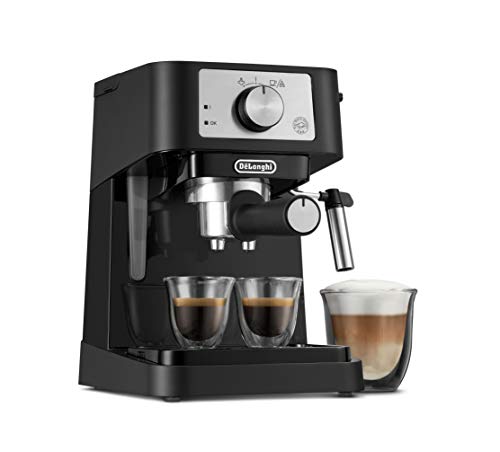
The De’Longhi Stilosa EC260 is the best-overall pick in my espresso machines under $200 guide, and it sells for $149.95. It is a manual machine: a 15-bar pump, a small stainless steel boiler, a steam wand and a portafilter with two pressurized filter baskets.
It holds 4.2 stars across 13,831 ratings, a large pool, and the distribution is split: 67% five-star but 9% one-star.
The owner reviews explain the split. Owners who learn the grind and tamp, and get a sound unit, report years of good espresso; owners who expect café shots out of the box, or get a faulty machine, write the one-star reviews.
Quick Verdict
| Score | Price | Rating | Buy |
| 7/10 | $149.95 | 4.2★ (13,831) | Check Price on Amazon |
What Comes in the Box
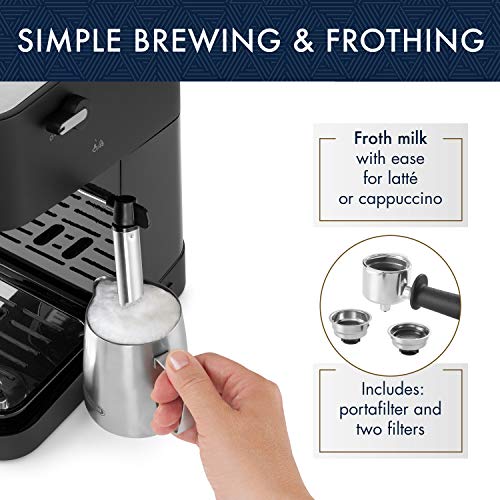
The machine, a portafilter with single and double filter baskets, and a combined measuring scoop and tamper. The water tank holds 1 litre (33.8 fl oz), per the listing.
There is no milk jug and no grinder, so budget for both if you do not already own them.
The included tamper is plastic, and one owner calls it a joke. Owners also say the baskets are a small, non-standard size, about 51mm, so a larger tamper will not fit.
Specifications
| Model | De’Longhi Stilosa EC260BK |
| Type | Manual pump espresso machine with steam wand |
| Pump | 15 bar |
| Heater | Stainless steel boiler, per the listing |
| Filter baskets | Single and double, pressurized; owners measure about 51mm |
| Water tank | 1 litre (33.8 fl oz) |
| Power | 1,100 watts |
| Dimensions | 8.07″ D × 13.5″ W × 11.22″ H |
| Weight | 9.48 lb |
| In the box | Portafilter, two filter baskets, measuring scoop and tamper |
| Coffee | Ground coffee |
| Warranty | 1 year, per the listing |
What the one-star reviews are about

Parts that fail. The plastic control knob is the most specific recurring complaint. One owner’s broke after four months, another is on a third knob in two years, and a third marked the machine down a star for its plastic knob.
Other owners report a pump that stopped working after just over a year, a leak above the group head that led to a replacement, and a front indicator light that failed.
Shots that disappoint. Weak or dripping espresso is the other theme. One owner found only 10 grams of coffee fit in the double basket; another tried different grinds and doses and still got a slow drip.
The shot problems usually have fixes, covered below. The parts failures do not, and the warranty is one year.
Who It’s For
- Beginners who want to learn espresso without spending much. One first-time owner says it is the only entry-level machine that earns a passing grade.
- Milk-drink makers. Owners describe the steam wand as easy for cappuccinos and lattes, and one who also owns a far more expensive Breville says it froths milk just as well.
- Anyone short on counter space. It is 13.5 inches wide, and owners mention its small footprint.
- People willing to tinker. Owners get more from it by swapping the pressurized basket for a non-pressurized one or a bottomless portafilter.
- Anyone who owns, or will buy, a burr grinder. The OXO Brew Conical Burr is the budget grinder reviewed on this site.
Who Should Look Elsewhere
- Anyone who wants café-quality shots with no learning curve. Owners describe grind size, dose and tamping as things to get right.
- Tall-mug drinkers. Owners say large mugs and tumblers do not fit under the portafilter.
- Anyone who wants a long warranty. The listing gives one year, and some owners report parts failing after that.
- People who make several milk drinks back to back. One owner lets the wand reheat three or four times to froth milk for two cups.
- Anyone who wants a machine to grow into. My Gaggia Classic Pro vs Stilosa comparison covers the step up.
Performance
Espresso and the pressurized baskets

Owners who are happy with the espresso describe good crema and consistent shots, including one going on four years with the same machine.
The baskets are pressurized, which builds pressure even with an imperfect grind. That makes the Stilosa forgiving for beginners, but one owner who also runs a far more expensive machine notes it caps how good the extraction can get.
Owners who want more swap in a non-pressurized basket or a bottomless portafilter.
Weak shots are the flip side. One owner found only 10 grams of coffee fit in the double basket, another got a slow drip despite changing grind and dose, and a four-year owner warns against grinding too fine or packing too tight.
Steam wand and milk
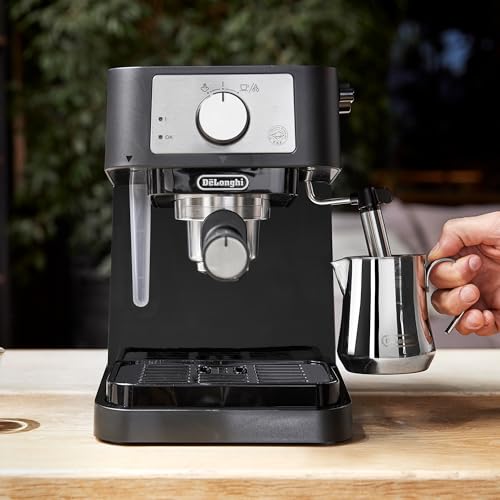
The steam wand is one of the most praised parts of the machine. Owners use it for lattes and cappuccinos without much fuss.
Switching from espresso to steam means waiting for the boiler to heat again, about 35 seconds according to one owner, who steams the milk first for that reason.
The small boiler is also why frothing for more than one drink is slow. One owner lets the wand reheat three or four times to froth enough milk for two cups.
Heat-up, size and cup clearance
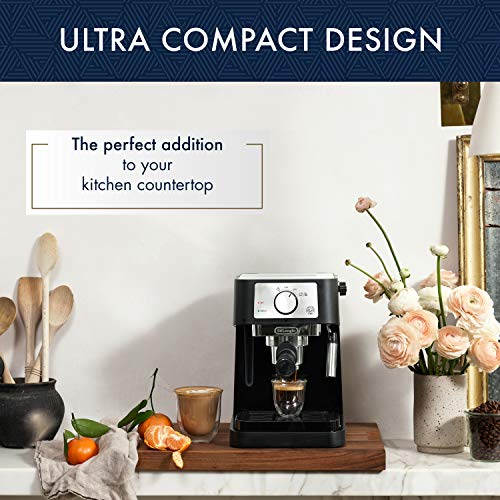
Owners put heat-up at about a minute or less, quick enough for a weekday shot.
At 13.5 inches wide and 11.22 inches tall, it fits under wall cabinets, and owners mention its small footprint.
The trade-off is cup clearance. Owners say tall mugs and tumblers will not fit under the portafilter, so plan on brewing into a small cup and pouring.
Design and Build

It is a compact black machine with a stainless front panel, a front control dial, a steam knob on the side, indicator lights and a two-level drip tray for different cup sizes.
Owner opinions on the build are split: a four-year owner calls it solid yet lightweight, while another calls it cheaply built and clunky. The specific weak points owners name are the plastic knob and dial markings that wear off with wiping.
The two-level drip tray helps with small cups, but owners still find little room for anything tall.
What Owners Report
Amazon shows 67% five-star, 13% four, 6% three, 5% two and 9% one across 13,831 ratings. A one-star share larger than either the two- or three-star share is the pattern of a machine most owners like and a minority find faulty.
What recurs in the positive reviews
- Value. Real espresso and a working steam wand for about $150.
- Milk drinks. A simple steam wand for cappuccinos and lattes.
- Longevity for many. Owners report two, three and more than four years of daily use.
- Small footprint. It fits a small counter.
- A good teacher. Beginners learn grind, dose and tamp on it.
What recurs in the critical reviews
- The knob. Plastic, and it breaks for some owners.
- Baskets and tamper. Pressurized baskets and a plastic tamper limit the shots until upgraded.
- Cup clearance. Tall mugs do not fit.
- Steam for more than one drink. The wand needs time to reheat.
- Failures. A pump, a leak and a failed indicator light among the critical reviews.
The five-star and one-star reviews describe the same machine. The difference is mostly expectations and luck: owners who learn it and get a sound unit keep it for years, and owners who expect café shots or get a faulty one do not.
Value
At $149.95 the Stilosa costs far less than the Breville Bambino Plus or the Gaggia Classic Pro, and it still uses a pump and a portafilter rather than steam pressure alone.
Owners stress grind size again and again, so a burr grinder is part of the real cost, and a proper tamper and a milk jug are worth adding. The OXO Brew Conical Burr is the budget grinder reviewed on this site.
If you are torn between this and a pricier machine, my Breville Bambino vs Stilosa comparison sets out what the extra money buys.
Durability
Longevity reports are encouraging for a $150 machine. One owner’s previous De’Longhi of the same style lasted more than four years at three to five drinks a day, another is going on four years, and others report two and three years of daily use.
The failures that do appear are specific: the plastic knob, a pump after just over a year, and a leak above the group head. With a one-year warranty, anything after the first year is on you.
Turn the knob gently, avoid packing the basket too tight, and keep the machine clean.
One owner reports receiving a used unit sold as new, which Amazon replaced, so check the box and seals on arrival.
Alternatives to Consider
- For automatic milk texturing and faster heat-up, see my Breville Bambino vs De’Longhi Stilosa comparison.
- For a machine to learn on and keep for years, my Gaggia Classic Pro vs Stilosa comparison sets out the step up.
- Every pick under $200 is compared in my espresso machines under $200 guide, and semi-automatic machines at every price in my semi-automatic espresso machine guide.
- Grinders, machines and brewing guides are collected in the coffee hub.
Verdict
The De’Longhi Stilosa is a good first espresso machine. For about $150 it pulls real espresso, steams milk well enough for lattes and fits a small kitchen, and many owners report years of use.
Its limits are the pressurized baskets, a plastic knob that breaks for some owners, and little room for tall mugs. Buy it to learn on, budget for a grinder and a proper tamper, and do not expect café shots on day one.
Seven out of ten: marked up for value, the steam wand and long owner histories, marked down for the knob, the baskets and a one-year warranty.
How This Review Was Put Together
Plainly: this is research-based, not a hands-on test. I have not owned or used this machine, and nothing here should be read as a report from my own kitchen.
What it rests on: the published specification — the pump, boiler, baskets, tank and warranty De’Longhi lists, and what owners report about shots, steaming, cup clearance and the parts that fail — read against the other machines in my espresso machines under $200 guide; the shape of the rating distribution across 13,831 Amazon ratings rather than the 4.2 average it produces; and the text of the positive and critical reviews, read for themes that recur across independent owners.
Why owner reviews are treated as evidence here: one reviewer cooking on one unit for a fortnight cannot show whether a plastic control knob survives two years of daily use. Several thousand owners over years can. A theme is only reported above where more than one unconnected owner raised it.
What I could not establish: what share of machines develop a fault, since failed units are over-represented in one-star reviews and working ones rarely get a follow-up. I also could not confirm the basket diameter from De’Longhi’s listing; the 51mm figure comes from owners.
Price, stock and ratings were read from Amazon’s US marketplace on 14 September 2026 and will move.
Frequently Asked Questions
Is the De’Longhi Stilosa good for beginners?
Yes, with a learning curve. The pressurized baskets forgive an imperfect grind, and first-time owners describe good results once grind size and tamping are right.
Does the Stilosa have a boiler or a thermoblock?
De’Longhi’s listing describes a stainless steel boiler. It is small, which is why steaming milk for more than one drink can mean waiting for it to reheat.
What size is the Stilosa portafilter?
Owners measure the filter baskets at about 51mm, smaller than many machines, so a larger tamper will not fit. De’Longhi’s listing does not give the size.
Can you use a non-pressurized basket in the Stilosa?
Owners do, swapping to a non-pressurized basket or a bottomless portafilter for better extraction once their grind is consistent.
How long does the De’Longhi Stilosa last?
Owners report two, three and more than four years of daily use. The failures they report are the plastic control knob, a pump after about a year and a leak above the group head, and the warranty is one year.
Will a tall mug fit under the Stilosa?
Owners say no. Large mugs and tumblers do not fit under the portafilter, so brew into a small cup and pour.
Why is my Stilosa espresso weak?
Owners trace weak or dripping shots to grind size, dose and tamping. One found only 10 grams fit in the double basket, and a long-time owner warns against grinding too fine or packing too tight.
What comes in the box?
The machine, a portafilter with single and double filter baskets, and a combined measuring scoop and tamper. There is no milk jug.

Glenn is the founder of Kitchenware Compare and has spent years researching, testing, and reviewing kitchen appliances, cookware, and gadgets. A lifelong home cook raised in a family that treated every meal as an occasion, Glenn started this site to cut through the noise of conflicting product reviews and give readers honest, practical guidance. When he is not testing the latest air fryer or digging into the specs of a new espresso machine, he can usually be found experimenting with new recipes or hunting for the perfect cast iron skillet at a flea market.
Leave a Reply