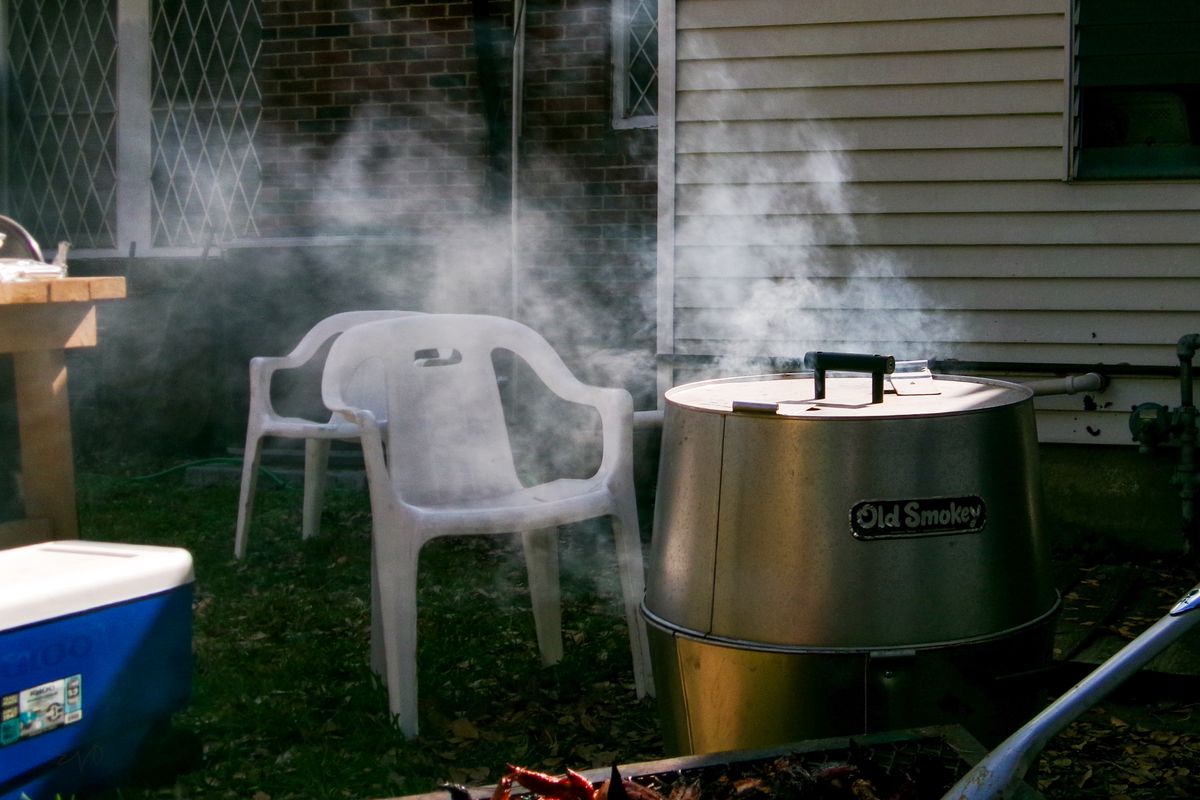
An electric smoker that trips the electrics is almost never doing what a kitchen appliance does when it trips. Indoors, the usual answer is an overloaded circuit. Outdoors, on a machine that sits in the weather and gets washed, the usual answer is that current is escaping to earth and a residual-current device is doing its job. The two need opposite responses, and telling them apart takes about a minute.
Check which device tripped, before anything else
Go and look at the panel. A standard circuit breaker protects the wiring from carrying too much current, and it trips on load. A GFCI — the socket with the TEST and RESET buttons, called an RCD in the UK and Ireland — is watching for current leaking somewhere it should not go, and it trips on leakage. They are different devices answering different questions.
The full version of that distinction, including the arithmetic for working out whether a circuit is genuinely overloaded, is set out in the guide to an air fryer that keeps tripping the breaker. It applies to any heating appliance and is worth reading first if the smoker shares a circuit with anything else.
What follows is the part that is specific to smokers, and it is mostly about water.
Why an electric smoker is usually not an overload
Two things separate a smoker from the appliances that genuinely overload a kitchen circuit.
The first is draw. Check the rating plate on the back of the unit rather than taking anyone’s word for it, but electric smokers are generally modest consumers compared with an air fryer, a kettle or a microwave. They hold a low temperature for hours rather than blasting heat for twenty minutes, and the element cycles rather than running flat out. A machine like that is an unlikely candidate for tripping a breaker on load alone.
The second is where it lives. A smoker is plugged in outdoors, or in a garage or on a porch, and outdoor receptacles are GFCI-protected as a matter of course. So the device most likely to be watching that circuit is precisely the one that trips on moisture rather than on load.
Put those together and the probability shifts hard. If the smoker trips the electrics and nothing else on the circuit was running, an overload is not the first thing to suspect.
Moisture is the usual cause
A GFCI trips when the current going out does not match the current coming back, because some of it has found another path to earth. Water is an excellent alternative path. On an appliance that lives outside, water is not an unusual event.
Where the water actually gets in
The vulnerable places are the ones people do not think of as openings.
- The control panel housing, where a seal has perished or a screw has loosened.
- The element terminals at the base of the cabinet, which sit at the lowest point where condensation collects.
- The plug and socket themselves, if the connection is exposed rather than under a weatherproof cover.
- The cord entry into the body, which flexes every time the smoker is moved and eventually cracks.
Rain is the obvious source, but it is not the only one. A humid night, a smoker stored uncovered, or condensation forming inside a cold cabinet in the morning will all put moisture where it should not be. The symptom that gives this away is intermittence: it trips on damp days and behaves on dry ones.
Washing, and the mistake that follows it
The single most common version of this problem is a smoker that was cleaned, then plugged in before it had dried. Water sits in the base and around the element terminals, and it does not evaporate as fast as the outside of the cabinet suggests.
The fix is patience rather than parts. Unplug it, open the door, take out the racks and the water pan, and leave it somewhere sheltered for a day or more — longer than seems necessary. If it then runs without tripping, the diagnosis is confirmed and nothing was broken.
The extension cord, which is the second most common cause
Most electric smokers end up on an extension lead, because the machine has to stand somewhere ventilated and the socket is rarely convenient. A cord that is not rated for the job causes two separate problems: it heats up under sustained load, and if it is not weatherproof it becomes a leakage path in its own right.
Two manufacturers give specific and compatible guidance here, which counts for something because they have no reason to agree with each other. Masterbuilt states that an outdoor extension cord must be marked with the suffix letters “W-A” and tagged “Suitable for Use with Outdoor Appliances”, must have grounding terminals in working condition, should be heavier than 16AWG, and should be no longer than 25 feet. Bradley Smoker’s guidance is shorter and points the same way: if an extension cord is needed, it should be heavy-duty and under 20 feet.
Five cords that meet all four points, screened against those exact specifications, are compared in the guide to the best extension cord for an electric smoker.
Read those as a single rule. The cord must be outdoor-rated, properly earthed, thicker than a household lead, and short. A thin indoor extension coiled on damp grass fails every part of that, and it is the cord most people reach for.
Testing this is straightforward: plug the smoker directly into the socket, with no extension at all, and run it. If the tripping stops, the lead was the fault and should be replaced rather than reused elsewhere.
When the element has actually failed
Heating elements fail by developing a path to earth. The sheath cracks, moisture gets into the magnesium oxide insulation packed inside it, and current starts leaking. This produces a distinctive pattern: the smoker trips reliably once it heats up, but not when cold, because the fault only opens up under thermal expansion.
If the machine has been thoroughly dried, is plugged directly into the socket without an extension, and still trips a few minutes into every cook, the element is the most likely remaining explanation. On many models it is a replaceable part, and on an out-of-warranty smoker that is a reasonable repair. It is also the point at which guesswork should stop.
The order worth working through
- Look at the panel and note which device tripped — a breaker, or a GFCI or RCD.
- Note the timing: instantly on switch-on, or several minutes into the cook.
- Remove the extension lead and plug the smoker straight into the socket.
- If it has been washed or rained on, dry it thoroughly and give it a full day before retrying.
- Try a socket on a different circuit to rule out a fault in the receptacle itself.
- If it still trips once hot, with no extension and after drying, treat the element as suspect.
- Check whether the smoker has a reset of its own, on the controller or in the plug head, before assuming the trip happened at the panel.
When to stop and call an electrician
Some symptoms are not troubleshooting problems. Stop, and get a qualified electrician, if there is any burning smell or scorching at the plug or socket, if the plug or cord is hot to the touch, if the same smoker trips on more than one circuit in different parts of the property, or if anyone has felt a shock or a tingle from the cabinet. A tingle in particular is the symptom the GFCI exists to prevent, and it means the leakage is real and reaching the metalwork.
Resetting a device that keeps tripping, in order to get the cook finished, is the one response with actual risk attached.
Keeping it from happening again
Most of the causes above are preventable, and the prevention is dull rather than clever.
Let it cool before you cover it. Masterbuilt’s storage guidance is written for its grills rather than its smokers, but the reason carries across every outdoor appliance: do not store or cover the unit until it has completely cooled, and keep it covered in a dry area. A cover thrown over a warm cabinet traps the moisture inside it, which is worse than leaving it uncovered.
Keep the element and its terminals clear. Grease and food debris collect at the base of the cabinet, which is the same low point where water sits. Cleaning that area is worth doing for its own sake, but the part that matters here is what comes afterwards: whatever the cleaning method, the cabinet needs to be properly dry before it is plugged in again.
Give it a circuit to itself. Masterbuilt’s advice for its electric fryer — a different product, but the same electrical problem — is to make sure no other appliance is plugged into the same outlet or circuit. On a cook that runs for hours, that removes the one variable you cannot see from the garden: somebody indoors switching on a kettle or a heater.
Know where your resets are. Some electric smokers have a reset of their own, on the controller or built into the plug head, separate from anything in the consumer unit. It is worth reading the manual for that before a cook rather than during one, because if the smoker’s own reset is the one that needs pressing, the household breaker was never involved.
Keeping the cook going while you diagnose
A trip that happens three hours into a brisket is worse than one that happens at the start, because the meat is now sitting in the danger zone while the cabinet cools. A leave-in probe that alarms on temperature drop is the difference between noticing immediately and noticing at dinner time — the picks are in the guide to meat thermometers for smoking, and the wireless models that alert a phone are covered in BBQ thermometers.
A smoker that is running fine but producing no visible smoke is a third question again, and usually not a fault at all — see an electric smoker not producing smoke.
A smoker that trips the electrics and a smoker that simply never reaches temperature are different faults with different causes. If yours is running without tripping anything but stalling well below its setting, that is covered in an electric smoker not getting hot enough.
The rest of the outdoor cooking guides on this site are collected on the outdoor cooking hub.
How This Guide Was Put Together
Plainly: this is a research-based guide, not a hands-on test. I do not own an electric smoker, nothing here is a report from my own garden, and no meter was put across an element.
What it rests on is three things. The published guidance of two electric smoker manufacturers, Masterbuilt and Bradley Smoker, whose extension cord specifications were written independently and point the same way. The standard behaviour of ground fault protection, set out at greater length in this site’s guide to an air fryer tripping the breaker. And the pattern of what owners consistently report, in which moisture after cleaning and an unsuitable extension lead dominate the cases that turn out to have a simple cause.
Also not established: what proportion of these faults are the element rather than moisture or the cord. That would need a sample of failed units stripped and tested, no manufacturer publishes failure-rate data for this category, and any percentage offered here would be invented. The order of checks above is arranged by how easy each cause is to rule out, not by a measured frequency.
Frequently Asked Questions
Why does my electric smoker trip the breaker but nothing else does?
Because it is probably not the breaker. Outdoor sockets are GFCI-protected, and a GFCI trips on current leaking to earth rather than on load. A smoker that lives outside and gets rained on or washed is far more likely to be leaking than to be overloading a circuit that handles a kettle without complaint.
Can rain make an electric smoker trip?
Yes, and so can a humid night or condensation inside a cold cabinet. The tell is intermittence: it trips on damp days and runs normally on dry ones. Water reaching the control panel housing, the element terminals or an exposed plug gives current an alternative path to earth, which is exactly what a GFCI watches for.
I washed my smoker and now it trips. Is it ruined?
Almost certainly not. This is the most common version of the problem. Unplug it, open the door, remove the racks and water pan, and leave it somewhere sheltered for a full day or more before trying again. Water sits around the element terminals at the base long after the outside feels dry.
What extension cord should I use with an electric smoker?
An outdoor-rated one, earthed, thicker than a normal household lead, and short. Masterbuilt specifies a cord marked “W-A” and tagged for use with outdoor appliances, heavier than 16AWG and no more than 25 feet; Bradley Smoker says heavy-duty and under 20 feet. A thin indoor lead lying on damp grass fails on every count.
How do I know if the heating element has failed?
The pattern is the giveaway. An element with a crack in its sheath leaks current only once it is hot and has expanded, so the smoker trips a few minutes into every cook rather than instantly. If it still does that after being dried thoroughly and plugged straight into the socket with no extension, the element is the most likely remaining cause.
Is it safe to just keep resetting it?
No. The device is doing its job, and repeatedly resetting it while the same fault is present is the one response that carries real risk. Stop altogether and get an electrician if there is a burning smell, if the plug or cord is hot, if it trips on more than one circuit, or if anyone has felt a tingle from the cabinet.

I'm Glenn, and I started Kitchenware Compare to cut through conflicting product reviews and help readers pick kitchen gear with confidence. I don't own or test the products I write about — these guides are built from verified-purchase reviews, manufacturer specifications, and independent testing where it exists, with the reasoning shown, not just a rating.
Leave a Reply