Some links here go to Amazon. If you buy through one, I earn a commission at no extra cost to you.
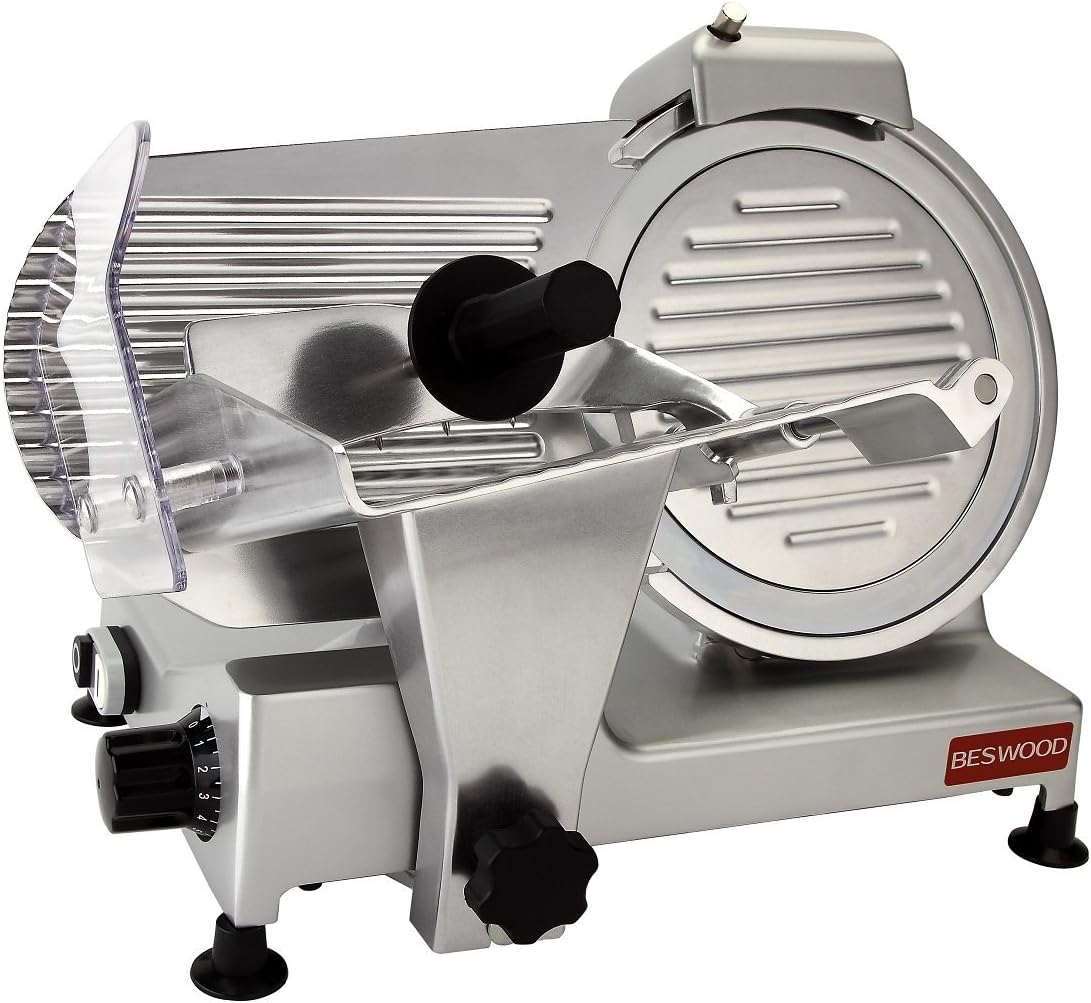
BESWOOD250 — $358.00

KWS MS-10NT — $394.00
Which one do I buy? Buy the KWS MS-10NT if the machine has to satisfy a health inspector, or if you intend to still be using it in ten years. It is the only one of the two with unambiguous NSF certification and a published, priced spare-parts list that includes a $159.99 replacement motor.
Buy the BESWOOD250 for everything else. It is $36 cheaper, better rated across a review base nearly twice the size, sells roughly twice as fast, and has the better-finished body. For a home kitchen that is the safer purchase.
Prices and stock verified 2 September 2026. BESWOOD250 $358.00, in stock, 4.6 out of 5 from 3,368 ratings. KWS MS-10NT $394.00, in stock, 4.5 out of 5 from 1,959 ratings. Both are sold on Amazon by the manufacturer rather than a reseller, and both cost exactly the same buying direct from the maker, so there is no saving either way.
The difference is $36
That is the whole financial question, and it is small enough that specification arguments matter more than price. These are not machines from different tiers. They are two 10-inch, metal-bodied, belt-driven slicers with on-board sharpening stones, aimed at the same buyer, separated by about ten percent.
So the useful comparison is not “which is better value.” It is which of two genuine differences you actually need: certification, or validation.
Head to head
| BESWOOD250 | KWS MS-10NT | |
|---|---|---|
| Price | $358.00 | $394.00 |
| Rating | 4.6★ (3,368) | 4.5★ (1,959) |
| Motor | 240W / 1⁄3 HP | 320W / 0.4 HP |
| Blade speed | 282 rpm | 525 rpm |
| Blade | 10″ high-carbon, chromium plated | 10″ 304 stainless, Teflon coated |
| Slice thickness | 1–12 mm | 0–10 mm |
| Certification | ETL. NSF inconsistent on its own site | ETL, NSF and FDA, stated throughout |
| Spare parts | Blade only, $120.00, was out of stock | ~20 parts priced, motor $159.99 |
| Weight | 33 lb | 36 lb |
| Footprint | 20″ × 17″ × 14.75″ | 20.5″ × 18.5″ × 15.5″ |
| In the box | Cleaning brush, machine oil | Spare whetstone, spare drive belt |
| Warranty | 12 months | 1 year factory limited |
The certification claim to be careful about
If you research this comparison elsewhere you will find the BESWOOD described as ETL and NSF certified. That claim needs checking, because it is not what the BESWOOD’s own materials consistently say.
The Amazon listing for the BESWOOD250 states one certification: ETL listed and certified. On BESWOOD’s own website, a line of marketing copy lists the approvals as ETL and NSF, while the specification block further down the same page gives ETL, GS, CE and ROHS — with no NSF among them. Those cannot both be right.
The KWS has no such ambiguity. NSF and ETL appear in the Amazon listing title, in a dedicated bullet naming Intertek as the certifying body, and on the manufacturer’s product page, which also claims FDA approval.
What this means in practice. For a home kitchen it changes nothing: ETL is the electrical safety mark that matters for plugging a machine in, and both have it. For a business that gets inspected, NSF is often a requirement, and the difference between “stated everywhere” and “stated in one place and contradicted in another” is the difference between a machine you can rely on and a phone call you have to make. If you need NSF on paper, that alone settles this comparison.
Repairability: the argument that gets ignored
Both machines have on-board sharpening stones, so neither has the disposable-blade problem that ends most cheap slicers. Beyond the blade, though, they are not comparable at all.
KWS publishes a public, priced parts catalogue for the MS-10 series — around twenty items. BESWOOD lists one part, a blade at $120.00, and it was showing as sold out when I checked on the same day.
| KWS MS-10 part | Price |
|---|---|
| Teflon blade | $204.99 |
| Product tray assembly | $199.99 |
| 320W motor | $159.99 |
| Support arm | $59.99 |
| Relay | $38.00 |
| Power cord | $32.99 |
| Sharpening stone set | $29.99 |
| Bearing set | $28.49 |
A machine with a published motor price can outlive its motor. That is a different ownership proposition from one where a failed component means the machine is finished, and it is why the KWS earns its $36 for anyone thinking in decades rather than seasons.
The honest counterweight: the KWS blade costs $204.99 against the BESWOOD’s $120.00, so the part you are most likely to replace is $85 dearer. If you expect to wear out blades rather than motors, that runs the other way.
Motor and blade speed
The KWS has a third more motor, 320W against 240W, and turns its blade at a stated 525 rpm against 282. Nearly double the blade speed is a striking difference on paper.
It is worth resisting the obvious conclusion. Faster is not automatically better on a slicer: a slower blade backed by enough torque can give cleaner results on soft product, and blade speed is not the specification that separates a good slicer from a bad one. What matters is whether the machine holds its speed under load, and both of these do, which is most of what the extra money over a $110 home slicer buys in either case.
Where the KWS motor genuinely helps is sustained running and dense product — long sessions, semi-frozen meat, hard cheese. If your slicing is measured in hours rather than minutes, it is the stronger machine.
Thickness: they are good at opposite ends
This is the most practical difference between them and it is easy to miss, because the two ranges look similar until you notice which end each one covers.
- BESWOOD250: 1–12 mm. Reaches thicker cuts — a half-inch steak cut is within range.
- KWS MS-10NT: 0–10 mm. Starts at zero, which is the end that matters for prosciutto, bresaola and anything meant to be translucent.
Most people buying a 10-inch slicer care more about the thin end than the thick one, which is a quiet point for the KWS. If you are portioning roasts rather than making charcuterie, it runs the other way.
One caution: the KWS Amazon listing states a range of “0 to 14 mm depending on models.” That is generic copy written for the whole KWS range. The manufacturer’s page for this specific model gives 0 to 0.4 inches, about 0 to 10 mm. Plan around 10.
What the ratings say about each
Both machines are well rated, and the distributions are more informative than the averages. Read on the listings on 2 September 2026:
| Rating | BESWOOD250 | KWS MS-10NT |
|---|---|---|
| 5 star | 83% | 76% |
| 4 star | 10% | 13% |
| 3 star | 2% | 5% |
| 2 star | 1% | 2% |
| 1 star | 4% | 4% |
The one-star rate is identical. What differs is the middle: the KWS collects more three- and four-star reviews, so its negative feedback is graduated where the BESWOOD’s is closer to all-or-nothing.
The recurring KWS complaint across the sources that discuss it is fit and finish rather than function — rough castings, machining marks, labels attached with gaps. That is a real difference and it favours the BESWOOD if you care how the machine looks and feels.
The market agrees, for what that is worth. The BESWOOD sits at an Amazon sales rank around 20,300 against the KWS at roughly 42,900, and its listing shows 500+ bought in the past month. Sales rank is a demand signal, not a quality one, but a review base of 3,368 resolves a machine’s real-world behaviour better than 1,959 does.
What each one costs over ten years
The $36 gap is the number everyone compares. It is also the least important one, because on machines built to run for a decade the purchase price is not the whole cost. Using each maker’s own published parts pricing, here is what the two look like over a long life.
| BESWOOD250 | KWS MS-10NT | |
|---|---|---|
| Machine | $358.00 | $394.00 |
| One replacement blade | $120.00 | $204.99 |
| Machine + one blade | $478.00 | $598.99 |
| If the motor dies | No part listed — replace the machine | $159.99 |
| Motor failure, total | $836.00 (buy a second machine) | $758.98 |
The arithmetic flips depending on what fails first. If you wear out blades, the BESWOOD is cheaper to keep running by $85 a blade. If anything else fails, the BESWOOD has no listed part and the realistic answer is a new machine, at which point the KWS is the cheaper machine to have owned.
This is a projection from list prices, not a prediction. Neither machine is likely to need a motor in a home kitchen, and BESWOOD may sell parts on request that they do not publish. But the published position is the only one a buyer can actually check, and on the published position the KWS is the machine with a floor under it.
Frozen and semi-frozen meat
Both listings advertise frozen slicing, and the KWS puts it in the product title. Neither will cut meat frozen solid, and attempting it is how slicer blades get chipped on any machine at any price.
What both do well is semi-frozen — meat firmed in the freezer for 30 to 45 minutes so the fibres stiffen, which is the standard technique for getting clean thin slices from raw meat. This is the one everyday task where the KWS’s extra motor is doing something you can feel, because dense chilled product is exactly the load that makes a weaker slicer slow down.
If semi-frozen slicing is the reason you are buying — portioning bulk meat, making jerky, cutting your own hotpot slices — that is a real argument for the KWS beyond the certification question.
Cleaning
Neither is difficult to take apart, and both come apart far enough to clean properly, which is the hygiene point that matters on a slicer. The KWS has a removable product tray and carriage; the BESWOOD ships with a cleaning brush and food-grade oil for the slide rod.
The practical advice from owners applies to both, and it is worth repeating: wear cut-proof gloves when you strip either machine down. The full routine for either machine is in my guide to how to clean a meat slicer. The parts come off easily; what takes the time is handling them safely next to a very sharp 10-inch blade.
The KWS Teflon coating is a small genuine advantage here, since less residue clings to the blade in the first place. That is also why it is the better pick if you slice a lot of cheese.
What else each maker sells
Neither machine exists alone, and in one case the alternatives change the decision.
BESWOOD sells the same 10-inch machine in a red finish at the same $358.00, with a removable serving plate the standard model does not include — a free accessory, though on 219 ratings rather than 3,368. Its own site also sells the Classic Line in 9-inch and 10-inch with 9-inch preselected, so it is possible to order a smaller machine than you intended.
KWS sells a ladder: the MS-10NT at $394.00 is the cheapest 10-inch it makes, with the MS-10ES at $419.00, the MS-10ET at $449.00, the MS-10DS at $502.00, and a 12-inch range from $639.00 to $1,299.00 at 60 to 84 pounds. If you were considering a KWS at all, the MS-10NT is the value entry point rather than a compromise.
Choose the BESWOOD250 if
- You are buying for a home kitchen, where ETL is the certification that matters.
- You want the better-validated machine — higher rating, nearly twice the reviews, roughly twice the sales rate.
- Fit and finish matter to you.
- You cut thick more often than paper-thin.
- You want to save $36 without giving up anything you will notice.
Choose the KWS MS-10NT if
- You need NSF certification stated without ambiguity.
- You are thinking in decades and want a machine whose motor, bearings, relay and tray you can buy.
- You slice for hours rather than minutes, or work with dense and semi-frozen product.
- You slice a lot of cheese, where the Teflon coating earns its place.
- You want the thin end of the thickness range more than the thick end.
Or buy neither
Both of these are commercial machines, and most people asking this question do not need one. The Best Overall pick in my meat slicer buying guide is the CUSIMAX at $109.78, and below roughly two pounds of slicing a session it will not be the limiting factor in your kitchen.
The honest test is whether your current slicer fails on capability or on volume. If you have never owned one, it is volume you cannot yet judge, and $250 is a lot to spend on a guess.
How this comparison was researched
Plainly: I have not run either machine. This is a research-based comparison, not a firsthand account, and nothing in it is written as one.
What it rests on: each manufacturer’s own published specification for the exact model, read from their sites rather than taken from a listing; live Amazon price, stock, seller and rating data pulled on 2 September 2026; the published spare-parts pricing from KWS and BESWOOD; the rating distributions as shown; and owner discussion for the cleaning and finish observations. The certification discrepancy was found by reading BESWOOD’s marketing copy and specification block against each other on the same page.
What I could not establish: slice consistency under sustained load, and the low-noise claims both makers make, which nobody measures. Motor rating, blade speed and mass stand in for the first, and a proxy is not a measurement. Full detail on each machine is in my BESWOOD 250 review and my KWS MS-10NT review.
Frequently Asked Questions
Is the BESWOOD or the KWS better?
For a home kitchen the BESWOOD250 is the safer buy: $36 cheaper, rated 4.6 against 4.5, and across nearly twice as many reviews. The KWS MS-10NT is the better choice in two specific cases — when NSF certification is required, and when you want a machine you can rebuild from published parts.
Is the BESWOOD250 NSF certified?
Its own materials do not agree. The Amazon listing states ETL only, and while one marketing line on BESWOOD’s site claims ETL and NSF, the specification block on the same page lists ETL, GS, CE and ROHS with no NSF. Confirm directly with BESWOOD before relying on it. The KWS states NSF unambiguously.
Which slicer has the more powerful motor?
The KWS, at 320W and 0.4 HP against the BESWOOD’s 240W and 1/3 HP, and it turns its blade at 525 rpm against 282. The extra power matters for long sessions and dense or semi-frozen product rather than for ordinary deli slicing, where both are comfortable.
Which one slices thinner?
The KWS, whose range starts at 0 mm against the BESWOOD’s 1 mm. The BESWOOD reaches thicker, to 12 mm against the KWS’s 10 mm. Note that the KWS Amazon listing quotes “0 to 14 mm depending on models,” which is generic range copy rather than this model’s figure.
Can you get spare parts for either?
For the KWS, yes and extensively — around twenty priced parts including a $159.99 motor, a $28.49 bearing set and a $29.99 stone set. BESWOOD lists a single part, a blade at $120.00, which was showing as sold out when checked on 2 September 2026.
Are they worth it over a $110 home slicer?
Only for volume or longevity. Below roughly two pounds of slicing per session a $110 machine will not be your limiting factor, and the extra $250 buys headroom you never reach. Both of these earn their money when a cheaper slicer would be overheating or losing its thickness setting.
The bottom line
These two machines are closer than the $36 between them suggests, and both are good. The decision is not really about price at all.
If a health inspector will look at it, or you want to still be running it in 2036, buy the KWS MS-10NT — unambiguous NSF, and a parts list that means a dead motor is a $159.99 problem rather than a new machine. Otherwise buy the BESWOOD250, which is cheaper, better finished, and validated by nearly twice as many buyers.
Everything else on slicers is in my meat slicer hub. If neither is right, the home-priced picks cover the $66 to $153 range, and my food processors hub covers the chopping and shredding side of prep.
Prices, ratings and stock verified 2 September 2026. Both Amazon and manufacturer pricing move; check the current figures before buying.

Glenn is the founder of Kitchenware Compare and has spent years researching, testing, and reviewing kitchen appliances, cookware, and gadgets. A lifelong home cook raised in a family that treated every meal as an occasion, Glenn started this site to cut through the noise of conflicting product reviews and give readers honest, practical guidance. When he is not testing the latest air fryer or digging into the specs of a new espresso machine, he can usually be found experimenting with new recipes or hunting for the perfect cast iron skillet at a flea market.
Leave a Reply