Some links here go to Amazon. If you buy through one, I earn a commission at no extra cost to you.
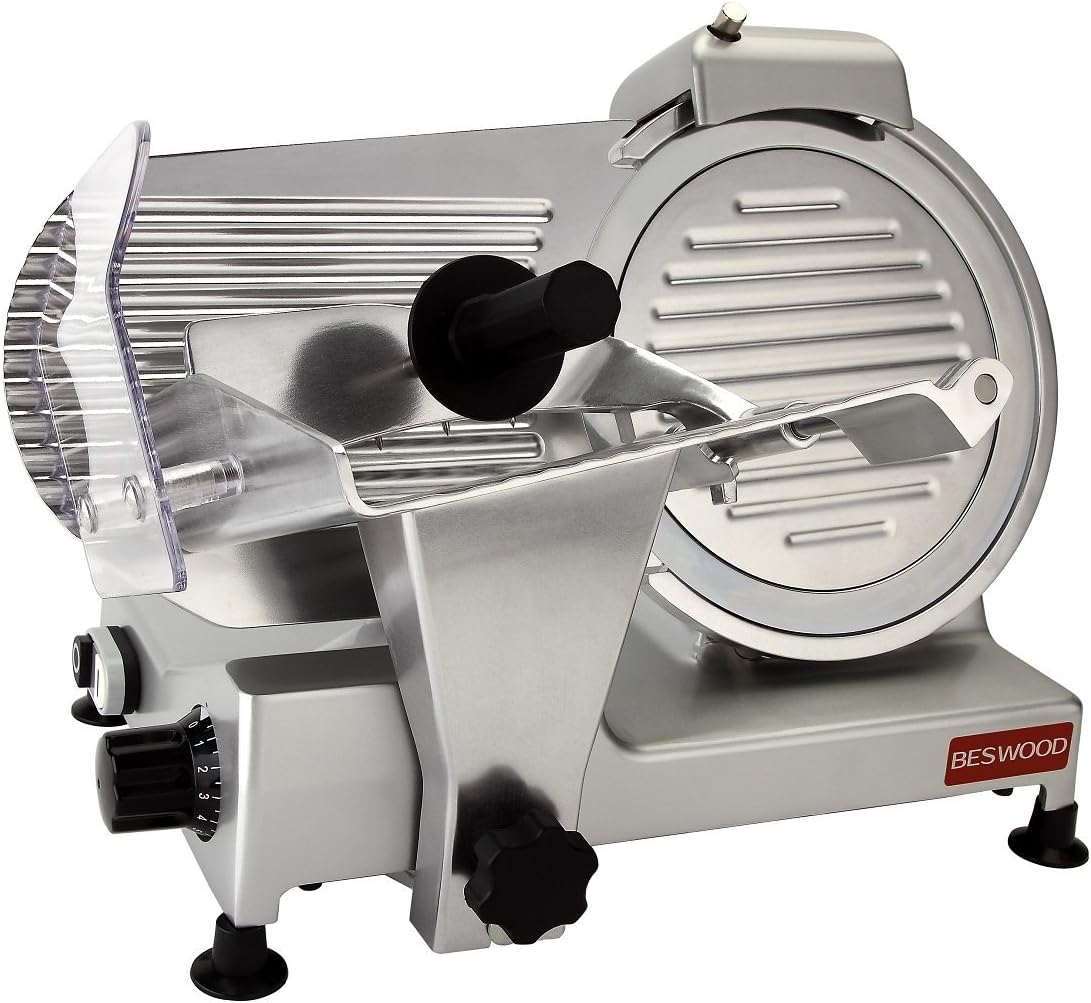
Short version. The BESWOOD250 is a $358 machine that does one thing the $70–150 home slicers cannot: it keeps going. A 10″ chromium-plated blade turning at 282 rpm off a 240W, 1/3 HP motor will work through a whole brisket or a case of cheese without heating up or bogging down, and the top-mounted twin sharpening stones mean the edge is maintained on the machine rather than sent away.
It is also 33 pounds and takes up 20 inches of counter by 17 inches deep. If you slice deli meat twice a month, this is the wrong purchase and the CUSIMAX at around $110 does the same job for a third of the money. Buy the BESWOOD when volume, not capability, is what your current slicer is failing at.
Price and availability verified 2 September 2026: $358.00, in stock, sold on Amazon by BESWOOD directly rather than a reseller. Rating 4.6 out of 5 from 3,368 ratings.
BESWOOD250 specifications
| Blade | 10″ high-carbon steel, chromium-plated |
| Motor | 240W / 1⁄3 HP, 110–120V |
| Blade speed | 282 revolutions per minute |
| Slice thickness | 1–12 mm (about 0 to 1⁄2″) |
| Max cutting length | 210 mm (8-1⁄4″) |
| Max cutting height | 170 mm (6-7⁄10″) |
| Sharpener | Built in, twin stones, top mounted |
| Weight | 33 lb |
| Footprint | 20″L × 17″W × 14.75″H |
| Certification | ETL listed (see the certification section below) |
| In the box | Machine, manual, cleaning brush, food-grade machine oil |
| Warranty | 12 months from purchase |
What the $358 actually buys
Almost every slicer sold for home use runs a direct-drive motor between 130W and 200W behind a 7.5″ blade. Those machines are sized for a task measured in minutes: a pound of turkey, a block of cheese, a few servings of prosciutto. The BESWOOD is sized for a task measured in pounds.
Three specifications carry that difference. The motor is 240W rated at 1/3 horsepower, which is roughly a fifth more power than the strongest of the home machines. The blade is 10 inches rather than 7.5, so a single pass covers 8-1/4 inches of cutting length instead of about 6. And the blade turns at a stated 282 revolutions per minute, which is deliberately unhurried — slicer blades are not meant to spin fast, they are meant to keep turning at a constant rate under load.
The body is aluminium rather than moulded plastic, which is most of the 33 pounds. Weight on a slicer is a feature and not a penalty: a machine that stays still while a blade turns against resistance produces more even slices than one that walks across the counter. It is the same reason a heavy stand mixer outperforms a light one.
The built-in sharpener is the part that matters most
The BESWOOD250 carries two sharpening stones mounted on top of the machine. You engage them against the blade and run it briefly, and the edge is restored in place.
This is easy to skim past on a spec sheet and it is the single biggest ownership difference between this machine and a $100 one. A slicer blade dulls. When a cheap slicer’s blade dulls, the realistic options are to buy a replacement blade or to live with a machine that tears rather than cuts, because sending a 7.5″ slicer blade out for sharpening costs a meaningful fraction of what the whole slicer cost. Neither option is good, and it is the reason a lot of budget slicers end up in a cupboard within two years.
A chromium-plated high-carbon blade with stones on the machine changes the arithmetic. The plating resists corrosion, so the edge does not pit between uses, and the stones mean maintenance is a two-minute job rather than a purchase.
Here is the number that makes the point. BESWOOD sells the original replacement blade for this machine directly, at $120.00 — a third of what the whole slicer costs, and more than the price of an entire budget slicer. It was also showing as sold out on their site when I checked on 2 September 2026, which sharpens the argument rather than softening it.
On a machine where a new blade costs $120 and may not be in stock when you want one, keeping the existing blade sharp is not a convenience feature. It is the difference between a long-term tool and a disposable one.
What it will and will not cut
The published capacity is 210 mm of cutting length by 170 mm of height, which in practical terms is a cut face of roughly 8-1/4 by 6-7/10 inches. That takes a whole turkey breast, a standing rib roast, a full deli-sized block of cheese, or a large salami along its length rather than at an angle.
Thickness runs from 1 mm to 12 mm. The bottom of that range is genuine deli-paper territory, and the top is a half-inch steak-cut. Most home slicers stop at 15 mm but cannot hold a setting at the thin end under load, which is the specification that actually matters: a slicer’s job is repeatability, and a dial that drifts by a millimetre between slices is what separates a machine from a toy.
What it will not do is cut bone, and no belt-driven slicer will. It is also not designed for hard-frozen meat. Semi-frozen — firmed in the freezer for 30 to 45 minutes so the fibres stiffen — is the standard technique for getting clean thin slices from raw meat, and a 240W motor is comfortable there in a way a 130W one is not. Solid-frozen is how blades get damaged, on this machine as on any other.

The certification question, and why it is worth checking
This is the part of the listing I would treat carefully, and no other review of this machine seems to raise it.
The Amazon listing states one certification: USA standard approved: ETL Listed & Certified. ETL is an electrical safety mark, equivalent in function to a UL listing, and it is the certification that matters for plugging the machine in at home. On that point the sources agree and there is no ambiguity.
NSF is a different thing entirely. It certifies that equipment can be cleaned and sanitised to a standard health inspectors accept, and it is what a commercial kitchen is often required to have. BESWOOD’s own website is inconsistent here: one line of marketing copy on the product page lists the approvals as ETL and NSF, while the specification block further down the same page gives the certifications as ETL, GS, CE and ROHS, with no NSF among them. The Amazon listing does not mention NSF at all.
For a home kitchen this changes nothing; ETL is the relevant mark and it is confirmed. But this machine is sold as “for Commercial and for Home Use,” and if you are buying it for a business that gets inspected, do not take NSF certification from the product description. Ask BESWOOD to confirm it in writing before you order. If NSF is a hard requirement, the KWS MS-10NT at $394 states it explicitly on its listing, and my KWS MS-10NT review covers that machine in full, with the two set against each other in my BESWOOD vs KWS comparison.
Is it too much machine for a home kitchen?
For most people, yes. That is not a criticism of the machine, it is a description of who it is for.
The honest comparison is against the CUSIMAX, which is the Best Overall pick in my meat slicer buying guide at $109.78 with 8.7″ dual blades and a 200W motor. The BESWOOD costs $248.22 more. For that you get an inch and a bit more blade, about 20% more motor, an aluminium body instead of plastic, and the on-board sharpener.
Whether that is worth $248 depends entirely on one question: how much do you slice at a time? Below roughly a pound or two per session the CUSIMAX will not be the limiting factor in your kitchen and the extra money buys capability you never reach. Above that — a hunter processing a season, a household that buys whole roasts and portions them, anyone slicing for a market stall or a small deli counter — the cheaper machine starts overheating and the dial starts drifting, and the BESWOOD simply does not.
The specification that decides it
Duty cycle is the useful frame, even though no manufacturer in this category publishes one. A 130W to 200W direct-drive motor is designed for short runs with cooling gaps. A 1/3 HP motor in an aluminium housing is designed to run continuously. If you have ever stopped slicing because the machine got hot rather than because you were finished, that is the specification you are buying.
The same-price sibling almost nobody mentions
BESWOOD sells a second version of this machine on Amazon: the same 10″ 240W slicer in a red finish, listed at $358.00 — identical to the standard model — but with a removable serving plate included that the standard listing does not ship with.
It rates 4.6 out of 5, the same as the original, though from 219 ratings rather than 3,368. That is the trade: the same machine and the same price with an extra accessory, against a review base that is fifteen times smaller and a much shorter sales history. There is also a third variant, the BESWOOD250RX, which was showing as unavailable when I checked on 2 September 2026.
If the serving plate is useful to you, the red model is a free upgrade. If you would rather buy the version that thousands of people have already reported back on, the standard listing is the safer pick. Both are sold by BESWOOD rather than a third party.
Watch the blade size if you buy direct
BESWOOD’s own site sells this machine in both 9″ and 10″ blade sizes on a single product page, with 9″ selected by default and its specifications displayed until you switch. The 10″ is $358.00 there, the same as Amazon, so there is no saving in buying direct — but there is a way to accidentally order a smaller machine than you meant to.
What 3,368 ratings actually say
A star average on its own is close to useless, because a 4.6 from two hundred people and a 4.6 from three thousand are different claims about the world. Here is how the BESWOOD250’s rating breaks down, read off the listing on 2 September 2026.
| Rating | Share | Approx. ratings |
|---|---|---|
| 5 star | 83% | ~2,795 |
| 4 star | 10% | ~337 |
| 3 star | 2% | ~67 |
| 2 star | 1% | ~34 |
| 1 star | 4% | ~135 |
Ninety-three percent of buyers rated it four or five stars, which is a strong result on a sample this size. The interesting part is the shape at the bottom. The one-star share is larger than the two- and three-star shares combined, which means the negative feedback is not a gentle slope of mild disappointment — it is a large group who are very happy and a small group who are not happy at all, with very little in between.
I am not going to tell you why those roughly 135 people rated it one star, because Amazon now requires a sign-in to read filtered reviews and I have not read them. Anyone who tells you the cause without having read them is guessing. What the distribution supports is a narrower and more useful conclusion: whatever goes wrong for a small minority of buyers goes wrong badly rather than gradually.
The practical response is the same one that applies to any 33-pound appliance shipped by carrier. Unbox it, run it, and check the blade and the carriage properly within the return window rather than leaving the box in the garage for three weeks. That is cheap insurance on a purchase where the failure mode, whatever it is, appears to be binary.
It is also the reason to prefer this listing over the red variant if you are undecided. Both average 4.6, but 3,368 ratings resolve a distribution that 219 ratings cannot.
Setup, counter space and running costs
There is no assembly. The machine arrives built, with a manual, a cleaning brush and a bottle of food-grade machine oil, and the oil is a hint about the maintenance the manufacturer expects: the slide rod that the carriage travels on wants lubricating periodically so the stroke stays smooth.
Plan the counter space before it arrives rather than after. The footprint is 20 inches wide and 17 inches deep, which fits a standard 24- to 25-inch counter depth with room behind, but the number that catches people out is the clearance at the carriage end. The food carriage travels its full stroke out to one side, so the machine needs room beside it as well as under it, and a slicer wedged into a corner cannot use its own capacity.
At 33 pounds, this is not an appliance that gets lifted in and out of a cupboard between uses. Decide now whether you have somewhere it can live permanently, because a slicer that has to be hauled out is a slicer that stops being used — and that failure is much more common than any mechanical one.
Ongoing costs are otherwise close to nothing. The consumables are the oil and, eventually, a blade at $120.00, which the on-board stones exist to postpone.
Cleaning and maintenance
The slicer strips down without tools: the blade, the food carriage and the pusher all come off for washing. A cleaning brush and a bottle of food-grade machine oil are supplied, which tells you what the routine is meant to be — brush the seams, wash the removable parts, and oil the slide rod so the carriage keeps moving smoothly.
My guide to how to clean a meat slicer covers the full routine, including the step almost everyone skips. It is hand wash only. That is standard for slicers and it is not a shortcut the manufacturer is taking: dishwasher detergent is hard on a plated blade edge, and the plating is what stops the high-carbon steel underneath from corroding.
The thing to be disciplined about is the seams. Across verified-purchase reviews of slicers generally, trapped residue in places the machine does not open up is one of the two recurring complaints, alongside blades loosening over time. A machine that comes apart properly is easier to keep hygienic than one that does not, and that is worth more on a slicer than on most appliances. My guide to choosing a cutting board covers the same principle for the surface the sliced food lands on.
Who should skip it
- Occasional slicers. If a slicer comes out once or twice a month for sandwich meat, this is roughly $250 of capability you will not use.
- Small kitchens. 20 inches by 17 inches of counter, and 33 pounds. This is not a machine that gets lifted into a cupboard after each use, and a slicer that lives in a cupboard stops being used.
- Anyone who needs NSF certification on paper. Confirm it directly with BESWOOD first, or buy a machine that states it.
- Anyone hoping to cut frozen blocks or bone. Neither is what a belt-driven slicer does, at any price.
BESWOOD250 vs the alternatives
| Slicer | Best For | Blade | Price | Rating |
|---|---|---|---|---|
| BESWOOD250 | Volume slicing at home | 10″ / 240W | $358.00 | 4.6★ (3,368) |
| KWS MS-10NT | When NSF is required | 10″ / 320W | $394.00 | 4.5★ (1,959) |
| CUSIMAX dual blade | Most home kitchens | 8.7″ / 200W | $109.78 | 4.3★ (5,038) |
The KWS is the closest thing to a direct competitor: a 10″ machine with a stronger 320W motor and a 304 stainless blade, $36 dearer and three pounds heavier. Its advantage is the explicit NSF statement and the extra motor; the BESWOOD’s advantage is a review base almost twice the size and a chromium-plated blade with the stones to maintain it.
The CUSIMAX is in the table because it is the machine most people buying a slicer should actually buy, and a review that does not say so is not being useful. Full comparisons for the home-priced machines are in my best meat slicers guide, and if slicing is only part of the prep problem, my food processors hub covers the chopping and shredding side.
How this review was researched
Plainly: I have not run this machine. This is a research-based review, not a firsthand account, and nothing in it is written as one.
What it rests on: the manufacturer’s published specification for the 10″ variant, cross-checked against the Amazon listing and against the figures third-party reviews report; live price, stock and seller status pulled on 2 September 2026; the pattern of complaints across the verified-purchase review base; and the certification claims read directly off both BESWOOD’s site and the Amazon listing, which is how the ETL and NSF discrepancy above surfaced.
What I could not establish: slice consistency under sustained load, which is the whole job of a slicer. Measuring it means slicing the same chilled product at one setting repeatedly and measuring every slice, and no independent test does that for this machine. Motor rating, blade diameter and body mass are used here as proxies for it, and a proxy is not a measurement.
Frequently Asked Questions
Is the BESWOOD250 worth it for home use?
Only if you slice in volume. The capability it adds over a $110 machine is sustained running and on-board sharpening, and both only pay back if you regularly slice more than a pound or two at a session. For occasional deli meat, a 7.5″ or 8.7″ home slicer does the same job for a third of the price.
Does the BESWOOD250 have a built-in sharpener?
Yes. Two sharpening stones are mounted on top of the machine and engage against the blade in place, so the edge is maintained without removing the blade or sending it out. Combined with the chromium plating on the high-carbon blade, that is the main reason this machine stays usable for longer than cheaper slicers.
Can the BESWOOD250 slice frozen meat?
Semi-frozen, yes; solid-frozen, no. Firming meat in the freezer for 30 to 45 minutes before slicing is the standard way to get clean thin cuts, and the 240W motor handles that comfortably. Cutting meat frozen through is how slicer blades get chipped, regardless of the machine.
Is the BESWOOD250 NSF certified?
The Amazon listing states ETL only. BESWOOD’s own site is inconsistent, with one marketing line claiming ETL and NSF while the specification block on the same page lists ETL, GS, CE and ROHS. If NSF matters for your kitchen, confirm it with BESWOOD before buying rather than relying on the listing.
How thin will it slice?
The thickness range is 1 mm to 12 mm, so from deli-paper at the bottom to roughly a half-inch cut at the top. The more useful question is whether a slicer holds its setting between slices under load, which is where heavier machines with stronger motors separate from budget ones.
What is the difference between the BESWOOD250 and the red BESWOOD model?
Mechanically nothing, as far as the listings show: both are the 10″, 240W machine at $358.00. The red version includes a removable serving plate the standard one does not. The standard model has 3,368 ratings against the red model’s 219, so you are choosing between an extra accessory and a much larger body of buyer feedback.
The bottom line
The BESWOOD250 is a genuinely capable machine at a fair price for what it is, and the specification that justifies the money is the on-board sharpener rather than anything about the motor. A slicer you can keep sharp is a slicer you still own in five years.
Buy it if volume is the thing your current slicer fails at, if you have the counter space to leave 33 pounds standing out, and if ETL rather than NSF is all the certification you need. If you are buying your first slicer and you are not sure how much you will use it, buy the CUSIMAX instead and spend the $248 you save on the meat.
Prices, ratings and stock verified 2 September 2026. Amazon pricing moves; check the current figure before buying.

Glenn is the founder of Kitchenware Compare and has spent years researching, testing, and reviewing kitchen appliances, cookware, and gadgets. A lifelong home cook raised in a family that treated every meal as an occasion, Glenn started this site to cut through the noise of conflicting product reviews and give readers honest, practical guidance. When he is not testing the latest air fryer or digging into the specs of a new espresso machine, he can usually be found experimenting with new recipes or hunting for the perfect cast iron skillet at a flea market.
Leave a Reply