For fast, very crispy small batches, an air fryer wins. For baking, multi-rack cooking, or feeding a family in one go, a convection oven is the better tool. The right choice depends less on which appliance is “best” and more on your counter space, typical meal size, and whether crunch or capacity matters more to you.
TL;DR:
- Air fryers excel at quickly crisping small portions and finishing foods with a golden crust, but they are limited in capacity and require careful spacing.
- Convection ovens handle larger batches, cook more evenly on multiple racks, and are better suited for baking, roasting, and feeding more people at once.
- The quick heat-up time and concentrated airflow of air fryers produce superior crispiness for high-surface-area foods compared to convection ovens.
- The larger size, longer preheat, and more complex cleanup of convection ovens make them more appropriate for frequent baking and cooking for households of four or more.
- Buyers should prioritize capacity matching their typical meal size and consider space, energy, and cleaning needs, rather than chasing superficial speed or crispness advantages.
1. What is an air fryer: how it works, sizes, and limits
An air fryer is a compact, forced-convection cooker. It uses a smaller chamber and a stronger fan than a full-size oven, which is why it heats up in about 2 to 3 minutes rather than the 10 to 15 minutes a conventional oven often needs. That tight airflow loop is also what drives faster browning and crisping on foods like fries, wings, and breaded proteins. My air fryer guide covers model-specific mechanics in more depth.
Most units come as basket or drawer designs, with capacities ranging from small two-quart personal models to family-size baskets. That efficiency comes with trade-offs.
- Single-rack cooking limits how much food you can crisp at once.
- Overcrowding the basket blocks airflow and produces steamed, pale food instead of a crisp crust.
- Baskets and trays need frequent scrubbing, especially with breaded or saucy foods.
If your food regularly comes out soggy rather than crisp, the fix is usually spacing, not the appliance itself, as covered in the piece on air fryer food that won’t crisp up.
2. What is a convection oven: mechanics, capacity, and strengths
A convection oven applies the same principle at full oven scale. A fan circulates heated air around a much larger cavity, which cuts down on the hot and cold spots you get in a standard bake-only oven. That circulation matters most when you’re cooking food that needs even, sustained heat rather than a quick surface crisp.
- Multiple racks of cookies, sheet pans of vegetables, or a full tray of roasted chicken thighs cook more evenly at once.
- Whole birds and larger roasts brown more consistently because heated air reaches every side, not just the top.
- The bigger box takes longer to preheat and draws more energy per session than a countertop unit, an offset for its added capacity, as noted in a comparison of convection and conventional ovens.
For households that bake often or cook for more than two or three people at a meal, that evenness and volume tend to matter more than shaving a few minutes off cook time.
3. Key differences at a glance (speed, crispiness, capacity, energy, cleanup)
The two appliances share a mechanism, forced air, but differ sharply in scale and intent. Here’s how the trade-offs break down in practice.
- Heat-up time: air fryers reach cooking temperature in 2 to 3 minutes; convection ovens typically need 10 to 15 minutes.
- Airflow strength: air fryers use a smaller chamber and more forceful fan, which concentrates heat on less food and speeds up browning.
- Interior volume: convection ovens handle multiple trays or a whole bird; most air fryer baskets fit one layer of food.
- Best-food match: air fryers suit fries, wings, and reheated leftovers; convection ovens suit cookies, casseroles, and roasts.
- Cleanup effort: air fryer baskets are small and dishwasher-friendly in many models; oven racks and cavities take longer to wipe down or need a self-clean cycle.
If you’re cooking a single portion of something crispy tonight, grab the air fryer. If you’re feeding a table or baking in batches, the oven earns its longer preheat.
4. Cooking performance and results: why air fryers often crisp faster
The crispiness gap comes down to physics. A smaller chamber concentrates hot air against the food’s surface, transferring energy faster and accelerating the Maillard reaction, the browning process responsible for crisp, golden crusts.
According to a hands-on test by Delish, air fryers produced noticeably crispier surfaces and better interior texture than a convection oven when cooking potatoes, broccoli, and breaded chicken in shorter cook times. That kind of side-by-side result is consistent with how the two appliances are built: less air volume to heat, more concentrated airflow, faster crust formation.
- Small items with high surface area, like tater tots or Brussels sprouts, benefit most from the air fryer’s tighter airflow loop.
- A convection oven can close the gap using a dedicated air-fry setting, a high-heat broil, or placing food on the top rack closest to the fan.
- Larger cuts and casseroles rarely see the same crisping benefit in either appliance, since the interior needs time to cook through regardless of surface airflow.
5. Capacity, kitchen fit, and typical use cases
Matching capacity to household size avoids the two most common regrets: an air fryer too small for real meals, or an oven too big for a one- or two-person kitchen.
- A single cook or couple typically does fine with a smaller air fryer basket and skips a second oven entirely.
- A family of four or more often needs either a large-capacity air fryer or leans on convection for casseroles, sheet-pan dinners, and baking.
- Frequent bakers and batch preppers get more value from convection ovens, since multi-rack capacity outweighs the speed advantage of a countertop unit.
- Small kitchens with limited counter space may favor the compact footprint of an air fryer over a bulky countertop convection model.
Pro Tip: If you bake more than twice a week, prioritize oven capacity over air fryer speed. Crisping is a convenience; even baking is a requirement.
Cleaning habits differ too. Air fryer parts are typically removable and dishwasher-safe, while a convection oven’s fan and cavity need a more involved cleaning routine a few times a year.
6. Health, safety, and recalls: realistic health benefits and how to avoid hazards
Air fryers can cut the oil used compared with deep frying, but registered dietitians are clear that they don’t turn processed food into health food. According to Cleveland Clinic guidance, air fryers work best when used on lean proteins and vegetables rather than as a way to “healthify” fried snacks. My comparison of air frying versus deep frying breaks down the oil difference in more detail.
Safety is a separate issue from health, and it deserves equal attention. CPSC recall records document hundreds of thousands of recalled air fryer units tied to fire, burn, and laceration hazards, a reminder that model reliability matters as much as features.
- Register your appliance so you receive recall notices directly from the manufacturer.
- Stop using any unit that shows unusual smoke, smells, or overheating and follow the recall instructions provided.
- Always verify poultry reaches 165°F internally using a food thermometer, in either an air fryer or an oven.
If you’ve had recurring electrical issues, the guide on an air fryer that keeps tripping the breaker walks through common causes.
7. How to choose: a practical checklist to make the purchase decision
Buying the wrong appliance usually comes down to skipping one of these checks before checkout.
- Capacity: measure your usual portion size and pick a basket or oven volume that fits it without crowding.
- Wattage and preheat time: higher wattage generally means faster heat-up, useful for weeknight cooking.
- Features: preset modes, removable nonstick trays, and a viewing window make daily use easier.
- Warranty and reviews: check for at least a one-year warranty and read owner complaints, not just star ratings.
- Footprint and storage: confirm it fits your counter or a cabinet shelf when not in use.
- Price versus expected use: a cheaper model that sits unused after a month costs more than a pricier one you use weekly.
Pro Tip: Ask any product page or in-store display for exact basket volume in quarts, not just “family size,” since that label varies widely between brands.
If you cook mostly solo meals and crispy snacks, an air fryer covers most needs. If you bake regularly or cook for a household of four or more, a convection oven is the safer long-term investment. My kitchen essentials list covers where either appliance fits into a broader kitchen setup.
8. Why trust Kitchenware Compare
Kitchenware Compare builds its recommendations from published specifications and owner review patterns, then tracks pricing over time so comparisons stay current. This article was written by Glenn, drawing on that same comparison approach. For model-specific picks, my air fryer guide walks through current options side by side.
What the research actually tells you to prioritize
The most common mistake buyers make is treating this as a contest with one winner. It isn’t. An air fryer and a convection oven share the same core mechanism, a fan pushing hot air around food, and the marketing distinction between them is smaller than most product pages suggest.
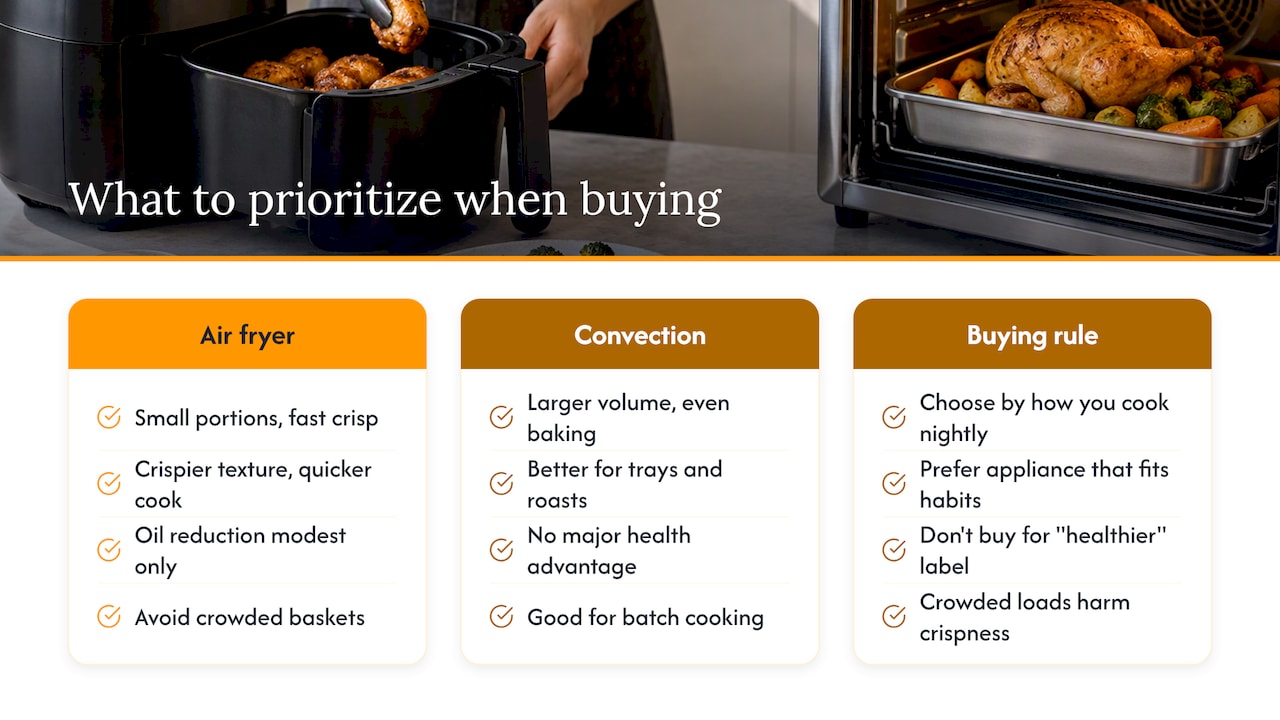
What the evidence actually supports is narrower and more useful: air fryers win on speed and crisp texture for small portions, convection ovens win on volume and even baking. Chasing “healthier cooking” as the reason to buy either one is largely misplaced. Dietitians are consistent that oil reduction is real but modest, and it does nothing to offset a diet built on processed food.
If you take one thing from this comparison, let it be this: buy based on how you actually cook most nights, not on which appliance has the flashier reviews. A crowded basket ruins crisp results just as fast in a top-rated model as a budget one.
— Glenn
Sources
- Air fryers and food safety | FSIS (USDA)
- Best Buy recalls Insignia air fryers and air fryer ovens due to fire, burn, and laceration hazards | CPSC recall
- Are air fryers actually healthy? | Cleveland Clinic
- I put an air fryer & convection oven to the test—here’s what made food crispier | Delish
FAQ
Why are people getting rid of air fryers?
Some owners report frustration with limited capacity for family meals, frequent basket cleaning, and counter space taken up by a single-purpose appliance. Others simply find their needs shift toward baking or larger batches, which a convection oven handles more easily.
Can I use my convection oven as an air fryer?
Many convection ovens include a dedicated air-fry setting that boosts fan speed to mimic a countertop air fryer’s crisping effect. Results are often close but slightly less crisp, since the oven’s larger chamber and longer preheat time dilute some of the concentrated airflow advantage.
When should you not use a convection oven?
Skip the convection oven when you need a single small portion crisped quickly, since its longer preheat and larger cavity waste time and energy for that job. It’s also a mismatch for delicate baked goods like soufflés or custards, where strong airflow can dry out or misshape the surface.
What cannot be cooked in an air fryer?
Wet-batter foods, whole roasts too large for the basket, and dishes that need submersion in liquid, like soups or stews, don’t work well in an air fryer. Overcrowded batches also fail to crisp properly, since overfilling blocks the airflow needed for browning.
Recommended
- How to Clean a Fan-Assisted Oven (Including the Fan)
- Air Fryer Food Not Crispy? Soggy vs Pale, Two Fixes
- Air Fryer Not Heating Up? Start With the Drawer

I'm Glenn, and I started Kitchenware Compare to cut through conflicting product reviews and help readers pick kitchen gear with confidence. I don't own or test the products I write about — these guides are built from verified-purchase reviews, manufacturer specifications, and independent testing where it exists, with the reasoning shown, not just a rating.
Leave a Reply