This guide has no affiliate links, but some pages it links to do. If you buy through those, I may earn a commission at no extra cost to you.
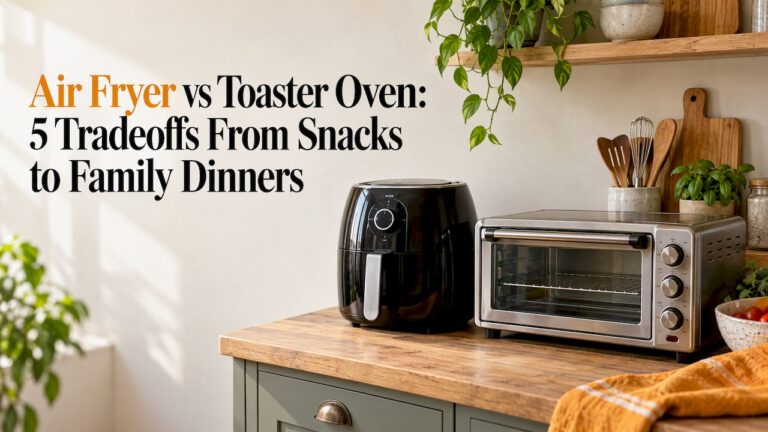
For the crispiest results in small batches, a pod-style air fryer is the better pick. For more room and more functions for family meals, a toaster oven or an air-fryer toaster-oven combo makes more sense. The real decision comes down to five tradeoffs: texture, capacity, speed, energy use, and counter space.
TL;DR:
- A 2 to 4 quart basket suits single servings and snacks, while 5 to 6 quarts handles family batches; check interior dimensions before buying.
- Air fryers need little preheating and cook small portions in 5 to 25 minutes; toaster ovens may finish large batches sooner in one load.
- Use a food thermometer for meat and poultry, leave space between pieces for airflow, and refrigerate leftovers within two hours.
- Choose a combo only if its extra modes will get regular use; it costs more and takes more space, while many baskets are dishwasher safe.
How Cooking Method Affects Results: Crisping, Browning, and Evenness
A pod-style air fryer works by forcing concentrated, high-speed air around food in a small basket. That tight cavity and fast airflow is why fries, wings, and breaded items come out with a crackling crust in a short cook. A toaster oven relies on a mix of radiant heat from exposed elements and convection from a fan, spread across a larger cavity. That combination suits foods that need gentler, even heat across a wider surface, like a sheet pan of roasted vegetables, a casserole, or a whole chicken.
According to Food Safety and Inspection Service guidance, air fryers are essentially countertop convection ovens that typically run between 350°F and 400°F and cook many foods in about 5 to 25 minutes.
Overcrowding is the most common mistake with either appliance. Pile too much into a basket or onto a tray and airflow gets blocked, which leaves some pieces soggy while others overcook. A few fixes help regardless of which appliance sits on your counter:
- Cook in smaller batches rather than one crowded load.
- Shake or flip food halfway through for even browning.
- Leave visible gaps between pieces so air can circulate.
- Use a lower rack position for items that need more browning from below.
Appliance Running Cost, an electricity-cost site, estimates that a toaster oven draws similar wattage to an air fryer (1,200 to 1,800W) but typically takes 20 to 40% longer to cook the same food because it lacks the air fryer’s powerful fan, so an air fryer uses about 20 to 30% less energy than a comparably sized toaster oven. A convection toaster oven narrows that gap but rarely closes it.
Capacity and Footprint: Matching Size to Household Needs
Air fryer baskets typically range from small to moderate capacities, which works for singles, couples, or quick snacks, but fills up fast with family-sized portions. Toaster ovens, including air-fryer toaster-oven combos, usually accept quarter, half, or even full sheet pans, along with 9×13 casserole dishes, making them a better match for multi-serving meals.
Usable interior space matters more than the quart number on the box. A basket listed as a certain capacity may still have a shallow, narrow shape that limits what fits, so checking depth and height against your own cookware avoids a disappointing surprise.
- A 2 to 4 quart basket suits single servings, reheating leftovers, or cooking a small side.
- A 5 to 6 quart basket handles a family-sized batch of fries or a few chicken breasts.
- A toaster oven with sheet-pan capacity handles a full dinner, a dozen cookies, or a small roast in one load.
For anyone who cooks for more than two people regularly, batch cooking in a small basket means multiple rounds and a longer total wait, even if each round itself cooks quickly.
Versatility and Functions: Presets, Modes, and Combo Ovens
A basic pod-style air fryer usually offers air fry and reheat, sometimes with a dehydrate setting. A toaster oven typically adds bake, broil, toast, and roast, and an air-fryer toaster-oven combo folds air frying into that same larger cavity. Some combo units bundle additional modes like proof or rotisserie, depending on the model.
That range comes at a cost. A combo unit generally costs more and takes up more counter space than a dedicated pod-style fryer, so the extra functions only pay off if you use them.
- Toast, bake and broil cover the everyday toaster-oven jobs: breakfast toast, reheats and small bakes.
- Air fry and roast cover crisping needs for proteins and vegetables.
- Dehydrate and proof are niche functions, useful for specific hobbies but rarely a daily habit.
- Rotisserie attachments suit larger cuts but add bulk and cleaning time.
Control interfaces matter too. Digital presets with numbered programs tend to produce more repeatable results meal after meal, while manual dial controls demand more guesswork but can feel faster for simple reheats.
Pro Tip: Pick the functions you will actually use weekly, not the ones that sound useful but will sit untouched after the first month.
Speed, Preheating, and Energy Efficiency
A pod-style air fryer often gets food to the table faster for small portions. Its smaller cavity heats up quickly and needs little or no preheat, while a full-size toaster oven can take several minutes to reach temperature before cooking even starts. For frozen snacks or a quick reheat, that difference is noticeable.
According to Food Safety and Inspection Service guidance, typical air fryer cook times run about 5 to 25 minutes depending on the food and setting, a range that reflects how much faster a compact, high-airflow cavity cooks compared to a standard oven cycle.
Energy use follows the same logic in reverse at larger scale. A short, fast cycle in a small air fryer basket can use less total energy than running a full-size oven for the same short time, but wattage and run-time both factor in. For a big batch that would otherwise need three or four air-fryer rounds, a toaster oven or combo unit cooking everything in one load often finishes faster overall and avoids the repeated heat-up cycles of each new basket.
Ease of Use and Cleaning: Daily Convenience and Maintenance
Air fryer baskets are usually nonstick and dishwasher safe, which makes cleanup quick after greasy foods like wings or fries. Toaster ovens rely on a removable crumb tray and wire rack, both of which need regular wiping since crumbs and drips build up on exposed heating elements over time.
- Air fryer baskets: often dishwasher safe, quick to rinse by hand.
- Toaster oven trays and racks: often hand wash only, with more surface area to scrub.
- Digital touch panels: easier to wipe clean than textured knobs and dials.
Noise levels differ too. Air fryer fans tend to run loud during the cycle, while toaster ovens are generally quieter since they rely less on forced air. For maintenance, avoid abrasive scrubbers on nonstick coatings, let every part cool fully before washing, and check door seals and hinges periodically so heat does not leak out during cooking.
Food Safety: Temperatures, Overcrowding, and Cooling
Visual cues are not reliable for judging whether meat or poultry is safe to eat. The Food Safety and Inspection Service says to check doneness with a food thermometer: 165°F for poultry, 160°F for ground meat, and 145°F for fish and for whole cuts of beef and pork (with a 3-minute rest). The same targets apply in a toaster oven.
Overcrowding a basket or tray blocks airflow and causes uneven cooking, which can leave parts of a dish undercooked even when the outside looks done. Cooking in smaller, properly spaced batches solves this.
After cooking, refrigerate leftovers within two hours to limit bacterial growth. Air frying also carries less burn and fire risk than deep-frying, since food never sits submerged in hot oil.
Decision Checklist: Pick the Right Appliance for Your Routine
Before buying either appliance, work through these steps in order:
- Rank your priorities. Decide whether crisped texture, large capacity, multiple functions, small footprint, or budget matters most to your routine.
- Check usable interior dimensions. Confirm whether a 9×13 dish, a half sheet pan, or a whole chicken actually fits, not just the advertised quart number.
- Check wattage and preheat behavior. Match this against the meals you cook most, since frozen snacks and quick reheats favor fast-preheating units.
- Inspect cleaning options and warranty. Ask whether racks and trays are dishwasher safe and what accessories ship with the unit.
A few extra pointers help narrow the final pick:
- Choose a dedicated pod-style air fryer for quick snacks, single servings, and maximum crisping in minimal space.
- Choose a basic toaster oven for everyday toast, bake, and broil needs without air frying.
- Choose a combo air-fryer toaster oven when you want both crisping and full sheet-pan capacity in one unit, accepting a larger footprint and higher price in exchange.
Kitchenware Compare: What I Offer and Where to Go Next
This site is a side-by-side comparison resource, pulling together specifications, pricing, and owner-review patterns rather than running appliances through firsthand testing. Every claim here traces back to manufacturer specs or cited third-party sources, not firsthand testing. The speed and energy comparisons are not from a measured side-by-side test of the same food in both appliances; they rest on the FSIS cook-time range and Appliance Running Cost’s modelled estimates.
To go deeper on a specific decision, these pages break down individual models and categories:
- Air fryer vs convection oven compares the two appliance types in more technical depth.
- Toaster oven reviews and buying guides narrow down models by capacity and function.
- Air fryer reviews and buying guides cover pod-style and basket options by size and price.
- How I review kitchen equipment explains the comparison approach behind these guides.
Typical Price Range and Cost Comparison
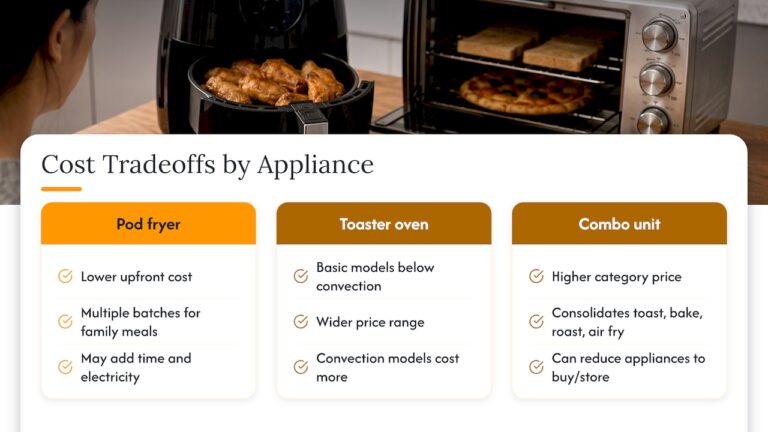
Pod-style air fryers generally sit at the lower end of the countertop appliance market, with basic 2 to 4 quart models priced lower than larger baskets or multi-function units. Prices climb with basket size, wattage, and extra presets like dehydrate or roast.
Toaster ovens span a wider range. A basic toast-and-bake model costs less than a full convection toaster oven, and air-fryer toaster-oven combos with sheet-pan capacity and multiple functions sit at the higher end of the category, since they pack more hardware, a stronger fan, and additional heating elements into one unit.
The real cost comparison is not just sticker price. A dedicated air fryer costs less upfront but may need to run multiple batches for a family meal, adding time and electricity across several short cycles. A combo unit costs more initially but consolidates toast, bake, roast, and air fry into one appliance, which can mean fewer small appliances to buy and store over time.
Replacement parts also factor in. A cracked nonstick basket or a worn crumb tray eventually needs replacing on either appliance, and checking whether a retailer sells spare parts before buying can save a headache later. For anyone weighing whether to spend more upfront on a combo unit versus buying a basic air fryer and a separate toaster, matching the purchase to how often you cook larger meals is the clearest way to avoid overspending on functions you will not use.
Ideal User Scenarios or Target Audiences for Each Appliance
A pod-style air fryer suits singles, couples, students, and anyone whose daily cooking leans toward snacks, reheats, or small single-serving meals. It also fits households with very limited counter space who want fast crisping without committing to a larger appliance.
A toaster oven fits households that bake regularly, toast bread daily, or want one appliance that handles breakfast toast through a small weeknight roast. Its larger cavity makes it the better fit for anyone feeding three or more people on a regular basis.
A combo air-fryer toaster oven suits home cooks who want both crisped textures and full sheet-pan capacity without owning two separate appliances. It tends to fit larger households, anyone who meal-preps in batches, or cooks who entertain occasionally and need extra capacity on demand.
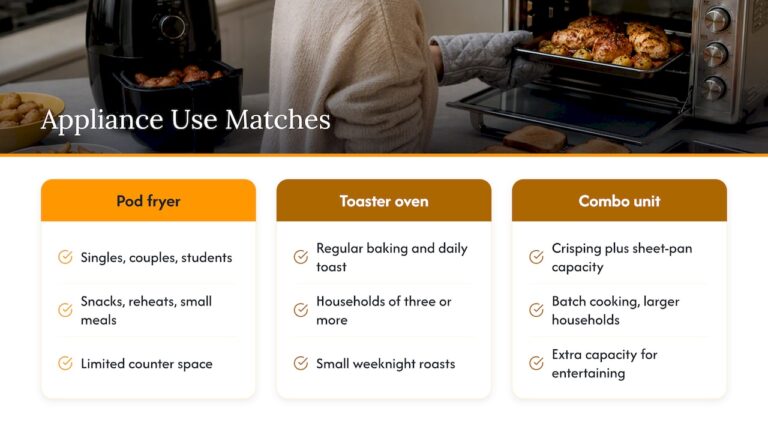
Anyone short on both time and counter space, but cooking for just one or two people most nights, usually gets the most consistent daily use from a compact pod-style air fryer. Larger families or anyone who bakes often will likely reach for a toaster oven or combo unit far more frequently than a small basket fryer.
Durability and Warranty Considerations
Nonstick coatings on air fryer baskets wear down with repeated use, especially with metal utensils or abrasive cleaning pads, and a worn coating eventually affects food release and cleanup. Toaster ovens face different wear points, mainly the heating elements, door hinges, and crumb tray, which can warp or rust over years of use if not cleaned regularly.
Warranty length varies by brand and price tier, with budget models typically offering shorter coverage than mid-range or premium units. Checking the manufacturer’s warranty terms before buying, rather than assuming coverage, avoids surprises if a heating element or fan motor fails early.
A sturdy exterior and a solid door latch are simple indicators of build quality worth checking in person or in product photos before buying either appliance type.
Typical Accessories or Add-Ons Available and Their Usefulness
Pod-style air fryers often ship with a single basket, though some brands sell additional trays, skewer racks, or silicone liners separately. A second basket or tray lets you cook two foods at different temperatures without waiting for one batch to finish.
Toaster ovens and combo units typically include a wire rack, a baking pan, and a crumb tray, with some higher-end models adding a rotisserie spit or a pizza stone. A rotisserie attachment suits anyone cooking whole chickens or roasts regularly, while a pizza stone helps with crisper crusts on homemade pizza nights.
Silicone liners and parchment sheets, sold separately for either appliance, cut down on cleanup and protect nonstick surfaces from scratches over time. For anyone buying a combo unit specifically for its added functions, checking which accessories ship included versus sold separately avoids an unexpected extra purchase right after checkout.
A Practical Take on Choosing Between the Two
The appliance that wins is not the one with the longest spec sheet. It is the one that matches how you actually cook on a Tuesday night, not the elaborate meal you imagine making someday.
Where to Start Comparing Models

A few starting points if you want to keep narrowing your choice:
- Air fryer reviews and buying guides break down basket sizes, wattage, and price by model.
- Toaster oven reviews and buying guides cover combo units and capacity side by side.
- The Kitchenware Compare landing page links to every category if you are still weighing other kitchen upgrades.
Browse the category that matches your priority from the checklist above, compare two or three models directly, and check current pricing before deciding.
FAQ
Is an Air Fryer or Toaster Oven Faster?
For small portions, an air fryer is usually faster since its compact cavity needs little preheat and cooks most foods in about 5 to 25 minutes. For large batches, a toaster oven can finish sooner overall because it cooks everything in one load instead of multiple air-fryer rounds.
Is Air Frying Healthier Than Deep Frying?
Air frying avoids submerging food in a pot of hot oil, which removes the spill and oil-fire risks that come with deep frying. Air frying also typically uses little to no added oil, which generally lowers fat content compared with deep-fried versions of the same food.
What Are the Best Foods to Cook in an Air Fryer?
Breaded and naturally crisp-friendly foods do best in an air fryer, including fries, chicken wings, and frozen snacks, since the concentrated airflow mimics deep-frying texture without the oil. Thinner cuts of meat and vegetables also cook well, as long as the basket is not overcrowded.
Is Air Frying OK for Diabetics?
Air frying itself does not change a food’s carbohydrate content, so it does not make a dish inherently diabetic-friendly or unfriendly on its own. The cooking method mainly affects fat content and texture, so portion size and ingredient choice remain the factors that matter most for blood sugar management, and anyone with specific dietary concerns should check with a healthcare provider.
Recommended
- Air Fryer vs Convection Oven: Which Should You Buy?
- Best Convection Toaster Oven 2026: 5 Picks Compared
- Best Air Fryers 2026: 5 Picks for Every Budget
- Best Air Fryer for Family of 4 in 2026

I'm Glenn, and I started Kitchenware Compare to cut through conflicting product reviews and help readers pick kitchen gear with confidence. I don't own or test the products I write about — these guides are built from verified-purchase reviews, manufacturer specifications, and independent testing where it exists, with the reasoning shown, not just a rating.
Leave a Reply