Choose hard anodized if you cook everyday meals like eggs and sautéed vegetables and want a lightweight pan that heats fast and releases food easily. Choose stainless steel if you want to sear, build pan sauces and own pans that can last for decades. The rest of this guide explains why, using specs, owner feedback and named third-party sources, because I don’t own or hands-on use the pans I write about.
TL;DR
- Hard anodized is aluminum with a hardened surface. It heats quickly, is light, and is usually sold with a nonstick coating, so it suits gentle, everyday cooking.
- Stainless steel is a coating-free metal that handles high heat, metal utensils and hard searing. It rewards a bit of technique.
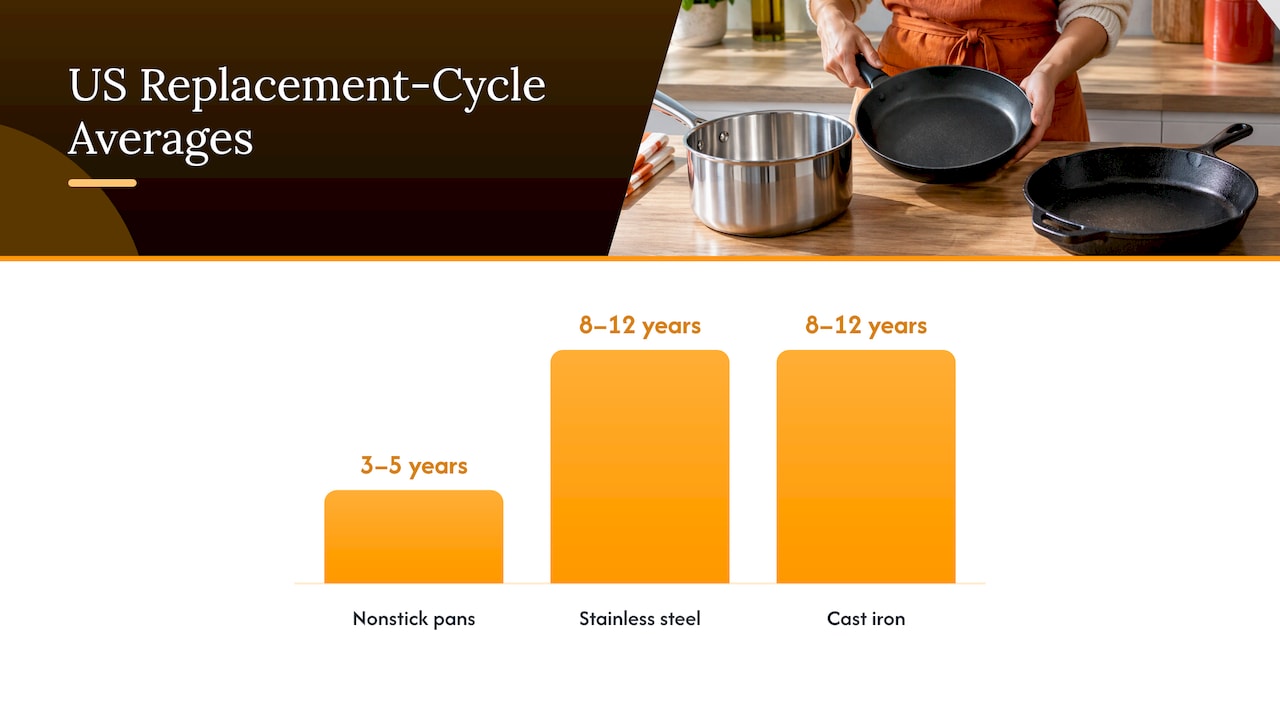
- Lifespan favors stainless. A market report puts typical replacement at 8 to 12 years for stainless and 3 to 5 years for nonstick pans.
- Safety is reasonable for both when used as directed. The main question with hard anodized is the coating on top, not the anodized metal.
- Budget buyers usually find hard anodized sets cheaper to start with. Long-term cost often tips toward stainless.
What each material actually is
The two names describe different things, which is why the comparison confuses people.
Hard anodized cookware is aluminum that has been through an electrochemical process. According to Food & Wine, the process oxidizes the outer layer of the metal into a hard surface. That surface is not quite as slick as a nonstick coating but is far more durable than bare aluminum. Bare aluminum reacts with acidic foods. An anodized surface does not, and Clemson University’s Home & Garden Information Center notes that manufacturers claim the aluminum is sealed in the final stage of anodization to prevent leaching into food.
Stainless steel cookware is an alloy. On its own, stainless conducts heat poorly. ThermTest, a thermal measurement company, lists stainless steel at only 45 W/(m/K), among the lowest of metal alloys, which is why most stainless pans have an aluminum or copper core or base. The core is the reason construction matters so much when you shop. I cover ply counts and cores in my guide to stainless steel cladding.
Here is the detail that decides many purchases: most hard anodized pans on shelves are also nonstick. Bon Appétit’s cookware guide notes that traditional PTFE nonstick is sold under many names, including hard-anodized aluminum. So “hard anodized vs stainless” often means “nonstick-coated aluminum vs bare steel.” Keep that in mind for every section below.
Quick comparison table
| Factor | Hard anodized | Stainless steel |
|---|---|---|
| Base metal | Aluminum, surface hardened | Steel alloy, usually with aluminum or copper core |
| Heat-up speed | Fast | Slower, but steady in clad pans |
| Best heat range | Low to medium-high | Medium to very high |
| Food release | Easy, if nonstick coated | Needs fat, heat and technique |
| Metal utensils | Avoid on coated surfaces | Generally fine |
| Weight | Light | Heavier |
| Dishwasher | Usually not recommended | Often rated safe, but hand washing is gentler |
| Typical lifespan | Shorter | Longer |
| Upfront cost | Usually lower | Usually higher |
Heat and cooking performance
Speed and control
Food & Wine’s stainless steel guide says an anodized pan takes less time to heat up and responds quickly to temperature changes. That is a real advantage for eggs, pancakes, fish fillets and quick vegetables, where you want the pan ready and forgiving. The same guide adds the other side: that quick response makes an anodized pan more likely to burn food on ultra-high heat.
A good clad stainless pan heats more slowly but holds heat well once it gets there. Because the aluminum or copper core spreads heat across the base, a well-built pan avoids the hot spots that cheap thin-bottomed steel pans have.
Searing and pan sauces
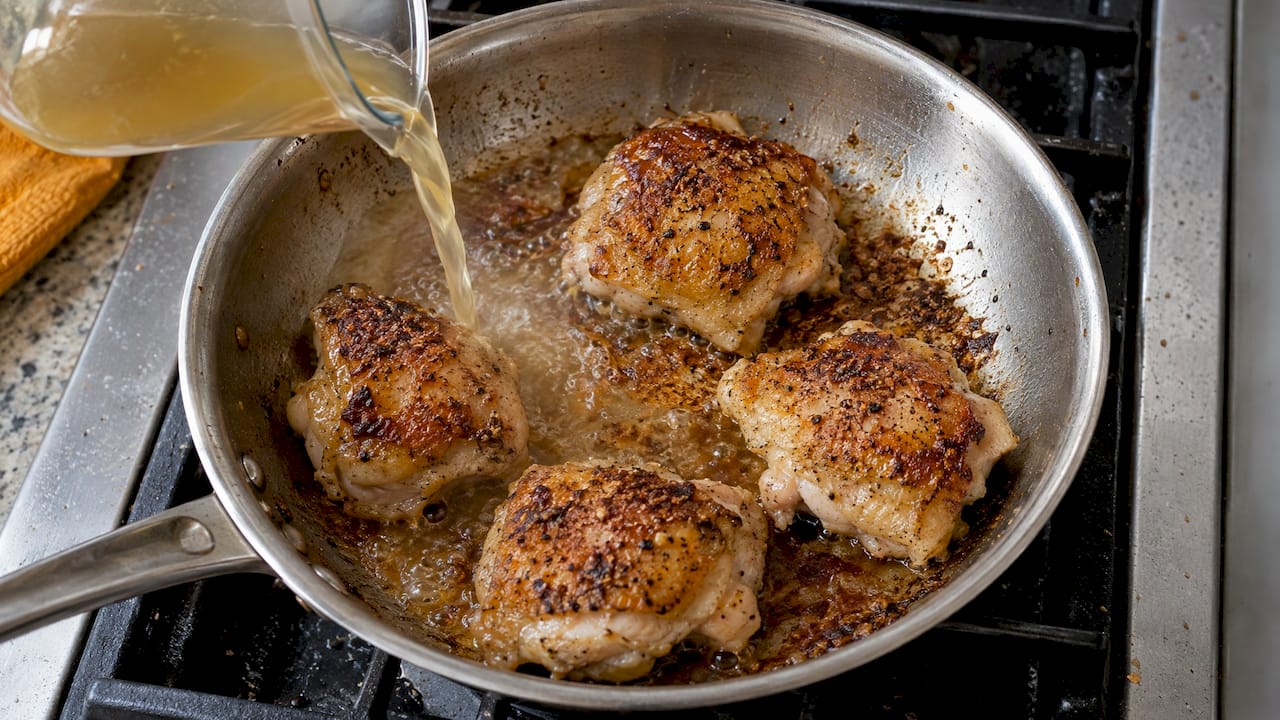
Food & Wine states that stainless steel is better suited to high-heat cooking, while hard anodized pans excel at gentler cooking. If your priority is a hard crust on a steak or chicken thighs, stainless is the better fit.
Stainless also produces fond, the browned bits left in the pan. Those bits become the base of a pan sauce when you deglaze with wine or stock. A nonstick-coated anodized pan is designed to let food release cleanly, so you get less of that browning and less to deglaze. If sauces are part of your cooking, that is a strong argument for steel.
Food release and technique
Stainless has a reputation for sticking. Bon Appétit’s non-toxic cookware guide says that with proper technique, stainless can release almost as easily as ceramic nonstick, using enough fat and heat and waiting until the oil is shimmering before adding food. In practice that means:
- Heat the empty pan over medium heat.
- Add oil and wait for it to shimmer.
- Add food that is dry and close to room temperature.
- Leave it alone until it releases on its own.
This takes a few tries to learn. If you want a pan that needs none of that, hard anodized with a nonstick surface is the easier path.
Durability and lifespan
This is where the two diverge most. Food & Wine’s hard-anodized explainer says that above the maximum temperature rating, hard anodized can begin to break down, and that it does not have the lifespan of stainless steel or cast iron.
The market data points the same way. IndexBox’s May 2026 report on the US oven-safe frying pan market puts average replacement cycles at 3 to 5 years for nonstick pans and 8 to 12 years for stainless steel and cast iron. That is a market-wide figure, not a promise about any one pan, but it matches what owners report: coatings wear before steel does.
There is a nuance worth stating. The anodized aluminum itself is hard and scratch resistant. What typically fails first is the nonstick layer on top. A pan that loses its coating is still a pan, but it no longer does the job you bought it for.
Stainless is also more forgiving of rough treatment. Metal spatulas, whisks and the occasional hard scrub will not ruin it the way they can ruin a coated surface. For a broader look at which materials last longest, see my ranking of the most durable types of cookware.
Safety: what the evidence supports
Both materials are widely used and generally considered safe when used as intended. The specifics differ.
Hard anodized. Clemson’s Home & Garden Information Center says the anodized surface prevents reactions with acidic foods and that manufacturers seal the aluminum to stop leaching. The more relevant question for most buyers is the coating. Bon Appétit warns that a label reading “PFOA- and PFOS-free” does not necessarily mean a product is free of every chemical in the PFAS family. If that concerns you, look at what the specific pan is coated with, and read my comparison of ceramic vs Teflon pans for heat limits and lifespan.
Stainless steel. According to Clemson, stainless cookware has no known health hazards from leaching of the metal, though manufacturers caution against leaving acidic or salty foods in it for long periods. Store leftover tomato sauce or brined dishes in a separate container rather than in the pan.
If you have a specific medical concern, such as a metal allergy, ask your doctor or allergist before choosing. That is a question for a clinician, not a review site.
Care and cleaning
Care is easier on paper for hard anodized and easier in practice for stainless, depending on how you cook.
- Hard anodized: Food & Wine quotes chef and educator Rachael Narins saying that anodized surfaces are stronger, scratch resistant and easier to clean. Coated versions generally need gentle hand washing with soft sponges, and wooden or silicone utensils protect the surface.
- Stainless steel: Food & Wine’s guide says hand washing is the single easiest way to prolong a pan’s life, even when the box says dishwasher safe. Let the pan cool before washing, because hot steel can warp when it meets cold water, and skip steel wool. It also advises cleaning right after use with the least abrasive scrubber rather than soaking overnight.
Stainless is the one that tolerates mistakes. Hard anodized rewards you for careful habits.
Which should you choose?
Match the pan to the way you cook, not to a general ranking. ThermTest makes the same point: the most common advice from cooking professionals is to select the material that fits your technique.
Choose hard anodized if you
- cook mostly eggs, omelets, pancakes, fish and sautéed vegetables
- want a light pan that is easy to lift and flip
- prefer minimal technique and quick cleanup
- need a lower upfront price for a full set
- accept that you will likely replace the pans sooner
Choose stainless steel if you
- sear meat, roast in the oven and build pan sauces
- want cookware without a coating to wear out
- use metal utensils and cook at high heat
- want pans that can last a decade or more
- are willing to learn a little heat control
The practical answer for many kitchens
Many home cooks end up with one of each: a stainless skillet and saucepan for searing and sauces, and a single nonstick or anodized skillet for eggs. That avoids asking one material to do everything. If you are comparing coated pans on their own, my nonstick vs stainless steel guide goes deeper, and if you are weighing heavier options, see cast iron vs stainless steel.
Cost over time
A hard anodized set is usually cheaper to buy than a good clad stainless set. That is why budget-conscious shoppers gravitate to it, and it is a reasonable choice if the price gap matters now. But cost per year of use is a different calculation. If a nonstick-coated pan lasts 3 to 5 years and a stainless pan lasts 8 to 12, as the IndexBox figures suggest for the US market, the cheaper pan can cost more over a decade once you replace it. Your own habits, heat levels and care will move those numbers either direction.
For a concrete example of a large anodized set and what owners say about it, read my T-fal Ultimate Hard Anodized review. It draws on specs and owner reviews, not on hands-on use.
Common mistakes to avoid
- Overheating anodized pans. Keep within the maker’s maximum temperature rating. Preheat on low to medium and don’t leave an empty pan on a high burner.
- Adding food to a cold stainless pan. Heat first, then oil, then food. Cold-start cooking is the main reason steel sticks.
- Crowding the pan. Too much food drops the temperature and causes steaming and sticking in both materials.
- Judging a stainless set by the label alone. Check for an aluminum or copper core or base, because bare stainless heats unevenly.
- Expecting dishwasher cycles to be harmless. Even when allowed, repeated cycles shorten the life of both types.
My perspective
I read this comparison as a question of what you want to stop thinking about. Hard anodized takes technique off the table: the pan heats quickly, food slides, and cleanup is short. For a first kitchen, a budget set or a busy weeknight cook, that is a genuine benefit, and the owner reviews I read back it up.
The trade-off shows up in owner-reported complaints, which mostly concern coatings wearing down. Stainless asks more of you at the start and gives it back over years. I don’t hand-test any of these pans, so I rely on specs, owner feedback and named sources, and I say so on my how I review kitchen equipment page.
My advice is to pick by cooking style, then pick the best-built pan in that style. Check the core of a stainless pan, the temperature rating of an anodized one, and what owners say after a year, not in the first week.
Glenn
Find the right pan on Kitchenware Compare
If you are ready to narrow it down, I compare cookware side by side on specifications, pricing, owner-reported performance and complaints, and I point out current deals. Start with the cookware reviews and buying guides to see sets and single pans in both materials.
If you are furnishing a kitchen from scratch, the kitchen essentials list for a new home shows where cookware fits among everything else you will need.
FAQ
Is hard anodized cookware safer than stainless steel?
Neither has a known health problem when used as directed. Clemson’s Home & Garden Information Center says stainless steel has no known leaching hazards and that anodized aluminum is sealed to prevent leaching. The bigger variable is the nonstick coating found on most anodized pans, so check what the pan is coated with.
Does food stick more on stainless steel?
It can, especially if the pan is cold or the food is wet. Bon Appétit’s guide says stainless can release almost as easily as ceramic nonstick when you use enough fat and heat and wait for the oil to shimmer. Hard anodized with a nonstick surface needs far less technique.
Which lasts longer, hard anodized or stainless steel?
Stainless steel generally lasts longer. Food & Wine says hard anodized does not match the lifespan of stainless or cast iron, and IndexBox reports average replacement cycles of 3 to 5 years for nonstick pans versus 8 to 12 for stainless and cast iron in the US.
Can I use metal utensils on hard anodized pans?
It is better not to if the pan has a nonstick coating, since metal can scratch the coating. Stainless steel handles metal utensils well. Wood, silicone or nylon tools are the safer choice for anodized pans.
Is hard anodized or stainless better for a beginner?
For pure ease, hard anodized, because food releases without much skill. For learning to sear and make sauces, stainless is the better teacher. Many beginners do well starting with one stainless skillet plus one nonstick pan.
Sources
- Our Essential Guide to Stainless Steel Cookware, Food & Wine
- What Is Hard-Anodized Cookware? Seasoned Chefs Explain, Food & Wine
- Cookware Safety, Clemson Home & Garden Information Center
- The Best Non-Toxic Cookware, Bon Appétit
- Oven Safe Frying Pan Market in the United States, IndexBox
- Thermal Conductivity Impacts on Cooking Technique, ThermTest
Recommended
- Nonstick vs Stainless Steel: Which Pan Fits Your Cooking?
- Cast Iron vs Stainless Steel: Which Pan for Which Job?
- Cookware Types for Induction Cooktops: Complete Guide
- Stainless Steel Cladding: Ply, Core and Metal Release

I'm Glenn, and I started Kitchenware Compare to cut through conflicting product reviews and help readers pick kitchen gear with confidence. I don't own or test the products I write about — these guides are built from verified-purchase reviews, manufacturer specifications, and independent testing where it exists, with the reasoning shown, not just a rating.
Leave a Reply