This guide has no affiliate links, but some pages it links to do. If you buy through those, I may earn a commission at no extra cost to you.
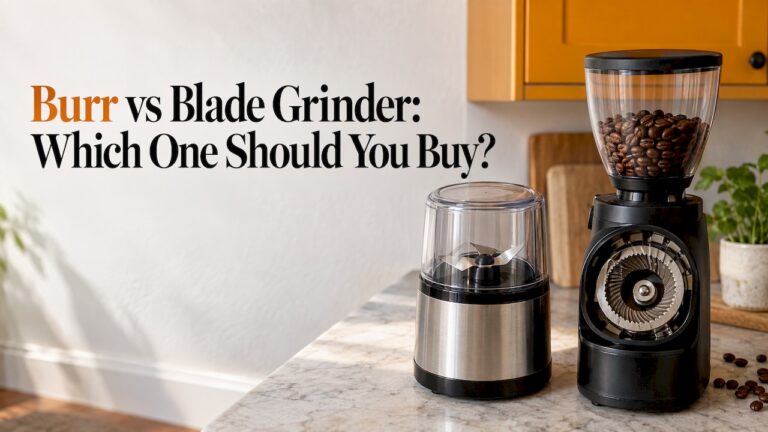
For most people who care about the taste of their coffee, a burr grinder is the better buy. It crushes beans between two abrasive surfaces set a fixed distance apart, so the particles come out far more uniform. A blade grinder chops beans at random, which gives you a mix of dust and boulders and a cup that is harder to repeat. A blade grinder still makes sense if you want the cheapest possible way to grind fresh and you are not fussy about the result. I have not used any grinder myself. Everything below comes from manufacturer specifications, published guides and owner feedback, and I name each source where its claim appears.
TL;DR
- Burr grinders crush beans between two burrs, and the gap between them sets particle size. Blade grinders chop with a spinning propeller, so particle size is left to chance.
- Uneven particles extract unevenly. That is why blade-ground coffee tends to taste both sour and bitter in the same cup.
- Choose a blade grinder only if budget and simplicity matter most and you brew with a forgiving method like a French press. Choose a burr grinder for pour-over, drip, and especially espresso.
- Between burr types, conical burrs are usually quieter, cooler and cheaper. Flat burrs usually give a more even grind and a clearer cup, at a higher price.
- Retention, the grounds left inside the machine, is a burr-grinder topic worth understanding before you buy.
How the two grinders actually work
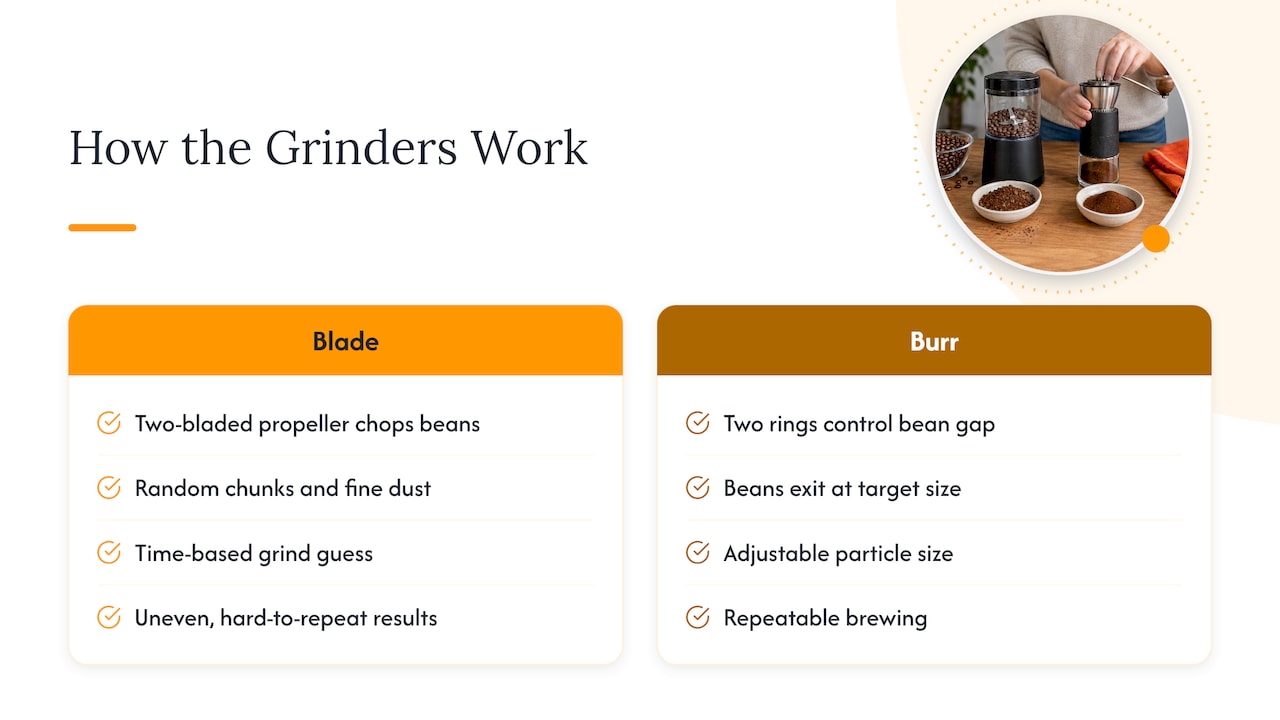
The names describe the mechanism. A blade grinder is a small motor spinning a two-bladed propeller at the bottom of a chamber. You hold a button, the blade whirls, and beans are struck again and again until you let go. A burr grinder feeds beans between two serrated rings or discs, called burrs, one fixed and one rotating. Beans can only leave once they are small enough to pass through the gap.
According to Mahlkönig USA’s grinder guide, burr grinders use two burrs, either conical or flat, set closer together or farther apart to control particle size and make extraction reproducible. The same guide describes blade grinders as chopping beans randomly into coarse chunks, fine dust and everything in between, which makes balanced flavor and repeatable brewing harder.
That difference in mechanism is the whole story. A burr grinder lets you choose a size and get roughly that size again tomorrow. A blade grinder gives you a time-based guess. Hold it for ten seconds and you get one result, hold it for fifteen and you get another, and nothing guarantees either result is even.
What grind consistency does to your coffee
Water pulls flavor out of coffee in a rough order: acids and brightness first, sweetness in the middle, bitterness last. Small particles give up their flavor quickly and can over-extract into bitterness. Large particles give up flavor slowly and can under-extract into sourness. When a grinder produces both at once, the cup carries both faults.
Mahlkönig USA makes the same point: uneven grounds extract at different speeds and can lead to sour or bitter cups. Breville’s US blog adds that burr grinders crush beans at their natural breaking point rather than cutting them, and says a blade can close up the bean’s cellular structure and make it less soluble.
There is a practical side effect too. Fine dust from a blade grinder clogs paper filters and slows the water in a pour-over, while the boulders in the same batch let water rush through. You end up changing several variables at once, and you cannot tell which one caused the flat or harsh cup.
Why blade grinders cannot be dialed in
A burr grinder gives you a setting. If your drip coffee tastes thin, you go one step finer and try again. A blade grinder gives you only a duration, and the particle size depends on how many beans happen to be near the blade at that moment. Beans at the top of the chamber may not be touched for several seconds.
KitchenAid’s guide to coffee grinder types suggests that blade users pause between pulses and shake the grinder, because beans can sit above the blade. That improves distribution, but it does not turn a blade grinder into a burr grinder. It is a way to get a little more from an inexpensive tool.
Burr vs blade at a glance
| Factor | Blade grinder | Burr grinder |
|---|---|---|
| How it grinds | Chops with a spinning blade | Crushes between two burrs |
| Particle consistency | Wide mix of dust and chunks | Narrower, more uniform range |
| Size control | Time held down, by feel | Adjustable setting, repeatable |
| Suits espresso | No | Yes, with a fine-adjusting model |
| Heat and noise | Fast and loud, with friction near the blade | Varies with motor speed and burr design |
| Upfront cost | Lowest | Higher |
| Footprint | Small | Usually larger |
| Best for | Casual drinkers on a tight budget | Anyone brewing pour-over, drip, espresso or wanting repeatable results |
I have left exact prices out of this table on purpose. Prices change often, so check the retailer listing before you buy.
Conical vs flat burrs: the two kinds of burr grinder
Once you decide on burrs, you choose between two shapes. Conical burrs are a cone-shaped center burr turning inside a ring. Flat burrs are two parallel rings facing each other.
Perfect Daily Grind summarizes the usual trade-off this way: flat burrs are generally more consistent and more expensive, while conical burrs are usually quieter, cooler and cheaper but less consistent. The article also stresses that individual model design still matters, so treat these as tendencies, not rules.
The cup differs a little as well. Mahlkönig USA notes that conical burr sets can produce a slightly more varied particle distribution with more fines than flat burrs, which can add body and sweetness. Flat burrs are prized for a very even grind and a cleaner, brighter profile with more clarity.
What that means for a buyer:
- Conical: a sensible first burr grinder. It is quieter, tends to cost less, and gives fuller-bodied coffee. If you drink milk drinks or a French press, the extra body is often welcome.
- Flat: worth the money if you drink light roasts black and chase clarity, or if you are building an espresso setup.
For a concrete conical example, see my OXO Brew Conical Burr review, written around specs and owner feedback. For a grinder with a wide range of settings, there is also my Breville Smart Grinder Pro review. I have read the owner complaints on the Capresso side as well, which I cover in my Capresso Infinity Plus review.
The other types you will see: manual and electric
Beyond blade and burr, grinders also split by how they are powered. KitchenAid’s guide lists manual, electric, burr, conical-burr, flat-burr and blade grinders as the main home types. Manual grinders use a hand crank. Electric grinders work at the touch of a button.
These categories overlap. A hand grinder is almost always a burr grinder, and an electric one can be either type. If you want to weigh effort against convenience, my guide to manual vs electric grinders goes through it, and my page on coffee grinder types lays out the full family tree.
Matching the grinder to how you brew
Grind size is the lever that changes extraction, so the right grinder is the one that can hit your method’s size reliably. Peet’s grind guide recommends:
- Medium-coarse for a four-minute French press.
- Medium for drip coffee.
- Medium-coarse to medium-fine for pour-over, generally brewed in three to four minutes.
- Fine for espresso.
- Extra-coarse for cold brew, steeped for 12 hours.
KitchenAid’s guide also puts pour-over at semi-coarse and espresso at almost powder-fine, and says burr grinders offer settings broad enough to go from coarse to very fine. For a deeper explanation of how to adjust size by method, this guide to matching grind size to brew method is worth a read.
In practice, this sorts into three groups:
- French press and cold brew: forgiving of coarse, uneven particles, though blade dust still turns the bottom of the cup muddy and silty. A blade grinder is at its most tolerable here.
- Drip and pour-over: consistency matters, because a paper filter and a timed pour punish fines and boulders alike. A burr grinder is the clear pick.
- Espresso: a pressurized, 25 to 30 second extraction leaves no room for uneven particles, and the grind must be fine enough that small setting changes matter. Blade grinders cannot do this job. If espresso is your goal, start with my best espresso grinder for home use guide.
Heat, noise, speed and static
These are the practical annoyances that spec sheets bury. KitchenAid says higher-speed grinders can create more noise and heat, while lower-speed grinders generally make less static and heat, and that excessive heat can make coffee bitter. Faster is not automatically better. A grinder that finishes in five seconds but warms the grounds and sprays static is trading one problem for another.
Blade grinders are fast and loud, and their grounds can cling to the plastic chamber. Burr grinders vary widely: some small motors are quiet, some are not. Static in particular is a common owner complaint on both types in dry winter kitchens, and I cover why it happens and what helps in my coffee grinder static guide.
When comparing models, I look at five things in this order:
- Adjustment range and steps. Do the settings reach the finest size your method needs?
- Motor speed and noise. Owner reviews usually describe this more honestly than the product page.
- Burr material and size. Larger burrs usually mean faster grinding at lower speeds.
- Static and mess. Look for repeated owner comments, not one-off ones.
- Retention. Covered next.
Burr grinder retention: what it is and why it matters
Retention is the ground coffee left inside the grinder after you finish a dose. It matters for two reasons: stale grounds from yesterday can mix into today’s cup, and the weight that comes out can differ from the weight of beans you put in.
Clive Coffee defines retention as particles remaining in the burr chamber, chute or screen after grinding, and in its own measurements found under 1 g on the small-burr Baratza Sette 270, 1.3 g on the Eureka Mignon Specialita, and typically 2 to 6.5 g on grinders with burrs of 60 mm or larger. Clive also says retained grounds lose freshness, and that changing the grind setting may not immediately change your dose because particles from the previous setting can linger.
Papel Espresso’s guide to retention separates mechanical retention, where grounds get trapped in crevices, from static retention, where grounds cling because of electricity. For reduction, it lists a short grind path, single dosing, bellows and purging.
For home use, here is how I would think about it:
- Under about 2 g is rarely a worry for drip or French press. One or two grams in a 20 g dose is small, and a coarse brew hides it.
- It matters most for espresso, where doses are small and precise.
- Purge before the first dose. A few beans run through and discarded clear most of what was left behind, which Clive recommends before the first shot of the day.
- Buy beans you will finish quickly. Retained grounds are only as fresh as what you put in, so freshly roasted whole beans bought in small quantities keep the leftovers from tasting stale.
Blade grinders have retention too, mostly as dust stuck to the lid and walls, but it is rarely discussed because nobody dials in a blade grinder to the gram.
When a blade grinder is the right call
I will not tell you a blade grinder is useless, because it is not. Breville says a blade grinder can be a suitable entry point for people starting their coffee journey or those who do not want to make a significant investment, because it is affordable, convenient and needs little maintenance. As tastes and skills develop, it says, a burr grinder’s consistency, control, durability and flavor extraction may be preferable.
A blade grinder fits you if:
- You brew with a French press or a cold-brew jar and strain well.
- You grind small amounts now and then, and you are mostly moving from pre-ground coffee to whole beans.
- You want a stopgap while you save for a burr model.
A burr grinder fits you if:
- You brew pour-over, drip, moka or espresso.
- You change beans often and need to adjust grind size to compensate.
- You have been disappointed by sour-and-bitter cups from a blade grinder.
The jump from pre-ground to fresh-ground coffee delivers a real improvement on its own. The jump from blade to burr is the second step, and the one that gives you control.
Perspective
The usual problem with a blade grinder is not that it breaks. It is that the cup stays inconsistent and the cause is hard to see. Mahlkönig USA puts it plainly: a blade chops beans at random into coarse chunks, fine dust and everything in between. The cause is the mechanism, not the brewer’s technique.
That is why I put the burr grinder first on almost every shortlist. A repeatable setting turns coffee from a lottery into something you can adjust. I would still rather show you the honest trade-offs: conical burrs for value and body, flat burrs for clarity, and the static and retention complaints owners report on specific models.
I do not test products and I do not claim to. My job is to put specifications, published guidance and owner complaints side by side so you can pick the grinder that fits your brewing method and budget, without marketing spin.
Where to go next
If you are ready to compare specific models side by side, with specs and owner-reported complaints, start with my coffee equipment reviews and guides. I explain how I assess products on the how I review kitchen equipment page, and the site is supported by affiliate links, which I describe in the affiliate disclosure.

The Kitchenware Compare homepage collects my latest grinder, espresso and cookware comparisons in one place, so you can move from deciding on a type to choosing a model.
FAQ
Is a burr grinder really better than a blade grinder?
For most brewing methods, yes. A burr grinder produces more uniform particles and lets you repeat a setting, which leads to more even extraction. A blade grinder remains a reasonable low-cost choice for a French press or for someone just starting with whole beans.
Is a burr grinder the same as a conical burr grinder?
No. Conical is one of two burr shapes, the other being flat. Both are burr grinders. Perfect Daily Grind notes that conical burrs are usually quieter and cheaper, while flat burrs are generally more consistent and more expensive.
Which grind is best for a drip coffee maker?
Peet’s recommends a medium grind for drip coffee. A burr grinder can hold that setting from one morning to the next, while a blade grinder leaves you guessing how long to hold the button.
Does grinder retention matter for home use?
It matters most for espresso, where doses are small. Clive Coffee measured under 1 g to 1.3 g on small low-retention grinders and typically 2 to 6.5 g on grinders with 60 mm or larger burrs. For drip or French press the effect is usually minor, and purging a few beans before your first dose helps.
Sources
- Burr vs Blade Grinders: A Comprehensive Guide, Mahlkönig USA
- Burr grinder vs. blade grinder, Breville US
- 8 types of coffee grinders, KitchenAid
- Conical vs flat burr coffee grinders, Perfect Daily Grind
- Coffee Grinds, Peet’s
- Grind Retention, Clive Coffee
- Espresso Grinder Retention, Papel Espresso
Recommended
- Manual vs Electric Grinder: Which Should You Buy?
- Best Espresso Grinder for Home Use (2026)
- OXO Brew Conical Burr Review: The Right First Grinder

I'm Glenn, and I started Kitchenware Compare to cut through conflicting product reviews and help readers pick kitchen gear with confidence. I don't own or test the products I write about — these guides are built from verified-purchase reviews, manufacturer specifications, and independent testing where it exists, with the reasoning shown, not just a rating.
Leave a Reply