This guide has no affiliate links, but some pages it links to do. If you buy through those, I may earn a commission at no extra cost to you.
Espresso needs a fine, even grind: finer than the grind for drip or pour-over, but not a powder. The National Coffee Association’s reference table lists espresso as fine, like table salt, and tells you to start there and adjust. The exact setting on your grinder is something you find yourself, because dial numbers do not carry over from one machine to the next. I do not test or own any of the gear mentioned below. This guide draws on published specifications, manufacturer guidance, peer-reviewed research and owner reports, and each claim is credited to its source.
TL;DR
- Start fine, like table salt. Espresso is a fine grind, but a true powder tends to choke the flow.
- Keep your dose and recipe fixed. Change only the grind, in small steps, and judge the result by shot time and taste.
- Several sources give a shot window of roughly 20 to 30 seconds. Baratza’s recipe is 18 g in, 36 g out, in 25 to 32 seconds.
- Grinder numbers are not universal. Treat any setting from a chart or a forum as a rough starting point, not a target.
- Grind evenness matters as much as grind size. Fines change flow and extraction in measurable ways.
How fine should espresso be?
The short answer is the finest range of any brew method, short of the powder used for Turkish coffee. Three descriptions from different sources point at the same texture:
- The National Coffee Association compares it to table salt.
- Breville says a fine grind makes the best espresso and describes fine grinds as having the texture of flour or powdered sugar, with coarse grinds looking like sea salt and medium grinds like beach sand.
- Sweet Maria’s offers a pinch test: the grounds should clump in the center of the pinch, but not too much.
These comparisons overlap but are not identical. Table salt, flour and powdered sugar are different textures. That is useful information in itself: the target is a band, not a single point, and your espresso machine, basket and beans decide where inside that band you land.
A practical way to read them together: begin at the table-salt end the NCA describes, where the grounds feel gritty but clump a little in the center of a pinch. Sweet Maria’s says grounds that compress into a dense pancake when pinched are too fine and will clog the portafilter, while grounds that do not clump at all are too coarse. Grounds that feel like beach sand, Breville’s description of a medium grind, are in filter territory.
A grind size chart, and how to use it
Charts usually run from extra coarse (cold brew, French press) through medium (drip) down to extra fine (Turkish). Espresso sits near the fine end, between the filter range and the Turkish range. Some sources put numbers on it: a roaster’s editorial team puts espresso at roughly 200 to 400 microns. Treat that as a ballpark, since a grinder produces a spread of particle sizes, not one size.
Here is a simple reference built from the sources above and standard brew practice:
| Brew method | Texture comparison | Relative to espresso |
|---|---|---|
| Turkish coffee | Powder | Finer |
| Espresso | Table salt to flour-like | Reference |
| Moka pot | Finer than drip, coarser than espresso | Slightly coarser |
| Drip / pour-over | Sand | Much coarser |
| French press | Coarse sea salt | Far coarser |
If you are choosing between a moka pot and a machine, my comparison of moka pot vs espresso covers pressure, strength, cost and upkeep, and my moka pot grind size guide covers the stovetop setting.
A chart tells you the neighborhood. It cannot tell you the number on your dial. Which brings up the most common mistake.
Why the same setting means different things on different grinders
If a forum post says “setting 12 on my grinder,” that number is close to meaningless on yours. There are a few reasons, each backed by published explanations:
- Burr alignment and wear. Barista Hustle explains that grind distributions differ between equipment, even between supposedly identical grinders at the same setting, because of factors like burr alignment or wear.
- Different scales. Baratza’s own guide shows how much dials vary by model: for the Encore ESP the espresso range is 1 to 20, while the Encore ESP Pro uses a 0 to 40 range, with 40 at the coarse end.
- Stepped versus stepless adjustment. Sweet Maria’s recommends a grinder with stepless adjustment for making slight changes to the degree of grind, since espresso is sensitive to small differences.
- Beans and age. The same source notes the grind may need adjusting between coffees and as beans age.
So a grind size chart or someone else’s setting is a first guess. Your own dial-in is the real answer. If you are still deciding on a grinder, my best espresso grinder guide compares models on adjustment range and step size, which matter more for espresso than for any other method. For one popular mid-priced option, I have a Breville Smart Grinder Pro review built from specifications and owner feedback.
What grind size does to flow, time and taste
Water takes the path of least resistance through the coffee puck. Finer grounds pack tighter and slow the water. Coarser grounds let it rush through.
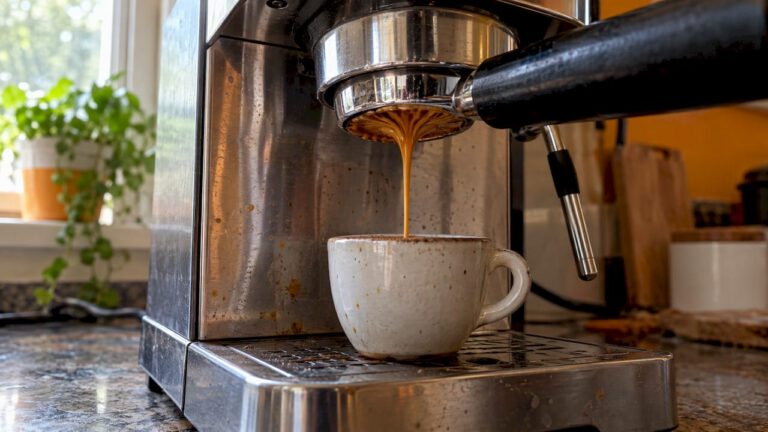
Perfect Daily Grind puts the effect simply: if espresso brews too fast, grind finer, and if it takes too long, grind coarser. It adds that too coarse risks a watery, sour, under-extracted cup, while too fine risks over-extraction and channeling. Channeling is when water cuts a fast lane through the puck and ignores the rest of it.
Breville frames the same idea as extraction: under-extracted coffee tends to taste weak, sour or acidic, while over-extracted coffee tends to taste harsh and overpowering, with a slower flow.
Why even grinds matter, not only fine ones
Grind size is an average. The spread around it matters too. A peer-reviewed study in Switzerland on the role of fines in espresso extraction reports that, for a given median grind size, adding fines (particles under 100 micrometers) lowers the permeability of the coffee bed, reduces flow rates and lengthens extraction time. It also reports that aroma compounds increase with extraction yield.
What that means in practice: two grinders set to the same average size can behave differently if one makes more fines. It is one reason I put grinder quality ahead of machine features when I compare coffee equipment. Burr grinders with a tighter particle spread give you a more predictable puck. For the burr-versus-blade and manual-versus-electric question, see my manual vs electric grinder comparison.
How to find your starting grind setting
This is a repeatable process. Write down every change so you can retrace your steps.
- Fix your dose. Use your basket’s recommended dose. Baratza’s recipe uses 18 g of coffee for 36 g of liquid, in 25 to 32 seconds. Smaller baskets may take less and larger ones more, so follow the basket’s own guidance.
- Start coarser than you expect. Baratza’s advice for the Encore ESP is to stay in the espresso range and start at the coarse end, then move finer until you find the sweet spot. For the ESP Pro it suggests starting at 40 and adjusting finer until shot time matches your target.
- Weigh in and out. A small scale removes guesswork. Measure the coffee going in and the liquid coming out.
- Time the shot. Start the timer when the pump starts. Several sources use roughly 20 to 30 seconds as a reference. The National Coffee Association gives 20 to 30 seconds of contact time, and KitchenAid’s support page gives the same 20 to 30 second window for its machines. Baratza’s recipe window is slightly longer.
- Change one thing. Baratza advises keeping the dose consistent, adjusting in small increments and re-testing. Its ESP Pro guidance is to move five or more settings finer if the shot reaches target volume within a few seconds, and otherwise a couple of settings at a time.
- Taste each result. Time is a proxy. Taste tells you whether the shot is actually good.
A common home-barista tip from a guide on adjusting dose and grind by taste is to set the grinder by pinching the grounds until they feel very fine, a little coarser than powder, then adjust from there. That is an owner-community method rather than a lab standard, so treat it only as a first step.
Reading the result: finer or coarser?
The logic is the same across sources I checked. A fast, thin, sour shot points to a grind that is too coarse, so go finer. A slow, harsh, bitter shot points to a grind that is too fine, so go coarser. Baratza says the same in its dialing guide: finer for a sour, quick shot and coarser for a bitter, slow one. If a shot still runs fast, slow, sour or bitter after a grind change, my espresso shot troubleshooting guide goes through each symptom.
To help you decide, here is how the signals line up:
| What you see | What you taste | Likely adjustment |
|---|---|---|
| Flow is fast, under about 20 seconds | Sour, thin, watery | Grind finer |
| Flow is in the 20 to 30 second window | Balanced, sweet | Leave it, adjust yield only |
| Flow is slow, well past 30 seconds | Bitter, harsh, dry | Grind coarser |
KitchenAid’s support page also notes that when a shot runs long, a coarser grind and lighter tamp pressure are the two levers. So tamping is part of the picture, alongside grind.
One piece of advice from an espresso-focused blog, Online Coffee Guide, is worth adopting: for most home dial-ins, keep the dose fixed, use grind to bring flow into a useful range, and use yield to refine flavor, rather than changing all three at once. That blog is one person’s view, but it matches the one-variable rule every major source repeats.
If your shots taste flat even after you land in the right time window, the beans may be the issue. Fresh roasted beans make dialing in much easier, and freshly roasted espresso beans roasted specifically for espresso, crema and milk drinks give you a more stable base to adjust from.
Why there is no single right number
Sweet Maria’s makes the point that espresso requires balancing several factors, among them grind, tamp, coffee and pressure, and that it is less about one right setting and more about making everything work together. Perfect Daily Grind agrees that there is no one-size-fits-all solution. Each method needs its own grind size.
Three practical consequences follow:
- Re-dial with each new bag. Different roasts, origins and ages of beans can all shift the best setting.
- Expect drift. Sweet Maria’s notes that freshness and roast degree change how water moves through the puck, so the grind may need adjusting as a bag of beans ages.
- Keep notes. A line per bag with dose, setting, time and a taste word saves you from starting over every time.
A tidy workspace helps the routine too. A well-planned coffee station setup keeps the grinder, scale and timer within arm’s reach, which makes a repeatable process easier to stick with.
Perspective
A common trap for first-time buyers is chasing a number: someone else’s setting, a chart’s micron range, a pre-set from a video. The published guidance says the opposite. The number is local to your grinder, and Barista Hustle notes that small differences in burr alignment or wear mean even two grinders of the same model at the same setting grind differently.
That changes how I recommend equipment. I look first at how much adjustment range a grinder gives you in the espresso zone, how small each step is, and what owners say about consistency after a few months. Those details decide how fast you can dial in and whether your settings stay put.
I do not claim to have used any of this equipment myself. My comparisons rest on specifications, pricing, manufacturer guidance and the real complaints and praise from owners, and I say so wherever it applies. If you want the full method, it is on my how I review kitchen equipment page.
Find the right grinder for your setup
Grind size only works if the grinder can hold a fine, consistent setting. If you are shopping, my side-by-side coverage of grinders, machines and other coffee gear lays out specifications and owner-reported strengths and complaints in one place.

Start with the coffee equipment reviews and guides, or browse the Kitchenware Compare home page for the latest comparisons. If you are timing a purchase, when to buy air fryers, cookware and espresso machines covers the seasons when prices tend to drop.
FAQ
What is the best grind size for espresso?
A fine grind, roughly like table salt per the National Coffee Association, then adjusted to your machine and beans. Use shot time and taste to move finer or coarser in small steps.
How long should an espresso shot take?
Sources commonly cite about 20 to 30 seconds. Perfect Daily Grind gives that window for a single shot, and Baratza’s 18 g in, 36 g out recipe lists 25 to 32 seconds. Use the range as a guide, then let taste decide.
Can I use pre-ground coffee for espresso?
Only if it was ground for espresso, and even then you cannot adjust it. The point of dialing in is changing the grind in small steps, and that needs a grinder with fine adjustment. Sweet Maria’s recommends stepless adjustment for slight changes.
Why did my grinder setting stop working?
Beans age, roasts differ and burrs wear. The setting that worked last month may need a small nudge finer or coarser now. Barista Hustle notes that alignment and other factors affect whether a recipe behaves the same way.
Sources
- Espresso – NCA – About Coffee
- How to find the best grind size for espresso – Breville
- Espresso: The Grind – Sweet Maria’s Coffee Library
- How to Grind Coffee Beans for Espresso – CoffeeRoast Co.
- Æ 1.04 Measuring Grinds – Barista Hustle
- Dialing in Espresso – Baratza
- Grinding for espresso at home – Perfect Daily Grind
- The role of fines in espresso extraction dynamics
- Why does espresso come out too quickly? – KitchenAid
- Espresso 101: How to Adjust Dose and Grind Setting by Taste – Home-Barista
- Espresso Dial-In Guide – Online Coffee Guide
Recommended
- Best Espresso Grinders for Home Use: 7 Picks
- Coffee Grinder Types: Blade, Burr, Manual and Electric
- Manual vs Electric Grinder: Which Should You Buy?
- How to Clean a Coffee Grinder: What Makers Say

I'm Glenn, and I started Kitchenware Compare to cut through conflicting product reviews and help readers pick kitchen gear with confidence. I don't own or test the products I write about — these guides are built from verified-purchase reviews, manufacturer specifications, and independent testing where it exists, with the reasoning shown, not just a rating.
Leave a Reply