This post contains affiliate links. If you buy through my links, I may earn a commission at no extra cost to you. Read the full disclosure.
A pellet tube is a ten-dollar fix for a specific problem, and buying one to get “more smoke” in general is how food ends up tasting bitter. The A-MAZE-N AMNTS12 is the one to buy, at $13.49, because it comes from the company that invented the format and its own instructions tell you what the thing is actually for.
The quick answer
Buy a 12-inch tube with a flat side — oval or hexagonal, so it does not roll off the grate. The A-MAZE-N at $13.49 or the LIZZQ at $13.93 both qualify and there is very little between them. Use it instead of a loaded chip tray, not as well as one. If you need to cover a full overnight cook, the Kaduf maze tray is the only format here that will.
What a smoke tube actually fixes
It is worth being precise about the problem, because it decides whether you need one at all.
An electric smoker holds its temperature by switching the element on and off. On most cabinets the chip tray sits on or beside that element, so the chips only smoulder while the element is drawing power. Once the box reaches 225°F the element spends most of each cycle off, and the smoke arrives in bursts with long gaps between them. That is normal behaviour rather than a fault, and it is set out in full in the guide to an electric smoker not producing smoke.
A tube sidesteps that entirely. It is a perforated metal tube filled with pellets, lit at one end, smouldering on its own. Nothing about it is connected to the thermostat, so it keeps producing smoke whether the element is running or not.
That is the whole mechanism, and it explains who should buy one: anyone whose smoke output tracks the element cycle rather than the cook. It also explains who should not. If the cabinet is not reaching temperature at all, or the chip tray is packed solid, or the vent is shut, a tube is treating a symptom.
The part the category does not tell you
Every guide to these things sells more smoke as an unqualified good. It is not.
Weber’s own smoking guidance is to start with a small amount of wood and add more only if you want a stronger flavour, because too much wood smoke over long periods can make food taste bitter. A tube runs continuously for hours by design. Add one to a chip tray that is already working and you have roughly doubled the smoke on a twelve-hour cook.
So the rule is substitution rather than addition. Run the tube or the chip tray. On a long cook, many people light the tube for the first few hours only and leave it out after that, which is closer to how the smoke would behave on a fire anyway.
How to choose one
Shape, for an unglamorous reason
Round tubes roll. A cylinder on a grate of parallel bars will find a gap, tip, and empty burning pellets into the bottom of the cooker. Hexagonal and oval sections sit still, which is why every serious version of this product has flat sides. It is the single most practical difference between two tubes that otherwise look identical.
Burn time, and how much to trust it
Claimed burn times run from about three hours to twelve, and none of them has been independently verified. Worth noticing: the most established brand claims the least. A-MAZE-N, which built this category, says up to four hours; the marketplace brands mostly say five for the same twelve-inch tube.
Treat the numbers as an ordering rather than a promise, and read them as a maximum in still air with dry pellets. Wind, damp pellets and a packed tube all shorten it.
Length and format
Twelve inches is the default and is right for most cooks. Six-inch tubes exist for small kettles and short sessions. An expandable tube covers both, which is genuinely useful if your cooks vary, since lighting five hours of pellets for a two-hour cook simply wastes them.
Above that sits the maze tray, a flat 5″ × 8″ grid rather than a tube, which trades footprint for burn time and is the only format that covers an overnight cook without a refill.
Pellets or dust
Tubes take standard barbecue pellets, which is what makes them convenient. Maze trays take pellets too, and some also take the finer sawdust used for cold smoking, which burns slower and cooler. If cold-smoking cheese is the goal rather than adding smoke to a hot cook, that distinction matters more than any other on this page.
My picks at a glance
| Product | Best For | Price | Rating | Buy |
|---|---|---|---|---|
| A-MAZE-N AMNTS12 12″ oval | Most people | $13.49 | 4.6★ (1,570) | Check Price |
| LIZZQ Premium 12″ | The safest default | $13.93 | 4.7★ (14,948) | Check Price |
| LOVEERCT 12″ hexagon | Spending as little as sensible | $9.99 | 4.7★ (1,378) | Check Price |
| Kaduf 5″×8″ maze tray | Long cooks and cold smoking | $29.99 | 4.5★ (744) | Check Price |
| Pit Boss Expandable 7–12″ | Matching burn time to the cook | $14.99 | No ratings yet | Check Price |
Prices and ratings were checked on 2 September 2026 and will move.
A-MAZE-N AMNTS12 — the one most people should buy
A-MAZE-N made this product category exist, and the reason to start here is not nostalgia. Its listing is the only one of the five that says what a tube is for rather than what it can do: designed to supplement smoke in an electric smoker. That is the actual use case, stated by the maker, and it is the sentence the rest of the category leaves out.
The oval section is the practical advantage. It cannot roll, which matters more than it sounds like it should when the alternative is burning pellets in the bottom of a cabinet.
It also claims less than its rivals — four hours against their five, for the same twelve inches. Read that as the difference between a figure someone has to stand behind and a figure written for a listing.
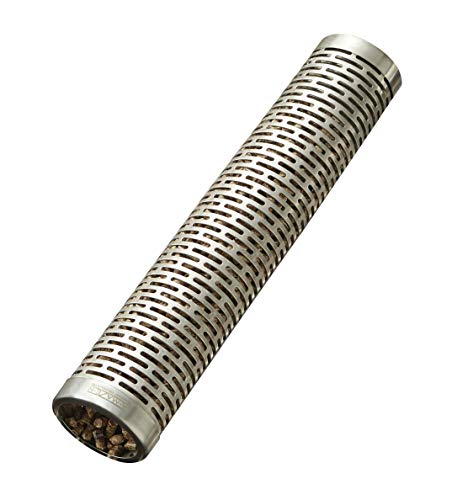
A-MAZE-N AMNTS12 12″ oval
- 12 inches, stainless steel, oval section
- Up to 4 hours of smoke, the maker’s own figure
- Designed to supplement smoke in an electric smoker
- Hot and cold smoking
Pros: The brand that established this category, and the only one whose own listing states what a tube is actually for — supplementing an electric smoker. The oval section will not roll off a grate. Cheapest of the five.
Cons: Claims four hours where the marketplace brands claim five, which reads as conservative rather than worse but does mean less unattended time. Ships in one to two days rather than from stock. No lid, so pellets can spill if it is knocked while loaded.
LIZZQ Premium 12″ — the safest default
If the A-MAZE-N is out of stock, this is the one to buy, and on the numbers alone it has a fair claim to being first.
Nearly fifteen thousand ratings at 4.7 stars is an evidence base nothing else in the category comes close to, and hexagonal sides solve the rolling problem the same way the oval does. It costs forty-four cents more than the A-MAZE-N.
What it does not have is a manufacturer with a history behind it. That is worth something on a piece of stainless steel that lives in a fire, and it is the only reason it is second here rather than first.
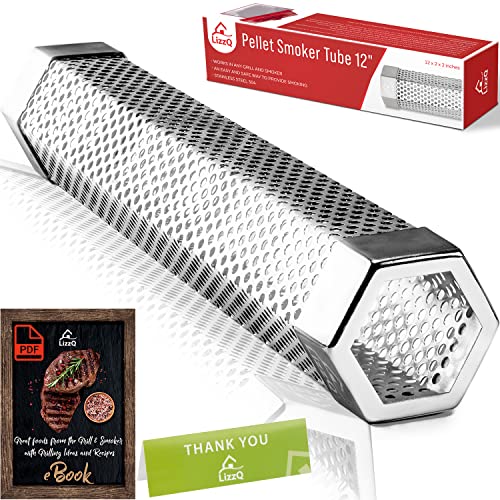
LIZZQ Premium 12″
- 12 inches, stainless steel, hexagonal
- Up to 5 hours claimed
- Works in any grill or smoker
- Nearly 15,000 ratings
Pros: By far the largest review base in the category, at 4.7 stars. Hexagonal, so it stays where you put it. Same money as the A-MAZE-N.
Cons: The five-hour figure is the maker’s and nobody independent has published a burn test. A house brand rather than a manufacturer with a history, so there is less to fall back on if it warps.
LOVEERCT 12″ hexagon — the cheapest one worth buying
Ten dollars buys the same format in 304 stainless, with over a thousand ratings behind it and a cleaning brush in the box.
This is also where the category floor sits. Below this price there are dozens of near-identical tubes with no reviews at all, often from sellers who will not exist next season. The difference between a $7 tube and a $10 tube is not the steel; it is whether anyone has used it.

LOVEERCT 12″ hexagon
- 12 inches, 304 stainless steel, hexagonal
- Up to 5 hours claimed
- Cleaning brush included
- Hot and cold smoking
Pros: Ten dollars for the same format as the picks above, in 304 stainless rather than unspecified steel, with over a thousand ratings at 4.7. The brush is a genuine convenience.
Cons: A marketplace brand with no track record beyond this listing, so long-term durability is unknown. Below this price the category is full of near-identical tubes with no reviews at all, and that is where the risk starts.
Kaduf 5″ × 8″ maze tray — for overnight cooks and cold smoking
This is the only pick that is not a tube, and the only one that will run a brisket through the night without a refill.
A maze tray is a flat grid: the pellets burn along a folded path rather than down a cylinder, which is what buys the longer time. It sits flat, so nothing rolls, and the low profile makes it the easier choice for cold smoking, where the point is smoke without heat.
The trade is footprint and price. It needs a clear patch of grate that a twelve-inch tube does not, and it costs three times as much. On a small kettle it is the wrong shape.
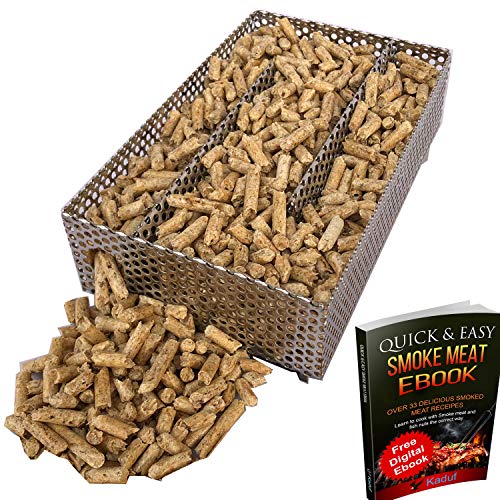
Kaduf 5″×8″ maze tray
- 5″ × 8″ maze tray rather than a tube
- Up to 12 hours claimed — the longest here
- Sits flat; no rolling to worry about
- Hot and cold smoking
Pros: The only format here that covers a full overnight cook without a refill, which is the whole point on a brisket. Flat, so placement is easy. Genuinely different from the four tubes rather than another version of them.
Cons: Three times the price of the tubes. The footprint is large for a small kettle or a crowded cabinet, and it needs a clear patch of grate. Fewer ratings than the leading tubes.
Pit Boss Expandable 7–12″ — when the cook is short
Every other tube here commits you to its full length. Light a twelve-inch tube for a two-hour cook and three hours of pellets burn away after the food comes off.
This one collapses to seven inches, so the burn matches the session. It also comes from a company that makes the cookers rather than only the accessory, which is worth something on fit and finish.
The caveat is unusual enough to state plainly: it has no customer ratings at all. That is a genuine unknown rather than a bad sign, but on a fifteen-dollar accessory with four proven alternatives on this page, it is a reason to buy it for the adjustability rather than by default.
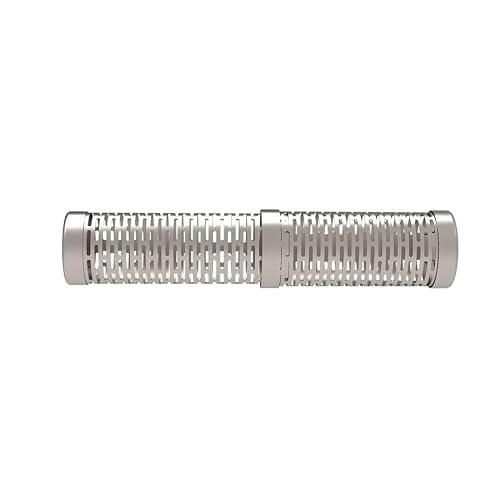
Pit Boss Expandable 7–12″
- Expands from 7 to 12 inches
- Approximately 3 hours of smoke
- Stainless steel; Pit Boss part 41075
- Hot and cold smoking
Pros: The only pick that lets you shorten the burn to match a two-hour cook rather than lighting five hours of pellets and wasting three. From a manufacturer that makes the grills rather than only the accessory.
Cons: No customer ratings at all yet, which is a real gap on a product this cheap to get wrong. Stock has been thin. Three hours at full extension is the shortest burn here, so it is the wrong choice for an overnight cook.
Which pellets to put in it
The tube is the cheap part of this decision. What goes in it matters more, and there is one distinction that is worth getting right before any question of flavour.
Barbecue pellets and heating pellets are not the same product. Pellets sold for pellet stoves are made to burn in an appliance, not to season food, and they can contain binders and material you would not choose to put smoke from into your dinner. Traeger describes its own barbecue pellets as free from additives and binders, which is the standard to buy to. Cooking pellets cost a little more per bag and the bag says what they are for.
Beyond that, wood choice is preference rather than rule. The conventional groupings are useful as a starting point: fruit woods such as apple and cherry are mild and suit poultry and pork; hickory and mesquite are assertive and suit beef; oak sits between them and is hard to get wrong. Weber publishes a chart pairing woods with foods, and it is worth a look before buying a large bag of anything.
Two practical points. Buy small bags until you know what you like, because a tube uses very little and a large bag will outlast your patience with the flavour. And blends are not a compromise so much as a hedge, which is why they are the safest first purchase.
Looking after it
The one thing owners get wrong is pellet storage rather than tube maintenance, and it is the cause of most tubes that will not stay lit.
Pellets are compressed sawdust and they absorb moisture from the air, after which they swell, crumble and refuse to hold an ember. A bag folded over in a damp shed is enough to ruin them over a winter. Keep them in a sealed container indoors, and check before lighting: good pellets have a sheen and snap cleanly, while damp ones look dull and crumble.
The tube itself needs very little. Tip the ash out while it is cool, and run a brush through it if one came in the box. Stainless steel discolours to a permanent brown and that is cosmetic rather than a fault. What does matter is storing it dry and empty — pellets left in a tube between cooks are the ones that will not light next time.
What was left out, and why
Round tubes. Plenty are sold and some are cheap, but a cylinder rolls on a grate and can tip burning pellets into the bottom of the cooker. Every pick here has flat sides for that reason.
Sub-$8 no-name tubes. The category has a long tail of identical-looking tubes with no reviews and sellers with no history. The saving is two or three dollars on a product that sits inside a fire, which is the wrong place to economise.
Dedicated cold smoke generators. Devices that pump smoke into a chamber with a small pump, at forty dollars and up, are a different product for a different job. If cold-smoking cheese and fish is the main use rather than an occasional one, look at those rather than at a tube.
Tubes bundled with pellets. The bundle is usually the same tube plus a small bag at a markup, and it locks you into one wood. Pellets are cheap and better bought separately in the flavour you want.
Getting it lit, which is where people struggle
The commonest complaint about these things is not that they burn out too soon but that they go out.
Fill the tube no more than about three-quarters full, so air can move through the pellets. Stand it upright, light the top end with a blowtorch or a chimney lighter, and keep the flame on it for a good half a minute or more — considerably longer than feels necessary. Let it burn with a live flame for a couple of minutes, then blow it out. What should be left is a glowing ember and a thin stream of smoke.
A tube that keeps dying is usually one of three things: pellets that have taken on moisture, a tube packed too tight for air to pass, or not enough initial flame to establish the ember. Damp pellets are the most common by a distance, and the test is the same one the pellet-grill makers give — good pellets have a sheen and snap cleanly rather than crumbling, which is set out with the sources in pellet grill temperature swings.
Lay it on the grate away from the food and away from direct flame, at the end where air enters if the cooker has an obvious flow. And leave the vent open. Smouldering wood needs air, and a closed vent starves the tube and deposits stale smoke on the food at the same time.
How These Picks Were Chosen
Plainly: this is a research-based guide, not a hands-on test. I do not own a smoker or a pellet tube, none of these has been through my hands, and no burn was timed to produce anything here.
What the selection rests on is what can be established without testing: the physical format and what it implies, the maker’s own stated figures, whether there is a manufacturer behind the product or only a listing, and the size and score of the review base. Flat-sided tubes were preferred over round ones for a mechanical reason rather than a taste one. Products with no review history were included only where they cover a need nothing else on the page does, and said so.
Prices, availability and product images come from the Amazon Product Advertising API, which is the licensed route for images. Star ratings and review counts were read from each product page on 2 September 2026, and every listing was confirmed live the same day.
Also not established: how long any of these actually burns. Every burn-time figure on this page is the manufacturer’s own claim, none of them is independently verified, and they are not measured on a common basis — a “five hour” tube and a “four hour” tube may well behave identically. Nobody publishes comparative burn tests for this category. The figures are quoted as an ordering, not as a specification, and the A-MAZE-N is recommended despite claiming the shortest of the twelve-inch times rather than because of it.
Frequently Asked Questions
Do pellet tube smokers actually work?
Yes, for what they are for. A tube burns independently of the cooker’s thermostat, so it produces smoke steadily while an electric smoker’s chip tray only smoulders when the element is running. It will not fix a cabinet that is not reaching temperature, and it is not a substitute for a working chip tray on a machine that has one.
How long does a 12-inch pellet tube burn?
Makers claim four to five hours, and none of those figures is independently verified. A-MAZE-N says up to four; most marketplace brands say five for the same length. Treat them as an ordering rather than a promise: wind, damp pellets and overfilling all shorten the burn.
Can I use a smoke tube and wood chips at the same time?
Better not to. Weber warns that too much smoke over long periods makes food taste bitter, and a tube plus a full chip tray roughly doubles the smoke on a long cook. Run one or the other. Many people light the tube for the first few hours of a cook and leave it out afterwards.
Why does my smoke tube keep going out?
Usually damp pellets, a tube packed too tightly for air to pass, or not enough flame at the start. Fill to about three-quarters, hold a torch on the lit end for well over thirty seconds, let it flame for a minute or two, then blow it out so an ember is left. Keep the cooker vent open.
What is the difference between a tube and a maze tray?
Burn time and footprint. A maze tray is a flat grid where pellets burn along a folded path, which is what lets it claim up to twelve hours against a tube’s four or five. It needs a clear patch of grate, costs more, and is the easier choice for cold smoking. A tube is smaller, cheaper and enough for most cooks.
Can I use a pellet tube for cold smoking cheese?
Yes, and it is one of the main reasons to own one, since the tube produces smoke without heating the chamber. Put the cheese as far from the tube as the cooker allows, work on a cool day, and expect to experiment. A maze tray is the better tool if cold smoking is the main use rather than an occasional one.
The verdict
The A-MAZE-N AMNTS12 at $13.49 is the one to buy for most people: the format’s originator, an oval section that will not roll, and a maker honest enough to claim four hours where its rivals claim five. If it is out of stock, the LIZZQ Premium is forty-four cents more and has fifteen thousand ratings behind it.
Spend more only for a reason. The Kaduf maze tray is the pick if a cook runs overnight or cold smoking is the point. The Pit Boss expandable earns its place only if your cooks are short and vary in length.
If the smoker is plugged into an extension lead, that is the other cheap thing worth getting right, and the specification is stricter than most people expect — see the best extension cord for an electric smoker.
And whichever you buy, use it instead of a loaded chip tray rather than alongside one. If the underlying problem is that the smoker is not making smoke at all, start with an electric smoker not producing smoke before buying anything. The rest of the outdoor cooking guides are collected on the outdoor cooking hub.

Glenn is the founder of Kitchenware Compare and has spent years researching, testing, and reviewing kitchen appliances, cookware, and gadgets. A lifelong home cook raised in a family that treated every meal as an occasion, Glenn started this site to cut through the noise of conflicting product reviews and give readers honest, practical guidance. When he is not testing the latest air fryer or digging into the specs of a new espresso machine, he can usually be found experimenting with new recipes or hunting for the perfect cast iron skillet at a flea market.
Leave a Reply