This post contains affiliate links. I may earn a commission if you buy through them, at no extra cost to you.
Quick Verdict
- Rating: 8/10 — a genuinely capable 5.5-quart mixer at a real price gap below KitchenAid, with one recurring complaint worth knowing about first
- Best for: bakers who want a heavier-duty motor and bigger bowl than an entry-level mixer, without paying KitchenAid Artisan prices
- Not ideal for: anyone who specifically wants the largest third-party attachment ecosystem — that still belongs to KitchenAid
- Current price: ~$312.43 on Amazon (verified 2026-09-24, Silver Lining finish)
- Bottom line: A 500-watt, die-cast metal mixer with real accessory attachments (pasta, ice cream, meat grinder) sold separately — the mixing-consistency complaints in the review data are worth reading before you buy.
Introduction
The Cuisinart SM-50’s case is straightforward: a 500-watt, die-cast metal stand mixer with a 5.5-quart bowl, 12 speeds, and a real optional-attachment ecosystem (pasta, ice cream, meat grinder), priced well under KitchenAid’s Artisan line. Over 10,000 Amazon ratings average 4.7 stars, with “Amazon’s Choice” attached.
This is a research-based review, built from Cuisinart’s specifications and product photography, Amazon’s compiled customer-review data, and a direct comparison against my stand mixer buying guide’s other ranked picks. What it surfaces that the spec sheet won’t: a specific, recurring mixing-consistency complaint in the review data, and exactly what’s included versus sold separately.
Specifications
| Dimensions | 14.17″D x 7.87″W x 14.13″H |
| Weight | 17 lbs |
| Bowl capacity | 5.5 quarts, polished stainless steel |
| Motor | 500 watts |
| Speeds | 12 |
| Construction | Die-cast metal body |
| Head type | Tilt-back head |
| Attachment hub | 1 power outlet for optional attachments |
| Colors | Silver Lining, Onyx, Periwinkle Blue, Ruby Red, White Linen, Robin’s Egg |
| Warranty | Limited 3-year |
| Amazon ASIN | B01K2FQ4DE |
Who It’s For
- Bakers who’ve outgrown a hand mixer and want a genuinely heavier-duty motor (500W) and bigger bowl (5.5 qt) than most entry-level stand mixers offer
- Anyone who wants real attachment versatility later — pasta extruder, pasta roller and cutters, ice cream maker, meat grinder, and spiralizer are all sold as genuine optional add-ons for this exact mixer
- Buyers who want a metal-body mixer (die-cast construction) rather than a plastic-bodied budget model, without paying KitchenAid Artisan prices
- Anyone who wants a color choice — six finishes are available, not just the one or two most budget mixers offer
- Households doing regular bread dough and batter work, where 12 speeds give finer control than a 6-speed basic mixer

Who Should Look Elsewhere
- Anyone specifically chasing the widest third-party attachment ecosystem — that’s still KitchenAid’s market, covered in my KitchenAid Classic vs Artisan comparison
- Buyers who want maximum mixing consistency confirmed by a large volume of owner reports — “mixing performance” is the one attribute in the review data that splits clearly, covered in Performance below
- Anyone on a tight budget who doesn’t need 500W or a metal body — a cheaper hand mixer or entry-level stand mixer covers occasional light baking for less
- Kitchens with very limited counter or cabinet storage — at 17 lbs and a 14″ footprint, this isn’t a mixer you’ll want to lift in and out of a cabinet daily
- Anyone who owns KitchenAid-specific attachments already and doesn’t want to rebuy a new attachment set — this mixer’s power hub uses Cuisinart’s own attachment line, not KitchenAid’s
Performance
The core spec claim — 500 watts, 12 speeds, die-cast metal construction — is a real step up from typical entry-level stand mixers, which usually run 250-350W in plastic housings. Amazon’s compiled review data backs the power claim specifically: “Power” is a frequently and positively mentioned attribute, with one owner-reported theme being that it’s strong enough for thick dough, a genuine stress test for any home mixer’s motor.
“Ease of use” is the single most-mentioned positive attribute in the review data, alongside consistent praise for quiet operation relative to other mixers in this class — a real point in this mixer’s favor if counter noise matters in an open kitchen.
Where the data is genuinely mixed: “Mixing performance” shows a real split — some owners report it handles bread dough well, others report it doesn’t mix ingredients evenly. This isn’t a universal complaint, but it’s specific and recurring enough to flag rather than smooth over. The most likely explanation, consistent with how planetary-action mixers behave generally, is scraping the bowl sides partway through a mix for anything thick or sticky — but that’s a reasonable inference from the pattern, not something the review data itself confirms.
The tilt-back head design (rather than a bowl-lift mechanism) is standard for mixers in this price tier — easier to use one-handed while adding ingredients, though it has less mechanical leverage than a bowl-lift design for very heavy, dense doughs. A planetary mixer like this one moves the beater around the bowl in a circular path while it also spins on its own axis, which is what lets a single attachment reach the whole bowl rather than just the center — the same basic mechanism every stand mixer in this price range uses, including the KitchenAid models it’s most often compared against. The 12-speed range matters here specifically because a mix that starts on a low speed (folding in flour without a cloud of dust) and finishes on a high one (whipping egg whites to stiff peaks) needs genuine range at both ends, not just a higher top speed number.

Design and Build Quality
The die-cast metal body is a genuine build-quality signal — plastic-bodied mixers at lower price points tend to flex and vibrate more under load, especially with stiff dough. At 17 lbs, it has real heft, which also means it stays put on the counter during heavy mixing rather than walking across the surface, a common complaint with lighter mixers.
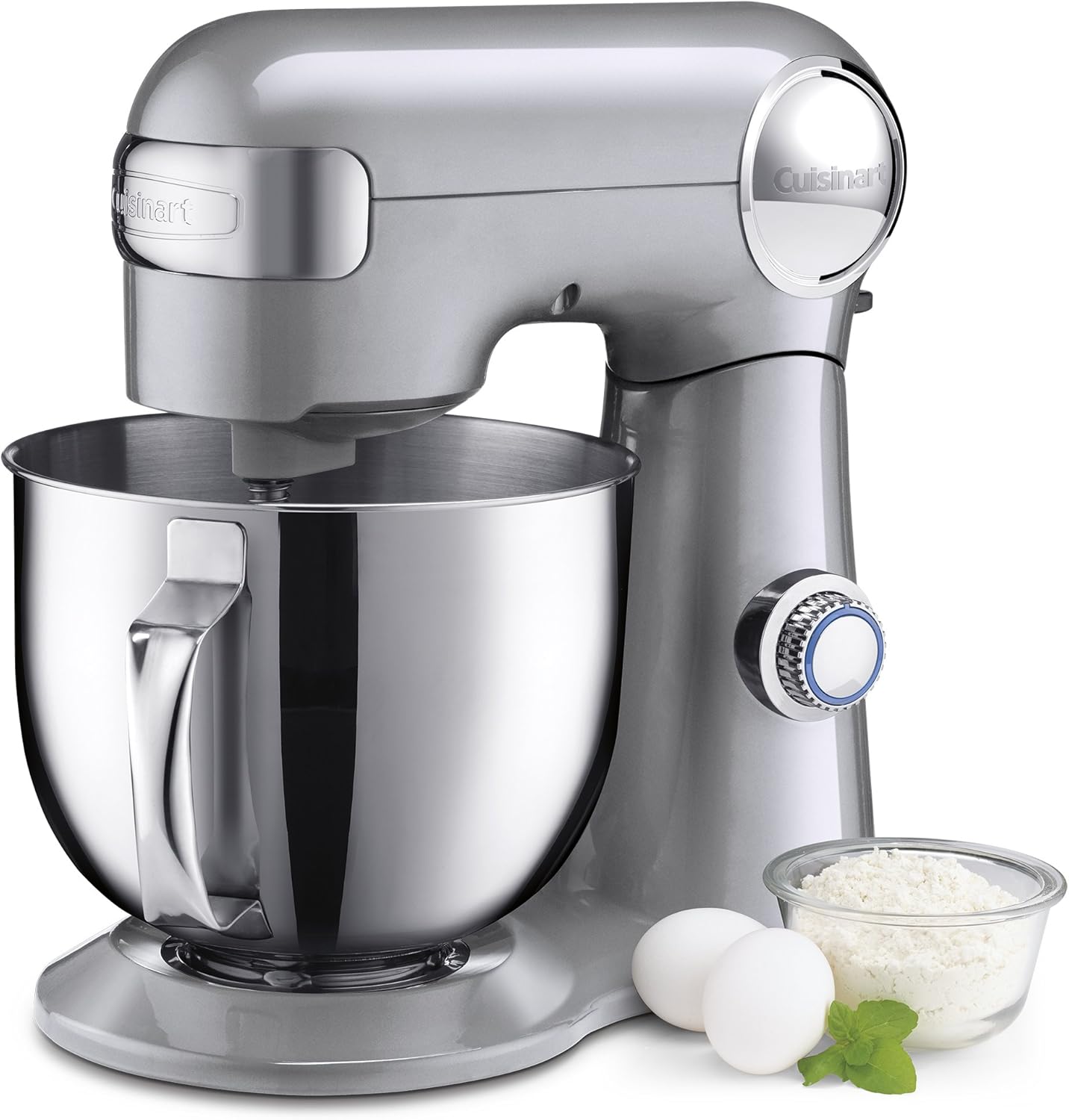
The tilt-back head reveals a single power outlet on the front of the unit for optional attachments — visible directly in Cuisinart’s own product photography, not just described in text. This is the same mechanism that lets the pasta extruder, roller and cutters, ice cream maker, meat grinder, and spiralizer attachments connect, all sold separately rather than bundled.
Six color options (Silver Lining, Onyx, Periwinkle Blue, Ruby Red, White Linen, Robin’s Egg) is more choice than most mixers in this range offer, where a single finish or two is typical.
Cleaning and Maintenance
The stainless steel bowl, chef’s whisk, dough hook, and flat mixing paddle are metal and generally dishwasher-safe on top rack for stand mixer accessories in this category, though checking the included instruction manual for this specific unit is worth doing before the first wash, since coated attachments can vary. The die-cast metal body itself should never go in a dishwasher or be submerged — wipe down with a damp cloth, keeping water away from the base and motor housing.
The splash guard with its own pour spout is a genuinely practical inclusion for cleaning ease: it keeps flour and batter off the counter during mixing, meaning less cleanup around the base afterward. For general stand mixer bowl and attachment care between uses, see my guide to maintaining bakeware and baking tools.

Value
At ~$312, the SM-50 sits meaningfully below KitchenAid’s Artisan line while offering a comparable 500W-class motor and metal body — the real value case is a heavier-duty mixer than most entry-level options without paying for KitchenAid’s brand premium. See my KitchenAid Classic vs Artisan comparison for how the price gap breaks down against that specific alternative.
Where the value case is more nuanced: the optional attachments (pasta extruder, ice cream maker, meat grinder, spiralizer) are sold separately, so the true cost of a fully-equipped setup is higher than the base mixer price if those are on your list — budget for that upfront rather than being surprised later.
Durability
Die-cast metal construction is the strongest single durability signal here — it resists the flex and wear that plastic-bodied mixers show under repeated heavy use. The limited 3-year warranty is a genuine commitment, longer than many mixers in this price bracket offer, and the product is BPA-free per Cuisinart’s own listing.
The review data doesn’t show a distinct durability or reliability complaint theme the way some appliances do — “Ease of use,” “Appearance,” “Noise level,” “Weight,” “Power,” and “Attachments” are all frequently and positively mentioned, with “Mixing performance” as the one attribute showing a real split (see Performance above). That absence of a durability-specific complaint pattern, across a 10,000+ rating sample, is itself a reasonably positive signal, though it isn’t the same as a confirmed long-term lifespan claim.
What Owners Report
KitchenwareCompare doesn’t own or test this mixer, so instead of claiming hands-on impressions, here’s what Amazon’s AI-generated summary of the verified-purchase review text (10,000+ ratings, pooled across all six color options) actually says, attribute by attribute:
- Ease of use (318 mentions, positive): the most-discussed attribute in the data, consistently positive
- Mixing performance (185 mentions, mixed): some owners report it mixes bread dough well; others report it doesn’t mix ingredients evenly — the one theme worth reading closely before buying
- Appearance (181 mentions, positive): owners like the look and finish across the color range
- Noise level (137 mentions, positive): reported as quiet relative to other mixers in this class
- Weight (124 mentions, positive): heavy enough to stay put during mixing, without being reported as unmanageable to move
- Power (103 mentions, positive): the motor is reported as strong enough for thick dough
- Attachments (89 mentions, positive): owners who use the optional attachments report them as a genuine value-add
Both sides are worth taking at face value: this is a well-reviewed mixer by volume and average rating, and it has one specific, recurring mixing-consistency theme that a purely positive summary would leave out.
What Comes in the Box
Confirmed directly from Cuisinart’s own listing: the mixer, a chef’s whisk, a dough hook, a flat mixing paddle, a splash guard with pour spout, an instruction manual, and a recipe book. The pasta extruder, pasta roller and cutters, ice cream maker, meat grinder, and spiralizer are genuine Cuisinart-made attachments for this exact mixer, but every one of them is sold separately, not included in the box.

Alternatives
If the SM-50 isn’t the right fit, three real alternatives from my stand mixer buying guide are worth a look:
- Cheaper: the Hamilton Beach 63326 is a genuine budget pick in the same guide — a smaller 3.5-quart bowl and a lighter-duty motor than the SM-50’s 500W, but a real option for occasional light baking rather than regular bread dough.
- More expensive, bigger ecosystem: the KitchenAid Artisan costs more but has the largest third-party and OEM attachment market of any stand mixer — the pick if attachment variety matters more than price. Its cheaper sibling, the KitchenAid Classic, sits closer to the SM-50’s price point with a smaller 4.5-quart bowl and lower wattage; see the full comparison for exactly how the two KitchenAid models stack up against each other.
- Similar price, bigger bowl: the Bosch Universal Plus in the same guide runs a larger 6.5-quart capacity at a comparable price bracket — worth a look specifically if bowl size, not motor power or attachment range, is the deciding factor for a household that bakes in bulk.
Cuisinart SM-50 Stand Mixer Review: Final Verdict
The Cuisinart SM-50 earns its place as a genuine mid-tier pick: a 500-watt, die-cast metal mixer with a real optional-attachment ecosystem, priced well under KitchenAid’s Artisan line, backed by a 4.7-star average across 10,000+ ratings. The included accessory set (whisk, dough hook, paddle, splash guard) covers real baking needs out of the box.
The honest caveat is the mixing-consistency split in the review data — a real, recurring minority report of uneven mixing that’s worth reading before buying, alongside the otherwise strongly positive themes (ease of use, quiet operation, power, weight).
Buy it if: you want a heavier-duty, metal-bodied mixer with real attachment options, without KitchenAid Artisan pricing. Consider the alternatives above if: attachment ecosystem breadth matters more than price, or you want the widest field compared side by side. For the full comparison, see KitchenAid Classic vs Artisan, and for the category overview, start at my stand mixers hub.
How This Review Was Put Together
This is a research-based review, not a hands-on test. I don’t own or test the products covered on this site. What’s above is built from Cuisinart’s published specifications and product photography, Amazon’s AI-generated summary of the verified-purchase review text (10,000+ ratings, attribute-by-attribute, pooled across all six color options), and a direct comparison against the picks in my stand mixer buying guide.
What I could not establish: the exact mechanical cause of the mixing-consistency complaints some owners report — the review data confirms the pattern exists but not whether it traces to bowl-scraping technique, a specific batch, or the paddle design itself. I also could not verify a precise db(A) noise measurement behind the “quiet” reports, since Cuisinart doesn’t publish one for this model.
Frequently Asked Questions
Is the Cuisinart SM-50 as good as a KitchenAid?
It’s a genuine step up from entry-level mixers with a comparable 500W-class motor and metal body, at a lower price than KitchenAid’s Artisan line — but KitchenAid still leads on third-party attachment ecosystem breadth. See my KitchenAid Classic vs Artisan comparison for the direct trade-offs.
What attachments work with the Cuisinart SM-50?
Cuisinart sells a pasta extruder, pasta roller and cutters, an ice cream maker, a meat grinder, and a spiralizer as genuine optional attachments for this exact mixer, connecting via the single power outlet under the tilt-back head. None of these are included in the box — the included set is a chef’s whisk, dough hook, flat mixing paddle, and splash guard.
Does the Cuisinart SM-50 mix bread dough well?
The review data is genuinely split here: some owners specifically report it handles bread dough well, others report uneven mixing. It’s a real, recurring theme worth weighing rather than a universal complaint — see the Performance section above for the full breakdown.
What colors does the Cuisinart SM-50 come in?
Six finishes: Silver Lining, Onyx, Periwinkle Blue, Ruby Red, White Linen, and Robin’s Egg.
Is the Cuisinart SM-50 dishwasher safe?
The stainless steel bowl and metal attachments are generally dishwasher-safe on the top rack for this mixer category, but check the included instruction manual for this specific unit before the first wash. The die-cast metal body itself should never be submerged or dishwashed — wipe it down with a damp cloth instead.
How much does the Cuisinart SM-50 weigh?
17 pounds — heavy enough to stay planted on the counter during mixing, which the review data confirms owners find manageable to move despite the weight.

I'm Glenn, and I started Kitchenware Compare to cut through conflicting product reviews and help readers pick kitchen gear with confidence. I don't own or test the products I write about — these guides are built from verified-purchase reviews, manufacturer specifications, and independent testing where it exists, with the reasoning shown, not just a rating.
Leave a Reply