
I earn a commission if you buy through the Amazon links below, at no extra cost to you.
The TECHEF Frittata and Omelette Pan is the no-flip pick in my omelette pan guide. It is a round pan split into two hinged halves: cook on one side, fold the other over, and the omelette turns without leaving the pan.
At $41.99 it holds 4.5 stars across 5,130 ratings. The folding idea works, owners say so repeatedly, and several describe years of use from the coating.
The catch is the hinge. The single most repeated complaint is liquid egg escaping through the seams when the pan is folded, and it is worth understanding before you buy.
Quick Verdict
| Score | Price | Rating | Buy |
| 7/10 | $41.99 | 4.5★ (5,130) | Check Price on Amazon |
What Comes in the Box

The pan, with a separate silicone cover for the small helper handle on the far side. That handle is bare metal and sits near the heat, so the cover earns its place.
Owners mention the cover more than once. One found it worked better than a bulky oven glove for grabbing the top half; another describes using it to lift and close the pan in one movement.
There is no lid, and none is needed: the second half of the pan is the lid.
Specifications
| Model | TECHEF Frittata and Omelette Pan, black |
| Shape | Round, 9.5 inches across, divided into two hinged half-moon halves |
| Depth | About 1.8 inches per half, per TECHEF’s drawing |
| Length | 18.5 inches open, including the handle |
| Body | Forged heavy-gauge aluminium (3004 alloy) |
| Coating | Teflon Select nonstick, PFOA-free, per Amazon’s specification table |
| Handles | Long double-riveted stainless steel handle; small helper handle with silicone cover |
| Oven limit | 450℉ |
| Hobs | Gas, electric and ceramic — not induction |
| Weight | 1.87 lb |
| Made in | South Korea; also sold in purple on the same listing |
How the fold works

The idea is simple. Pour beaten egg into one half, or both, let it set, then lift the helper handle and fold that half over onto the other. The omelette flips inside a closed pan, and the uncooked top meets a hot surface.
For frittatas and filled omelettes that would break apart on a spatula, that is a real advantage. One owner who makes an omelette every other day is on their second pan; another describes adding cheese once the eggs had set, closing the pan and turning out a finished omelette.
The problem is the join. When the pan is folded, the two halves meet along a hinged seam, and there are gaps near the hinges themselves. Any egg that is still liquid can run out through them, and that is exactly what a steady number of owners report.
Two owners describe the same technique: fold the pan front to back, over the handles, rather than tipping it side to side. One says that doing so means no leaking at all; another warns that side-to-side flips send liquid out of the hinge corners.
Who It’s For
- Anyone who makes frittatas or heavily filled omelettes that fall apart when turned.
- Cooks who find flipping an omelette in a round pan awkward or unreliable.
- People making two things at once — eggs in one half and wilted spinach in the other, as one owner describes.
- Anyone on gas, electric or ceramic glass hobs who wants a pan that can also finish in the oven at up to 450℉.
- Cooks happy with a Teflon coating and prepared to hand wash the rivets and hinges.
Who Should Look Elsewhere
- Induction users. The listing is explicit that it is not induction-compatible.
- Anyone who wants a simple omelette pan. The Tramontina Professional 8-inch is the omelette guide’s overall pick and costs less.
- Cooks who will not adjust their technique. Folded side to side with runny egg, this pan leaks.
- Anyone short of cupboard space. Open, it is 18.5 inches long; folded, it is 3.5 inches tall.
- Anyone looking for a Japanese rolled omelette pan: the TECHEF tamagoyaki pan is the right shape for that.
Performance
The fold, and the leak

When it works, owners describe it as easy: the omelette turns cleanly and cooks evenly on both sides without the spatula stage that tears filled omelettes.
The complaints are specific and consistent. Owners report egg spilling when they fold the pan, leaking every time they tried it, uncooked egg running onto a glass hob, and noticeable gaps of about an inch near the hinges. One owner who liked the pan still expects to lose a little egg on every flip.
Two things reduce it. Let the egg set further before folding, so less of it is liquid; and fold front to back over the handles, as the owner who reports no leaks describes.
Release and sticking

Most owners describe the surface as properly nonstick, with fluffy omelettes and quick cleanup. One owner brushes a little olive oil on before cooking and, three years in, says the surface is still very slippery.
A smaller group says the opposite. Owners report eggs sticking and failing to transfer to the other half, and one describes egg sticking and burning when turned. Two of the owners who report no sticking mention using a little oil or butter.
Food also catches on the rivets inside the pan, according to two owners. One soaks the pan for a few hours so egg and cheese come off the inside bolts easily.
Heat and hobs

The body is forged aluminium, which heats quickly; one owner notes that the eggs cook fast enough to need watching closely.
It suits gas, electric and ceramic glass, and TECHEF states it is not for induction. One owner points out that the base spans about 10 inches when open, so it wants a large burner.
The long handle is stainless steel and described by TECHEF as stay-cool, but the small helper handle is bare metal over the heat. One owner reports burned fingers even with the silicone pad, so keep the cover on and use it.
Design and Build
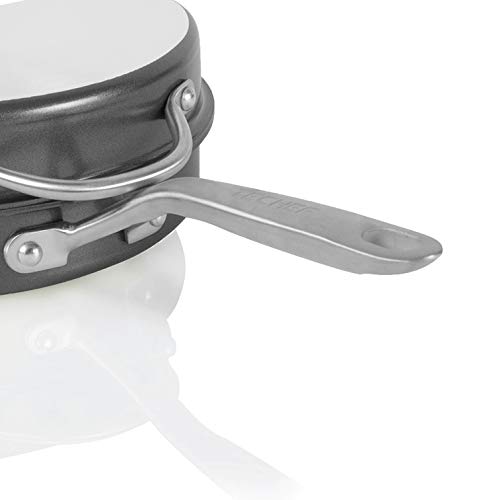
The build draws a split verdict. Several owners describe sturdy metal, a good finish and hinges that hold up; others call the materials cheap for the price, and one returned it on sight as poorly constructed.
The hinges are the part to watch. One owner describes them as looking flimsy but holding, and another had to have one reattached, yet still swears by the pan.
Capacity is generous. One owner puts the depth at around one and a half to two inches and says it takes all the filling you can imagine; another needs about six eggs for a decent omelette, which is more than a single serving.
It is listed as dishwasher safe and oven-safe to 450℉. Given the rivets and hinges, hand washing is the practical choice.
What Owners Report
The 5,130 ratings cover the black and purple versions, which share this listing. The distribution is 73% five-star, 15% four, 7% three, 2% two and 3% one — a larger middle than most pans in the omelette guide, which fits a product that works well once you learn how to use it.
What recurs in the positive reviews
- The fold works. Owners describe turning filled omelettes and frittatas without breaking them.
- Easy to clean. Repeatedly mentioned alongside the nonstick surface.
- The silicone handle cover. Singled out by more than one owner as genuinely useful.
- Longevity. One owner’s first pan lasted about five years of omelettes every other day; another says theirs still looks new and slippery three years after purchase.
- Build. Several owners describe it as sturdy and well made.
What recurs in the critical reviews
- Leaking at the hinges. The dominant complaint, from at least seven owners.
- Sticking. A minority report eggs sticking or burning when turned.
- Value. Several owners feel the materials do not match the price.
- Rivets and hinges. Food catches on the inside rivets, and one owner needed a hinge reattached.
- Coating life. One owner who washed it carefully and used it only for eggs and pancakes saw the coating peel at two years.
The positive and critical reviews are describing the same pan used two ways. Owners who learn to fold it front to back, with the egg mostly set, are happy; owners who expect it to work like a flip in a normal pan get egg on the hob.
Value
At $41.99 it is one of the more expensive pans in the omelette guide, costing about thirteen dollars more than the Tramontina Professional 8-inch overall pick.
Several owners think that is too much for the materials. The price is really for the folding design; if you do not need it, a conventional pan is the better buy.
For someone who makes frittatas or filled omelettes several times a week, the maths is kinder. Owners describe three and five years of use, which puts the yearly cost in the same range as a cheaper pan replaced more often.
For an occasional omelette, it is an expensive single-purpose pan that takes up a lot of cupboard.
Durability
The coating reports are mixed but include some long lives: about five years for one owner cooking an omelette every other day, three years and still slippery for another.
One owner saw peeling at two years despite careful hand washing and use only for eggs and pancakes, and compared that unfavourably with other nonstick pans they have kept for more than a decade.
The hinges are the other long-term concern. Few owners mention hinge trouble, but one needed a hinge reattached, and they are the part of the pan that takes the stress of every fold.
Hand washing, a little fat before cooking, medium heat and letting the pan cool before washing are the practical rules. Soaking loosens egg from around the rivets without scrubbing the coating.
Alternatives to Consider
- For ordinary omelettes, the Tramontina Professional 8-inch is the omelette guide’s overall pick, with owners reporting years of use.
- For Japanese rolled omelettes, TECHEF’s own tamagoyaki pan is the better shape.
- For a PTFE-free label, the SENSARTE ceramic pan is the option, with a shorter reported coating life.
- The full comparison is in my omelette pan guide, and the cookware hub collects everything else.
Verdict
The TECHEF Frittata pan does what it promises: it turns filled omelettes and frittatas without a spatula, it is well made enough for several owners to report years of use, and it can go in the oven.
But the hinge leaks unless you learn to use it. Let the egg set, fold front to back over the handles, and it works; tip it side to side with runny egg and you will clean the hob. It also does not work on induction and costs more than a conventional pan.
Seven out of ten: marked down for the leaking, the price, and the rivets and hinges that make cleaning more work.
How This Review Was Put Together
Plainly: this is research-based, not a hands-on test. I have not owned or used this pan, and nothing here should be read as a report from my own kitchen.
What it rests on: the published specification — the coating, construction, temperature and hob details on the listing, TECHEF’s dimension drawing, and what owners say about folding the pan without losing egg through the hinges — read against the other pans in my best omelette pans guide; the shape of the rating distribution across 5,130 Amazon ratings rather than the 4.5 average it produces; and the text of the positive and critical reviews, read for themes that recur across independent owners.
Why owner reviews are treated as evidence here: one reviewer cooking on one unit for a fortnight cannot show whether a hinged pan leaks egg on the hundredth fold as well as the first. Several thousand owners over years can. A theme is only reported above where more than one unconnected owner raised it.
What I could not establish: how many owners who report leaking were folding side to side rather than over the handles, since most do not say. I also could not establish how the rating splits between the black and purple versions, or how common hinge problems are over several years.
Price, stock and ratings were read from Amazon’s US marketplace on 14 September 2026 and will move.
Frequently Asked Questions
How do you stop the TECHEF frittata pan leaking?
Let the egg set more before folding, so less of it is liquid, and fold the pan front to back over the handles rather than side to side. The owner who describes folding it that way reports no leaking.
Does it work on induction?
No. TECHEF states it is suitable for gas, electric and ceramic hobs, excluding induction.
Is the coating Teflon?
Amazon’s specification table describes it as New Teflon Select nonstick coating, PFOA-free. The listing bullets call it a three-layer reinforced nonstick coating without cadmium or lead.
Is it oven safe?
Yes, to 450℉, according to both the listing and the specification table.
How big is it?
It is a round pan about 9.5 inches across, split into two half-moon halves about 1.8 inches deep. Open, it is 18.5 inches long with the handle; folded, it is 3.5 inches tall.
How many eggs does it need?
It holds a lot. One owner uses about six eggs for a decent omelette and another about three with plenty of filling, so it suits omelettes for two or a generous single serving.
Is it dishwasher safe?
The listing says so, but the rivets and hinges collect egg, and hand washing after a short soak is easier on the coating.
Does the small handle get hot?
Yes. The helper handle is bare metal over the heat, which is why TECHEF includes a silicone cover. One owner burned their fingers even with it, so keep the cover on.

Glenn is the founder of Kitchenware Compare and has spent years researching, testing, and reviewing kitchen appliances, cookware, and gadgets. A lifelong home cook raised in a family that treated every meal as an occasion, Glenn started this site to cut through the noise of conflicting product reviews and give readers honest, practical guidance. When he is not testing the latest air fryer or digging into the specs of a new espresso machine, he can usually be found experimenting with new recipes or hunting for the perfect cast iron skillet at a flea market.
Leave a Reply