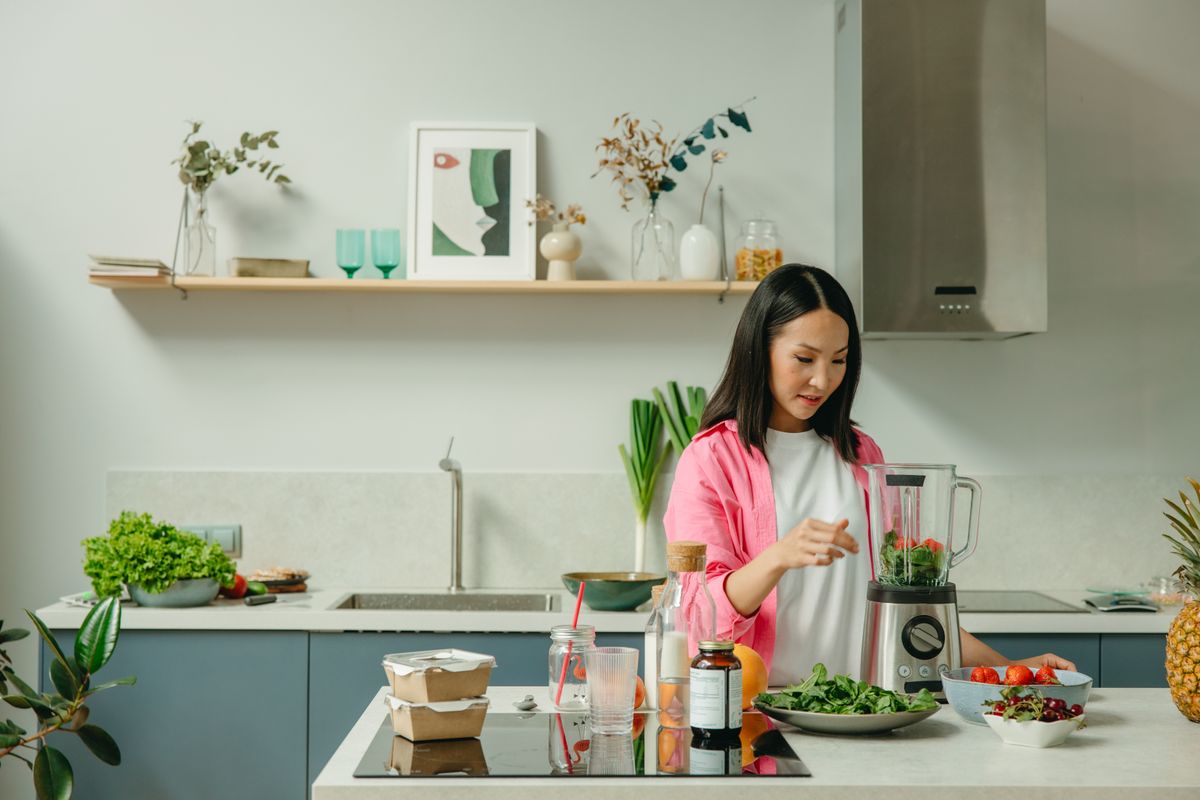
Photo by Yaroslav Shuraev from Pexels
Short answer: get a blender if you mainly make smoothies, soups, and sauces; get a food processor if you mainly chop, shred, or knead. The blade shape and bowl design are built for opposite jobs, and neither one does the other’s job well. Below is exactly where the line is, where the two genuinely overlap, and whether you need both. Set side by side on the jobs people actually buy them for, the honest answer is that they solve different problems more often than people expect.
The Actual Mechanical Difference
A blender’s blades sit at the bottom of a tall, narrow jar and spin fast enough to pull everything down into a vortex, so the contents keep circulating past the blade. That design needs some liquid to work — it’s why a smoothie blends cleanly but a handful of dry nuts just bounces on top of stationary blades until you add something wet.
A food processor’s S-shaped blade sits in a wide, shallow bowl and spins slower, cutting rather than pulling everything into a vortex. There’s no liquid requirement, which is why it handles dry, chunky, or sticky jobs — chopping onions, shredding a block of cheddar, cutting cold butter into flour for pastry — that would just sit on top of a blender’s blades. Most models also come with slicing and shredding discs, which is the real reason people buy one over a second blender. The University of Illinois Extension’s kitchen appliance guide draws this same line: blenders for liquids and purées, food processors for chopping, slicing, shredding, and mixing solid or semi-solid ingredients.
When a Food Processor Wins
Reach for a food processor for anything dry, large-volume, or sticky: a full head of cabbage for slaw, a pile of potatoes for hash browns, pie dough, or grating a block of cheese in seconds instead of by hand. It also does pastry dough faster than a hand pastry cutter, though it’s easy to overwork the dough if you run it too long. My food processor buying guide covers the specific models worth buying at each capacity if this is the appliance you’re missing, and if chopping is the main job, it’s worth reading through what else a food processor can replace in your kitchen before you buy one just for onions.
When a Blender Wins
Reach for a blender for anything that needs to end up smooth and pourable: smoothies, soups, sauces, and anything with ice or frozen fruit. A blender jar is also built with a pour spout, which matters more than it sounds — pouring soup out of a food processor’s wide, spoutless bowl is a genuinely messy job. If you’re choosing a blender mainly to save counter space alongside a food processor, a combo unit is worth a look; I’ve reviewed the Ninja BN801, which pairs both in one base, and compared it directly against a NutriBullet combo model.
Where They Actually Overlap
Both machines claim to make hummus, pesto, and nut butter, and this is the one area where the choice genuinely comes down to preference rather than a hard rule. A food processor’s wide bowl and slower blade give you more control over texture — pesto stays a little chunky unless you run it longer — while a blender gets everything uniformly smooth faster, assuming you add enough oil or liquid to keep it moving. Nut butter is the harder case for both: food processors can take 10-15 minutes of scraping down the sides before nuts turn to butter, and a lower-powered blender can stall out entirely on a dry load of almonds. If nut butter is a regular project, a higher-wattage machine matters more than which category it belongs to.
What neither one does well is the other’s core job. A food processor never gets a soup as silky as a blender does — the bowl’s low fill line means you’re working in frustratingly small batches, and the result stays grainier no matter how long you run it. A blender, in turn, struggles with genuinely dry or sticky loads: it can shred cheese in a pinch, but nowhere near as evenly as a disc attachment does, and thick cookie dough can stall the motor or crack a cheaper jar.
Whichever one you end up with, cleaning it properly matters more than most people expect — my guide to cleaning a food processor covers the two spots that cause most of the smell and staining complaints.
Which Costs More?
Both categories span a wide range, but a food processor with real capacity (11-14 cups) and a decent motor typically costs somewhat more than a blender that will handle daily smoothies well, mostly because of the extra discs, bowl, and gearing. Budget blenders under $50 exist and work fine for basic smoothies; a food processor below that price is usually too small or underpowered to be worth owning. Neither is a place to buy the cheapest option if you’ll use it weekly — a warranty and a motor that doesn’t bog down on a full load are worth paying for either way.
Do You Need Both?
If you’re only going to own one, ask what you cook more of. Someone who makes a smoothie most mornings and rarely bakes needs a blender first. Someone who cooks from scratch most nights — chopping vegetables, shredding cheese, making dough — gets more daily use from a food processor.
If your kitchen has room and budget for both, they’re genuinely not redundant: most cooks reach for the food processor several times a week for prep and the blender maybe twice — but on those two occasions, nothing else does the job. A combo unit like the Ninja BN801 above is the reasonable middle ground if counter space, not budget, is the real constraint.
Once you’ve settled on a food processor, the next question is what size to buy. My food processor sizing guide breaks that down by household size and by task, since the cup number on the box is not the same as your real working capacity.
Frequently Asked Questions
Can I use a blender instead of a food processor?
For soft, wet jobs like sauces or purées, yes. For chopping, shredding, or kneading dough, a blender will underperform badly or stall completely — those jobs need the food processor’s wider bowl and slower blade.
Can a food processor make smoothies?
It can, but the result is grainier than a blender’s, and the low fill line means processing a full-size smoothie in two or three small batches instead of one.
Which is easier to clean, a food processor or a blender?
A blender is usually faster — rinse the jar, or blend a little soapy water and rinse. A food processor has more parts (bowl, blade, lid, and any discs you used), all of which need separate washing, though most are dishwasher-safe.
Is it worth buying both a food processor and a blender?
If you cook from scratch regularly and have the counter space, yes — they cover genuinely different jobs. If space or budget is tight, pick based on which task you do more often, or consider a combo unit that houses both in one base.
Bottom Line
The blade and bowl design genuinely aren’t interchangeable: a food processor is built for dry, chunky, large-volume prep, and a blender is built for smooth, liquid results. Buy based on which one matches what you actually cook most nights, not which one sounds more flexible on the box.

I'm Glenn, and I started Kitchenware Compare to cut through conflicting product reviews and help readers pick kitchen gear with confidence. I don't own or test the products I write about — these guides are built from verified-purchase reviews, manufacturer specifications, and independent testing where it exists, with the reasoning shown, not just a rating.
Leave a Reply