This post contains affiliate links. If you buy through my links, I may earn a commission at no extra cost to you.
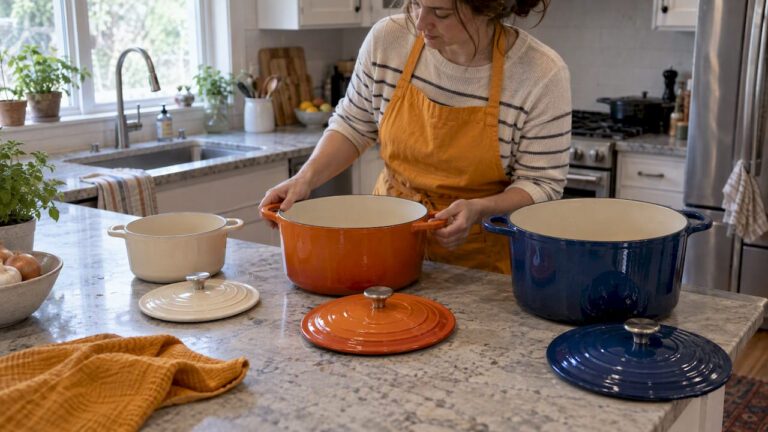
One quart per person is the rule, then round up for leftovers, bones, or a lid that won’t quite close. For most households, that lands in the 5 to 7 quart range, which handles everything from a weeknight braise to a holiday bird. Before buying bigger, though, I’d measure the oven and think about how much a full pot actually weighs.
TL;DR:
- The ideal Dutch oven size for most households ranges from 5 to 7 quarts, with larger sizes reserved for frequent entertaining or holiday cooking.
- A pot’s capacity should be paired with your oven dimensions and weight limits, especially for sizes above 7 quarts, to ensure safe handling and proper fit.
- Shape matters: round pots are best for stovetop use and bread baking, oval suits roasts and poultry, and braisers are optimal for searing and shallow sauces.
- Consider your primary recipes and storage space when choosing whether to buy a single all-purpose pot or a combination of smaller and larger sizes.
- Material affects heat retention and weight; enameled cast iron heats evenly and suits larger sizes, while bare cast iron reacts faster but requires more careful temperature management.
Servings-to-quarts: a quick reference for sizing your pot
The quart-per-person math works as a baseline, not gospel. Lodge Cast Iron puts it plainly: allot at least one quart per person, then round up, with 3 to 4 quarts suiting 1 to 2 people, 5.5 to 7 quarts suiting families of 4 to 6, and 7.5 to 9+ quarts suiting larger gatherings.
That one-quart figure assumes a standard 8 to 12 ounce serving of soup, stew, or braised meat and vegetables. Rounding up matters because a Dutch oven filled to the rim boils over, and you lose headroom for browning meat before adding liquid. A pot that’s technically “big enough” for four servings often cooks badly at that exact capacity.
| Household size | Recommended quarts | Typical recipes | Quick notes |
|---|---|---|---|
| 1 person | 3 to 4 qt | Soups, single-portion braises, small casseroles | Good for leftovers over two days |
| 1 to 2 people | 3 to 4 qt | Weeknight stews, rice dishes, small roasts | Easiest size to store and lift |
| 3 to 4 people | 5 to 5.5 qt | Family-size chili, pot roast, pasta sauce | Some room for batch cooking |
| 5 to 6 people | 5.5 to 7 qt | Whole chicken, bread, large braises | Lodge lists this range for families of 4 to 6 |
| 7 to 8+ people | 7.5 to 9+ qt | Holiday turkey, big-batch soup, entertaining | Check oven clearance before buying |
A few quick examples make the math concrete.
- A solo cook who batch-cooks on Sundays usually does better with a 4 quart pot than a 3 quart one, since the extra capacity covers leftovers without doubling storage space.
- A family of four fits comfortably in the 5 to 5.5 quart range for most dinners, but a 6 to 7 quart pot gives room for a whole chicken or a double batch of soup.
- A regular potluck host or holiday cook benefits from 7.5 quarts or more, mostly because large cuts of meat like a boneless chuck roast and big-batch sides need the extra width, not just the extra volume.
What the common sizes actually handle
Quart capacity tells you volume, not whether a recipe will actually work in the pot. Each size band has a practical ceiling.
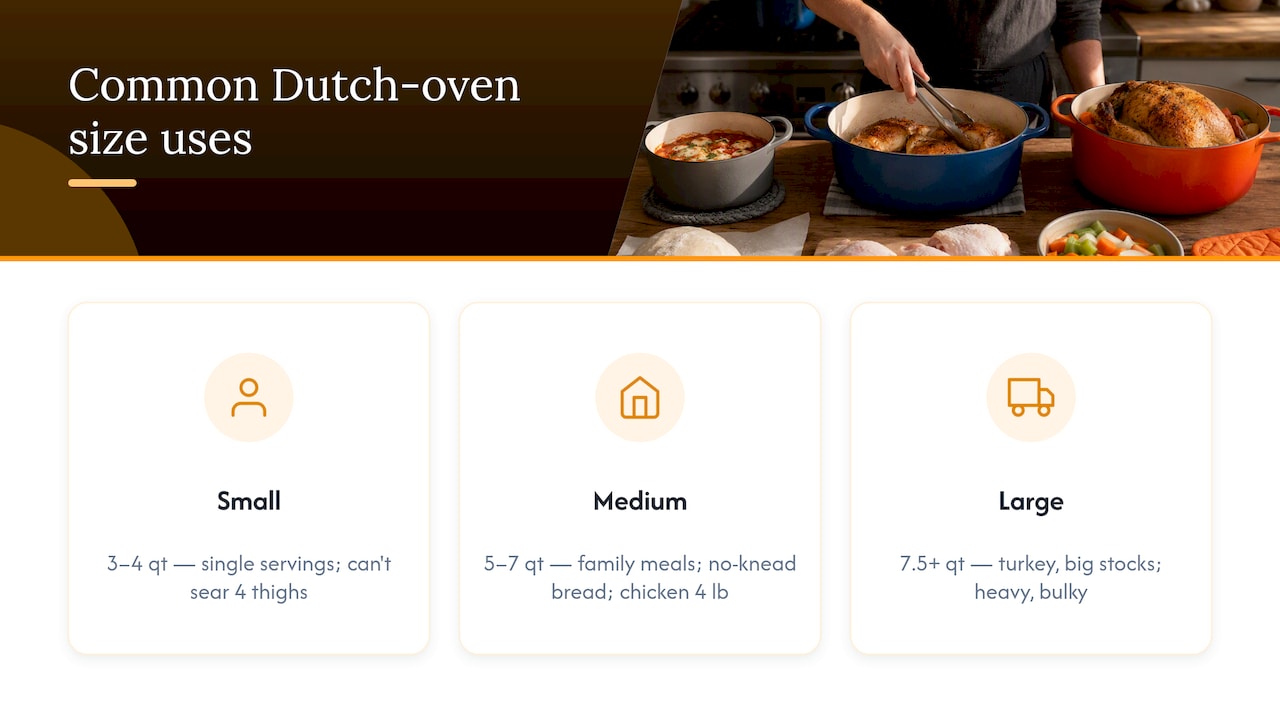
3 to 4 quart Dutch ovens work best for single servings and small households. They handle a pot of rice, a small batch of mac and cheese, or a weeknight chicken thigh braise. Their limit shows up fast with anything that needs to brown in batches: a 3 quart pot can’t sear four chicken thighs without crowding them, which steams the meat instead of browning it.
5 to 7 quart Dutch ovens are the size most home cooks reach for first, and for good reason. Tasting Table calls 5 to 7 quarts the sweet spot for most households, wide enough for no-knead bread and deep enough for a pot roast with vegetables. This range also covers whole chickens up to about 4 pounds, pulled pork for a family dinner, and soup for a crowd without needing a second pot.
7.5 quart and larger Dutch ovens earn their keep for holiday turkeys, big-batch stocks, and entertaining groups of eight or more. The trade-off is real: these pots are heavier empty and significantly heavier full, and they take up more cabinet space than most kitchens have to spare. Unless you cook for a crowd regularly, this size sits unused more often than it’s needed.
Pro Tip: If you only cook for yourself but love hosting twice a year, borrow or rent a larger pot for those occasions rather than storing one you’ll rarely use.
Shape and depth: round, oval, or braiser?
Quart size answers “how much,” but shape answers “what kind of cooking.” The three common shapes aren’t interchangeable, even at the same capacity.
- Round Dutch ovens perform best on the stovetop because they sit evenly over a single burner, and they’re the standard choice for no-knead bread, since the shape mimics a baking vessel.
- Oval Dutch ovens give extra length for roasts and whole poultry, which matters for a bird or a long cut of meat that won’t fit a round pot’s diameter, but the elongated shape wastes heat on small burners.
- Braisers and shallow pots are wider and lower-sided, built for searing large cuts and reducing sauces quickly. Tasting Table notes that braisers suit searing and shallow braises rather than high-liquid soups or tall stews, since the shorter walls limit how much liquid you can hold before it splashes over.
None of these shapes replaces the others. A braiser won’t make a good pot of chili, and a tall round Dutch oven isn’t the right tool for getting a good sear on a wide cut of meat. Choosing by the dish you cook most often, rather than by appearance on a shelf, saves you from owning a pot that looks right but underperforms in daily use.
Measure first: fit, weight, and storage before you buy
A Dutch oven that doesn’t fit your oven or your cabinet is a bad purchase regardless of price. Le Creuset recommends measuring oven interior height and shelf depth before buying, particularly for sizes above 7 quarts, since those pots can struggle with oven fit and become difficult to lift when full.
- Measure the interior height of your oven from the rack position you’d actually use, then add two inches of clearance for the pot’s lid knob.
- Check the door’s swing clearance. A wide oval pot with side handles can clip the door frame even if it fits the rack.
- Confirm shelf depth front to back. A pot that’s too deep sticks out past the door seal and won’t let the door close.
- Estimate filled weight: liquid plus food plus the pot’s own weight. Many enameled cast iron pots in the 7+ quart range already weigh 15 pounds empty, and anything over roughly 20 to 25 pounds filled becomes awkward for a lot of people to lift and pour safely.
- Check your cabinet or shelf storage for both the pot and the lid, since lids often need separate clearance and handle width can determine whether the pot fits between burners on a stovetop.
Pro Tip: If a filled pot is close to that 20 to 25 pound mark, plan on a two-person lift or at minimum a clear, short path from stovetop to table. For more on measuring your oven correctly, see this guide to cleaning a fan-assisted oven, which covers interior dimensions as part of upkeep.
Choosing your size in five quick steps
Matching a Dutch oven to your kitchen doesn’t require overthinking. Five steps cover it.
- Count your household. Use the one-quart-per-person rule, then round up for leftovers or odd-shaped foods like a whole chicken.
- Name your primary recipes. Bread and braises favor 5 to 7 quarts; single-portion soups favor 3 to 4 quarts; holiday roasts favor 7.5 quarts or more.
- Check oven fit. Measure height, shelf depth, and door clearance before you commit to anything above 7 quarts.
- Run the weight test. If a filled pot would exceed roughly 20 to 25 pounds, confirm you can lift and pour it safely, or plan for help.
- Buy up if you batch cook or entertain often. An extra quart or two of headroom costs little in storage but saves you from running two batches through a smaller pot.
Three quick scenarios show how this plays out.
- A solo cook who mostly makes soup and rice does fine with a 3 to 4 quart pot, and oven fit is rarely an issue at that size.
- A family of four cooking dinner most nights lands well in the 5 to 5.5 quart range, with 6 to 7 quarts giving room to roast a chicken or double a sauce recipe.
- A regular host who cooks for eight or more several times a year benefits from 7.5 quarts or larger, provided the oven and storage checks from the previous section hold up.
If none of that clarifies things, the 5 to 7 quart range is the safe default unless your oven or your back rules it out.
Where I’d point you next on sizing and fit
For most readers, I’d recommend starting in the 5.5 to 6.75 quart range with a round shape and a base diameter around 10 to 11 inches. That diameter matters more than people expect: it’s roughly what a 4-pound chicken needs to brown instead of steam, since a cramped base traps moisture against the walls.
Beyond quart size, I’d check listed product dimensions and owner reviews for real-world fit before buying anything online, since photos rarely show how a pot handles once it’s full. Kitchenware Compare covers side-by-side specs and owner feedback across cookware categories, which is useful groundwork before narrowing down a brand or finish. If your setting up a kitchen from scratch, this list of kitchen essentials pairs a Dutch oven purchase with the rest of what you’ll likely need.
— Glenn
Material and heat retention differences affecting sizing choice
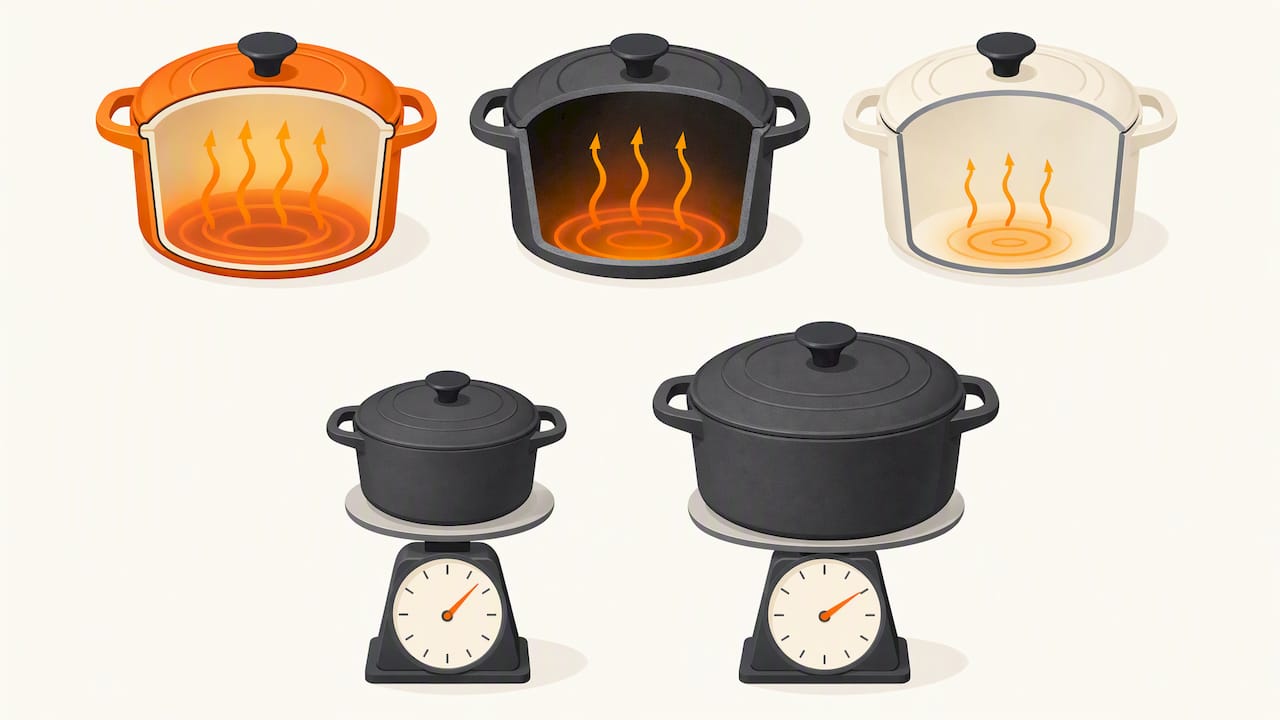
Enameled cast iron, bare cast iron, and ceramic-coated pots all hold heat differently, and that affects how size plays out in practice. Enameled cast iron retains heat well and distributes it evenly, which is part of why larger sizes in this material still work for slow braises without scorching the bottom. Bare cast iron reacts faster to temperature changes, which rewards careful heat management at any size but especially in larger pots where mass takes longer to heat through evenly.
Thicker-walled pots hold heat longer after the burner is off, which matters if you’re serving straight from the pot at a table. Thinner-walled options heat faster but lose that residual warmth sooner. For sizing specifically, denser materials mean a larger pot weighs meaningfully more than a smaller one in the same line, so a jump from 5.5 to 7.5 quarts in enameled cast iron isn’t a small step up in handling weight. For a broader look at how materials compare, this cast iron versus ceramic cookware guide covers trade-offs beyond heat retention alone.
Care and cleaning tips specific to different sizes
Smaller Dutch ovens are easier to clean simply because there’s less surface area and less weight to maneuver in a sink. A 3 to 4 quart pot can usually be washed by hand in a standard sink without needing to tip or angle it awkwardly. Larger pots, especially 7.5 quarts and up, often don’t fit comfortably in a single sink basin, which means soaking in sections or using a bathtub for a deep clean after heavy use.
Enameled interiors across all sizes benefit from soaking off stuck food rather than scrubbing with abrasive pads, which can dull the finish over time. Bare cast iron needs re-seasoning after cleaning regardless of size, but larger pots take longer to dry fully before that seasoning step, since more surface area means more time with residual moisture in corners near the handles. Whatever the size, drying thoroughly before storage matters most for cast iron, since trapped moisture under a lid is the most common cause of rust spots on an otherwise well-maintained pot.
One all-purpose pot or two complementary sizes?
A single 5 to 7 quart pot covers most cooking, and for many kitchens that’s genuinely enough. Adding a 3 to 4 quart pot makes sense once you’re batch cooking small portions often or entertaining enough that one pot can’t do both jobs at once. If storage space allows, I’d pick a primary 5 to 7 quart pot first and add the smaller size later, rather than buying both upfront on a guess.
FAQ
How do I know what size Dutch oven I need?
Start with one quart per person in your household, then round up for leftovers or larger cuts like a whole chicken. Lodge Cast Iron recommends 3 to 4 quarts for 1 to 2 people and 5.5 to 7 quarts for families of 4 to 6, which covers most households’ everyday cooking.
Should I get a 5.5 or 7 quart Dutch oven?
Either works well for a family of four to six, but a 7 quart pot gives more room for whole chickens, bigger braises, or doubled recipes. Le Creuset highlights both 5.5 and 6.75 quart sizes as especially flexible, so the choice often comes down to how often you cook for a crowd versus a standard dinner.
Is a 4.5 qt Dutch oven big enough?
A 3 to 4 quart pot suits 1 to 2 people comfortably for everyday meals like soups, pasta sauces, and small roasts. It starts to feel tight for a family of four or for recipes like whole chickens that need more interior width to brown properly.
Is a 3.5 qt Dutch oven too small?
A 3 to 4 quart pot works well for a single cook or a couple, handling soups, rice dishes, and small braises without trouble. It’s too small for a family’s main dinner pot or for recipes needing to brown multiple servings of meat at once, since crowding the base causes steaming instead of searing.
Sources
Larger Dutch ovens need a burner that can actually heat their full base, or you end up with uneven cooking at the edges. A 7 to 9 quart pot on a small gas burner often shows cold spots along the rim, since the flame doesn’t reach the outer edge of a wide base. Induction cooktops are pickier still: they need full contact with the pot’s base to transfer heat efficiently, so a warped or undersized base on a large pot reduces performance noticeably.
Smaller pots, in the 3 to 4 quart range, match almost any burner size without issue, which is part of why they’re easier to live with on compact stovetops common in smaller kitchens. Oval Dutch ovens complicate this further: their elongated shape rarely matches a round burner well, leaving portions of the base over unheated cooktop regardless of size. If your stovetop has one large burner and the rest standard-sized, that single burner effectively caps the largest pot you can use efficiently, independent of what your oven can hold.
- How to Choose the Right Size Dutch Oven | Le Creuset
- How To Pick The Perfect Dutch Oven Size For Your Cooking | Tasting Table
Recommended
- What Size Food Processor Do You Need? (Sizing Guide)
- How to Clean a Fan-Assisted Oven (Including the Fan)
- Cookware Types for Induction Cooktops: Complete Guide
- Most Durable Types of Cookware: Cast Iron, Steel & More

I'm Glenn, and I started Kitchenware Compare to cut through conflicting product reviews and help readers pick kitchen gear with confidence. I don't own or test the products I write about — these guides are built from verified-purchase reviews, manufacturer specifications, and independent testing where it exists, with the reasoning shown, not just a rating.
Leave a Reply