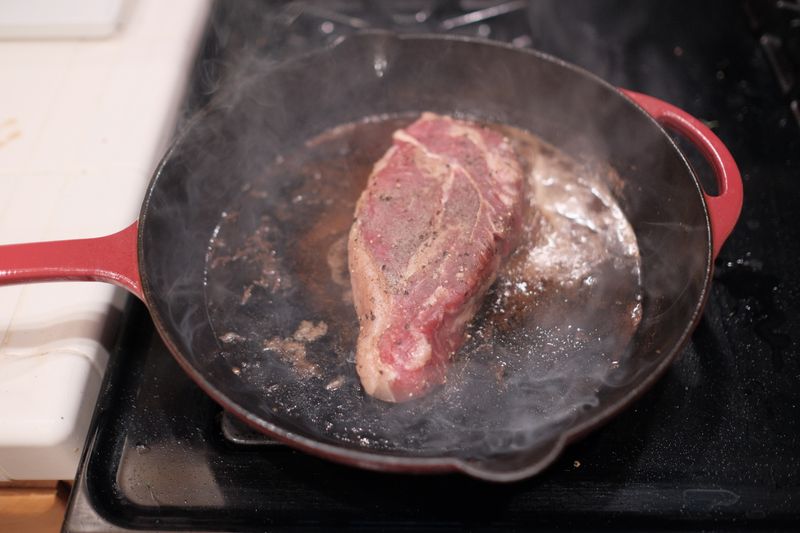
Photo by Deane Bayas from Pexels
This guide has no affiliate links, but some pages it links to do. If you buy through those, I may earn a commission at no extra cost to you.
Yes, you can use cast iron on an induction cooktop. Cast iron is magnetic, so bare and enameled cast iron both work without an adapter. What changes is how you handle it: heat it slowly, match it to the zone, and lift it instead of sliding it across the glass.
The sections below cover each of those points, and the one place where the makers disagree.
Why cast iron works on induction
Whirlpool’s help page says most induction-compatible cookware is made from ferrous materials, which contain iron, and lists cast iron and enameled steel as examples. Lodge’s own induction page explains it the same way: induction heats cookware with magnetic fields, so the pan must contain a ferrous metal, which makes cast iron a good fit. ABC News gives it as a main benefit of cast iron that it can be used on any cooktop surface, induction included.
That puts cast iron in a different group from aluminum and copper, which Whirlpool says typically do not work unless they have a magnetic base. This site’s guides cover those cases in copper pans on an induction cooktop and using a moka pot on an induction stove.
Three things that change on induction
Preheat slowly
Lodge says the magnetic fields on induction cooktops are very efficient, and that heating a skillet too quickly can leave the temperature of the iron unbalanced, causing thermal shock. In severe cases, it says, that can break cookware on the stovetop. Its advice is to preheat slowly with oil: the skillet is ready when the oil shimmers and ripples, and if the oil starts to smoke the pan is too hot and should come off the heat for a minute or two.
Match the pan to the zone
Lodge tells you to choose the piece closest to the size of the burner, and says many induction cooktops detect cookware size, so a skillet that is too small for the burner may not switch the zone on. Whirlpool and Jenn-Air say the same thing, and Jenn-Air adds that oversized pans may decrease performance. None of them gives a single number, because each cooktop sets its own minimum, so your manual is the final word.
Full contact is not required
Lodge says cookware does not have to sit flush with the burner to heat. Some pieces sit flush or nearly flush, and others have a heat ring that leaves a small gap, and a few millimeters of distance does not change how well the pan heats.
Will cast iron scratch the glass?
This is the one point where the sources do not line up, so here is what each says.
| Source | What it says |
|---|---|
| Lodge (cast iron maker) | Its cookware is cast very smooth on the bottom and should not scratch, but lift it between burners rather than sliding it |
| GE (appliance maker) | Do not use cookware with a rough bottom such as cast iron, do not slide cookware, and coarse particles like salt or pepper trapped under a pan can scratch |
| Bosch (appliance maker) | Avoid cookware with rough bases such as cast iron pans, because scratches cannot be removed once they happen |
| Jenn-Air (appliance maker) | Do not slide cookware, keep pan bottoms clean and dry, and check flatness with a ruler: no space or light should show under it |
The two sides are not really contradicting each other. Lodge is describing its own smooth-cast bottoms, and GE and Bosch are warning about rough ones. What none of these pages tells you is how smooth your particular pan is, which matters most for an older or rough-cast skillet.
So the check is yours to make:
- Run your hand over the base. If it feels gritty or has burrs, it is the rough kind that GE and Bosch warn about.
- Lay a ruler across the bottom, as Jenn-Air describes. Light under the edge means the pan is not flat.
- Wipe the base and the cooktop before every cook, since GE names trapped salt and pepper as a cause of scratches.
- Lift the pan on and off, and never drag it between zones.
GE also says small scratches typically become less visible after cleaning, and that some marks that only look like scratches come off completely. Bosch says real scratches cannot be removed.
How heavy it is matters on glass
ABC News lists weight as a main drawback of cast iron, especially when the pan is filled with food. On this site’s Lodge 12-inch skillet review the listing gives about 7.9 pounds empty. A pan that heavy is awkward to lift cleanly, so use both hands and never slide it to reposition it.
Bare or enameled cast iron
Both work. Whirlpool lists cast iron and enameled steel among its examples, and this site’s best cast iron Dutch oven guide says all cast iron Dutch ovens, enameled or bare, work on induction. ABC News adds that the enamel on enameled cast iron can chip and scratch, so look at the base as well as the cooking surface. Bare vs enameled cast iron covers the choice itself.
Griddles and double-burner pans
A pan that spans two zones is the case where cast iron can go wrong. Lodge says that with a larger griddle, such as a reversible grill/griddle, a bridge burner that sends heat to the gap between the main burners helps it heat evenly and reduces the risk of thermal shock. If the distance between the edge of the piece and the cooking surface is too large for it to heat efficiently, Lodge says to switch to a piece closer to the size of the burner.
Whether your cooktop has a bridge burner is a feature of the cooktop, so check its manual before buying a double-burner griddle for induction.
How to check a pan you are not sure about
Not every pan that looks like cast iron is cast iron, and an old skillet may carry no marking at all. Whirlpool’s test is simple: hold a magnet against the bottom, and if it sticks firmly the pan is induction compatible, while a magnet that slides off or does not stick at all means it is not suitable. The word “cast” on a label is not the test, because Whirlpool says aluminum typically does not work on induction unless it has a magnetic base.
If you are buying, this site’s best cast iron skillet guide states that every pan on its list works on induction, and its reviews give each pan’s weight so you can judge how easy it is to lift.
What usually goes wrong
- Heating on high straight away. Lodge’s thermal shock warning is the main risk specific to induction.
- A small skillet on a large zone. The cooktop may not detect it, so it will not switch on.
- Sliding the pan across the glass. Lodge, GE and Jenn-Air all say to lift.
- Grit under the base. GE says trapped coarse particles scratch, so wipe both surfaces.
- An old, rough-bottomed pan. This is the case GE and Bosch single out.
- A large griddle without a bridge burner. Lodge says it may heat unevenly.
How this guide was put together
The facts come from Lodge’s induction page, Whirlpool’s and Jenn-Air’s help pages, GE’s and Bosch’s pages on scratches, ABC News, and this site’s own Lodge review. It does not come from cooking on an induction cooktop.
Several things could not be established. None of the pages used here addresses cast iron making noise on induction, or how evenly a large skillet heats across a small zone. No independent test of scratching was found, only each maker’s advice. Le Creuset’s and Staub’s own induction guidance was not read for this guide.
Frequently Asked Questions
Can you use cast iron on an induction cooktop?
Yes. Cast iron is magnetic, and Lodge, Whirlpool and ABC News all say it works on induction. Preheat slowly, match the pan to the zone, and lift it instead of sliding it. No adapter is needed, unlike aluminum or copper pans without a magnetic base.
Does enameled cast iron work on induction?
Yes. Whirlpool lists enameled steel among its induction-compatible examples, and this site’s Dutch oven guide says enameled and bare cast iron both work. Check the base for chips, because ABC News says enamel can chip and scratch, and handle it the same way as bare iron.
Will cast iron scratch an induction cooktop?
It can. Lodge says its smooth-cast bottoms should not scratch, but GE and Bosch warn against rough-bottomed cast iron, and trapped grit can scratch too. Check the base, wipe both surfaces, and lift the pan rather than sliding it. Bosch says scratches cannot be removed.
Does cast iron have to touch the whole burner?
No. Lodge says cookware does not have to make full contact to heat, and that a few millimeters of gap, such as from a heat ring, does not change how well the pan heats. Size matters more: choose a pan close to the size of the zone.
Can you use a cast iron griddle on induction?
Yes, with care. Lodge says a larger griddle heats more evenly on a bridge burner, and that a piece too far from the cooking surface may not heat efficiently. Choose one close to your zone’s size, and check your manual for a bridge feature.
What heat setting should cast iron use on induction?
Start low and go up slowly. Lodge gives no dial setting, because cooktops differ, only the signal: the oil shimmers and ripples when the skillet is ready. If the oil smokes, take the pan off the heat for a minute or two before cooking.
The short version
Cast iron works on induction, bare or enameled, with no adapter. Preheat slowly, match the zone, check the base for roughness and grit, and always lift. For a skillet to buy, see the best cast iron skillet guide and the cast iron skillet guide, and for the wider picture cookware that works on induction.

I'm Glenn, and I started Kitchenware Compare to cut through conflicting product reviews and help readers pick kitchen gear with confidence. I don't own or test the products I write about — these guides are built from verified-purchase reviews, manufacturer specifications, and independent testing where it exists, with the reasoning shown, not just a rating.
Leave a Reply