This post contains affiliate links. If you buy through my links, I may earn a commission at no extra cost to you.
A watched pot never boils — but an underpowered hot plate genuinely takes twice as long. Wattage decides almost everything here: an 1800W induction burner brings a quart of water to a rolling boil in around four minutes, while a 1000W coil burner can take three times that once you factor in plate warm-up. My top pick is the Duxtop 8100MC — 1800W of induction heat that boils water faster than most full-size stove burners, for $70.99. Below it are four more picks: a cast iron burner that works with any pot, a $21 budget option, a cheaper induction unit, and a double burner for boiling and simmering at the same time.
Best Hot Plates for Boiling Water — Quick Comparison
| Product | Best For | Price | Rating | Buy |
|---|---|---|---|---|
| Duxtop 8100MC 1800W Induction | Best Overall | $70.99 | 4.4★ (17,327) | Check Price |
| CUSIMAX 1500W Cast Iron | Best for Any Cookware | $37.80 | 4.2★ (6,840) | Check Price |
| Elite Gourmet 1000W | Best Budget | $20.99 | 4.4★ (25,114) | Check Price |
| Mueller RapidTherm 1800W | Best Budget Induction | $44.45 | 4.2★ (1,595) | Check Price |
| CUKOR Double 1800W | Best Two-Burner | $49.99 | 4.3★ (3,125) | Check Price |
How I Picked
I haven’t strapped thermocouples to twenty hot plates. This guide is built from spec verification, wattage math, and a long read through owner reviews — the five picks here carry over 54,000 Amazon reviews between them. Every product was checked live: current price, rating and availability confirmed on 28 August 2026.
Boil-time estimates come from the physics of wattage and heating technology, cross-checked against what owners actually report. Where induction’s efficiency changes the picture — and it changes it a lot — I say so.
The 5 Best Hot Plates for Boiling Water in 2026
1. Duxtop 8100MC 1800W Induction — Best Overall

Induction is the fastest way to boil water short of an electric kettle, and the Duxtop 8100MC is the induction burner everyone else gets compared to. At full power it transfers roughly 85% of its 1800 watts straight into the pot — a quart of water hits a rolling boil in three to four minutes. A cast iron burner at the same wattage wastes a chunk of that heat warming its own plate and the surrounding air.
You get ten power levels from 200W to 1800W, a timer, and auto shut-off when you lift the pot. The glass surface barely warms up outside the pan zone, so there’s no red-hot plate waiting to burn you after cooking. It has held a 4.4-star average across more than 17,000 reviews — remarkable consistency for a product this popular.
Downsides: induction only works with magnetic cookware — stainless steel with a magnetic base or cast iron. Aluminum, glass, and copper pots won’t register at all. The cooling fan is clearly audible at full power. And the pan-detection sensor needs a minimum pan diameter, so very small items like a 1-cup moka pot may not trigger it.
2. CUSIMAX 1500W Cast Iron — Best for Any Cookware

If your pots are aluminum, glass, ceramic, or anything else that fails the magnet test, induction is off the table — and this CUSIMAX is the burner to get instead. The solid cast iron plate heats whatever you put on it, no compatibility questions asked. Seven thermostat settings run from a bare simmer to full blast, and the stainless housing sits on non-slip rubber feet.
Downsides: cast iron plates heat slowly. Expect three to five minutes of warm-up before serious heat reaches the water, and eight to ten minutes total to boil a quart. The plate also stays dangerously hot for a long while after you switch it off — there’s a reason induction burners don’t need a “hot surface” warning light. No timer, either. At 4.2 stars across 6,840 reviews, owners rate it slightly below the others here; most complaints are about heating speed, which is a cast iron reality rather than a CUSIMAX defect.
3. Elite Gourmet 1000W — Best Budget
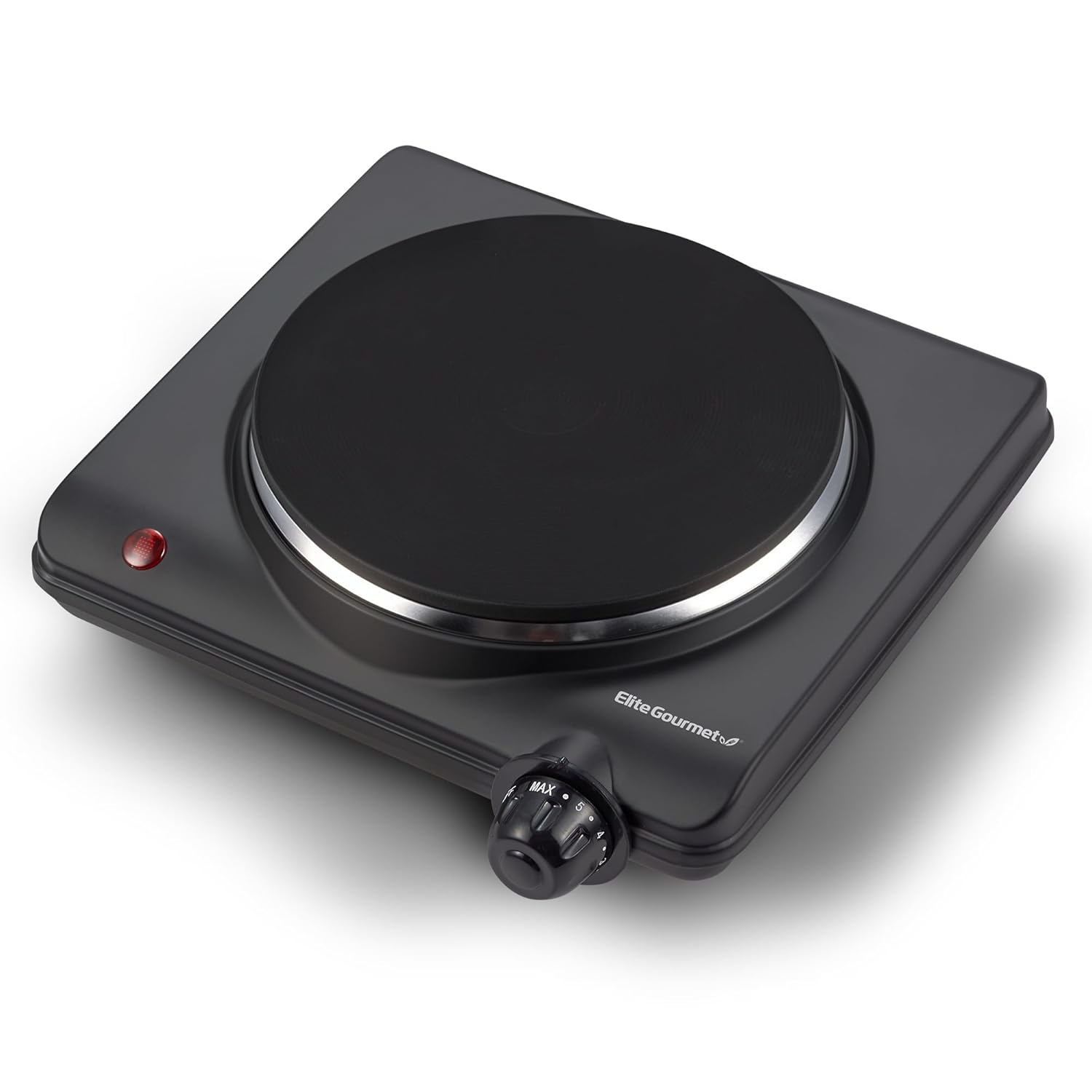
Twenty-one dollars. That’s the whole pitch, and with over 25,000 reviews at 4.4 stars, it clearly lands. The Elite Gourmet is a compact 1000W cast iron burner with seven heat settings — the default answer for a dorm room, office, RV, or anywhere you occasionally need to heat something and don’t want to spend real money.
Downsides: 1000W is slow for boiling. A quart of water takes twelve minutes or more once the plate warms up — fine for tea and instant noodles, tedious for pasta. The 7.5-inch plate limits you to small and medium pots; a big stockpot will overhang and heat unevenly. And the thermostat cycles power on and off to hold temperature, so keeping a precise simmer takes some knob-fiddling.
4. Mueller RapidTherm 1800W — Best Budget Induction

Same 1800W induction as the Duxtop for about $26 less. The Mueller RapidTherm splits its controls two ways — eight power levels from 200W up to 1800W, or eight temperature settings from 140°F to 460°F — and adds four presets, a four-hour timer, auto shut-off and a child lock. For boiling speed per dollar, it is the cheapest way onto induction in this guide.
Downsides: at 4.2 stars across roughly 1,600 reviews it has both the lowest rating and the smallest review base here, so the evidence behind it is thinner than the Duxtop’s 17,000. Touch controls are fiddly with wet or greasy fingers — knobs are honestly better in a kitchen. Like all induction it needs magnetic cookware: the base takes pans from 4.7 to 10.2 inches, and if a fridge magnet doesn’t stick to your pan, it won’t heat.
5. CUKOR Double 1800W — Best Two-Burner

Boiling pasta while a sauce simmers next to it needs two burners, and the CUKOR is the rare portable unit that does this well for under $50. Two cast iron plates share 1800W total, with independent temperature dials and a stainless body. Owners rate it 4.3 stars across 3,000+ reviews, and it’s become the standard recommendation for temporary kitchens and renovations.
Downsides: that 1800W is shared — run both plates at once and each heats noticeably slower than a dedicated single burner. The cast iron plates have the same slow warm-up and long cool-down as the CUSIMAX. And the double-wide footprint takes real counter space, which defeats the purpose if portability was the point.
How to Pick a Hot Plate for Boiling Water
Wattage is the whole game
Heating a quart of tap water to boiling takes a fixed amount of energy — roughly 0.09 kWh. The only variables are how many watts your burner pushes and how much of that actually reaches the water.
At 1800W with induction’s ~85% efficiency, that’s under four minutes. At 1000W through a cast iron plate that first has to heat itself, you’re waiting twelve or more. If boiling speed is why you’re here, don’t buy anything under 1500W.
Induction vs cast iron vs infrared
Induction heats the pot directly through a magnetic field — fastest, coolest surface, and the safest of the three, but it only works with magnetic cookware. Cast iron coil plates heat everything including aluminum and glass, at the cost of slow warm-up and a surface that stays hot long after shutoff. Infrared sits in between and is less common in portable units. If you already own a decent set of stainless cookware, go induction; check my cookware sets guide if you’re starting from zero.
Cookware compatibility
The magnet test settles it: if a fridge magnet sticks firmly to the bottom of your pot, it works on induction. Flat bottoms matter on every hot plate type — a warped or ridged base loses contact with cast iron plates and confuses induction sensors. My frying pans for electric stoves guide covers flat-bottom pans that behave well on portable burners.
Safety features worth having
Auto shut-off when a pot is removed, a hot-surface indicator light, and a child lock are the three that matter. Induction wins by default here — the surface itself barely heats. If you go cast iron, treat the plate like a stove burner: it holds burn-level heat for ten minutes or more after you switch it off.
Frequently Asked Questions
How long does a hot plate take to boil water?
For one quart: around 3–4 minutes on an 1800W induction burner, 8–10 minutes on a 1500W cast iron plate, and 12+ minutes at 1000W. Double those numbers for a half-gallon stockpot.
Are induction hot plates faster than electric coil?
Yes, roughly twice as fast at the same wattage. Induction transfers about 85% of its energy into the pot; a cast iron plate loses a large share heating its own mass and the air around it.
Can I use a moka pot or kettle on an induction hot plate?
Only if it’s magnetic. Most aluminum moka pots won’t work, and small ones may not trigger the pan sensor even if they are steel. A stainless steel moka pot with a magnetic base solves both problems.
Can a hot plate replace a stove?
For boiling, simmering, and one-pan cooking — yes, and plenty of people cook this way through kitchen renovations. The limits are capacity (one or two pots) and recovery speed with big batches.
How much electricity does a hot plate use?
An 1800W burner at full power draws about 1.8 kWh per hour — roughly 28 cents at average US rates. Boiling a single quart costs about two cents. The wattage sounds scary; the actual cost isn’t.
Are hot plates safe to leave unattended?
No — treat them like any stove burner. If you want a margin of safety, pick a model with a timer and auto shut-off like the Duxtop, and avoid leaving cast iron plates energized with nothing on them.
Bottom Line
If your cookware passes the magnet test, buy the Duxtop 8100MC and boil water twice as fast as a coil burner. If it doesn’t, the CUSIMAX 1500W heats any pot made. And if you just need occasional hot water for around $21, the Elite Gourmet has 25,000 reviews saying it’s fine to be patient. For everything else in the kitchen, my cookware guides cover pans, pots, and sets in the same no-nonsense format.
How These Picks Were Chosen
Plainly: this is a research-based guide, not a hands-on test. I have not run these side by side, and nothing here should be read as a report from my own kitchen.
What the picks rest on: wattage, element type – coil, solid or induction, which changes both speed and what cookware works – plate diameter against a normal saucepan base, whether the control is a numbered dial or a genuine thermostat, and stability on a worktop; plus the complaint patterns across verified-purchase reviews, which for hot plates concentrate on elements failing early and controls that run far hotter or cooler than the number suggests.
What I could not establish: actual time to boil, which is the entire point of this category. It needs a fixed volume of water at a fixed starting temperature timed on each unit, and no independent test does that for these models. Wattage and element type are used here as indicators, and wattage alone is a poor predictor across different element types.
You Might Also Like
- Best fry pans for gas stoves
- Best omelette pan
- Best small chest freezer for dorms and small kitchens

I'm Glenn, and I started Kitchenware Compare to cut through conflicting product reviews and help readers pick kitchen gear with confidence. I don't own or test the products I write about — these guides are built from verified-purchase reviews, manufacturer specifications, and independent testing where it exists, with the reasoning shown, not just a rating.