Some links on this site are affiliate links; I may earn a commission from qualifying purchases at no extra cost to you. See my affiliate disclosure.
Most air fryers sold in the US are rated between about 800 and 2,000 watts, with standard single-basket models around 1,500 watts and large or dual-basket units higher. That rating is a maximum, not a constant draw.
It matters for three practical reasons: your circuit, your electric bill and how well the machine cooks. I cover all three below, using manufacturer specs, government guidance and published third-party figures. I have not run any of these machines myself, and I attribute every outside finding to its source.
TL;DR
- Expect roughly 800 to 2,000 W. A typical single-basket model is about 1,500 W, which is about 12.5 amps on a 120 V US outlet.
- The label is a ceiling. The heating element cycles on and off, so a 20-minute cook uses less than 1,500 W multiplied by 20 minutes.
- Running cost is small: a few cents per session at the current national average rate. Preheating a full-size oven usually costs more.
- Higher wattage is not automatically better. Basket size, airflow and your batch size decide results, and food safety temperatures never change.
- Plug 1,500 W and larger units straight into a wall outlet, not a thin extension cord, and avoid sharing the circuit with a microwave.
How many watts an air fryer uses
According to EcoFlow’s US guide, air fryer wattage depends on the model, the capacity and the number of cooking drawers. Standard single-drawer units usually sit around 1,500 W, while bigger twin-drawer models can climb close to 2,600 W. Those twin-drawer figures are the outliers, and you should read the nameplate on any specific unit.
Here is a rough grouping by type. The 1,500 W single-drawer and 2,600 W twin-drawer figures come from EcoFlow, and the overall 800 to 2,000 W range from the GreenMatch research quoted below. The narrower ranges are my own approximation, so treat the nameplate as the answer:
| Type | Typical wattage | Who it suits |
|---|---|---|
| Compact (1 to 3 quarts) | About 800 to 1,200 W | One or two portions, small counters, dorms |
| Standard single basket (4 to 6 quarts) | Around 1,500 W | Most households of two to four |
| Large or dual-basket | 1,500 W or higher; twin-drawer models near 2,600 W | Families, two foods at once |
| Air fryer toaster oven or combo | Varies by brand and design | Replacing a countertop oven |
Brand ranges vary a lot. Do not assume a brand name tells you the wattage. The sticker on the back does.
Why the label is a maximum, not a meter reading
The rated wattage is what the machine can draw at full output. Once the cavity reaches your set temperature, the heating element cycles while the fan keeps running. According to Endesa’s September 2025 explainer, actual consumption can therefore come in below the nameplate maximum. So when you estimate cost, use realistic cooking time, not a worst case.
Air fryer amps: will your outlet handle it?
US household outlets supply nominally 120 volts, and current in amps is roughly watts divided by 120. EcoFlow’s guide gives the same conversions: 1,200 W is about 10 A, 1,500 W is about 12.5 A, and 2,000 W is about 16.7 A. At 1,800 W you land at about 15 A.
| Rated watts | Approx. amps at 120 V |
|---|---|
| 800 W | 6.7 A |
| 1,200 W | 10 A |
| 1,500 W | 12.5 A |
| 1,800 W | 15 A |
| 2,000 W | 16.7 A |
The arithmetic is mine; the label and manual are the controlling numbers. Most kitchen receptacles sit on 15- or 20-amp circuits. One electrical explainer notes that the National Electrical Code suggests loading a 15-amp circuit to only 80 percent for continuous use, which is about 1,440 W. An air fryer runs in bursts rather than continuously, but the point stands: an 1,800 W unit leaves a 15-amp circuit almost no headroom.
Practical rules for avoiding a tripped breaker
- Plug the air fryer directly into a wall outlet.
- Do not run it at the same time as a microwave, toaster or kettle on the same circuit. Shared appliances are the usual cause of a trip.
- If a 1,700 W or larger unit trips the breaker repeatedly, see my guide to air fryers that keep tripping the breaker, or move it to a different outlet or a 20-amp kitchen circuit. Do not swap the breaker for a bigger one; have an electrician look at it.
- Stop using the appliance if the cord or plug feels hot.
The Consumer Product Safety Commission has long advised that extension cords should only be used when absolutely necessary, and that a cord must be rated to carry the current. With a 12 to 15 amp appliance, an undersized cord is the real hazard. If you must bridge a gap, ask a licensed electrician about adding an outlet.
Air fryer energy consumption and running cost
The formula is simple. Watts multiplied by hours, divided by 1,000, gives kilowatt-hours. Endesa’s example is a 1,500 W air fryer running 30 minutes, which comes to 0.75 kWh. Multiply by the rate on your bill.
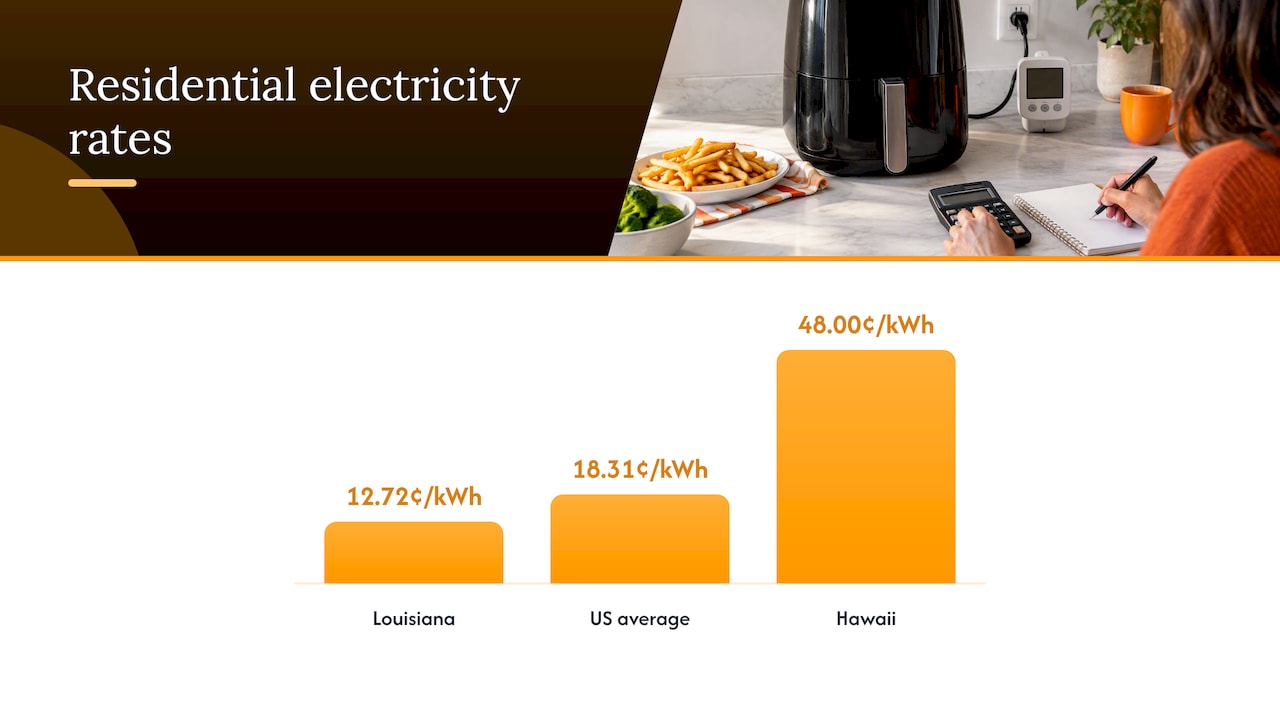
For the rate, ChooseEnergy, citing July 2026 EIA data, reports a US average residential rate of 18.31 cents per kWh, with Louisiana the lowest of the states it lists at 12.72 cents and Hawaii the highest at 48.00 cents. Your own bill is the better number.
Worked examples at 18.31 cents per kWh
These are my calculations, assuming the element runs at full rated power the entire time, which overstates real use:
| Scenario | Energy | Cost at 18.31¢ |
|---|---|---|
| 1,500 W, 20 minutes | 0.5 kWh | About 9 cents |
| 1,500 W, 30 minutes | 0.75 kWh | About 14 cents |
| 1,200 W, 15 minutes | 0.3 kWh | About 5 cents |
| 1,800 W, 25 minutes | 0.75 kWh | About 14 cents |
A few cents per meal will not move your bill. If you cook one air fryer meal every day, the 20-minute example adds up to roughly $33 a year at the national average, again as an upper-bound estimate. For purchase prices, price tiers and sale timing, see my price breakdown on air fryer cost, which I keep separate from this running-cost math.
Is an air fryer cheaper to run than an oven?
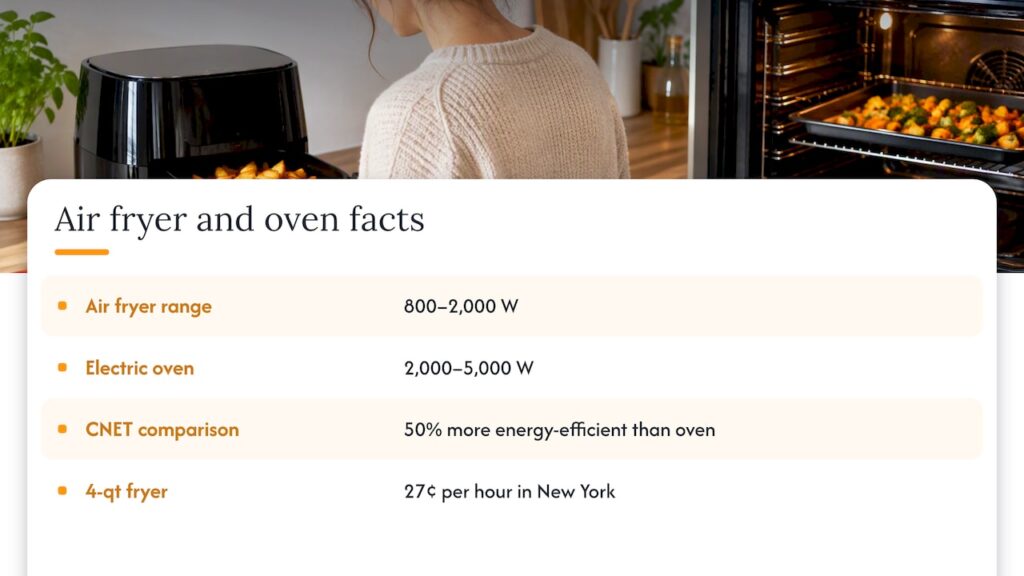
Usually, for small batches. According to CNET in May 2025, a 4-quart Ninja-style unit rated around 1,500 W costs about 27 cents per hour at New York electricity prices. CNET described it as roughly 50 percent more energy-efficient than its assumed full-size electric oven, and that comparison allowed about 10 minutes of oven preheating. Those results depend on location and usage, not on a universal US figure.
Better Homes & Gardens Australia quoted RMIT sustainability expert Alan Pears on the reason. In 2024 he explained that air fryers can use about half the electricity in relevant comparisons, and that fast airflow boosts heat transfer. The same article cites GreenMatch research putting electric ovens at 2,000 to 5,000 W against 800 to 2,000 W for air fryers. Notice what drives the saving: a small cavity and moving air, not a high wattage number.
The advantage shrinks or reverses when you cook a large batch in several rounds, since an oven handles it all at once. If you are weighing the two appliances, my air fryer vs convection oven comparison and the air fryer vs toaster oven page go through capacity and counter space.
Does higher wattage cook better?
Only partly. According to Endesa, a higher wattage reaches the target temperature faster. A higher-wattage machine can brown faster when the extra watts come with a bigger heater and stronger fan, but it is not a rule across designs.
Wattage has to be judged alongside:
- Basket area and usable capacity. A 6-quart basket needs more heat than a 3-quart one. The same watts spread over a larger cavity can feel weaker.
- Airflow. Fan design and basket geometry decide how evenly food crisps.
- Temperature control. Accurate thermostats matter more than raw power for repeatable results.
- Your batch size. A smaller unit can be the better value for one or two portions because it heats less mass. A higher-rated unit helps with recovery after loading cold food and with batch throughput.
Is a 1,200 W air fryer good?
Yes, for the right job. A 1,200 W model is a sensible fit for one or two people, small kitchens and shared circuits, and it draws about 10 A. Expect it to need slightly longer cooking times than a 1,700 W model, and follow its own manual.
One point is non-negotiable. According to USDA FSIS, manufacturers’ instructions vary with the appliance’s power and size, but food safety temperatures stay the same. Check doneness with a thermometer rather than the clock. If you want a wireless probe for that, see my MEATER Plus review, which draws on specs and owner reports.
FSIS also documented how this goes wrong. Its after-action review of a 2021 Salmonella Enteritidis outbreak describes 36 illnesses linked to frozen, raw, breaded, stuffed chicken products, where some ill people reported using an air fryer or shortened cooking times rather than following package directions. Raw poultry products should reach 165°F as verified by a thermometer, and more watts will not rescue an overloaded basket.
Choosing the right wattage for your kitchen
Start with who you cook for, then check the electrical side.
- Count your portions. One or two people: a compact, lower-wattage unit is usually enough. Three or four: a 4- to 6-quart unit around 1,500 W. Larger families or two foods at once: a dual-basket model, accepting the higher draw.
- Check the circuit. Find which outlets share a breaker with your microwave. If your counter is tight on circuits, a lower-wattage model avoids nightly trips.
- Read the nameplate in the spec sheet. Compare watts, basket capacity in quarts and the temperature range side by side.
- Think about counter space. Capacity and footprint are separate from wattage, and a bigger basket usually means a bigger machine, so measure your counter and cupboard first.
- Match the feature set. Dual baskets, roasting racks and combo ovens each add draw. My Ninja DZ201 review covers a two-basket design and its limits, and the Ninja AF101 vs COSORI Pro II comparison puts two popular single-basket units next to each other.
Is an air fryer just a convection oven?
Nearly. According to USDA FSIS, an air fryer is essentially a countertop convection oven, with food crisped by the rapid circulation of hot air. The small enclosed cavity is what makes it handy for small portions and for reheating foods that benefit from crisping. If you are asking whether it is healthier than deep frying, see are air fryers healthy.
Using an air fryer on a generator or power station
For outages, compare the appliance’s continuous wattage with the inverter’s continuous output, not only battery capacity. A 1,500 W air fryer can overload a small portable power station even though a short cook uses few watt-hours. Never run a fuel-burning generator indoors or wire it into your home through an outlet. The CPSC issued generator safety guidance after Hurricane Rita in 2005 for this reason.
My perspective
The wattage question is often framed as a contest, and I think that is the wrong frame. Watts tell you how much electricity the machine can pull. They say little about whether dinner comes out right, which depends more on basket size, airflow and how full you pack the basket.
So here is how I weigh it. I would pick capacity first, then confirm the amps fit the kitchen, then use wattage as a tiebreaker between otherwise similar models. I would treat a hot cord as a reason to stop, and a thermometer as the final word on doneness. I do not own or run the products I compare, so I lean on manufacturer specs, regulator guidance and the published figures cited above, and I flag where the evidence is thin.
Compare models side by side
If you are ready to shop, my air fryer reviews and buying guides list specifications, pricing and owner-reported strengths and complaints for each model, so you can check wattage, capacity and footprint in one place. Some links on the site are affiliate links, explained on the affiliate disclosure page, and my method is described in how I review kitchen equipment. For a starting point on how these machines work, see the air fryer guide.
FAQ
How many watts does an air fryer use?
Most use 800 to 2,000 W. Compact models run lower, standard single-basket models sit around 1,500 W, and twin-drawer units can approach 2,600 W. The nameplate on your specific model is the authoritative figure.
How many amps does an air fryer draw?
Divide watts by 120 on a standard US outlet. A 1,200 W model draws about 10 A, a 1,500 W model about 12.5 A and an 1,800 W model about 15 A. Avoid sharing the circuit with a microwave and skip thin extension cords.
How much electricity does an air fryer use per hour?
At full power, a 1,500 W unit uses 1.5 kWh per hour, which is about 27 cents at the 18.31 cents per kWh national average. Real use is lower because the element cycles, and most meals take 10 to 30 minutes, not an hour.
Is a higher-wattage air fryer always better?
No. Higher wattage can mean faster heat-up and better recovery with large batches, but basket size, airflow and temperature accuracy matter as much. A smaller, lower-wattage unit can suit one or two portions better and is easier on your circuit.
Sources
- EcoFlow: Air Fryer Wattage, Watts and Amps
- Endesa: Air fryer energy consumption
- CNET: How little energy air fryers use
- Better Homes & Gardens Australia: Is an air fryer cheaper to run than an oven?
- ChooseEnergy: Electricity rates by state (EIA data)
- Air Fryer Bite: How much current does an air fryer use?
- USDA FSIS: Air Fryers and Food Safety
- USDA FSIS: Salmonella Enteritidis outbreak after-action review
- CPSC: Limit Extension Cords To Reduce Risk Of Fire
- CPSC: Tips after Hurricane Rita
Recommended
- Air Fryer Cost: Price Tiers, Running Costs and Sales
- Air Fryer vs Deep Fryer: Which Should You Buy?
- Air Fryer vs Convection Oven: Which Should You Buy?
- Air Fryer Keeps Tripping the Breaker? How to Fix It

I'm Glenn, and I started Kitchenware Compare to cut through conflicting product reviews and help readers pick kitchen gear with confidence. I don't own or test the products I write about — these guides are built from verified-purchase reviews, manufacturer specifications, and independent testing where it exists, with the reasoning shown, not just a rating.
Leave a Reply