The short answer: buy a French press if you want a full-bodied, rich cup for one to several people with almost no technique. Buy an AeroPress if you want a cleaner, brighter cup, mostly for one person, with room to experiment and a brewer that travels. I own and use neither for reviews, so everything below rests on manufacturer specs, published research and owner feedback, each attributed where it appears.
Both brewers are immersion-style, both are cheap next to an espresso machine, and both reward fresh beans and a decent grinder. The differences come down to the filter, the grind, the volume you brew and how much effort you want to put in.
TL;DR
- Taste: French press gives a heavier, oilier cup with some fine sediment. AeroPress gives a cleaner, lighter-bodied cup because of its paper filter.
- Volume: French press suits two or more mugs. AeroPress is built for one serving, and the Clear XL stretches to 20 oz.
- Convenience: AeroPress is faster and travels better. French press is simpler and needs no filters.
- Cost: AeroPress lists at $49.95 for the Original and $89.95 for the Clear XL. French presses range widely depending on material.
- Health: Paper filtering removes most diterpenes, but the research does not prove filtered coffee is healthier.
How each brewer works
A French press is full immersion. You steep coarse grounds in hot water, then push a mesh plunger down to separate the grounds from the liquid. Nothing else touches the coffee. According to the Swiss coffee retailer Cafetiere.ch, a French press uses a metal filter, so some oils and fine particles stay in the cup, which gives it more body.
The AeroPress is a hybrid. According to AeroPress’s own instructions, it combines a short immersion with air pressure and a paper micro-filter, producing a rapid brew that removes grit. You stir, press the plunger down over a mug and stop when you hear the hiss.
That difference in design drives nearly every other difference between them.
Grind size
AeroPress’s own comparison says the AeroPress uses a medium-fine grind, while a French press needs coarse grounds because of the size of the holes in the metal filter. Grind is the reason a French press punishes a cheap blade grinder: fine dust slips straight through the mesh and into your mug. The AeroPress is more forgiving, because the paper catches the dust.
If you are buying your first grinder alongside your first brewer, my Breville Smart Grinder Pro review covers whether a $200 burr grinder makes sense for this kind of brewing.
Time and effort
French press brewing is mostly waiting: add grounds, add water, steep, press, pour. The AeroPress asks for a bit more attention, since you are stirring, pressing and sometimes flipping the unit (the inverted method). In exchange you get repeatable control over time, temperature and dose. AeroPress describes the result as full-bodied like a French press, smooth like a pour-over and rich like espresso. That is the manufacturer’s marketing line, and I would treat the “like espresso” part loosely: neither brewer reaches the pressure of a real espresso machine.
Taste, body and clarity
This is the question that decides most purchases, and the answer is straightforward: filter type changes the cup more than anything else.
French press coffee is heavy and round. The metal mesh lets oils and a little sediment through, so the texture is thicker and the flavor tends toward chocolate, nuts and roast character. If you like coffee that coats your tongue, this is the style. The trade-off is a layer of silt at the bottom of the mug, and a cup that keeps extracting if you leave it sitting on the grounds.
AeroPress coffee is cleaner. The paper filter traps grit and most oils, so acidity and fruit notes are easier to pick out, and the cup reads closer to a pour-over than to a French press. The trade-off is less body. Someone raised on French press coffee may find a default AeroPress cup thin until they adjust the recipe, for example by using more coffee, a finer grind or a shorter dilution.
The practical read:
| French press | AeroPress | |
|---|---|---|
| Filter | Metal mesh | Paper micro-filter (metal disc optional) |
| Grind | Coarse | Medium-fine |
| Body | Heavy, oily | Lighter, cleaner |
| Sediment | Some fine silt | Very little |
| Best at | Rich, classic cup | Clarity and experimenting |
| Typical batch | Several mugs | One mug |
If you like light-roast, single-origin coffees with distinct flavors, the AeroPress shows them off better. If you drink medium or dark roasts and want comfort rather than nuance, a French press is hard to beat. For bean suggestions on the French press side, see my guide to the best coffee for French press.
Capacity and who you are brewing for
A French press is the better choice for a household. You can brew enough for two or three people in one go, and the larger models handle a small crowd. The AeroPress is a one-mug machine. According to AeroPress’s product page, the Clear XL holds 20 oz, which helps if you drink from a big mug or want to brew a concentrate and top it up, but it still works best one serving at a time.
A quick way to think about it:
- Solo drinker, one or two cups a day: AeroPress is efficient. Brew, press, rinse.
- Couple who drinks coffee together: French press saves repeat brewing.
- Guests at the weekend: French press, no contest.
- Desk, office or campsite: AeroPress, because it is compact and does not need a carafe.
Cleanup, durability and carrying
Both are easy to clean, in different ways. The AeroPress produces a compact puck of grounds that you eject straight into the trash or compost, then rinse the chamber and plunger in a few seconds. The French press is messier: wet grounds sit in the bottom of a glass or steel beaker and tend to clog the sink if you pour them down it. You also need to disassemble the plunger screen occasionally to clean trapped grounds and oil.
On durability, the French press has one obvious weakness: glass models break. Stainless steel and double-walled versions avoid that and hold heat longer, at a higher price. The AeroPress Original is plastic, so it survives a backpack, though the rubber seal is a wear part that eventually needs replacing. For a comparison of materials, sizes and what owners complain about, my best French press coffee maker roundup goes through the options.
What each one costs
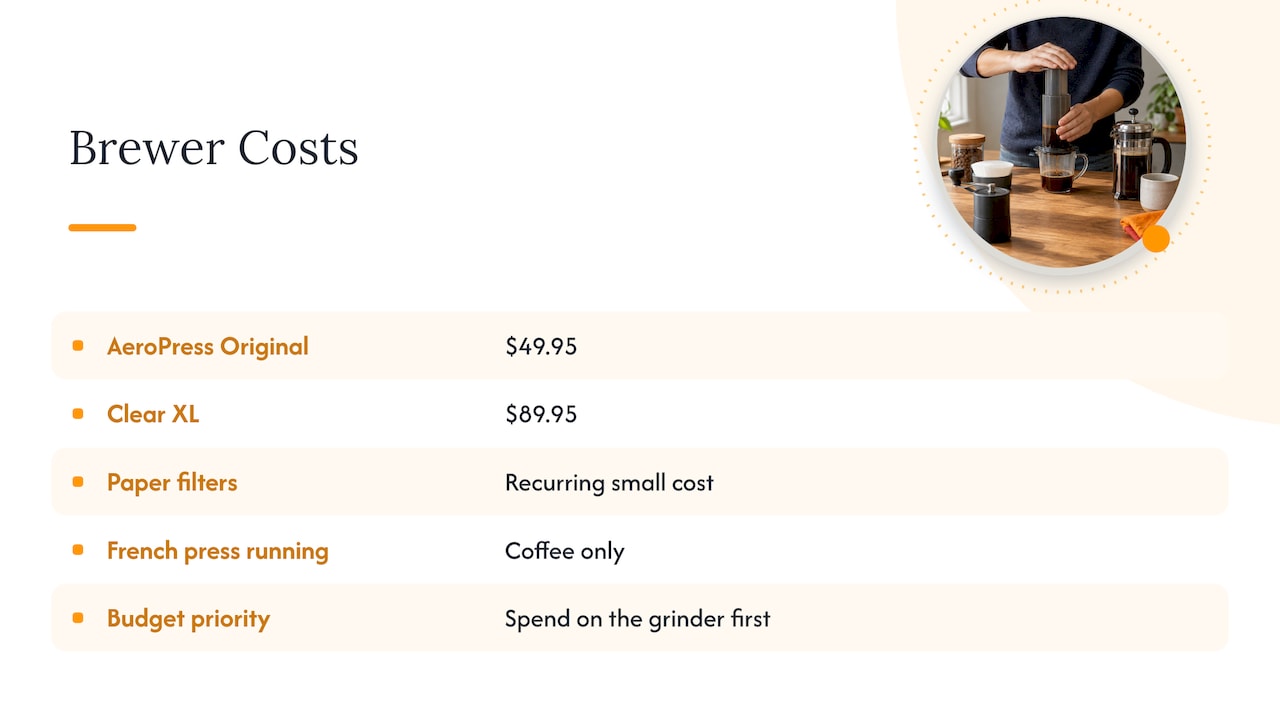
According to AeroPress’s US product page, the Original is listed at $49.95 and the Clear XL at $89.95. Paper filters are a recurring cost, though a small one, and AeroPress also sells a reusable metal disc if you want a bit more body and want to cut paper waste.
French press pricing is less tidy. Basic glass models sit at the cheap end, while double-wall stainless steel units cost noticeably more. Because there are no filters to buy, the running cost is just coffee. Over a few years, that makes a French press the cheaper brewer to own, even if the AeroPress Original and a budget glass press are not far apart at purchase.
The bigger value question is the grinder. A good brewer with stale, badly ground coffee will not beat a modest brewer with fresh, evenly ground beans. If your budget is tight, spend on the grinder first. My data study on expensive appliances looks at where extra money buys real improvement and where it does not.
Health: caffeine, diterpenes and microplastics
The People Also Ask boxes for this topic cover three recurring concerns. Here is what the published evidence supports.
Caffeine
There is no meaningful caffeine gap between the two. A December 2024 review in Applied Sciences reported overlapping caffeine ranges of 56.35 to 120.92 mg per 100 mL for AeroPress and 52.00 to 123.90 mg per 100 mL for French press. The authors concluded the two have similar caffeine content and that time, temperature, coffee-to-water ratio, pressure, roast and origin all materially affect the result. Your recipe matters more than your brewer.
Filtered vs unfiltered coffee
Paper filters remove diterpenes, compounds found in coffee oils. According to Harvard Health, unfiltered coffee contains 30 times more diterpenes than filtered coffee, but the underlying observational study does not prove that filtered coffee is healthier. That caveat matters: nobody should buy an AeroPress as a medical decision. If you have been told by a doctor to watch your cholesterol, ask that doctor whether your brewing method is worth changing, rather than relying on a headline number.
On antioxidants, a separate academic study found espresso had the highest antioxidant activity, while cold brew was preferred for sensory characteristics, with results varying across coffee types and extraction methods. Neither the AeroPress nor the French press is declared a winner there.
Microplastics and materials
The AeroPress is plastic, so the question is fair. AeroPress’s April 2023 Declaration of Conformity states that the chamber and plunger are copolyester, the seal is black silicone rubber and the filters are ECF paper, and it specifies contact with aqueous foods up to 100°C for less than five minutes. WIRED’s March 2025 review adds that the plastic AeroPress is BPA- and phthalate-free and approved for food contact by the FDA and EU, and that the AeroPress Premium swaps the plastic brewing chamber for borosilicate glass with aluminum, stainless steel and silicone parts.
I found no source here that measures microplastic release from AeroPress brewing, so I will not claim it is zero or that it is a problem. If you want to avoid plastic altogether, a stainless steel or glass French press, or the glass-chamber Premium, removes the question.
Which one fits you
Choose a French press if:
- You brew for two or more people regularly.
- You like a heavy, rich cup and do not mind a little sediment.
- You want no filters to buy and a very simple routine.
- You drink medium or dark roasts.
Choose an AeroPress if:
- You mostly brew one mug at a time.
- You like a clean cup that shows off lighter roasts.
- You travel, camp or brew at a desk.
- You enjoy adjusting recipes and getting repeatable results.
Buy both if you drink coffee at home with company and also want something for trips. They are different tools, and plenty of people find that each covers the other’s weak spot.
If neither quite fits, look at the wider field. My coffee equipment hub collects every brewer guide, and the pour over vs drip comparison covers the other common clean-cup route. If you want something pressurized and portable, see the best portable espresso maker picks. If you already own a French press and want stronger coffee from it, my guide on making espresso-style coffee with a French press explains what is realistic.
Perspective: why I lean on the filter
I do not brew or review any of these products myself, and I say so because it shapes how I work. What I can do is read the specs, the manufacturer’s own documents, the published research and a large volume of owner feedback, then sort out where they agree. On this topic they agree on one thing: the filter is the headline difference. Everything else, from grind size to sediment to how much body you get, follows from it.
My honest view is that the AeroPress is the more versatile brewer and the French press is the more relaxed one. If you enjoy fiddling with variables, the AeroPress gives you a lot to play with. If you want to pour water on grounds, wait four minutes and walk away, the French press does that better, and for a household it is the more economical choice. Marketing claims that either one “tastes like espresso” deserve skepticism. Pick on the cup you want and the number of people you brew for, not on a slogan.
You can read how I assess products on the How I Review Kitchen Equipment page.
— Glenn
Find the right gear
If you are still comparing options, Kitchenware Compare lays out specs, pricing, owner-reported complaints and current deals side by side, so you can see what each product does well and where owners say it falls short before you click through to a retailer.
FAQ
Does AeroPress make better coffee than French press?
It depends on what you call better. The AeroPress makes a cleaner, lighter-bodied cup because its paper filter traps grit and oils, while the French press makes a heavier, oilier one. Neither is objectively superior; the right pick follows your taste.
Is AeroPress coffee stronger?
Not inherently. The review in Applied Sciences found overlapping caffeine ranges for both brewers, and strength mostly follows your coffee-to-water ratio and brew time. An AeroPress is often used with a smaller water volume, which can make a concentrated cup, but you can make a strong French press just as easily.
Is AeroPress coffee healthier than French press coffee?
Paper filtering removes most diterpenes, and Harvard Health notes the large difference in diterpene content between filtered and unfiltered coffee. It also says the observational study behind that does not prove filtered coffee is healthier. If you have a cholesterol concern, ask your doctor rather than choosing a brewer on that basis.
Can I use the same coffee grind for both?
No. A French press needs coarse grounds, and an AeroPress works best with medium-fine grounds. Using fine grounds in a French press sends silt into your cup and often makes the coffee bitter.
Which is better for a first-time buyer?
For a household or anyone who wants simplicity, start with a French press. For one person who likes a clean cup and does not mind a few extra steps, the AeroPress is a good first brewer. Whichever you choose, budget for a decent grinder.
Sources
- Getting Started With The AeroPress Coffee Maker
- AeroPress vs French Press: What’s the difference?
- How AeroPress Works: The Science of 3-in-1 Brewing
- AeroPress Clear XL Coffee Press
- Seven coffee brewing methods compared
- Quantitative Analysis of Caffeine in Roasted Coffee (Applied Sciences)
- What’s the healthiest way to brew coffee? (Harvard Health)
- Effect of Extraction Methods on Aroma Profile, Antioxidant Activity
- AeroPress Declaration of Conformity
- AeroPress Premium Review (WIRED)
Recommended
- Best French Press Coffee Maker 2026: Reviews + Buying Guide
- Best Coffee for French Press in 2026
- How to make espresso with a French Press
- Espresso Machine vs Coffee Maker: Which One Fits Your Routine?

I'm Glenn, and I started Kitchenware Compare to cut through conflicting product reviews and help readers pick kitchen gear with confidence. I don't own or test the products I write about — these guides are built from verified-purchase reviews, manufacturer specifications, and independent testing where it exists, with the reasoning shown, not just a rating.
Leave a Reply